Remember ME - You Me and Dementia

Showing posts with label Spain. Show all posts

December 30, 2011

SPAIN: Thoughts on the Immune System and Aging

SEATTLE, Washington / FightAging.Org / Research / December 30, 2011

The Immune System Is An Excellent Indicator of Health


MADRID, Spain: 

In aging there is a lot of correlation - many biological systems that are traditionally studied separately are declining at once, so most researchers are only looking in detail at one tiny part of aging. 

Part of the challenging facing researchers has always been how to figure out what is cause and what is consequence given the need for specialization to make progress in any given small area of the biology of aging. 

Here, researchers focus on the immune system, and you can see the biases inherent in being a specialist: "The aging process is accompanied by an impairment of the physiological systems including the immune system. This system is an excellent indicator of health. 

We have also observed that several functions of the immune cells are good markers of biological age and predictors of longevity. 

In agreement with the oxidation-inflammation theory that we have proposed, the chronic oxidative stress that appears with age affects all cells and especially those of the regulatory systems, such as the nervous, endocrine and immune systems and the communication between them. This fact prevents an adequate homeostasis and, therefore, the preservation of health. 

We have also proposed an involvement of the immune system in the aging process of the organism, concretely in the rate of aging, since there is a relation between the redox state and functional capacity of the immune cells and the longevity of individuals. 

A confirmation of the central role of the immune system in oxi-inflamm-aging is that several lifestyle strategies such as the administration of adequate amounts of antioxidants in the dietphysical exercise, physical and mental activity through environmental enrichment and hormetic interventions improve functions of immune cells, decreasing their oxidative stress, and consequently increasing the longevity of individuals."

____________________________________________________________
Credit: Reports and photographs are property of owners of intellectual rights. 
Seniors World Chronicle, a not-for-profit, serves to chronicle and widen their reach.

December 10, 2011

SPAIN: Montserrat Figueras, celebrated for her mastery of pre-Baroque music, dies aged 69

LONDON, England / The Independent / News / Obituaries / December 10, 2011

With her ethereal voice, Montserrat Figueras sang many styles of ancient music
said ANASTASIA TSIOULCAS in Npr classic. Photo: Alberty Aymami/npr classic

Montserrat Figueras: Soprano celebrated for her mastery of pre-Baroque music

By Martin Anderson in The Independent

One evening in 1988 my girlfriend and I were driving home from work when one of the most exquisite sounds I had heard emerged from the car radio.

I asked her to pull in at the side of the road so I could pay more attention. It was obviously something medieval: a drone below a slow-moving chordal choral texture above which a dazzlingly clear soprano voice spun a line of the purest silk, as strong as it was delicate. That voice belonged to the Catalan soprano Montserrat Figueras, in a new recording, El Cant de la Sibilla, three sibylline chants – Latin, Provençal and Catalan – recorded with her husband, Jordi Savall, and the early-music group they had recently founded, La Capella Reial de Catalunya.

What made Figueras' voice so compelling was its uncanny blend of purity and power, of innocence and authority. She was also a prolific recording artist, singing music from the Middle Ages to the Classical period – a longer stretch of time than from then to the present day; the early focus was the music of Spain, but soon expanded to take in most of mainland Europe and latterly stretched to the Middle East. The unusual ambit and number of those recordings made her the pre-eminent singer of pre-Baroque music for three decades.

Figueras was born into a musical family and began to study singing as a girl, intending to become an actress. Together with her sister Pilar, who has also made a number of striking recordings of medieval music, she paid especial attention to early vocal techniques. Joining a local choir, Aleluya, she graduated from there to an early-music group, Ars Musicae de Barcelona, with which Victoria de los Angeles had made her earliest surviving recording.

Figueras and Savall had already encountered each other, as Savall later recalled: "We met in cello class, when we were both studying cello around the age of 22 or 23. My teacher was not very comfortable with the way I played Bach. Montserrat would remain behind, listening from the hallway. When I'd leave the class, she'd always say to me very softly, 'Don't worry. You play very well'. This was a fantastic feeling that lasted the whole day."

A little later, Enric Gispert, the conductor of Ars Musicae, asked Figueras if she knew a good viola da gamba player for another Los Angeles recording that was on the horizon. Figueras wondered if Savall, already a fine cellist, might be interested, and so they both took part in the recording. This first encounter with Figueras' voice, Savall said, was "the beginning of everything".

They moved together to Basel to study at the Music Academy and Schola Cantorum Basiliensis, then the nub of the burgeoning early-music movement, and in 1968 they were wed. In their 43 years of marriage neither seemed to age much; Figueras especially retained a schoolgirl freshness that belied her age.

In 1974, together with the Argentinian bassoonist Lorenzo Alpert and American lutenist Hopkinson Smith, Savall and Figueras set up the first of their early-music consorts, Hespèrion XX, "Hesperion" being a Greek word referring to both Spain and Italy, and "XX" to site the group in the 20th century (keeping up with the times, it was renamed Hespèrion XXI in 2000). Hespèrion XX was a viol-based group, and so it was followed in 1987 by La Capella Reial de Catalunya to allow the performance of vocal music. A third group, Le Concert des Nations, followed two years later; it provided La Capella Reial with a specialist period-instrument orchestra. Each ensemble expanded the music accessible for performance, so that Figueras, Savall and their fellow musicians could eventually reach as far as opera, the mid-19th century and the music of Turkey.

A logical extension was the foundation of their own CD label, Alia Vox, in 1998. Their releases became a byword for freshness and fidelity, with recorded sound that was both immediate and warm; the recording schedule was buttressed by extensive international concertizing. The versatility of Figueras' voice was an important element in their success: whether she was singing a formal operatic aria or a simple lullaby, Figueras invested it with dignity and an essential honesty.

In a newspaper interview in 2006 Savall explained the improbable popularity of what had hitherto been a specialist activity. "Montserrat and I, we are from our time and we have our own experience and sensitivity. [But] The way we say 'I love you' has not changed through thousands of years ... The essential things in life, there is no change".

The quality of Figueras' work was acknowledged in 2003 when she was made an Officier of the Ordre des Arts et des Lettres by the French government, and earlier this year the government of Catalonia bestowed on her its highest civilian award, the Cross of St Jordi. By then she was already struggling against the cancer that would eventually take her life, but she carried on making music. Her last concert appearance was in August, and her last recording, La Sublime Porte: Voix d'Istanbul, 1430–1750 – with, of course, her husband and Hespèrion XXI – was released only a month before she died.

Montserrat Figueras García, singer: born Barcelona 15 March 1942; married 1968 Jordi Savall (one son, one daughter); died Cerdanyola del Vallès, Spain 23 November 2011

© independent.co.uk

____________________________________________________________
Credit: Reports and photographs are property of owners of intellectual rights. 
Seniors World Chronicle, a not-for-profit, serves to chronicle and widen their reach.

October 6, 2011

SPAIN: Spain celebrates a royal wedding

NEW YORK, NY / The Huffington Post / Style / October 5, 2011

By


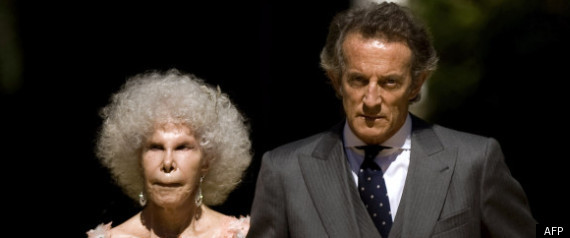
SEVILLE, Spain - 85-year-old Cayetana Fitz-James Stuart, the Duchess of Alba and possessor of more aristocratic titles than anyone else in the world, has married Alfonso Diez, making the commoner the Duke of Alba.

The wedding took place this morning in the chapel of one of the Duchess's palaces, the Dueñas Palace in Seville, with a variety of high-profile Spaniards, including the bride's children, in attendance.

The octogenarian bride wore a short, coral-colored dress with lace detail at the shoulder and a green ribbon around the waist. The groom wore tails.

The wedding, which follows the Cayetana and Alfonso's lengthy courtship, has made one of Spain's more controversial pairings official.

The Spanish aristocrat has 46 titles, according to Reuters, as she is a duchess, a countess and a marquesa several times over. Spanish Vanity Fair reports that her wealth is valued at an estimated at nearly $4.9 billion and when combined, her property is 170 times the size of Monaco.

As such, Cayetana Fitz-James Stuart is a tabloid fixture -- in the past and now.

The Duchess' wedding to Diez, a professional civil servant 25 years her junior, caused a stir, as the Duchess' children disapproved of the marriage quite vocally. Reuters reported that the Duchess' son Cayetano Martinez de Irujo, the Duke of Salvatierra, expressed displeasure at having only met Diez three times, especially because he will become the Duke of Alba.

The Duchess told Hola! in August, "The tough part was that my children didn't understand and they got quite angry with me."

But the magazine reported that to allay her family's fear, she spent the summer dividing up her wealth, including palaces and artwork by masters like Goya and Velazquez, among her six children. By giving up her wealth in advance, she seems to have her children's support in time for her nuptials, according to Hello!.

Unfortunately the bride's only daughter, Eugenia Martinez de Irujo, was not in attendance, having pulled out of the wedding just yesterday. A press release confirmed that the 42-year-old had fallen ill with the chickenpox, reports Hello!.

But the wedding still happened -- congrats to the happy couple!

Copyright © 2011 TheHuffingtonPost.com, Inc.

__________________________________________________________
Credit: Reports and photographs are property of owners of intellectual rights.
Seniors World Chronicle, a not-for-profit, serves to chronicle and widen their reach.

October 3, 2011

SPAIN: A retirement home for gay people in Spain

MADRID, Spain / BBC  News / Europe / October 3, 2011

By Sarah Rainsford, BBC News, Madrid

A landscaped, luxury home is envisaged

A short train ride from central Madrid is a scruffy plot of land covered in weeds and surrounded by wire fencing. In just a couple of months work is expected to start to transform the site into Spain's first ever retirement home for gay and lesbian residents.


Spain has been at the vanguard of Europe in terms of gay rights in recent years, but activists say reforming laws has been easier than changing attitudes.

"Gay old people have to go back in the closet when they enter retirement homes," explains Federico Armenteros, who runs the December 26th Foundation in Madrid.

It is named after the date in 1979 when the law used during Gen Franco's dictatorship to imprison homosexuals - or to send them for "cure" with electric shocks - was repealed.

"For many years, a lot of people believed that homosexuals were sick and sinners," Mr Armenteros says.

"That is more pronounced among older people, and hard to change,"

So the foundation has been working on a solution.

'Insulted and alone'
____________________________________________________________________________


"I have to make myself as invisible as possible - go back in the closet - so they don't notice me”

Jose Maria Herreras
______________________________________________________________

It has formed a co-operative, recruited architects and designed a luxury, landscaped retirement complex - complete with 115 apartments, gym, spa and restaurant.

There is space for yoga, Tai Chi and dance classes - and plans to house archive material for the first research centre on the history of the gay rights movement in Spain.

Designed to be "gay-friendly", the Foundation says the home will be open to anyone regardless of their sexuality.

Jose Maria Herreras describes it as a dream come true.

He looks relaxed, sitting at street cafe in Chueca - the gay heart of Madrid. But Jose is 65 and lives in a retirement home. He says his life has been miserable ever since the other residents discovered he was gay.

"They started to steer clear of me and insult me," he explains.

"They called me 'queer' and it made me feel awful. My room has two beds but no-one wants to share with me. So I'm alone and it's bad.

"I have to make myself as invisible as possible - go back in the closet - so they don't notice me. And I spend as much time outside the home as possible."

For now the site of the home is just wasteland

Gay rights activists believe that experience is widespread.

Predominantly Catholic Spain was among the first countries to legalise gay marriage and adoption.

Gay pride celebrations in Madrid are among the best-known and most extravagant.

The formerly run-down neighbourhood of Chueca now has a thriving gay scene including clubs, saunas, bars and bookshops.

But four decades of Gen Franco's right-wing dictatorship meant that change came late to Spain and has spread slowly.

'Anti-camp law'

"We only started fighting for our rights in the 1980s," explains Mili Hernandez, who opened Madrid's first gay and lesbian bookstore, Berkana, in 1993.

"Until 1979 there was a law that [they] could take us to jail just for walking on the streets and being a bit camp."
________________________________________________
I think we should go to the homes and ask for our rights”

- Mili Hernandez
Spanish gay rights pioneer
________________________________________________

The 1980s Aids epidemic was another setback for equal-rights campaigners.

"Now we have [some] of the best laws in the world for homosexuals, but we didn't have enough time to change mentalities," Ms Hernandez says, and points out that there are still very few high-profile, openly gay role models in the country.

"We're still in the closet," she says.

The bookstore owner sympathises with the problems of gay pensioners in care but she would prefer a different approach.

"I think we should go to the homes and ask for our rights. Ask for a double room, and tell them we are gay. We should try to insist."

But plans for the alternative home are already well advanced.

"It's too tough to make people who are suffering now wait until society changes and the discrimination ends - when people whisper about you and call you names, and won't enter your room," argues Federico Armenteros.

"These things are shrinking but unfortunately they exist."

He and his partner have already signed up for an apartment.

"I'll be living in a quality place, with people who respect, understand, love and care for me," Mr Armenteros says.

"Usually, when you end up in a home you're just another number. But this is something completely different."

'Social need'

A flat at the new complex should also work out considerably cheaper than the average retirement home.

How the home should look eventually

That is largely because a sympathetic local mayor has granted a low-cost 75-year lease on the land.

The co-operative system means members will cover 40% of the home's costs in advance while remaining funds will be sought from the banks.

For the architects who have drawn up the plans - for no charge, so far - the project makes sound sense.

"This is a project which will actually happen - that's important because we've done a lot of unnecessary building in Spain," says chief architect Julio Touza Sacristan, walking the plot with his sketches and artist's impressions.

But he also got involved because he saw a social need for the residence.

"I'm not sure everyone would like to be associated with such a project," he says.

"We're not as modern as we think we are in Spain but we think this is really necessary."

For Jose Maria Herreras, the place cannot be built quickly enough.

"This is somewhere where everyone will be equal," he says. "It's a totally different home where we won't have to hide who we are. We will be people. I will be free again."

BBC © 2011

__________________________________________________________
Credit: Reports and photographs are property of owners of intellectual rights.
Seniors World Chronicle, a not-for-profit, serves to chronicle and widen their reach.

June 8, 2011

SPAIN: Spanish writer Jorge Semprun has died aged 87

PARIS, France / Le Nouvel Observateur / Culture / News / June 8, 2011

Jorge Semprun, author of "The Writing or the Life" has passed away "very peacefully" at the age of 87 in his Parisian residence.

Spanish writer and former Minister of Culture Jorge Semprun
died on Tuesday in Paris.  Photo AFP

Jorge Semprun, the writer and the former Spanish Minister of Culture, died on Tuesday evening, June 7 in Paris, it is learnt from his grandson Thomas Landman.

Jorge Semprun, who exiled himself in France with his family after the Spanish civil war (1936-39 ), died "very peacefully" at the age of 87 in his Parisian place of residence, announced Thomas Landman.

Resistance fighter and deported convict:  Jorge Semprun was a Resistance fighter of Nazism, and was deported to the camp at Buchenwald. He was an anti-Franco communist activist.

He dedicated himself to writing, in French and in Spanish. He wrote about his deportation in "The Writing or the life". In 1969, his novel "The second death of Ramon Mercader" won the Femina prize.

Screen play and dialogue writer of films "Z" (1969) and "The Confession" (1970 ), Jorge Semprun also collaborated in the cinema of Yves Montand and the director Costa Gavras.

He was also Minister of Culture from 1988 till 1991 in the government of the socialist Felipe Gonzalez.

Source: Le Nouvel Observateur - with AFP

October 7, 2010

SPAIN: Mario Vargas Llosa wins Nobel Literature Prize

.
STOCKHOLM, Sweden / Agence France Presse / News / October 7, 2010

Peruvian-Spanish author Mario Vargas Llosa won the 2010 Nobel Literature Prize on Thursday, the Swedish Academy said.

The 74-year-old author, a one-time presidential candidate, is best known for works such as "Conversation in the Cathedral" and "The Feast of the Goat" but is also a prolific journalist.

Announcing the award, the academy hailed "his cartography of structures of power and his trenchant images of the individual's resistance, revolt, and defeat."

Vargas Llosa has won a string of major literary awards, including the most prestigious of all for a Spanish-language author, the Cervantes Prize, and had often been tipped to win the Nobel prize.

Mario Vargas Llosa. (AP Photo)
Born in Arequipa, Peru, Vargas Llosa grew up with his mother and grandfather in the city of Cochabama in Bolivia before moving back to Peru in 1946.

He then became a journalist, moving to France in 1959 where he worked as a language teacher and as a journalist for Agence France-Presse as well as for French television before establishing his reputation as an author.

His first major success came with the novel "The Green House" which appeared in English in 1966. He has since continued to produce a string of best-sellers, many of which deal with political themes and the troubled history of Latin America.

Source: AFP

September 22, 2010

SPAIN: Elderly men die in care home van

.
MALAGA, Spain  / Euro Weekly News / September 22, 2010

MADRID -- A 47-YEAR-OLD man who was arrested after two elderly people were found dead in a van in which they were being taken to a care home, has admitted his responsibility. The detainee, who is charged with negligent manslaughter, is the co-owner of a private care home in Ciempozuelos, Madrid, and was called to testify this week after being provisionally released. He could face between one and four years in prison.


He was supposed to take the two men, aged 81 and 87, to the care home, but he left them inside the vehicle in their wheelchairs. Both had senile dementia and the detainee was in charge of them.

The owner has apologized to the families and says that he is the sole culprit,. All the elderly people who could walk themselves had been taken out of the van but he forgot the two victims were there after he was interrupted. This was at approximately at 10am, and he didn’t return to the van until 8pm when he went to take the elderly people back to their homes. He found the two men unconscious and attempted to resuscitate them. He then called the relatives and the Guardia Civil.

The van had been in the shade all day and neither victim needed constant medication, so an autopsy is awaited to confirm the cause of death.

Nobody missed the two men because not all the visitors attend the centre every day.

The detainee says that he does not care about going to prison but that he feels terrible about what happened especially as he had an extremely close relationship with one of the victims, and their families are friends.

Copyright © Euro Weekly News Media Group s.a.

September 20, 2010

SPAIN: Singer-songwriter, politician José Antonio Labordeta dead at 75

.
BARCELONA, Spain / The Barcelona Reporter / News / September 20, 2010

Mr. José Antonio Labordeta died on Sunday in a Zaragoza hospital after battling prostate cancer for four years, said Chunta Aragonesista, the political party he represented during two terms in Parliament.

Spanish singer-songwriter, politician and author Jose Antonio Labordeta, a lifelong defender of democracy and of his native region of Aragon, died on Sunday from cancer. He was 75.

The party advocates for greater financial resources for Aragon, the protection of its environment and of the Aragonese language.

Labordeta’s musical career began with the release in 1974 of “Cantar y callar,” an album that showcased his pro-democracy convictions during the final months of the military dictatorship of Francisco Franco. His musical style combined traditional Aragonese tunes with modern Spanish folk melodies, and gained popularity throughout the country.

“He was a great Spaniard and a great patriot,” King Juan Carlos said.

Prime Minister Jose Luis Rodriguez Zapatero also paid tribute to Labordeta, saying at a political rally in Barcelona: “I remember and pay homage to Jose Antonio Labordeta, an authentic man who has left us and whom we love.”

Born March 10, 1935, in the Aragonese capital, Zaragoza, Labordeta graduated from the city’s university and became a teacher while pursuing his musical, literary and political interests

© 2010 AP

May 9, 2010

SPAIN: Catalan linguist Miquel Siguan, 92, has died

.
BARCELONA, Spain /  The Barcelona Reporter / Society / May 9, 2010


In 1988 the Government awarded him the Creu de Sant Jordi.
Miquel Siguan a key scientific figure in the early years of the Transition, brought the Quebec language immersion model that would end the school system implemented for Catalan.

He was the creator of the School of Psychology at the University of Barcelona (UB), doctor honoris causa by the Universidad Autónoma de Barcelona and Geneva universities, Basque Country and Seville, and author of some thirty works, many of them translated into various languages.

Fotografia: Dr. Miguel Siguán i Soler

His ability led him to a scientific career that would lead him to clinical psychology industrial psychology, social, developmental and finally, in the 70s, in the field of psycholinguistics, and the study of the Catalan language.

In the 80’s and 90’s he became an adviser to Unesco and the European Commission. [rc]

© 2010 Barcelona Reporter

May 2, 2010

SPAIN: Ten women died in gender violence during April 2010

.
Domestic Violence Spain in April 2010

Ten women died gender violence highest of the decade

BARCELONA, Spain / Barcelona Reporter / Society / May 2, 2010

April 2010 marked a tragic and sad negative record: it was the month with the highest deaths of women victims of gender violence in the last decade. The latest, today, was on the outskirts of Valencia.


Nine died in April 1999 and 2002 and so far marked the limit of the crimes of ‘machismo’ in the last decade in Spain.

Recently, a study of the Observatory Against Domestic Violence and Gender under the Council of the Judiciary (CGPJ), warned of the overrepresentation of 'gender murders in Spanish towns with fewer than 5,500 inhabitants, which "shows the need to extend all prevention resources". [rc]


© 2010 Barcelona Reporter

April 27, 2010

SPAIN: "Life Begins Today" At Malaga Film Festival

. MADRID, Spain / Variety / Film Review / April 27, 2010 Malaga Life Begins Today La vida empieza hoy (Spain) By Jonathan Holland A Filmax release of an Ovideo production with the collaboration of TVE, TVC. (International sales: Filmax, Barcelona.) Executive producer, Quique Camin. Directed by Laura Mana. Screenplay, Alicia Luna, Mana. With: Pilar Bardem, Rosa Maria Sarda, Mariana Cordero, Luis Marco, Sonsoles Benedicto, Osvaldo Santoro, Maria Barranco, Eduardo Blanco, Fernando Tielve. Elderly people falling in love is a feel-good cinematic cliche, but that they also have sex remains largely taboo -- an oversight rectified by the feel-good if uneven comedy "Life Begins Today." A celluloid invitation for the over-60 set to trade in bifocals for vibrators, pic has a lively, sympathetic script brought to bubbling life by fine perfs, agile scripting and a shot of social critique, making this helmer Laura Mana's most commercial effort to date. Though nobody under the age of 30 need apply, offshore play is likely for an item that's uplifting in more ways than one. Pilar Bardem in “La vida empieza hoy.” Photo courtesy: © 2010 Ovideo Olga (Rosa Maria Sarda) teaches a sex class for senior citizens. Among her students are cantankerous widow Juanita (Pilar Bardem), longing for death; Pepe (Luis Marco), obsessed with staying in shape and thinking of divorcing his wife, Rosa (Mariana Cordero); and Herminia (Sonsoles Benedicto), who lives with her daughter Nina (Maria Barranco). Meanwhile, Julian (tubby, terrific Osvaldo Santoro) has flown in from Argentina to visit his son Alfredo (Eduardo Blanco) and family, though it soon becomes clear he's planning a longer stay. Seeing Herminia in the street, he follows her to the sex class. Elsewhere, Pepe's affair with his secretary ends, plunging him further into crisis; Juanita starts to detect unusual stirrings as she's examined by her doctor (Francesc Garrido); and geriatric hijinks ensue. Perfs are understated and naturalistic from a cast with the combined experience of Methuselah. Shuttling easy between the lyrical and the comically crude, the busy script keeps things moving with a vigor wholly appropriate to a movie that's selling vigor as a lifestyle choice. Dialogue is sometimes quite funny, especially when the seniors are criticizing the political correctness of their offspring, who come in for some stinging satire in terms of their generation's hypocritical attitudes to the old. Pic is strongest when focusing on the oldsters. One particularly well-judged thread is the relationship between Julian and his grandson Kim (Fernando Tielve), who end up gratifying themselves, side by side: It's a sign of the helmer's skill that, far from being offensive, the scene is both comic and celebratory. The script rarely fails to hit the comic G-spot, but some of the comedy is still based on the oddity of seeing the elderly having sex. Particularly patronizing -- and cheap, given what the pic is capable of -- are later scenes featuring Rosa in dominatrix gear. (Indeed, the entire Pepe-Rosa strand is likely to raise feminist eyebrows.) Xavier Capellas' attractive score, though overused, is well deployed in the wonderful final sequence. Camera (color, widescreen), Mario Montero; editor, Lucas Nolla; music, Xavier Capellas; art director, Balter Gallart; sound (Dolby Digital), Dani Fontrodona. Reviewed at Malaga Film Festival (competing), April 22, 2010. Running time: 91 MIN. [rc] © Copyright 2010 RBL

October 3, 2009

SPAIN: Two million Spanish people use a bicycle almost every day

. Barcelona Bike Ride. Photo courtesy: University of San Diego . BARCELONA, Catalonia / The Barcelona Reporter / October 3, 2009 Two million Spanish people use a bicycle almost every day. Almost 400,000 of them are from Catalonia. The bicycle has become a means of transport, as its use for daily trips increased by 34.5% in Catalonia in a year, and the number of people who used it to go to work has increased by 57% in three years The data provided was obtained as a result of a total of 1,620 telephone interviews with people between 12 and 79 years, after which it was concluded that 90% of citizens know how to cycle and 60% use it for personal use. Therefore, percentage wise, in Spain there are 35 million people who know how to cycle, and five million live in Catalunya. Of these, 23 million own bike. Nadal said the increase of cycling is for different reasons. "The first impulse was received through the 'mountain bike', it became fashionable to use the bike for transportation" he said. Although the results are "very positive", Nadal also acknowledged the main complaint is the serious problems of coexistence between bicycles and other occupants of the roads and streets, and pedestrians. This creates insecurity among cyclists, particularly at the lack of infrastructure, i.e, specific lanes for bicycles. Nadal set out to create routes and recalled that, under the Infrastructures Plan of Catalonia (PITC) there are plans to build a 1,200 kilometre network of bike lanes. [rc] © 2009 Barcelona Reporter

August 27, 2009

SPAIN: Pacemaker keeps body in the pink

. SYDNEY, Australia / The Sydney Morning Herald / AFP / August 27, 2009 Relatives of a dead man in Spain asked a doctor to confirm his death a second time because his body showed no signs of going pale hours after he passed away, local officials say. The 70-year-old died of a heart attack and his body was on display at a funeral home in Lorca, a city of about 90,000 people in southern Spain, when his family noticed that it still had a healthy pink glow, a spokesman for the funeral home said on Wednesday. They then called in the doctor to confirm that their loved one was in fact dead. The doctor concluded that the man still had a healthy glow, even though he was dead, because his pacemaker was still running. [rc] Copyright © 2009. Fairfax Digital

July 16, 2009

SPAIN: Oldest mother, Maria Carmen del Bousada, dies

. LONDON, England / The Times / Europe News / July 16, 2009 By Graham Keeley in Barcelona A pensioner who became the world’s oldest mother at 66 through anonymous sperm and egg donations has died, leaving her twin sons orphaned and reigniting controversy over fertility treatment for older women. María Carmen del Bousada de Lara, a single mother, died from cancer two years after giving birth to Christian and Pau. She was 69. Ms Bousada learnt that she had a tumour before she gave birth to her sons at a clinic in Barcelona in December 2006. Maria Carmen del Bousada said she would see her sons live into adulthood at the time she must have known she was suffering from a tumour (News of the World) The retired shop worker, one of four children from a middle-class family, sold her house in Cádiz to raise the £36,000 needed for the in vitro fertilisation treatment in America. Later she admitted lying to doctors about her age, claiming that she was 55 to get round age limits at the Pacific Fertility Centre in Los Angeles. She had not told her family about the purpose of her trip — but when the boys were born the news caused outrage among them, in Spain and around the world. The care of the twins is likely to be entrusted to family members — who will be helped by lucrative media deals — possibly to a younger generation of the family such as the boys’ cousins, who are believed to be in their thirties or forties. In Spain, where family values are important, Ms Bousada’s case provoked fresh calls last night for a legal limit on the upper age for fertility treatment. There is none at present in Spain. Nuria Terribas, from the Borja Bioethics Institute, a think-tank in Barcelona, said: “We think a limit of 45 should be established in law. Cases like this not only create physical dangers for the mother but many family complications.” Josep Torrence, of Iglesia Plural, a progressive Catholic group, said: “The most important thing is the children are left unprotected, which should not be allowed. What is needed are stricter controls to stop this happening again.” After the birth, Ms Bousada insisted that she did not want money for her story, preferring to guard the privacy of the twins. Weeks later she sold her story to The News of the World for an undisclosed sum, telling the paper: “I have always wanted to be a mother all my life, but I have never had the opportunity or met the right man. “My mother lived to 101 years old and I have every reason to believe longevity runs in my family.” She said she felt healthy and predicted that she would see her sons grow into adulthood. She later told a Spanish television programme she was suffering from what was thought to be breast cancer. Ms Bousada, who insisted she had no regrets, said the drugs used during her intensive fertility treatment might have helped to spread the disease. Related Link World's oldest mother was not in the wrong Her decision to give birth was condemned by Ms Bousada’s family. Manuel Bousada de Lara, 73, said: “My mother would roll in her grave if she knew what my sister has done. She would ask, ‘How’re you going to bring up two boys at your age?’” Vicken Sahakian, the American doctor who carried out Ms Bousada’s IVF treatment, said later: “If I had known her real age I would not have treated her. She lied to me. She faked documents, knowing that my age limit for single women is 55.” Ricardo Bousada yesterday confirmed his sister’s death but refused to disclose the exact cause. He said that to provide for the twins he had signed a deal with a Spanish television channel to tell the story of his sister’s fight against cancer.[rc] Copyright 2009 Times Newspapers Ltd.

July 4, 2009

SPAIN: Catalan writer Baltasar Porcel dies from brain tumour

. BARCELONA, Spain / Barcelona Reporter / Culture / July 4, 2009 The Majorcan writer Baltasar Porcel has died in hospital in Barcelona, aged 72, as a result of a brain tumour which was operated three years ago. A chapel at the Palau Moja ardent welcomes the remains of the author, to be buried in his hometown of Andratx. The body of Baltasar Porcel lies in state on July 3. Photo courtesy: El Pais. Baltasar Porcel won the 2002 Premio Nacional de Literatura de la Generalitat de Catalunya in 2007 and the Award of Honor for Literature Catalanas / Pedro Madueño / Archivo writer. Baltasar Porcel, won the 28th prize Caixa Sabadell Sant Joan with his novel "Every castell i totes les ombres "Jordi Porcel Belver Baltasar a hawk, creating a portrait that appears on the cover of his new book, 'Every castell i totes les ombres' / Peter MadueñoPORCEL in the archive Porcel, one of the great European writers of our time, was born in Andratx, Mallorca, in 1937. His family had been on the island for centuries, in some of his books Porcel researched his lineage back to the conquest by King Jaume I in the thirteenth century. The grandfather and the father of the writer emigrated to Cuba in search of fortune and returned without it, "nobody was rich there," say Porcel. For some time, he worked as a cook on a schooner, until he returned to the village of origin. "In the post-war years, the writer-remembered Andratx was a very small community , squeezed between the mountains and the sea, with very poor communications with Palma. Many people had never left the village. The people were poor, and had few possessions. Most of the families have living there for several centuries, mingling among themselves and with little contact with the outside world. In town, most people are engaged in agriculture, fishing and contraband. A key figure in his life was his uncle and godfather, Baltasar Guillem, adventurous and linked to smugglers, who encouraged the author's imagination early. Porcel has stated that although the prevailing doctrine of the Church was not Catholic, but pantheistic, "and used the example of his own mother, who believed unequivocally in the visible presence of ghosts. He was a precocious reader, he was elected president of the Congregation of Marian priests and people, "educated people", and was introduced to the writings of authors like Jules Verne or Pío Baroja. In the 50s, coinciding with the beginning of the boom in tourism, Porcel moved to Palma, whose father found work in a hotel in Victoria. They lived in the suburb of Son Armadams, which also had already the famous Galician writer Camilo Jose Cela. He was one of the few attendees at the trial of Jordi Pujol, who along the years he maintained a significant relationship. The happy and turbulent sixties. Baltasar Porcel landed in Barcelona at the beginning of the decade that changed the world. The 70s opened with the publication of one of his most famous writings, Difunts sota els Ametllers blossoms, which won a prize at the Pla Noche de Reyes 1970. It's time of intense professional and political debates. In the years following the death of the dictator, Porcel established a cordial relationship with the monarch and Juan Carlos I. "In life you can not act only by rationalism, and is much better to have a king like this than any president." [rc] © 2009 Barcelona Reporter

June 15, 2009

SPAIN: Saffron-laced Spanish cuisine can help fight eyesight loss

. BARCELONA, Spain / Barcelona Reporter / News / June 15, 2009 Saffron, the spice which is commonly used in Spanish, Indian, and Italian cuisine, could hold the secret to preventing eye sight loss in old age, says a new study. Study's scientists, who are based at the University of L'Aquila, in Italy, and Sydney University, in Australia, have discovered that saffron can protect against some of the most common forms of blindness. Through the study, researchers revealed that eating saffron on daily basis helped to make the delicate cells in the eye needed for vision more resilient against disease. Animal studies further confirmed that a diet containing saffron can protect the eye from damage caused by bright sunlight and slow the progress of genetic diseases such as retinitis pigmentosa. Click here for more about saffron The researchers also found saffron had a beneficial effect in humans suffering from age-related macular degeneration, the most common form of blindness in old age. The scientists are now conducting a clinical trial on human patients with age-related macular degeneration. Professor Silvia Bisti, who led the research from the University of L'Aquila, said: "Saffron seems to possess a number of properties that are protective to vision. We are now trying to understand the mechanism, but it appears to block cell death. Saffron components have strong antioxidant properties. It also appears to affect genes which regulate the fatty acid content of the cell membrane and this makes the vision cells tougher and more resilient." [rc] © 2009 Barcelona Reporter

June 8, 2009

SPAIN: Tourism promotion plan targets senior citizens from EU countries

The spectacular colours of nature in the Alcornocales Natural Park in Cadiz, Spain.
Photo: andalcucia.com / Michelle Chaplow .

BARCELONA, Spain / The Barcelona Reporter / Tourism / June 8, 2009


The Secretary of State for Tourism, Joan Mesquida, pointed out that "there were 100 million 55 to 75 year olds in Europe, many of whom had never travelled outside their own country.

"Plan de Turismo Senior Europa" targets EU countries senior citizens. The plan will target senior citizens from the newer EU countries with the purpose of enticing 500,000 of them to holiday in Andalucía during the quieter winter period. The scheme, costing six million euros, will be co-financed at regional and national level.

The head of Tourism at the Junta, Luciano Alonso, said "that the initiative would allow Andalucía to open up new markets and increase the rate of bed occupancy during the low season, thereby protecting jobs.

Aimed at the over 55 age group, marketing will be carried out in Poland, Hungary, the Czech Republic and Slovakia offering holidays of varying duration at four star hotels along the coast in Malaga, Huelva and Cadiz".

The offer will run from October until April 2010 and travellers will be offered a half board deal to encourage them to use other local businesses during their stay.

The Secretary of State for Tourism, Joan Mesquida, pointed out that "there were 100 million 55 to 75 year olds in Europe, many of whom had never travelled outside their own country.

This scheme will give them an opportunity to spend part of the winter in a more agreeable climate at a reasonable cost". The initial marketing exercise will offer 80,000 holiday deals in Andalucía and the Balearics to the four EU countries mentioned.

© 2009 Barcelona Reporter

May 28, 2009

SPAIN: Playing for keeps – computerised play helps elderly stay sharp

. ALACANT, Spain / AIJU / ElderGames / Cordis / May 28, 2009 European researchers have built a computerised play platform for elderly people. Field testing shows that the system keeps elderly players mentally sharp, stimulates socialisation, and can alert caregivers to developing problems. Three years ago, researchers at the EU-funded ElderGames project set out to create a high-tech play platform specifically for the elderly – the first designed to provide cognitive and social stimulation, and to allow early detection of cognitive decline. Games and technology can be more than fun for the elderly. © Michael Gray - Fotolia.com The researchers knew that play can help ageing people stay cognitively fit and stimulate much-needed social interaction. What they hoped was that they could design and build a computer-enhanced play platform that elderly people could use easily, would enjoy, and that would enhance quality of life. “Play is good in itself,” says Malena Fabregat, ElderGames coordinator, “but the challenge was to allow the users to train what the experts told us were the most important cognitive abilities in this period of life.” Fabregat and her colleagues were aware that many elderly people are afraid of new technologies and tend to avoid them. They were surprised by how quickly elderly participants overcame their technological fears. “Even with the first prototype, which had lots of cables and cameras, after five or ten minutes they had absolutely forgotten about the technology,” says Fabregat. Extensive trials allowed the researchers to perfect an inviting, interactive play table and display, and develop a set of computer-driven games that exercise and track important cognitive skills, stimulate social give and take, and are fun. “This is very simple, but very important at this time of life,” says Fabregat. “Elderly people need to feel useful, to feel capable, and to feel that they have things that are interesting to do.” The ElderGames play platform and suite of games meet all of those objectives. “And they provide an opportunity just to have a good time,” she says. Attractive computerised play platform The ElderGames project, which received funding from the Sixth Framework Programme for research, had several goals. The researchers wanted to create an attractive, easy-to-use play platform that could support a wide variety of computer-driven games, and that would allow caregivers to assess the cognitive skills of individual players over time. To accomplish those goals, the researchers needed to be able to identify individual players accurately, and to track each person’s play on a moment-to-moment basis. They accomplished that by using multiple cameras mounted on risers at the corners of the table and special handheld pointers that players use to indicate their moves or choices. The cameras and pointers allow the real players to interact naturally with the virtual world on the display. The result is a comfortable table with graceful bays on all sides which make it easy for players to reach anywhere on the large plasma or LCD display that makes up most of the table’s surface. Different games for different skills The ElderGames team put a great deal of effort into identifying and developing games that seniors would find interesting, that would stimulate socialisation, and that would challenge important cognitive skills. Working with experts from a variety of fields, the researchers homed in on a set of important mental abilities that are most affected by ageing, including the ability to maintain and direct one’s attention, executive functions such as planning, problem-solving and decision-making, fine motor skills, and memory. They analysed hundreds of games to find ones that utilised those key mental skills, that could be played interactively, and that were challenging and enjoyable enough to entice players to play again. The result is a suite of 20 games that seniors or caregivers can select, which together exercise all of the targeted skills. In addition, the researchers developed software that tracks the functioning of each player over time, with the aim of providing caregivers with an early warning of potentially serious cognitive changes. The researchers have now tested the suite of games and the prototype game table at centres in Spain, Norway and the UK. According to Fabregat, the trials have shown that the ElderGames system benefits seniors in a variety of ways. Crucially, she says, it promotes active, healthy ageing. “There are many studies showing that play and leisure activities correlate to life satisfaction,” she says. “This is one area where ElderGames has proven itself.” In addition, caregivers and doctors have been impressed by the ability of the system to warn them when an elderly person is showing even subtle cognitive changes. “The experts were able to get high-quality individual information from these group activities,” says Fabregat. “This multiplied their ability to monitor and assess the people they were responsible for.” One reason for the high quality of information the system provides, Fabregat says, is that even though the elderly players know that their performance is being tracked, they are relaxed and responding naturally, in contrast to their performance in anxiety-provoking clinical testing situations. Amparo Ruiz, an occupational therapist in Galicia, Spain who helped supervise some of the field trials is excited by the system. “The elderly people like it when they play and feel integrated into the new technologies,” she says. “And for me it’s very important that I can get information about their attention, memory and other functions while they are playing, and then choose games that emphasise the areas where they have problems.” Fabregat and her colleagues are eager to see ElderGames reach seniors and their caregivers worldwide. Commercial game companies in Europe, North America and India have already shown interest in the system. “We’ve had some very good reactions to the prototype,” says Fabregat. “We’ll see what happens next.” ICT Results

May 22, 2009

SPAIN: Internet blogging great-grandmother, 97, has passed away

. BERLIN, Germany / Die Welt / May 22, 2009 A Spanish great-grandmother whose blog attracted tens of thousands of readers from around the world has died aged 97 in the northern Spanish province of La Coruna. Maria Amalia Lopez, best known as 'Internet Grandma' died in Muxia (A Coruæa, Spain) aged 97 on 20 May 2009. The granny started blogging in December of 2006 and it didn't take long until she was discovered by the cybernauts. Maria Amelia Lopez charmed readers with a homely mix of memories and chat at http://amis95.blogspot.com/, including stories of a long life that witnessed Spain's Civil War and years of dictatorship under General Francisco Franco. Lopez, who dictated her entries to her grandson Daniel because she suffered from cataracts, became a nationally loved figure in Spain and met Prime Minister Jose Luis Rodriguez Zapatero. "My grandson gave me this blog when I was 95 on Dec. 23 2006 and my life changed,“ reads one of her entries. "Since that day I've had 1,570,784 visits from bloggers from 5 continents who have cheered up my old age.“ A banner on her site read "Rest in Peace“, with nearly 500 messages mourning her death. Source: Welt.de

April 29, 2009

SPAIN: Cruise Ship Pensioners Were Drug Mules

. LONDON, England / Sky News / April 29, 2009


Spain has become the main entry point for bringing drugs into Europe


 CADIZ, Spain -
A gang accused of using pensioners to
smuggle cocaine on luxury cruises has
been arrested by Spanish police.

They were held after two women in their 60s were caught trying to bring 27kgs of cocaine into Spain, stuffed in their suitcases. When the ship docked in Cadiz, the elderly women were reportedly supposed to pass the drugs on to two others. They would then distribute the drugs across Europe. Police detained the two people who were at the port to collect the drugs, as well as the alleged leader of the group as he tried to flee to Brazil. The women, who were posing as tourists, picked up the drugs when the cruise ship they were on stopped at a Brazilian port. Police say it is the first time anyone has been caught using this method to bring drugs into Spain. The gang allegedly has connections to Brazil, The Netherlands and Spain. Spain is the main entry point for drugs into Europe and police have thwarted a number of such attempts this year. Last month police in Barcelona discovered a 42-piece blue crockery set, that was actually made entirely from 20kg of cocaine. And in March a 66-year-old Chilean man was also arrested in Barcelona after it emerged his broken leg was supported by a cast made entirely out of cocaine.

Copyright ©2009 BskyB