Remember ME - You Me and Dementia

Showing posts with label Relationships. Show all posts

March 30, 2012

USA: How to Live Alone Without Being Lonely

WASHINGTON, DC / US News & World Report / Money / March 29, 2012

Healthy and happy solo households achieve well-being by expanding social networks and activities


By Philip Moeller

They are known as singles, singletons, the never-married, the divorced, and the widowed. What they share is that they are part of the country's fastest-growing living unit—more than 31 million one-person households in 2010, according to the U.S. Census.

Traditionally, relationship researchers have found that people living alone are on the bottom rung of the wellness ladder. They lack the emotional, financial, and daily help of a committed partner, which are major reasons why people in successful marriages and other strong two-person relationships fare better in measures of health, happiness, and longevity.
"When people succeed in having a good intimate relationship, it has so many benefits," says UCLA psychology professor Ben Karney. "Your body works better, your immune system functions better, your body produces more antibodies. Study after study shows that people in good relationships live longer." Even severely ill people who were in good relationships recovered faster and lived longer than comparably ill people who were not in good relationships.
Single men, in particular, take especially poor care of themselves. "Unmarried men are more likely to have bad health habits than married men," says Linda Waite, a sociologist at the University of Chicago. "They drink too much, don't eat well, don't wear seat belts, have more unprotected sex" and don't enjoy the kind of social supports they would in a committed relationship. Single women, by comparison, fare better, precisely because they have better social connections and are used to taking care of themselves.
However, many experts say the health and happiness disadvantages of living alone are disappearing. Social science research tends to look at a long-distance rearview mirror, analyzing large groups of people over many, many years. Current trends are easily documented.
"Over the past 30 years, the health gap between the married and never-married has narrowed to almost nothing," says Debra Umberson, a sociologist at the University of Texas. "Being not married has increasingly become an accepted option."
"Once they accept [being unmarried] and make their peace with it, they fare just as well as anyone else," says Deb Carr, a Rutgers University sociologist. "We see them expanding their definitions of what is a family. Not only do they have larger numbers of friends [than married people], but they have more frequent contact with them and closer relationships with them." Carr says society has become friendlier to "never marrieds" as well, and that people are more tolerant and supportive of a broad range of different ways people choose to live.
"I think that there is a really important distinction to be made between social isolation and choosing to live alone," Umberson says. "People who are socially isolated are the ones more likely to die" at earlier ages.
Eric Klinenberg is a sociologist at NYU and author of a recent book about living alone called Going Solo. It supports, if not celebrates, the emergence of the one-person household as an increasingly preferred living choice, not only in the United States but even more so in many Western European nations.
Klinenberg is careful to distinguish among different types of one-person households when assessing their occupants' health and well-being. He also thinks that much of the pro-marriage research is based on either misleading or flawed assumptions.
"Many, if not most, studies of the health consequence of marriage compared currently married people versus never married people," he says. The adverse health consequences of divorce and widowhood are well-documented but are usually viewed separately from the positive health effects of people who remain married. No one gets married thinking the marriage will fail or their spouse will die, Klinenberg notes. And while staying married produces benefits, he says it's impossible to conclude that simply getting married improves a person's well-being and longevity compared with staying single.
In looking at the effects of living alone, Klinenberg says, "I make a very careful distinction between living alone, being alone, being isolated, and feeling lonely. These are four different things. And most researchers, even the best of them, conflate them."
"It's really a specific minority of people who live alone who are vulnerable," he says. "And we could do much more to provide care and support for them than we do now. We could do more to connect them to other people and services. And that's what would make them safer."
The opportunities and challenges of living alone differ greatly, depending on a person's age and marital history. About 5.5 million young adults under age 35 live alone, Klinenberg says. Especially in larger urban areas, they have an unparalleled mix of social options. Coupled with the explosion of online media and networking tools, there is no societal reason for these people to be lonely, and many reasons why living alone can produce a fulfilling and happy experience.
Among people ages 35 to 65, he explains, most of the those who live alone were previously married. "What's new today is that they are not going to remarry the wrong person." Social pressure to be married has receded, and single people are getting a lot more affirmation about making the best decisions for themselves. "People who live alone do get lonely," Klinenberg says, "but so do people in marriages."
Among people over age 65, there are 11 million one-person households. It's here, many experts fear, that loneliness and isolation can take an enormous toll on health and happiness. Many of these people are widowed, and most of them are women who have outlived their husbands.
Building new friendships and social networks is an effective strategy to ward off the negative consequences for older people who live alone. Moving into a senior living complex may make sense for those who may need help finding companionship, social activities, and help with their daily lives. Throughout the country, hundreds of groups of seniors have formed virtual senior communities to provide organized support to one another as they continue to live alone in their homes.
The key to healthy aging, sociologist Laura Carstensen says in her book A Long Bright Future, is to build a plan that anticipates the needs of older age. Renew your social networks. Find younger friends and new activities and social organizations. Build daily routines and a lifestyle that matches what you've previously envisioned as the way you want to live.
In the end, human relationships are the best antidote to the downside effects of living alone. Toni Antonucci, a University of Michigan psychologist and relationship expert, creates an image of people having a social convoy that helps them navigate their life. Keeping that convoy intact is essential for our happiness. People need to realize this and take ownership of their relationships. "We just sort of think happiness comes to us," she says. "We need to rethink that. You can do things to make yourself happier. People should take some responsibility for being happy instead of it being a passive thing."
Copyright © 2012 U.S.News & World Report LP
____________________________________________________________
Credit: Reports and photographs are property of owners of intellectual rights. 
Seniors World Chronicle, a not-for-profit, serves to chronicle and widen their reach.

March 29, 2012

INDIA: Live-in mela for senior citizens on April 15

RAJKOT, Gujarat / The Times of India / March 29, 2012

City's Arvind Maniyar Hall is likely to become the epicentre for a social change. For the first time, a mass programme for senior citizens to choose live-in partners will be held here on April 15.

The first-ever public function to help 50-plus men and women in Saurashtra region to find a companion will be organized by Natubhai Patel, who runs Vina Mulya Amulya Sewa, an organization created to help arrange marriages of lonely senior citizens in the country.

"After the success of similar live-in relationship functions in Ahmedabad last year, we are now going to organize this in Saurashtra region," said Patel.

He said that the concept of live-in relationships has interested a lot of elderly, who are shy of getting married again and don't want to embarrass their children.

"We are expecting more than 300 elders (males) to come from across the country. The event is being held in Rajkot, but people can come from across the country to take part to find their companion for live-in relationship in their autumn years,'' Natubhai told TOI.

Interestingly, the ratio of elderly women's participation in such live-in relationship mela is about 20 per cent. "In order to encourage women to participate, we are offering females free of cost travelling from any part of the country as well as accommodation in Rajkot. We will also gift a sari to each woman participant," said Patel.

"Our experience says that live-in relationship for elder is the need of the hour. It is better that a lonely person finds a partner in their last span of life instead of staying in old-age home when your children are not taking care. Also, in many cases, even children have happily agreed to get their parents married," he added.

The criteria for a male participant are that he should have monthly income of above Rs 10,000 and his age should be above 50 years.

Patel said all men and women above 50 years of age including divorcees, widows and single are eligible to join the meet. He said that women above 40 years can also take part in the meet.

Copyright © 2012 Bennett, Coleman & Co. Ltd.
____________________________________________________________
Credit: Reports and photographs are property of owners of intellectual rights. 
Seniors World Chronicle, a not-for-profit, serves to chronicle and widen their reach.

February 23, 2012

USA: Watch What This 90 Year Old Couple Does at the Clinic


At the age of 90 and married 62 years, these two are acting like they're in their 20s.
This is a great video that shows we are only as old as our attitude. These two were
an inspiration to everyone at the clinic that day. 
Source: godvine.com
____________________________________________________________
Credit: Reports and photographs are property of owners of intellectual rights. 
Seniors World Chronicle, a not-for-profit, serves to chronicle and widen their reach.

February 14, 2012

USA: Love remains the mystery of life

WASHINGTON, DC / The Washington Post / Lifestyle / February 14, 2012


By 

 The complicated emotion has been studied and dissected, but still remains the central mystery of life. Here are photos that depict the many different forms of love.
A middle-aged couple huddled under a blanket at a picnic table in the park. So adorable! The two were leaning into one another, combining body heat, talking softly on a chilly winter afternoon. Cozy. Merged for protection. And let us repeat: middle-aged. This was the perfect image of enduring love, the dream of every person, the whole “On Golden Pond” fantasy. It can happen!
But when a Post photographer approached and asked to take their picture, they declined. The photographer thought: Affair?
The photographer was about to leave when the man walked over and apologized.
The problem, he said, is that we’re breaking up.
Ouch! Didn’t see it coming.
Love is the central mystery of life. You can’t see inside the heads of other people or into their hearts, to use a metaphor that somehow has survived 400 years of medical research. You can barely know your own thoughts.
Love deceives. It confuses. It heals and it hurts. It can make you lose your mind. It should come with a warning label. Carolyn Hax, a Post advice columnist, suggests: “Don’t operate heavy machinery when you’re under the influence of this stuff.”
Yet people still are trying to explain love, to measure it, calibrate, capture it with advanced medical imaging. The science of love is in the air. Scientists are homing in on the neurochemistry of love. The love experts talk about dopamine and oxytocin and vasopressin and opioids. They study brain scans of people in various throes and permutations of love, and say things such as (we got this the other day from Helen Fisher, a pioneer in the field, and a professor at Rutgers): “We found activity in a tiny little part of the brain called the ventral tegmental area.”
Yet when you’re in love, it doesn’t feel like the ventral tegmental area is the cause.
It seems like, for example, that the eyes are more important. The hands. And other parts.
A recent study, highly publicized, suggested that women prefer the smell of men who produce a different set of disease-resistant antigens than they do. It’s like the DNA is deciding on a mate. Are we animals? No, more like robots. Human mating behavior varies from individual to individual, but collectively, we obey the commands of biology. We follow reproductive strategies of which we are barely conscious. The man possesses billions of sperm, the woman releases only about 400 of her eggs, and from the difference emerges a million romcom screenplays.
Yet when you reduce love too much, you lose the essence of it, the texture, not to mention your audience (boring!). It may be that love demonstrates the limits of empirical inquiry. “The Science of Love” flirts with being an oxymoron. Love is an emergent phenomenon, like consciousness, and thus a little bit squishy, immeasurable, enigmatic. Water is two hydrogen atoms and an oxygen atom, prone to joining other such molecules through bonds in the hydrogen atoms — but that tells you nothing about what it feels like to be wet.
We’re looking at a photograph of a mother, a father, a newborn. She’s kissing the baby. The baby has launched its relentless project of reeling in the parents. The two have become three, forever connected, with the child now carrying the nerve endings of the mother and father. Give it any technical name you want — this is a picture of love, abundant.
In his book “The Social Animal,” journalist David Brooks offers a tour de force examination of two fictional people falling in love, describing their interactions at the unconscious level:
“As Julia and Rob semi-embraced, they silently took in each other’s pheromones. Their cortisol levels dropped. . . . Later in their relationship, Rob and Julia would taste each other’s saliva and then collect genetic information. . . . They had decoded silent gestures — a grin, a look, a shared joke, a pregnant pause.”
It’s smart stuff, though not exactly . . . hot. It’s a bit of a buzzkill, like explaining a joke. And some jokes, such as the one about the chicken crossing the road, simply defy explanation (because what’s funny about the chicken joke is that it’s not funny — get it???).
The Greeks had a nice vocabulary of love, starting with agape, the unconditional love, and eros, that passion that may involve a flaring in the groinal region, and philia, the friendship love, and storge, which we need to Google. Modern writers find all kinds of words to describe the shadings of love, as in a pdf we got by e-mail:
“According to Sternberg (1988), for example, types of love are determined by various combinations of passion, intimacy, and commitment. Possible combinations result in romantic love, infatuation, companionate love, liking, fatuous love, empty love, and consummate love.”
Fine, but what do you call the love you feel when, after 17 rounds of “No, it’s your turn,” the spouse finally agrees (because itwas her turn, by the way) to get up at 3:45 a.m. to deal with the squawking child?
People talk about “infatuation,” but even that has degrees, ranging from a carefully controlled interest to a manic obsession, and from a theoretical (repressed, inappropriate, guilt-inducing) crush to the full-blown sensation of being as out of control as a dishrag in the washing machine.
“Be my valentine”: After all these years, no one knows what that means. It sounds like a euphemism. Probably for something dirty.
A valentine is shaped like a heart, which, oddly, is not shaped like a human heart at all. The valentine shape is symmetrical, two halves perfectly conjoined in the middle. It’s not just a metaphor: One of our accompanying photos shows two people in love. They’re both male, but that’s not what’s striking. The way they put their heads together and their arms: They form, for the viewer, a perfect valentine.
Raymond Carver wrote a story called “What We Talk About When We Talk About Love.” The four characters, boozing it up over a kitchen table, talk about love in terms of jealousy, rage, pain, abuse, suicide and an overpowering need to connect. The ice melts in the ice bucket. The sun goes down. Finally, they sit in the dark, saying nothing. They can feel their hearts beating. Thumpa thumpa thumpa.
Maybe love should be defined as the thing about which people write songs. No one writes songs about, say, the Higgs boson. No one writes songs about Vince Lombardi. No one writes songs about the Peloponnesian War. At least not any that are very hummable.
When people have a song in their heart, it means they’re in love or an advanced state of like. Cole Porter once asked (it helps to listen to the Sinatra version, in his great Capitol Records phase):
What is this thing called love?
This funny thing called love?
Just who can solve its mystery?
Why should it make a fool of me?
Fools in love: They talk like mice, or in baby voices, and follow each other around obsessively, cooing, fussing with each other, nuzzling, gurgling, sniffing, sniveling, being completely nauseating in every way to the outside observer. In the throes of it, in that first rush of connection, no one else matters.
There are primitive elements to love. There are parts of the love instinct that predate the caveman. That caveman habit of grunting, being lewd and gross, swinging a club — that’s actually relatively civilized compared with how things used to be, back before we were technically people. This is a good line of argument for men who have to get out of a jam: “Honey, that’s nothing compared with what’s common practice among lizards.”
It’s never entirely clear where sex fits into a discussion about love. You can have love without sex, and sex without love. The experts tell us that that women fall in love and then want to have sex, and men want to have sex and then fall in love. In the long run, somehow, supposedly, it all works out, collectively, for the species. We all get along, because, through divergent evolutionary needs, we wind up co-signatories on a mortgage.
But there are outliers, exceptions, mutations, perversions, distractions, digressions, transgressions. If it weren’t for transgressions, we’d have no literature. Anna Karenina; Hester Prynne; Madame Bovary; every John Updike character.
Maryetta Andrews-Sachs, a Washington couples therapist, says modern life can be rough on romance because people work such long hours and are so thoroughly distracted by communications technologies.
“I see couples, young couples, who are so busy working, they don’t have sex. That’s crazy, right?” she says.
And then the older couples, they don’t even look at each other.
“Couples neurologically regulate each other through their eye contact,” she says. At first, early in the relationship, the eyes are key to the flirting, the fun, the connection. “Then if you get married, you get caught up in all the management part of life, and people stop having fun and stop having eye contact.”
So we like this photo of the old couple on the couch. They’re holding hands. They’re looking directly at one another. They’ve been together for 74 years. See, it really can happen — it’s not something we imagined, or projected.
This one, we dare to think, is gonna last.
© 1996-2012 The Washington Post
____________________________________________________________
Credit: Reports and photographs are property of owners of intellectual rights. 
Seniors World Chronicle, a not-for-profit, serves to chronicle and widen their reach.

February 13, 2012

JAPAN: “For whom are we rebuilding?”

NEW YORK, NY / The New York Times / Asia Pacific / February 13, 2012

ONAGAWA JOURNAL
As Japan Works to Patch Itself Up, a Rift Between Generations Opens


Hiroaki Suzuki, 21, opposes rebuilding a small village, saying he wants to live in a centralized community away
from the sea. Kazuhiro Yokozeki for The New York Times
By 

ONAGAWA, Japan — At age 39, Yoshiaki Suda, the new mayor of this town that was destroyed by last March’s tsunami, oversees a community where the votes, money and influence lie among its large population of graying residents. But for Onagawa to have a future, he must rebuild it in such a way as to make it attractive to those of his generation and younger.

“That’s the most difficult problem,” Mr. Suda said. “For whom are we rebuilding?”

The reconstruction of Onagawa and the rest of the coast where the tsunami hit is a preview of what may be the most critical test Japan will face in the decades ahead. In a country where power rests disproportionately among older people, how does Japan, which has the world’s most rapidly aging population, use its dwindling resources to build a society that looks to the future as much as to the past?

The clashing generational interests are perhaps most striking here in Onagawa, ......Click to continue

© 2012 The New York Times Company
______________________________________________________
Credit: Reports and photographs are property of owners of intellectual rights. 
Seniors World Chronicle, a not-for-profit, serves to chronicle and widen their reach.

January 17, 2012

USA: The Truth About Your Grandkids' Parents

NEW YORK, NY / Grandparents.com / Family / January 17, 2012
There are all kinds, and they all bring challenges
by Georgia Witkin, Ph.D.

The Modern Grandparent's Handbook: The Ultimate Guide to the New Rules of Grandparenting
written by Senior Editor, Dr. Georgia Witkin, 
has been published by New American Library.
Here's an excerpt from Georgia's chapter, "The Truth About the Parents," a field guide to modern moms and dads:
The Panicky Parent
Today's parents are smart. They may even betoosmart — too keenly attuned to every possible danger that their children face. It's no wonder they're always on alert; 24-hour news channels fill the screen with constant updates about every abduction, accident, illness outbreak, schoolyard danger, and bus disaster. There are specials on children's learning problems, emotional problems, drug problems, allergies, and eating disorders. Talk shows discuss kids sexting, drinking, cyberbullying, and getting pregnant. The information is so abundant and immediate that our adult children are aware of everything that could ever happen to any child — and many are fearful it could happen to theirs. These fears can turn them into hovering "helicopter dads" and overprotective "smother mothers," ready to swoop in and rescue their children from every scraped knee or hurt feeling.

As grandparents, we can give our grandchildren's parents some perspective. We've been through it. When they were young, they survived riding bikes and climbing trees, viruses and infections, bullying and dead fish.Tell them!Remind parents that safety products like helmets and car seats work, that toys are much safer now, and that medicines have childproof caps. Help your children become more realistic about their children's lives by remembering their own childhood. Only you can do that. You were there then, and you're here now. Sometimes being a grandparent means parenting your grandchildren's parent all over again.
The Child-Centered Parent
Many parents today put their children at the center of the family. This doesn'tsoundlike a bad thing. Putting the kids ahead of their own needs, even ahead of their marriage, may seem child-friendly, but when it becomes extreme, it can lead to complications.
When a child is the absolute center of the family, she can grow up without boundaries. This can lead to a demanding, entitled kid and, eventually, a demanding, entitled adult. Some acting out might be accepted from a child, but future bosses and spouses will not be so tolerant.
Furthermore, being the center of the family is too much pressure for a child. Kids cannot fulfill all their parents' emotional needs and it's not fair to expect them to. Children in this position often feel they need to parent their parents — and that's not their job. It's yours. Be there for your children when they become parents. Remind them to take time for themselves and their spouses or partners. Offer to babysit. They can have a date night or weekend getaway, and you can spend extra time with your grandkids.
The Distracted Parent
Every grandparent can see it: When parents are stressed, children are stressed. It's like a virus that spreads from grown-ups to children. Children learn by watching, so when they don't get to see their parents relax, they're not learning stress management. They are learning to do what their parents do —distractthemselves instead of relax themselves. When parents spend time at the computer, playing with apps, watching TV, so do their children. Here's how to help your distracted child and your grandchild at the same time:
1. More Face Time.When the family is at your house, ban TV, texting, or answering e-mail at dinner or during "family time." Tell your child that you don't want to miss out on precious moments, and that you don't want your grandchild to think that they can distract themselves from the family, either. You're giving them an island of peace, and giving them ideas about family time that they can take back to their own home. And when your grandchildren are with you alone, give them as much face-to-face time as you can. Researchers find that face-to-face time from grandparents correlates with less anxiety in young children and less delinquency in teens.
2. Less Junk.Sometimes our children are so busy that they say yes to junk food without even realizing it, or pass it out as a pacifier or reward. (Actually, sometimes we grandparents do this, too.) But the Centers for Disease Control warns that child and adolescent obesity has more than tripled in the past 30 years, and that our grandchildren are chugging down three times as much soda as our children did.
Help your child and grandchild by fighting the urge to say yes to junk. I know that as grandparents we want every visit to be "the best," and so we treat our grandchildren to their favorites, including fast-food lunch. Think twice. Go just once in a while. At least you'll save your child from hearing your grandchildren say, "But Grandma lets us have candy!"
3. More Manners.Teaching children manners takes time, so manners are becoming scarcer as parents become more distracted. We may understand and sympathize, but we're also upset about watching some children run wild in supermarkets and talk back to their parents.
Politeness, kindness, respect for others, generosity, and empathy will all help children in life, so we want our grandchildren to develop these virtues sooner rather than later. Helping children learn manners is one area where grandparents rarely get flak. Most parents are thrilled if their child comes home from grandma's neater or more polite.
Parenting our children doesn't stop when they become parents. In fact, when they are stressed and distracted, they need us more than ever. We know what worries them and how to reassure and comfort them. We know what they are going through, because we've been there and done that. We know what we needed when we were harried parents, and what our parents might have done to helpus. Now we can pass it on. After all, when we are parenting our adult children, we are grandparenting at our best too!
Copyright © 2007-11 Grandparents.com LLC 
____________________________________________________________
Credit: Reports and photographs are property of owners of intellectual rights. 
Seniors World Chronicle, a not-for-profit, serves to chronicle and widen their reach.

December 21, 2011

UK: Magic Me unites young and old for charity

LONDON, England / The Guardian / Society / December 20, 2011

MAGIC ME: A project where schoolgirls and older women mix is breaking down age barriers and bringing the local community closer


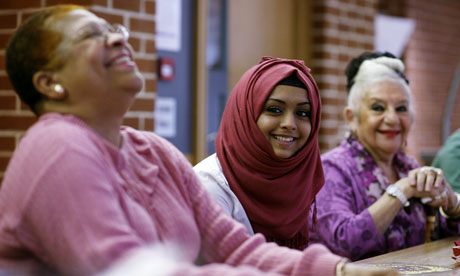
The group taking part in the Moving Lives project range in age from 14 to 80.
Photograph: Martin Godwin for the Guardian
 
'People say: 'How can you deal with teenagers?' But try dealing with women in their 70s," laughs Susan Langford. In an airy room in east London, a group of teenagers and older women are looking at piles of brightly coloured portraits in between giggling and chatting. But it's not the young girls laughing and teasing their new friends; it's the older women who are irrepressible.

Langford's charity Magic Me was set up in 1989 to break down generational barriers through creative projects. It certainly seems to work: the all-female group I meet – ranging in age from 14 to 80 – collapse with mirth when they read back the teenagers' comments about what they expected the older women to be like before they started a four-month art project together.

"Boring," one wrote. "Bad tempered" was another favourite – oh, and "snoring when they sleep". "But we do snore. I snore when I think I'm awake," points out Roberta, plaintively. "It just seems to happen lately, just all of a sudden … zzzz" – she mimes falling asleep to more gales of laughter.

Brought together once a week for The Moving Lives project, the older women from the borough of Tower Hamlets and teenagers from the local Mulberry School for Girls created an audio-video installation inspired by the collections at the nearby Women's Library, which, to their obvious pride, was then displayed there. But it's the new friendships they formed that have proved transformational.

Anisa Islam, a quiet 15-year-old, is passionate about the sessions, which she says have given her a safe place to talk about difficult emotions. "One day we had to bring something in from our rooms and I brought a poem my sister wrote when she was in hospital. She's sadly passed away now and I keep it as a memento. I told [the women] about it and it meant a lot to me that I could trust them."

Alongside the emotional support, there is much-needed practical guidance only older women can give, she says. "I am closest to Winnie [Roach]. She gives me a lot of advice – about GCSEs, telling me not to stress about it too much." Winnie, sitting next to her, nods in agreement, "They can confide in us and we will keep our mouths zipped."

And mixing with women of different ages has given the once-hesitant Anisa a newfound self-assurance, she says. "Before I was really shy and I couldn't talk up, but now I join in and am confident. I didn't think I would have anything in common with [the older women] but as soon as you get to know them you find out this isn't true."

Her headteacher, Vanessa Ogden, agrees that Magic Me, which has worked with the school on eight such projects, has had an extraordinary effect on the girls taking part. "Every year, every student blossoms in self-confidence and their ability to think about their lives. I think young girls learn an enormous amount from older women. They respect meeting women with life experiences, and begin to understand how they can shape their own lives. They regard them as role models."

The Moving Lives project is just one of a host of schemes Magic Me runs across London that bring together people of different age groups; from singing lessons for primary school students and care home residents, to cocktail nights for young adults and older people living in residential homes. Langford believes such projects are becoming essential, as the generations mix less often.

"There are not many places outside family groups where people congregate naturally and interact with one another that are truly intergenerational these days," she says. "Society is more age-divided than ever so there are few places where people have a chance to get to know each other. We miss out on variety and we are no longer used to talking to people who are different."

Such projects are especially important in Tower Hamlets, where rapid changes in the area's demographics – both in terms of age and ethnicity – has had serious consequences for community cohesion, says Langford. The borough is one of the UK's most deprived and the social makeup has been shaped by successive waves of migration; while Mulberry school has been deemed outstanding by Ofsted its makeup is reflective of the area – 95% of the pupils are from Bangladeshi backgrounds, most speak English as a second language and the proportion taking free school meals is five times higher than the national average.

"There's so much social mobility in the East End," says Langford, who was featured in Gordon Brown's book Britain's Everyday Heroes in 2007 thanks to her work with the charity. "New neighbours come in and people find it hard to get to know each other because of cultural differences; they are scared to go and knock on the door and introduce themselves, which they would have done in the past." For older people, this can lead to isolation, she adds. "If people have a bad experience with someone older or younger they get suspicious and worried. Tower Hamlets, especially, has an above-average young population and a smaller-than-average older population, so older people do feel quite outnumbered."

Social embarrassment can also stoke fear within communities, she points out. "One of the older [white] women who comes to a different project said she was in Whitechapel market when someone put their hand on her shoulder. She told me: 'A few years ago I would have jumped a mile.' But this time she didn't. She recognised that if an Asian woman had put a hand on her shoulder before the project she would have reacted differently."

Sue Mayo, the artist who leads the Magic Me groups at the library, says creating art together is important in helping the women and girls relax in each other's company and express themselves. "By 2007 we were aware that people were not mentioning the fact they came from different faith communities. So we introduced a theme, 'What is heartfelt for you', that allowed people to talk about it." And later, after the July bombings, young participants who wore headscarfs felt comfortable enough to open up about being harrassed or spat at on the street.

The women and girls of the Moving Lives project are clear that the group's diversity – the older volunteers include women with Jewish, West Indian and African origins, while some of the girls wear headscarfs, and others salwar kameezes – is a strength, because it means there are more opportunities to learn. Rachel Ogunleye, a lively 78-year-old, says she knew nothing about the second world war's effect on London before meeting Marion [Davies, one of the older volunteers], while Samira Begum, her 16-year-old friend, says she is entranced by Rachel's own tales of life as the daughter of a Nigerian chief. "It is fascinating – she was a princess!" she enthuses, before reflecting: "It's backgrounds, though, not cultural differences."

This year the group looked at the archives connected with suffragette Emily Wilding Davison, who died in 1913 after stepping in front of the king's horse at the Derby. The Moving Lives project created and displayed an interactive audio-video installation around the contents of her pockets – with some unexpected results. "When we first came to do a project here we were allowed to touch Emily's purse. Marion had never voted until that day, but after she held the purse and learnt about the suffragettes it got her thinking she should join in and she has voted ever since."

Davies, a glamorous woman with bright red lipstick, a leopardprint cane, and her white hair piled into a bun, says the benefits of schemes such as this are enormous for older and younger people alike. "I think there should be a Magic Me in every borough. When we first started, we looked at each other and thought, 'What can we possibly learn? We can't even talk to each other.'

"We were like strangers but by the end of the project we are like family. I look forward to seeing the girls and they look forward to seeing us. They have given me 20 years off my life, and they make me feel young again."

© 2011 Guardian News and Media Limited____________________________________________________________
Credit: Reports and photographs are property of owners of intellectual rights. 
Seniors World Chronicle, a not-for-profit, serves to chronicle and widen their reach.

December 17, 2011

USA: The High Cost, and High Rewards, of Longer Lives


WASHINGTON, DC / The Atlantic / Business / December 16, 2011

Red, White, and Gray: The High Cost, and High Rewards, of Longer Lives

Live long and prosper? You bet. Americans' rising longevity threatens fiscal calamity and generational warfare. But we have reason to think a grayer society is a richer society.


615_Elderly_Working2_Reuters.jpg
Reuters


PAUL STAROBIN - The writer is a contributing editor to National Journal and the author of After America: Narratives for the Next Global Age.

WEST BRIDGEWATER, Mass.--It's noontime on a Wednesday at the town dump in this small (population: 6,600), middle-class community 30 miles south of Boston. This means that Bill Weleck, a 64-year-old retired mail carrier, is due for his four-and-a-half-hour work shift. He bicycles in, as usual, and dons a town-issued, fluorescent-green vest and a pair of gloves, then starts sorting through bags of plastic bottles in search of recyclables. The air is a tad pungent, but that doesn't bother Weleck, who looks forward to the work. As he puts it, "What would I be doing at home? This gets me out into the community."

Weleck isn't working for wages. He is compensated for his time by an abatement on his property taxes worth up to $750 per year. The state's "senior property tax work-off program" is popular with fiscally strapped Massachusetts towns that can't afford to pay union-scale wages for needed work. Some 30 residents in West Bridgewater, ranging in age from their mid-60s to mid-80s, can be found not only at the dump (a much-desired worksite among the men) but also at the library, the forestry and maintenance departments, and the warrens of town hall. "The girls I have--and I call them girls--want to learn," said Karen Lavin, a Building Department supervisor for a rotating crew of seniors who greet customers at the window, answer the phones, and help to process permits. "In my opinion, they're worth every penny."

Americans, it's no secret, are living longer than ever. Life expectancy at birth, currently about 78 years, is increasing at the rate of roughly 1.5 years per decade. Baby boomers, born between 1946 and 1964, are turning 65 at the rate of 10,000 per day. The number of Americans age 65 or older, a mere 20 million in 1970, is on track to rise from about 40 million today to some 70 million by 2030. The share of seniors in the population, now about 13 percent, will reach 18 percent by 2030. The ranks of Americans who survive into their 90s are expected to soar from 1.9 million in 2010 to 9 million in 2050.

Long life may well be a blessing for the individual. But is it also a blessing for society? The fashionable answer is an increasingly anxious no. Choose your apocalyptic metaphor. The aging of America represents a "financial time bomb," The New York Times has proclaimed--with the solvency of Social Security, Medicare, and Medicaid (the last in line for nursing-home payments for patients who have depleted their assets) all at risk. Foreign Policy magazine has warned that a "gray tsunami is sweeping the planet," the United States included.

And yet the forecast that Americans' increased longevity is a collective downer for the nation ain't necessarily so. The fiscal threat, while real, provides too narrow a prism for understanding a question so complex. History suggests that the size of the total economic pie tends to grow larger as life expectancy rises. From 1950 to 2010, Americans' life expectancy at birth grew by 15 percent and, at age 65, by more than 30 percent--even as household incomes and the gross domestic product increased sixfold.

Thomas Malthus was wrong. 
Better health -- and longer living -- drives wealth 

So, as counterintuitive as this may sound, it is possible, even likely--listen up, worrywarts!--for Americans to live longer and grow richer.

Everything depends on two variables. The first is the health of older Americans, now and in decades to come. Will we have a population of bedridden elders subsisting in nursing homes as wards of the state, or will seniors be relatively able-bodied contributors to the economy, whether by working or by spending money on golf outings or gifts for the grandchildren? The difference for society is huge.

The second crucial factor is public policy. Will government take an imaginative and flexible approach to contributions that seniors can make--as exemplified by West Bridgewater's tax work-off program? Will Washington relieve the fiscal stress on entitlement programs by, perhaps, raising the age of eligibility for Social Security and Medicare commensurate with the increase in life expectancy?

Nobody can say. But experts cite grounds for optimism, especially in regard to improvements in health. Medical advances make it likelier that seniors will spend a diminishing portion of their remaining days in pricy nursing homes. "People are staying healthier longer--we're not producing a generation of really sick old people," said David Canning, a professor of population science, economics, and international health at Harvard's School of Public Health. "From the individual's point of view, this is good news. From society's perspective, this is also good news."

How rare.

"NEVER ACT YOUR AGE"


Signy Moen, vibrant and free of pain at age 106, poses no financial burden for society or for anyone else. Jason Grow
By courtesy of National Journal

The fancy term for what Canning described is "compression of morbidity" the squeezing of serious illness, of all "morbid" conditions that cause death, into as short a time as possible at life's end. Maximize the living, minimize the suffering, is one way to think about it. A personification of this principle is 106-year-old Signy Moen of West Barnstable on Cape Cod. Born in 1905, she tells of a childhood on a Norwegian farm with no electricity, of hopping on a ship to America by herself at age 18 ("I wanted to go places"), and of working as a Rosie the Riveter in a factory in Chicago making airplanes during World War II. And she recounts stories of her husband, who died in 1974"a good man; I miss him," she says, gently rocking in a parlor chair, a red blanket on her lap.

A wonderful life. But from society's point of view, maybe the most remarkable thing about it is how slight a financial burden Signy Moen represents. She lives not in a nursing home but in a house on grounds that her family owns. She doesn't take any prescription medicines--"I don't have any pains." (Her drug of choice is a nip of Baileys Irish Cream at day's end.) She fixes her own peanut butter and jelly sandwich for breakfast.

The future promises more of these healthy, vibrant centenarians, according to Thomas T. Perls, a geriatric physician at Boston University's medical school and the director of the New England Centenarian Survey, the world's largest such database (which includes Signy Moen). The number of centenarians in the U.S. grew from 2,300 in 1950 to 79,000 in 2010--and may top 600,000 by 2050. Research could spur a new wave of age-delaying drugs; scientists are experimenting on removing "senescent cells," believed to accelerate the aging process, from mice.

Already, the United States is undergoing a sort of cultural revolution on aging--60 is the new 40, and all of that. The subject has spurred a burgeoning literature, stocked with recent titles such as 100: How the Coming Age of Longevity Will Change Everything, From Careers and Relationships to Family and Faith by Sonia Arrison (really, everything?) and Susan Jacoby's Never Say Die: The Myth and Marketing of the New Old Age.

Proselytizing for the revolution are the likes of "Dr. Roger"--Roger Landry, a physician who promotes "a culture of successful aging" in rousing speeches at senior centers nationwide. "Never act your age," he told a recent gathering at the Chatham Senior Center on Cape Cod. Why? "When you buy into that, it is buying into age as decline." The good news, Landry went on, is: "Your purpose doesn't end after you retire, your kids are gone, and the dog dies. You are now at a point of being unencumbered." Check any thoughts of moving in with the obliging daughter or son: "You never want to live with your kids," Dr. Roger advised, because "they want to make your life risk-free." On the slide screen flashed a quotation from the 19th-century novelist George Eliot: 

"It's never too late to become what you might have been."

Asked afterward if he agreed with this inspirational message, 76-year-old Stu Tuchinsky shot his questioner an even look and replied, "I live it." Mary Chesnut, 77, said of Dr. Roger, "He was right on." Two years a widow, she has joined a group of "wild women" who regularly play canasta and the like. (American women at 65 are apt to live an average of about 20 more years, nearly three years longer than men of that certain age--although this gender gap is narrowing.) Opinion polls suggest that baby boomers, ages 47 to 65, are receptive to an anthem of independence. A recent survey by the Associated Press/LifeGoesStrong.com found that 73 percent of them expect to continue to work past age 65. (See sidebar, p. 8.)

AN ELDER ECONOMY

In the short run, in an economy stuck at close to 9 percent unemployment, a decision by baby boomers to keep working past 65 (or once retired, to return to the job market) may well restrict younger workers' job prospects. "In a slack job market, certainly, people postponing retirement does mean fewer job openings for prime-age and younger workers," said Monique Morrissey, an economist at the Economic Policy Institute in Washington. Moreover, the temporary "surplus of labor" partly created by the big labor pool of seniors also exerts downward pressure on wages, according to Dean Baker, codirector of the Center for Economic and Policy Research in Washington. That's especially true for jobs--in retail, say--for which a senior and a young person may compete directly.

But in a healthier economy, and presumably in the long run, the presence of more seniors in the labor force would likely be a plus: Instead of displacing younger workers (or anyone else), they would add to the total economic output. There's precedent. The entry of more women into the workforce in recent decades hasn't meant fewer jobs for men, Morrissey noted, but rather a stronger and wealthier economy overall.

The economy, like the culture, is finding some benefit in Americans' ever-longer life spans. The business of caring for the elderly has changed seismically in recent decades and now ranks among the economy's most dynamic sectors. Starting in the 1970s, "elder care" expanded beyond nursing homes to include so-called assisted-living institutions that provide services (meals, laundry) in apartment-like settings. The business of delivering health-related services to seniors at home is booming. The size of this market more than quadrupled, to $46 billion, from 1999 to 2007. Even in a sluggish economy, industry executives expect the sector to add 100,000 jobs in 2011.

Technology is driving this growth. Cutting-edge products such as "companion robots," designed to resemble dogs or baby seals, can make it easier for seniors to stay in their homes. Techno-savvy baby boomers, accustomed to using baby monitors and other gizmos in raising their children, may employ the latest devices to manage their own well-being. America's grayest places--in the 2010 census, Scottsdale, Ariz., ranked No. 1 in median age, at 45.4 years--could serve as frontiers in an elder-care economy. An aging population might act as a spur to entrepreneurs.

HIGH COST OF LONG LIVES

Even so, revolutions in technology and culture have their limits. Sadly, many seniors are cognitively impaired, no longer capable of using a cell phone or a computer, much less of reinventing themselves to become what they "might have been." Debilitating, slow-killing diseases such as Alzheimer's--which afflicts more than 5 million Americans and costs Medicare and Medicaid $130 billion annually for treatment--confine many older people to years in a helpless twilight.

In this context, the fiscal worrywarts certainly have a point. Absent changes in public policy, a financial time bomb could well explode. The most pressing concern is Medicare. Federal spending on the program grew from 1.7 percent of GDP in 1985 to 3.6 percent in 2010, totaling $520 billion for the 48 million participants. If nothing changes, the Congressional Budget Office predicts, Medicare spending will nearly double its share, approaching 7 percent of GDP, by 2035.

Social Security is in better shape, despite a published report that its trust fund is paying out more than it is taking in. The program disburses an average lifetime benefit of $300,492 to 44 million retirees and is running a $2.6 trillion surplus. But the surplus will be gone, the trustees say, by 2037. By 2050, Medicare is on track to pay 83 million retirees--nearly twice as many as now--an average lifetime benefit (in 2010 dollars) of $554,942.

These twin entitlement burdens, if left unaddressed, could provoke not only a fiscal calamity but also a political firestorm. Regressive payroll taxes, after all, finance all of Social Security and 35 percent of total spending on Medicare. (Beneficiaries' premiums account for only 12 percent of Medicare expenditures.) This wasn't a problem in 1960, when five Americans were in the workforce for each retiree. But this ratio has declined to 3-to-1 and is expected to shrink to 2-to-1 by 2030.

The political climate is ripe for generational warfare between the workers who pay for Medicare and Social Security and the elderly who benefit. Demagoguery is one result, as in Texas Gov. Rick Perry's likening of Social Security to a Ponzi scheme. (A true Ponzi scheme requires secrecy.) Cynicism is another. A Gallup Poll in 2010 found that six in 10 workers held no hope of receiving Social Security. Among Americans ages 18 to 34, the proportion of pessimists ballooned to three-fourths.

DEATH AND TAXES

Fortunately, a politics of bitterness isn't foreordained. Two main public-policy remedies could help the nation prepare for a future in which people live longer. The first: taking steps to stretch out the years of a healthy life--that is, to accelerate the compression of morbidity. America has made remarkable progress over the decades; life expectancy at birth has increased by nearly 30 percent since 1933, when it stood at 61 years. Still, considerable room for improvement remains. The onetime East Germany--yes, the former Communist state that's now part of the unified German republic--has attained a longer life expectancy at birth, of nearly 80 years, than America's 78. Among the United Nations' member countries, the U.S. ranks a middling 34th in life expectancy at birth, just above Albania. Japan is first among major nations, at over 82 years.

What to do? The government could try to improve public health by taking steps--using the tax code, for example--to alleviate conditions such as obesity, which lengthens morbidity by raising the risks of heart disease, stroke, and diabetes. Since 1980, the rate of obesity has more than doubled (to 35 percent) among Americans 20 and older and nearly tripled (to 17 percent) among children ages 2 to 19. The Center for Science in the Public Interest has proposed that the government levy a stiff tax on soda, as it does on tobacco.

Boston geriatrician Dr. Thomas Perls  goes so far as to suggest taxes on meat--yes, the T-bones and ribs that Americans savor--to curtail consumption of those cholesterol-suffused, artery-clogging instigators of heart disease and stroke. It isn't a coincidence, he said, that Seventh-day Adventists live to 88, on average, a decade longer than the populace as a whole: For more than a century, the church has defined a godly lifestyle as including a diet that favors fresh vegetables and fruits, whole-grain breads, and low-fat dairy products but avoids beef, lamb, pork, and chicken as well as coffee, tea, and alcohol.

The certainty that retiring baby boomers will add to the strains on Medicare and Medicaid may or may not nudge a financially strapped government to spend more on research to cure Alzheimer's and other lingering diseases. The National Institutes of Health devotes $469 million of its annual $31 billion budget to Alzheimer's research--a pittance, critics say, considering that annual treatment costs may reach $1 trillion by 2050. NIH's director, Francis Collins, told Congress earlier this year that the projected tab could be reduced by half if improved detection and treatment could delay the onset of Alzheimer's by five years. He noted that a massive research effort into heart disease had contributed to a 60 percent reduction in coronary-related deaths.

LESS-ENTITLED ENTITLEMENTS

Washington could also help to curb the financial dangers posed by an aging population by overhauling the entitlement programs that pay benefits to the elderly. This would entail renegotiating, in effect, the bargain between the country and its growing ranks of seniors. A big step, as suggested by Nicholas Eberstadt, a demographer at the American Enterprise Institute, would be to raise the age of eligibility in line with longer life spans.

Today, workers born before 1938 can receive full Social Security benefits at age 65; the eligibility ages rises gradually for those born later, so that workers born after 1959 must wait until they're 67--starting in 2027--for full benefits. (Any worker may take reduced benefits at age 62.) Even as Americans' life expectancy keeps rising, current law has no provision to raise the retirement age beyond 67. Third Way, a centrist Democratic think tank in Washington, has proposed gradually increasing the retirement age to keep pace with life expectancy, thereby lopping a cumulative $1 trillion from the trust fund's payments by 2040.

Similarly, postponing eligibility for Medicare could yield substantial savings--of 7 percent by 2035, according to CBO, if Americans must wait until they're 67 to receive benefits. "Raising the eligibility age to track with increased life expectancy is the best way to preserve Medicare while reducing the cost to taxpayers," said Veronique de Rugy, a senior research fellow at George Mason University's market-oriented Mercatus Center.

Another oft-proposed solution is to reduce or eliminate entitlement benefits for high-earning seniors. Such means-testing seems in line with the progressive taxation of income, a cornerstone of the federal tax code, but it would save far less than raising the eligibility age. Third Way's proposal for Social Security would save a half-trillion dollars by 2040 by phasing out benefits for seniors with individual incomes of $150,000 (for couples, $200,000), but twice as much by indexing the retirement age to life expectancy.

These prescriptions have the advantage of political plausibility. Republican presidential candidate Mitt Romney, often cautious to a fault, recently called for raising the retirement age for Social Security and the eligibility age for Medicare in step with increases in longevity. He also backed means-testing for Social Security. President Obama and House Speaker John Boehner agreed on raising the eligibility age for Medicare before their talks about a grand bargain on the federal debt fell apart last summer.

Washington could also rescind the active disincentives--punishments, really--it metes out to Americans who choose to work past 65. The seniors who sign up for West Bridgewater's program must declare the value of any property-tax abatement as income in their federal tax filings (though not their state filings). The town must also pay for participating seniors' contributions to Medicare. Mary Harrington Graf, director of elder services for the West Bridgewater Council on Aging, declared, "The big nonsupporter of this program is the federal government."

HEALTH = WEALTH

Thomas Malthus was wrong. The 18th-century British philosopher famously predicted that life on Earth was doomed because the planet's food supply grows arithmetically while its population expands exponentially. The only thing that could save humankind, he warned, was multitudes of deaths--caused by war, pestilence, or some other catastrophe. To put the Malthusian proposition in economic terms (as many economists have done), a shorter life span is a plus, allowing a nation to spread its wealth more generously among a smaller population.

Malthus failed to anticipate, however, the productivity of the Industrial Revolution or the spectacular improvements in public health (springing from the mid-19th-century discovery of germs) that would ease his grim equation. Science and machinery extracted greater crop yields from the same acreage. From 1820 to 2001, the world's population increased by nearly six times while per capita income increased ninefold. Over the same period, life expectancy in the West shot up from 36 to 79 years; in the rest of the world, from 24 to 64.

The essential lesson, for Americans and everyone else, is that improved health (for which increased life expectancy is a gauge) is itself a driver of wealth. Harvard's Canning is fond of noting that the causal arrow runs in both directions. When a society is growing in wealth, it can devote more resources to improving the health of its people. So, more wealth, better health. It is also true that when a society is healthier, its workers are likely to be more industrious and productive, creating more wealth. So, better health, more wealth.

Think of a flu epidemic threatening to wipe out a city, confining workers to bed. If a vaccine can restore everyone's health, wage earners go back to work. Wealthier societies are healthier, and healthier societies are wealthier. Evidence: The United States circa 1900, when just 4 percent of the population was 65 or older, was far poorer than today's America, with more than triple that share.

As the numbers of the aged grow, societies as diverse as China's and America's will grapple with the challenge, following starkly different cultural and political norms. A nation such as this one, that prides itself on personal reinvention, is apt to do just fine in rethinking the culture of aging. The U.S.economy, still one of the world's most flexible and innovative, is also bound to adapt.

The hardest challenge may be the political one. As the baby boom turns into an elderly boom, the federal government has no choice but to be deeply involved. Even privatized solutions to the ever-costlier federal entitlement programs, favored by conservatives who want Washington out of the way, would require landmark legislation to repeal chunks of the New Deal and the Great Society. That would take government action.

All of this suggests that the current political paralysis includes among its victims any hope of a coherent strategy for handling the demographic certainties of a graying population. Since this nation began, Americans have been living longer and enjoying greater prosperity. There is no defensible reason the 21st century should be any different.

COPYRIGHT © 2011 BY THE ATLANTIC MONTHLY GROUP.
____________________________________________________________
Credit: Reports and photographs are property of owners of intellectual rights.
Seniors World Chronicle, a not-for-profit, serves to chronicle and widen their reach.

December 1, 2011

AUSTRALIA: Old people's stories more boring. shows study

SYDNEY, NSW / Sydney Morning Herald / Life & Style / November 30, 2011


By Amy Corderoy


Impatient children have long complained about it but now it seems scientists agree: older people really do tell longer, more boring stories.

Australian researchers have found people aged over 65 seem to lack the ability of their younger counterparts to tell stories efficiently and clearly.

Their study found when younger people tell a story repeatedly, they become more efficient, cutting the number of words they use. But older people don't - and it's not because they add important details.

The author of the study, Lauren Saling, said older people were also more likely to contradict themselves.

Old man with grandson
WIND IT UP, GRANDPA: Old people used an average of 100 words to 
tell a story that younger people could tell in 70. Getty Images


''They were not keeping in mind what they had said previously ... and they didn't pick that up at all so there was no self-correction,'' she said. ''What they were actually doing was telling a story that was not coherent.''

The study of 30 healthy people aged over 65 and 30 aged between 18 and 49 found the older group used about 100 words to tell a simple story about a cowboy who had a trick played on him and this did not change after four tellings. The younger group used about 80 words, decreasing to about 70 by the fourth telling.

Only 50 per cent of the older group told the complete story, compared with 96 per cent of young adults.

''Even with repetition, these participants were not presenting the required narrative, much less an elaborated narrative,'' Dr Saling wrote in the journal Acta Psychologica.

Dr Saling, a lecturer at Charles Sturt University, said storytelling required the teller to form a mental representation of the facts of the story, as well as its overall point. ''That's where they seem to be falling down.''

If older adults were less able to tell coherent stories, they could have trouble receiving information in important situations, such as medical consultations.

Copyright © 2011 Fairfax Media
___________________________________________________________
Credit: Reports and photographs are property of owners of intellectual rights.
Seniors World Chronicle, a not-for-profit, serves to chronicle and widen their reach.