Remember ME - You Me and Dementia

Showing posts with label Turkey. Show all posts

September 13, 2011

TURKEY: 121-year-old Turkish citizen Gaışhıkaan Sıhıkaan

NEW YORK, NY / Global Action on Aging / Newsletter / September 12, 2011

The latest edition of Global Action on Aging Newsletter has published this photograph with a caption:
                                                                           
Gaışhıkaan Sıhıkaan, the oldest woman of the world got Turkish citizenship at the age of 121.

HABERMONITOR.com carried a news item on September 6, 2011 which said:

​​Sıhıkaan'a was born in 1890 in the town of Manisa Salihli and from Turkestan (also written as Turkistan), migrated to Turkey,  making a recording of the fact that birth certificate was given full citizenship after 58 years.

Her husband and children in Turkey epidemics in India lost their first country of asylum from Sıhıkaan, married since 1940 to avoid the same pain again.

Salihli district of Manisa, Turkey in 1953, settled after emigrating, since then, Sıhıkaan'a who live here alone without interruption, Salihli Social Assistance and Solidarity Foundation, provides support for 6 months Salihli Municipality and sensitive citizens living in the same street neighbor looking Arife Eken.

KIMIZLI TEA, MEAT AND SORPA

which is the main language of Kazakh Turkish-speaking Sıhıkaan, Kazakhstan immigrant himself told reporters through the sitter Arife Eken, the northern foothills of the Tien Shan Mountains Turkestan Erenkabırga in the Region In 1890 are born in, lived here until 1940, he said.

doing a marriage, 5 children, indicating that the Sıhıkaan, 1940, before his wife and children to Pakistan, if there is left to emigrate to India, the epidemic his wife and 5 children had died due to illness, said the city of Hyderabad in India.

Sıhıkaan, 13 more years left in this city, mainly inhabited by Turks in 1953, the Kazakh Salihli Liberation said the district settled.

In this age could have remained secret until the arrival of the nutrition and healthy Sıhıkaan that, throughout his life, kımızlı tea, meat, butter and boiling of meat consumed in the soup they call sorpa, he said.

Sıhıkaan, Turkey is happy but not forgotten never said that the main homeland.

Sıhıkaan'ın sitter Eken Arife the world's oldest woman''who''Sıhıkaan'ın care because they are sitting on the same street, said that 6 months he has to bear.

Sıhıkaan'ın material situation is not good, at home, which state that there are many missing Eken,''the moment when the refrigerator needs during the summer. Teyzeyle to sit on the same street foods and drinks that put their evimdeki fridge. Winter is approaching, but do not even have a stove,'' he said.

WORLD'S OLDEST WOMEN
a U.S. citizen at the age of 115 Eunice Sanborn'un January 31, 2011 ' Following the death of another U.S. citizen, born August 26, 1896 ''Besse Cooper had obtained the title of''world's oldest woman. With the acquisition of birth registration has taken the title of this 121-year-old Sıhıkaan.

NOW OLDEST WOMAN??
Gaışhıkaan Sıhıkaan, the oldest woman of the world got the Turkish citizenship at the age of 121.

She has been a widow since 1953.

Related report in netgazete


Dünyanın en yaşlı kadını sonunda vatandaş oldu
_________________________________________________________
Credit: Reports and photographs are property of owners of intellectual rights.
Seniors World Chronicle, a not-for-profit, serves to chronicle and widen their reach.

April 24, 2011

TURKEY: ‘Turkey chance for aging Europe’

.
ANKARA / Hurriyet Daily News / National / April 24, 2011

Anatolia News Agency

Photograph by Rana Mullan © UNICEF Turkey

Turkey’s young, dynamic, high-quality labor force has to ability to solve problems of the European Union as it strives to maintain its competitive power in the global economy, according to Turkey's Secretariat General for the European Union Affairs.

"The increasing number of people over the age of 65 and decreasing number of people at a working age are problems in the European Union that require urgent solutions,” the secretariat said in a statement. “According to the European Policy Center's report 'Temporary and Circular Migration: Opportunities and Challenges,' the active labor force will be down to 207 million in 2050 from today's 240 million. That number will decrease to 169 million if migration from the third countries to the EU-member states is not allowed. These figures should spur the European Union to review its migration policies," it said.

"Turkey with its young, dynamic and quality labor force has the ability to solve problems of the European Union in its efforts to maintain its competitive power in the global economy. While the European Union faces the threat of an aging and decreasing labor force, Turkey's working-age population has been increasing since 1980," it said.

"Today, Turkey's population is 74 million. People aged between 15-64 account for 65.2 percent of the total population. People aged between 0-14 account for 25.6 percent while people over the age of 65 account for 7.2 percent of Turkey's population. As Prime Minister Recep Tayyip Erdoğan and State Minister for European Union Affairs Egemen Bağış said on numerous occasions, Turkey will not be a burden to the European Union; to the contrary Turkey will ease the burden on the European Union," it said.

© 2011 Hurriyet Daily News

February 21, 2011

TURKEY: Respect and honour

.
ISTANBUL, Turkey / Today's Zaman / Columnists / February 21, 2011

By Charlotte Mcpherson


Unlike much of the West, Turkey is a culture where “old-fashioned” manners are still practiced.

For the most part, elderly people are respected. You will see younger people offering their seat on the bus to an older person. It is still common not to contradict an older person in front of others.

Perhaps you have noticed that different people will use different titles for you. It all depends on age and education. Certain names are used as signs of respect. Here are the basic ground rules: A person who is in her 20s or 30s will be addressed by children and youth by adding the title “abla” (older sister) or “ağabey” (big brother) after their name. Shop vendors and taxi drivers may also call just you “abla” or “ağabey” as a sign of respect. If you are older you will be referred to as “teyze” (aunt) or “amca” (uncle).

In Turkish culture it is rude to call a new acquaintance who you have just met by his or her first name. The polite form to use is to put “bey” (sir) or “hanım” (madam) after their first name. If you are a teacher, you will be called by your first name and then “hoca” (teacher).

The other day I was in the supermarket and the young Turkish man at the checkout counter wanted to practice his English with me. When he handed me my change he called me “lady.” Naturally this struck me as funny, but I did not laugh. I knew that he had done a literal translation and was trying to be polite. In English a simple “thank you” or “thanks, ma’am” is fine.

Throughout the Middle East and Asia you will observe how important honor is in the society. Turkish culture is strongly hierarchical. Individuals are ranked according to status.

Age is of great importance in determining status.

Sometimes this can be offensive to Westerners in their 40s and 50s who still feel like they are 21. Special respect is given to older people. By this I mean in absolute terms any individual past middle age.

Significantly older could also be determined by the age difference between you and your parents. It is true in Turkey that determining relative status by age also depends on the older person’s perception of himself as I hinted above.

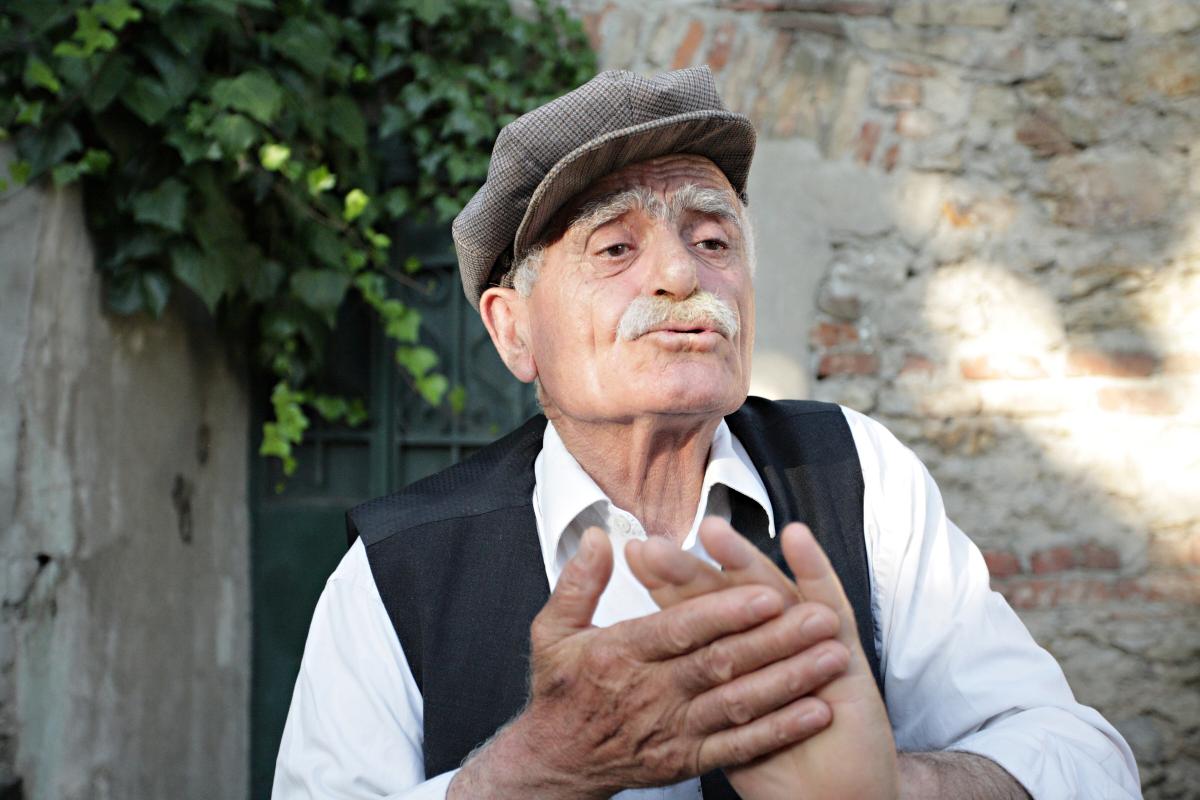
Portrait of an elderly Turkish man with hands together. © 2011 Erik Annis

The foreign guest needs to be careful to use the right title at the right time. Let me just give an example: A visitor in his 20s with all honorable intentions addressing a person in his 40s as “brother” when that man may prefer to be called “uncle” can prompt some teasing from his friends. The general rule is until the foreigner knows just how that person prefers to be treated in regard to age, he should show more honor than less. It is better to err on the conservative side.

Although some young adults may indicate that showing respect is not as important as it used to be and that it is a show, generally speaking, showing respect is still important. Other people who are normally honored are people with power based on individual reputation, family, fame, wealth and political or religious leadership.

For example, an employer is usually treated deferentially by an employee. A teacher is honored by a student. Westerners can make the mistake of being too friendly with their employees or students and lose control of boundaries and discipline, as their students or employees are not used to this type of relationship.

It is important to know how and when to honor others. A visitor, particularly from a Western background, can easily overlook or ignore the standard ways of affirming status. This may cause humiliation for the person of special status. A visitor who overlooks the deferential behavior to show respect and honor will be seen as being rude.

When refusing a request, it can be done in a manner that avoids personal offense. Westerners who are used to being more direct must learn to not give straight refusals and a frank “no.” Such direct replies cause the person who has made the request to lose face. It is best to give an answer that takes the embarrassment from the one asking and puts the blame on an outside cause. This can be hard for us Westerners who value frankness and directness.

Often Westerners interpret polite and indirect answers as being dishonest. Beware! These two points can lead to cultural clashes between Turks and Westerners.

© Feza Gazetecilik A.Ş.

September 12, 2010

TURKEY: Expanded rights for the elderly after constitutional reforms

.
ANKARA, Turkey / Hurriyet Daily News / September 12, 2010

What will the constitutional changes mean for Turkey?

The ruling party-led amendments approved by a majority vote Sunday bring a wide range of changes to the country’s Constitution, from expanded rights for women and children and the elderly.

Reuters reported that Turkish voters on Sunday approved constitutional reforms that the government says will strengthen the Muslim nation's democracy and help its candidacy for the European Union.

The amendments to the articles of the constitution that the government will now enact include:
* Article 10: Equality before the law. This would be amended to say that measures favoring children, the elderly, the disabled, widows and orphans of martyrs and veterans do not violate the principle of equality.

© Copyright 2010 Thomson Reuters

May 7, 2010

TURKEY: Caring for the Elderly in Turkey

.
ISTANBUL, Turkey / TurkeyCentral / Life & Culture / May 7, 2010

By Mehmet Birbiri

Turkish families typically take care of their elderly as respected members of the family.

Question: My turkish friend asked me where my mother was the other day and I told her she was in a nursing home. After explaining what this type of institution was, my friend was shocked that I would do that to my family. Does Turkey not have such facilities?

Answer: As you might have noticed, ties are very strong among members of Turkish families. Children, boys and girls, usually continue to live with their parents regardless of their age, until they get married. The elderly also live with one of their children. Turks show great respect to their elders. Sending an elder parent to a nursing home is not a common practice in Turkey.

Traditionally, Turks believe that treating the elderly well is a must. If we don't respect our elders and treat them well, how can we expect respect and good treatment for ourselves from our own grandchildren?

If an elder is not taken care of by his or her children, then neighbors and the community often take care of them. People over age 65 who have no income at all are paid a monthly salary by the state. They are also treated free of charge at state hospitals. Also, Turkish Airlines, the railroads and many other organizations apply reduced prices for the elderly.

On the other hand, we have nursing homes in Turkey, similar to the ones in the United States. We don't have that many and not in every city. These homes are run by the State. Some elderly people go voluntarily to these nursing homes. Most of the big cities have nursing homes as well. Those homes are run by municipalities and many volunteers work there, and companies sponsor or support those nursing homes. The poor elderly who have no income and no relatives are accepted into these nursing homes.

There is a retirement program in Turkey as well. Men used to work for 25 years and women work for 20 years before becoming eligible for retirement.

Now, according to a law passed recently, depending on the time you have worked, you must reach a certain age before becoming eligible for retirement. There are three retirement institutions in Turkey, one for government employees, one for regular workers, and one for the self-employed. Workers don't have to work all those years at the same place to become eligible for retirement. Deductions made for retirement are deposited to the Social Insurance Organization (SSK) in the workers' name.

As well as retirement, SSK is also in charge of the medical insurance of the workers. Parents and children of the workers are also eligible to be treated free of charge at those SSK hospitals. [rc]

Copyright © 2002-2010 Turkey Central

May 21, 2009

TURKEY: Five-star health hotel for elderly opens

. ANTALYA, Turkey / Hurriyet Daily News / May 21, 2009 Turkey’s first five-star hotel and health center for elderly people, supported by the Ministry of Culture and Tourism to diversify tourism, has opened in the village of Duacı, about two kilometers away from Antalya. The center, named Ayka Vital Park and owned by physical therapy and rehabilitation expert Dr. Kazım Doğan and his wife, cardiologist Dr. Aynur Doğan, cost 15 million euros to build and has a 280-bed capacity. It aims to provide five-star service to elderly people and expects to attract mostly northern Europeans. Elderly people can use the center as a rest home or spend their holiday there while receiving medical treatment. All emergency medical equipment has been concealed in the center so as not to disturb people who stay there, said Aynur Doğan, who added that the entire facility was designed with special consideration for the elderly and people with disabilities. "There are nurse call buttons in all rooms and bathrooms," she said. "Plus, our guests will be under 24-hour surveillance for their own safety and their relatives can follow patients staying in our center on the Internet." "We were planning to build a villa for ourselves," Doğan said. "But the increasing demand in the European market and the increasing number of tourists coming to Antalya pushed us to build such a center." © Copyright 2008 Hürriyet

May 17, 2009

TURKEY: Seniors learn new skills, build new friendships in home away from home

. ISTANBUL, Turkey / Sunday's Zaman / May 17, 2009 “Don't be shy, give me your hand,” said Pinocchio as his puppet-maker Ercan Ansen put his hand out for a handshake. Ansen, the 73-year-old designer of the Pinocchio puppet, hasn't been making puppets for a very long time, in fact he hasn't received any professional training either, but he spends most of his time in the woodshop, improving his skills each day. Pointing out that he can build a wooden replica of just about any toy, Ansen said that there are currently more than 30 toys in the workshop. What's unique about this woodshop, however, is that it isn't located inside an art or design school, but in an assisted living center for the elderly. The smart and happy 73-year-old explained that he first learned how to build toys and puppets after moving into the Akyurt Foundation's Assisted Living Center and Nursing Home in 2001. His collection of puppets and toys has been displayed at many social events in the community. Located on the second floor of the woodshop is a mini second-hand clothing store, which has a variety of items ranging from shoes and purses to fur coats and fancy gowns. Gönül Buhararılar, a 70-year-old former lawyer who lived in Paris for five years, helps with keeping the shop clean and organized. Buhararılar, who likes to do her hair, put makeup on, wear jewelry and look stylish, provides fashion tips to those who'd like to buy something. Holding her head up high, she provides information about the different items in the store. Her sparkling-clean room at the center is decorated with her own furnishings, making it her own unique and personalized living space. On her wall, is a portrait of herself painted by an artist in France when she was a young lady. She has a fancy bedcover over her bed, tulle decorating her mini coffee table and a crotchet tablecloth and antique knick-knacks lining her nightstand. Her positive energy is felt through the decoration in her room. She isn't shy or hesitant to make a joke or comment and has a strong relationship with other occupants. Many prefer to stay here Fikriye Arıkan is another resident at the assisted living center who is full of energy. Arıkan was born in Kastamonu, a province located in the north-central part of Turkey, and used to be a midwife. She also worked at the Ankara Municipality for 22 years. “Workers at the municipality still keep in touch with me and sometimes ask for my help. A lot of times people will know me, but I won't remember them,” she said. When asked her age, she is reluctant to tell and says with a big laugh, “All my friends here want to know my age so much. I tell them, once I get a little older, I am going to wear a huge sign with my age on it.” She lost her husband and son in two separate car accidents and her sister passed away several years ago. Although her extended family has welcomed her into their home, Arıkan prefers to stay at the assisted living center, where they visit her often. She spends a few months at her home in Ankara, a few months at the facility and a few months at her summer home in Çeşme. Asked why she comes back, Arıkan said, “I am used to this place. I have friends here,” and added with a smile, “I will go to Çeşme, swim in the sea and then come back.” Her humorous comment attracts the attention of her friends sitting on the patio. Emine Toluer, dressed in a lavender sweater and pants, jokes around with Arıkan, saying “Let's have a swimming contest between each other.” They share laughs while standing out on the patio, and Toluer starts to explain her life story. Born in Bandırma, Toluer is 85 years old and has a great singing voice. She usually sings to her friends on special evenings. Among those sitting on the comfortable seats on the patio enjoying the nice weather and the sound of chirping birds, was Suat Arbek, an 86-year-old resident, who has been living at the Akyurt Foundation center for almost three years. Eager to talk about his personal life, Arbek explains in a low voice that he was born in Thessaloniki but raised in Ankara by a strict father. He worked at Sümer Bank's Ankara branch for 30 years. His full name is Ali Suat Arbek, but he insists that he be called Suat. Asked about his family, his aged and trembling hands go to his shirt pocket to pull out an old, dark brown wallet, the edges of which have been taped and takes out a picture of his brother, noting that he is a military officer. In his rough and rasping voice, Arbek went on to share his insights on life, noting that respect and politeness were two of the most important virtues that people needed to have. With a bitter-sweet smile, Arbek mentions that he has been waiting for his daughter to visit him at the center for some time now, but went on to say he was very happy there. Care with compassion Another resident who says she enjoys being at the center is 85-year-old Mebrure Yücel, who has been there for two-and-a-half years. Sitting by herself on one of the benches in the corridor near the lobby with her arms resting over her wheeled walker, Yücel said her son lives in America and her daughter in Germany. She worked as an accountant for 30 years and has traveled to San Francisco, Houston and Las Vegas. She describes America as a nice country, but does not have plans to go again because it is too far. Noting that she usually spends time chatting and interacting with friends, Yücel said she was sitting by herself on the bench because she was resting. People living at the Akyurt Foundation assisted living center are highly valued for their qualities. “You can build very big and nice places but without love, those places don't mean anything,” said Umut Çınar, a member of the Akyurt Foundation's board of directors, adding that care and compassion are strong principles for them. Noting that the health of some of their residents has improved after moving into the facility, Çınar said the reason for this was not only linked to the medical care they received but also because of the love and friendship they developed and added that “with love, anything is possible.” Çınar has a close relationship with almost all of the residents. He has developed a strong sense of awareness about their needs and sensitivities, noting that it's important to treat them fairly and show equal attention to all of them in order to prevent jealousy. “Old people are sensitive and easily offended. For example if you take a picture of one and not the other, those who didn't have their photos taken will get jealous and hold a grudge,” he said. The moment Çınar sees one of the residents, he smiles and gives either a strong handshake or a big hug, followed by compliments, which instantly spark a smile on the elderly person's face. Improve the quality of elders’ life The Akyurt Foundation is not only a modern living facility providing high quality nursing and residential care, but a place where the elderly find opportunities to build lasting relationships and new talents. Nurten Berik, the center's full-time administrator, said their aim isn't just to provide a facility for the elderly but also to improve the quality of their life. The center spans three floors serviced by two elevators and is certified by the International Organization for Standardization (ISO). It employs 25 workers, including nurses, chefs and house cleaners and has more than 100 volunteers, including doctors and Emergency Medical Services (EMS) students. With quiet hallways, wonderful wall paintings and a home-like atmosphere, first time visitors to the Akyurt Foundation's assisted living facility might mistake it for a fine hotel. But a closer look reveals hallways lined with rails, non-slip floors, private rooms equipped with emergency call buttons and many other details designed to help elderly residents to live as safely, comfortably and independently as possible. The center can accommodate up to 85 residents. While most of the rooms are for one person only, there are five rooms with two beds. Residents can choose between private or companion room accommodation. The Akyurt Foundation was set up in Ankara's Akyurt district in 1999 by Mete Bora, the owner of one of the largest construction companies in the world, and a group of business owners. The foundation began providing assisted living services to the elderly in 2001. Copyright© Feza Newspaper Publishing Co.

March 20, 2009

TURKEY: Old Europeans spend last years of life lonely, shows Turkish film

. ISTANBUL, Turkey / Hurriyet Daily News / LifeStyle / March 20, 2009 A short film, ’Kiralık’ (For Rent) features the West's lone elderly population from the perspective of young Turkish filmmakers. The film’s director Emre Karapınar says the old spend the last years of their lives lonely in the West. As technology drives youth to be antisocial, elderly people are left to face loneliness and their own fate because of weak family relations, says a screenwriter whose short film script on the subject won a Turkish Ministry of Culture competition. Emre Karapınar, whose parents divorced when he was a child, was sent to Vienna alone for education. His biggest dream was to have a happy family, but it has never come true. He has tried to satisfy this longing with his neighbors. Marianna, his 70-year-old next-door neighbor of Serbian origin, has become like family to Karapınar.
Fotoğraflar: Sedat ÖZKÖMEÇ
Karapınar, who studied cinema at universities in Vienna and Istanbul, has observed that there are many old and lonely people living in his surroundings. The turning point for him came when he saw a newspaper story about a man whose death was recognized only seven years later.
Research in other countries
Considering his own world of loneliness, Karapınar decided to write a short film script for this story with İsmail Onay, one of his university friends. The two friends co-wrote a short script and named it "Kiralık" (For Rent). Karapınar and Onay sent this script to a competition called The Cinema of the Future, sponsored by Turkish Ministry of Culture and organized by the Turkish Foundation for Cinema and Audio-visual Culture, or TÜRSAK. The script won first place in the competition.
Karapınar and Onay not only wrote the script but they also carried out research on elderly people living in Austria, Germany, Switzerland, Turkey, Italy and Australia. Speaking to the Hürriyet Daily News & Economic Review, Karapınar said the following about his long-term work: "The old spend the last years of their lives lonely in the West. Their family ties are too weak and most of them move to a nursing home and die there.
"Europe is ’selfish,’ ’materialistic’
Karapınar said even in young families in the West, dialogue with children is based on military-like discipline and order. "Selfishness and materialism are very dense in Europe," he said. Karapınar said he was deeply shaken by a dialogue he read in a textbook while he was visiting Germany for research. "In the box, it read ’Come on children, we are going to visit your grandmother in the nursing home. Excuse us, mother, we could not have visited you for the last four years.’
" The young are also feeling deep loneliness, said Karapınar. "This is really worrisome," he said.
Karapınar said 90 percent of the elderly population is living in nursing homes and pointed out that this ratio was low in Italy and Turkey.
"Elderly people in Europe donate their pensions to nursing homes and live a very happy life under the protection of their state," he said. "In Turkey, however, the elderly who do not have the chance to live with their families struggle for life in nursing homes under bad conditions, lacking many facilities."
’For Rent’
The script is about an elderly woman who needs constant medical care. The doctor suggests that the woman move to a nursing home, but she does not want to leave her home. It has been made into a 15-minute film and describes the woman’s struggle against loneliness while trying to survive.
emrekarapinar@emrekarapinar.com
© Copyright 2008 Hürriyet

March 9, 2009

TURKEY: Dust clouds reduce visibility, cause respiratory problems for Adana seniors

. ADANA, Turkey / Hurriyet Daily News / Anatolia News Agency / March 9, 2009 Turkey's fourth largest city Adana's residents woke up to dust Monday morning. The city situated in the Mediterranean region is under a deep dust cloud and is expected to stay that way for two more days due to winds from Africa. Nomadic family near Adana sells old carpets woven by elderly women. The Regional Meteorology Department released a statement saying that the low-pressure system from Africa coupled with northern winds caused the dust clouds to descend on the city late Saturday. The meteorology department expects the clouds to endure for two more days before dissipating. The dust clouds may cause visibility to drop to 1.5 kilometers. Local officials are asking city residents to be careful when driving. "It is hard to breathe. If it would just rain the air would clear but then you get mud everywhere. It is getting worse with time. I hope we do not have worse days ahead," said one Adana resident. Health officials warned that the elderly, children and people with respiratory problems are most susceptible to the adverse affects of breathing in dust. They are urging people to stay indoors as much as possible and to keep doors and windows closed to reduce the amount of dust that makes its way inside. © Copyright 2008 Hürriyet

January 31, 2009

TURKEY: Pandora’s Box - All about their mother

. Yeşim Ustaoğlu's movie, ’Pandora’nın Kutusu’ which released this week in Turkey, tells the story of an elderly woman diagnosed with Alzheimer’s disease. It received the best film award at the prestigious San Sebastian Film Festival last year, as well garnering its French star, Tsilla Chelton, the best actress accolade for her performance in the lead role. ISTANBUL, Turkey / Hurriyet Daily News / January 31, 2009 Director Yeşim Ustaoğlu dissects middle-class sensibilities and decaying city life in her heartbreaking tale of a mother with no memory, three children on the verge of breakdowns and a confused grandson in ’Pandora’nın Kutusu’ (Pandora’s Box). Having wowed crowds and garnered awards around the world at international film festivals, director Yeşim Ustaoğlu’s latest feature "Pandora’nın Kutusu" (Pandora’s Box), has finally come home for local audiences to enjoy. For film lovers, the moment three siblings hop into one of the sisters’ middle-size car and travel to their hometown from Istanbul, it is a cinematic moment of joy and anticipation. Nesrin, Güzin and Mehmet are living, breathing characters. These are characters we have seen plenty of times in Turkish cinema, yet they are more real than most. The siblings’ meaningless banter disarms audiences instantly, leaving them wanting to know more. The movie begins with no dialogue and two seemingly unrelated characters and scenes: An elderly woman in her decrepit home in the mountains and a boy waking up to a new day on the streets of Istanbul. The boy’s clothes and the constant ringing of his mobile phone indicates he is not homeless, but waking on the streets suggests there is something more to his middle-class existence than meets the eye. Middle-class sensibilities and the constant flux of classes in big cities are at the core of Ustaoğlu’s film. Audiences are introduced to the three protagonists, siblings, and their suffocating lives before they come together with the news that their mother is missing in the mountains. Experienced actress Derya Alabora plays Nesrin, the elder sister, a control freak who has trouble ruling her marriage, her relationship with her son and her life in general. The second sister, Güzin, is a journalist who finds love and self-destruction in an affair, possibly with a married man, and is played by Övül Avkıran who won a Golden Orange award for Best Supporting Actress for her screen debut. The youngest sibling and only brother, Mehmet, played by Osman Sonant, is an anarchist and loser and one step away from becoming homeless. As the three of them journey to the green mountains near the Black Sea, the popular region of Ustaoğlu, even the dark clouds surrounding their mother’s whereabouts are not enough to suspend their resentment of one another. This is a family lost in the demands of middle-class life and the choices about where to work, where to live, and their family. After their mother is found wandering aimlessly in the mountains, the children discover they have another burden on their already tired shoulders: a mother with Alzheimer’s who needs care. French screen legend Tsilla Chelton plays the elderly mother to perfection, the broken accent of her occasional Turkish words are easily mistaken for those found in the Black Sea region, and the performance garnered her Best Actress awards at the San Sebastian and Amiens film festivals. The mother has lost any sense of the present and observes gloomy city life with alarming curiosity, staying alternately with each of her children. All of the children are going through their own life crises, and a mother who urinates on carpets and wanders out the door the moment she finds it open, does not help any of their situations. Special relationship The movie takes a surprising turn as grandson Murat, who awoke on the streets at the beginning of the movie and later moves to his uncle’s shabby apartment, and his grandmother establish a special bond that transcends shared memories, small talk and dying traditions. Murat, played with impressive subtlety by Onur Ünsal, and his grandmother create a special relationship that audiences love in movies. It reproduces special moments that are beyond words, social roles and the grind of everyday life. These two journey quietly across the distinctive areas of Istanbul and eventually travel back to the mountains, preparing audiences for some heartbreaking scenes. The film might seem less political than Ustaoğlu’s previous "Bulutları Beklerken" (Waiting for the Clouds) and "Güneşe Yolculuk" (Journey to the Sun), but in reality, "Pandora’nın Kutusu" is a finer, more subtle take on social class, migration and the scary clash between rural and urban Turkey. Ustaoğlu brilliantly portrays a decaying city, a dreary middle-class and the city’s constant traffic, with her fine attention to detail. This film is a Pandora’s box we are thankful has been opened. © Copyright 2008 Hürriyet

January 28, 2009

TURKEY: Women outlive men, recent census shows

. ISTANBUL, Turkey / Today's Zaman Daily / January 28, 2009 İSA YAZAR ANKARA Turkey’s elderly population consists mainly of women, census figures recently released by the Turkish Statistics Institute (TurkStat) have shown. There are 285,100 more females than males in Turkey, and the male population declines more rapidly with age. The number of women above the age of 90 is three times higher than that of men in the same age group. Thus, out of 60,176 people above 90, 44,446 are women and 15,730 are men. In the 85-89 age group, there are 116,145 women compared to 59,076 men. The size of the male and female populations is roughly equal until the age of 50, after which women start to gain the advantage. For instance, in the 50-54 age group, the number of men is 1,824,000 while that of women is 1,818,000. However, there are 213,000 men and 336,000 women in the 80-84 age group, which serves as proof for the widespread belief that women outlive men. Experts explain this incongruity between the lifespans of women and men by saying that men face greater risks than women. According to Health Ministry statistics, men are more susceptible to coronary diseases than women. These diseases, accounting for 43 percent of deaths, are common in men above 40, who have increased vulnerability if they smoke cigarettes and consume alcohol. It is also noted that men are subject to business-related stress and risk at greater rates than women. Yet, the birth rate for males is higher than for females. The number of males in the age group 0-4 is 3,082,000 while that of females is 2,915,000, a difference of 167,000. What should men do to live longer? * Keep their weight in a healthy range, especially after middle age; * Avoid smoking and alcohol; * Engage in hobbies to relieve business-related stress; and * Consume a healthy diet, especially when performing exhausting work. © Feza Gazetecilik A.Ş. 2007

April 7, 2008

TURKEY: Foreigners eye 5-star retirement

Some private rest homes in Turkey for the elderly resemble five-star hotels with their saunas and cinema halls. While the number of such homes has increased eight-fold within the last five years, foreign investors have begun conducting market research in Turkey

ANKARA, Turkey (Turkish Daily News), April 7, 2008:

ÖZGÜÇ KOZAN
ISTANUL - Referans

With Turkey's elderly population gradually beginning to increase, investments in luxury rest homes are becoming a profitable venture and have also attracted the attention of foreign investors.

A semi-feudal lord, or ağa, from the southeastern Anatolian region of Turkey enters, by chance, a rest home for the elderly while escaping from a hospital in Istanbul. Finding himself amid some elderly people left alone by their families, the old ağa, later goes on a journey to his hometown together with the elderly people he met at the rest home.

His aim is to show the genuine appreciation and love for the elderly to those people left to their destiny. The movie “Beyaz Melek” (White Angel), which tells the story of elderly people living in rest homes, did not bring a plethora of awards for its director Mahsun Kırmızıgül but with the box office record it broke it caused many to grasp the sensitivity of its theme.

Private rest homes provide a wide range of services from swimming pools with sauna to fitness centers, cinema halls, and even barbecue fun on weekends to the elderly.

Increasing in number daily, the number of private rest homes seems to erase the bad rest home scenes that mostly become the subject of movies and news programs. In fact, the last five years have witnessed an eight-fold increase in the number of private rest homes, which, with their saunas, cinema halls and physical therapy clinics, almost resemble five-star hotels. Competing to present the best familial comfort and warmth, these private rest homes for the elderly have also attracted the attention of foreign investors.

While investors from Australia and Germany are currently focusing on Turkey, the De Wever Foundation, providing care for about 2,000 elderly people in a total of 17 rest homes in the Netherlands has been in contact for some time with Istanbul's Darülaceze (Almshouse) Foundation to take over the management of a 300-bed rest home in Yakacık district that it established through a YTL 8 million investment.


Private rest homes shelter 5,000 old people

According to figures by Turkey's Social Services and Child Protection Agency (SHÇEK), the number of private rest homes for the elderly has reached 109 since 2002. Five years ago there were only 12. In addition to private ones, there are a total of 69 rest homes that are dependent on SHÇEK, six that belong to different ministries, 19 that belong to municipalities and seven that belong to non-Muslim communities in Turkey.

In the 69 rest homes belonging to SHÇEK, a total of 6,412 elderly people are being cared for as of September 2007. According to estimates, the number of elderly people residing in privately owned rest homes has exceeded 5,000.

Read on


© 2005 Dogan Daily News Inc.

December 13, 2007

TURKEY: Emerging-Market Billionaires Turn To Philanthropy

. ISTANBUL, Turkey / International Herald Tribune / December 13, 2007: Husnu Ozyegin has spent over $50 million of his own money building 36 primary schools and girls' dormitories in the poorest parts of Turkey. (Lynsey Addario for The New York Times)

Stuck in the snarl of a traffic jam in his bullet-proof BMW, the richest man in Turkey lets loose with a satisfied grin.

Since 2000, Husnu Ozyegin, now 63, has spent more than $50 million of his own money building 36 primary schools and girls' dormitories in the poorest parts of Turkey. Next to the Turkish government, Ozyegin is the biggest individual supporter of schools in the country - and an official from the Education Ministry has told him that his market share is increasing.

"Not bad," he says in his gruff, cigarette-scarred voice as he pockets his mobile phone. "If I can have an impact on one million Turkish people in the next 10 years, I will be happy."

The global wealth boom has created a new breed of billionaire in countries like Turkey, India, Mexico and Russia. Propelled by their surging economies, robust currencies and globally competitive companies, they have ridden a boom in local stock markets that have reached previously untouchable heights in the past five years. Now, a number of them are using their wealth to bolster their standing and push for social changes.

These entrepreneurs, who have made their billions in private-sector industries like telecommunications, petrochemicals and finance, are distinct from a past generation of international billionaires, most with ties to Middle Eastern oil or valuable land holdings. Not only have they become the richest people in their countries, but rank among the wealthiest in the world.

For these emerging economies, where loose regulation, opaque privatization processes and monopolistic business practices abound, this extraordinary and uneven creation of wealth rivals in many ways the great American fortunes made at the turn of the 20th century. While such countries have long been used to vast disparities between a tiny wealthy elite and impoverished masses, the new elites share some characteristics with their counterparts in the United States.

And just as Rockefellers, Carnegies and Morgans once used philanthropy to sooth the rough edges of their cutthroat business reputations - as have a current generation of wealthy Americans like Bill Gates of Microsoft and Sanford Weill of Citigroup - local billionaires in emerging markets are trying to do the same.

Carlos Slim, the telecommunications entrepreneur in Mexico who is worth more than $50 billion, has pledged billions to his two foundations that will target health and education. The richest man in Russia, Roman Abramovich, with a net worth of $18 billion, has channeled more than $1 billion into the poor Arctic province of Chukotka, where he also serves as governor, building schools and hospitals.

To be sure, the sums donated are relatively small in light of the pressing social needs these countries face. But as targeted, return-driven philanthropy has gained in popularity through the efforts of Gates and others, emerging-market billionaires are applying similar bottom-line lessons at home.

"What we are seeing in these countries," Jane Wales, president of the Global Philanthropy Forum, said, "are people emerging from the private sector with tremendous wealth who are attracted to highly strategic philanthropy."

In Turkey, Ozyegin, 62, with a net worth of $3.5 billion, did not secure his wealth by buying government assets on the cheap or by belonging to a rich family with control of a monopoly - two traditional routes to great wealth in the developing world.

As founder of the midtier corporate bank, Finansbank, he cashed in on a rush of interest from foreign financial institutions in Turkish banks last year and sold a controlling stake in his bank to National Bank of Greece, receiving $2.7 billion in cash.

Flush with money and ambition, he decided to do all that he could to lift Turkish educational standards at the primary school and university level.

Sitting in his personal conference room in the Finansbank headquarters, Ozyegin recalls August 18, 2006, the date that the sale of his 49 percent stake officially closed.

"I remember that day better than my birthday," he said as he leaned back in a plush leather chair. "I was not only a billionaire but the richest man in Turkey. It's a great feeling, but your responsibilities increase."

Like many self-made billionaires, Ozyegin has a direct, forceful and demanding manner and a day spent traveling with him does not yield much casual conversation.

He carries two cell phones and throughout a long day juggles calls from his wife, his assistant, his son, assorted government bureaucrats as well as the managers of his various businesses.

Ozyegin's grandparents came to the western Turkish city of Izmir from the Greek island of Crete in the late 19th century during the dying days of the Ottoman Empire. The son of a doctor, he attended Robert College, an elite high school in Istanbul, before setting off for Oregon State University in 1963 with $1,000 in his pocket.

He played basketball and led the student government, but logged mediocre grades. Harvard Business School seemed like a long shot given that he was in need of a scholarship. But on his application, he attached a picture of himself welcoming Robert F. Kennedy to Oregon State, and was accepted.

"I guess they liked me for my leadership abilities," he said.

After a successful banking career, he founded Finansbank in 1987, selling his two homes and borrowing $3 million to get the deal done.

At the outset, the bank's ambitions were small, providing corporate banking services to Turkish businesses.

The bank's fortunes fluctuated in line with the volatile economy, expanding rapidly during the heady years of strong economic growth, but facing extinction on two separate occasions, in 1994 and 2001, when the Turkish markets suffered brutal contractions.

As a businessman, his frequent interaction with Southeast Asia, China and Russia have impressed upon him the need for Turks to become more competitive in the global economy.

"The most important problem that Turkey has is education," he said.

He cites the rapid increase of applications to Harvard Business School from Chinese and Indian students. Turkey, albeit a smaller country, sends only four to eight students there a year, said Ozyegin.

"I would like to see that figure go higher."

Beyond his public school investments, Ozyegin has plans to spend as much as $1 billion over the next 15 years on a new private university, to be called Ozyegin University.

"I want to do something on a major scale," he said. "My vision is that we can train and export people like India does."

Since he started his building program in 2000, Ozyegin has completed 36 schools and girls' dormitories at a cost that varies between $400,000 and $1.8 million each. He wants to complete 100 by 2010.

He works closely with the government, with most of the building taking place in the country's poorest regions in the south and northeast.

Turkey has the lowest ratio of girls to boys in primary and secondary school of any country in the Organization for Economic Cooperation and Development, which requires its 30 members to meet minimum requirements for living standards and democratic practices. Turkey's low standing is a result of a traditional culture that, especially in poorer areas, places a higher premium on educating boys than girls.

In a country where the governing party draws its root support from an electorate that is viewed as becoming more Islamic in outlook, Ozyegin's effort to reach out to undereducated girls touches a sensitive cultural vein.

A practicing Muslim but avowedly secular in his own outlook, Ozyegin embodies the hopes as well as fears of Turkey's elites, many of them now supporters of the governing Justice and Development Party, which has led the revitalization of the Turkish economy.

Ozyegin hopes that focusing on education as an economic development tool will help transcend the bitter disputes over religious practice, including whether the increase in the number of women wearing head scarves signifies the emergence of a more Islamic Turkey.

"I want Turkey to have the same education levels as Europe 25 years from now," he said. "Whether you wear a scarf should not matter."

At a newly built primary school in a village close to the Turkish border with Armenia, 360 students shout as Ozyegin's sister and brother-in-law, who oversee the logistics of the building program, as well as his wife, stop by.

Rarely do the children here, many of whom speak Kurdish as their first language and whose parents eke out an existence as sheep and cow herders, continue on to high school.

Clothes are frayed and toes poke through the holes of plastic shoes. But with the light fading on the snowy peak of nearby Mt. Ararat, there are glimmers of hope for a better future.

Danyan Kuba, a nervous seventh grader in a coat and tie, is asked what he wants to be when he grows up. He shifts awkwardly, looks at his shoes and back up again.

"I want to be a math teacher," he answers in a strong, clear voice.

By Landon Thomas Jr.
Copyright © 2007 the International Herald Tribune