Remember ME - You Me and Dementia

Showing posts with label Memory. Show all posts

May 16, 2012

USA: Grandma still sharp as a whip

 DETROIT USA / Examiner.com /  Mental Health / May 2012

By Debbie Nicholson 

The age old belief that the brain slows as we age may just be fiction as new research shows it just may be a matter of choice.
Grandma still as sharp she just prefers to be more accurate.
 Researchers from Ohio State University demonstrate that grandma just may be as mentally agile as the younger people in the family. They may appear slow but they just prefer to think things over before deciding. When they are trained to give a response faster in some decision tasks without hindering their accuracy.
The researchers have been studying cognitive processes and aging for almost ten years and have extended this researcher to children.
Dr. Gail McKoon, professor of psychology at the university and co-author of study noted results in children are what most scientists expect, young children have slower response times and less accuracy in comparison to adults. Those slow response times in children are signs that the brain is still growing. That slow thinking in seniors could just be due to the fact seniors prefer accuracy over speed.
Researchers conducted several experiments designed to rate mental ability and agility for all ages. One experiment consisted of 300 volunteers that watched a computer screen where asterisks would flash up on the screen. The amount of asterisks ranged from 31 to 70. Volunteers had been instructed to without hesitation to decide whether they had been shown a small amount (31 to 50) or a large amount (51 to 70) of the star shaped symbol by pressing one of two keys dependent on their answer.
Another experiment on the computer screen consisted of a string of letters. Volunteers had to decide if the words appeared in English or not. There was a mix with some words easy and some harder.
For the child development study the asterisk test had been used on students from second grade to college level. Third graders and college students had participated in the word test.
Research had shown there was an increase in accuracy and decrease in response time on both experiments from the second and third graders to college age.
Dr. Roger Ratcliff, professor of psychology and co-author of study explained that younger children are not able to make good use of the information they are presented so they are less accurate. Older adults have a different pattern.
The journal of Cognitive Psychology published a study by Dr. Ratcliff and associates. In the study researchers compared participants of college age and older adults aged 60 to 74 and 75 to 90. The same experiments had been used. Researchers found little difference in accuracy among the groups including the oldest of the groups.
Dr. McKoon stated “For these simple tasks, decision-making speed and accuracy is intact, even up to 85 and 90 years old.”
According to Dr. Ratcliff all cognitive processes decline at the same rate as people age. But keep in mind that does not mean that there are no affects on aging, decision making and accuracy.
Dr. Ratcliff notes that research is finding that there is no such thing as uniform decline. Seniors can do some things just as well as the younger generation. They just do not want to make mistakes so they choose a more conservative decision standard which slows them down.
What can help cognitive decline? In a word yoga. Studies have shown that yoga meditation improves cognitive functions in adults that experience cognitive decline.
Research as far back as 2005, from a study conducted by Harvard, MIT and Massachusetts General had used brain MRI's to compare those who regularly practiced yoga and those who did not use yoga. The study had revealed that those who meditated had a constantly thicker right insula in comparison to those who did not use yoga mediation. And those who meditated also the thickness of the Brodmann 9 and 10 areas of the brain (located in the frontal cortex) did not decrease with age.
For clarity the right insula is involved in brain functions such as body awareness, laughter, tears, language, heart rate, empathy, compassion, speech and social emotions. The Brodmann 9 and 10 regulates emotion and cognition.
Basically all this translates to is it seems that yoga mediation not only strengthens the brain but keeps it from degeneration.
There are many yoga practices so it is important to find the right one you like and fits any physical restrictions you may have.

 ©2006-2012 Clarity Digital Group LLC 

________________________________________________________
Credit: Reports and photographs are property of owners of intellectual rights.
Seniors World Chronicle, a not-for-profit, serves to chronicle and widen their reach.

April 19, 2012

USA: Active Aging fair provides seniors with plenty of healthy information

DECATUR, Illinois / Herald-Review.com / Life/ April 18, 2012

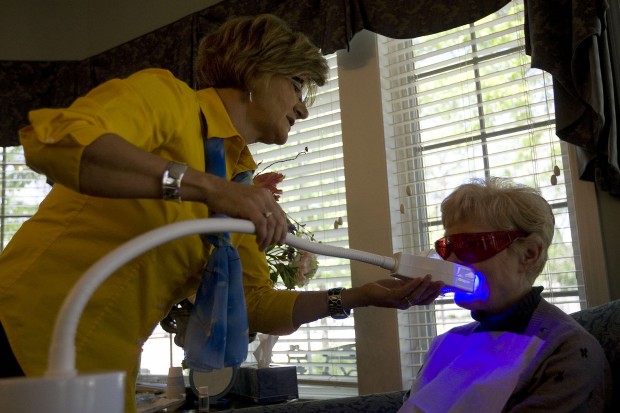
Office manager Ann Rohde of Renew Total Body Wellness Center aligns a teeth whitening device to Maxine Koenig at the business’s table during the Active Aging Fair in the Imboden Creek Gardens assisted living facility


By ALLISON COPENBARGER - H&R Staff Writer


Barbara Young, 79, of Decatur closed her eyes and tried to recall a good memory, a time when she felt relaxed and accomplished.
She took a deep breath and tried to conjure up the sights, smells and emotions of the memory so she could recreate that good feeling.
She was participating in a hypnotic exercise instructed by Julie Lauper-Cook of Bright Skies Hypnotherapy at the first Active Aging Fair held at Imboden Creek Gardens on Tuesday. The fair, free and open to the public, included several services and presentations for elderly health.
Young said she has suffered from depression since she was in her 20s and wandered into the hypnotherapy presentation, intrigued by the alternative approach.
“I think it’s important to come to events like this to keep up to date,” she said.
The hypnotherapy exercises all aimed to connect the mind to the body and to replace negative experiences with positive emotions. The 30-minute presentation was intended to alleviate chronic physical or emotional pain through mind exercises.
“Hypnotherapy is not a mystery, it’s just relaxing.” Lauper-Cook said. “It’s not meant to replace a doctor’s opinion, but to supplement it.”
There were also other presentations on zumba, holistic health, estate planning and prescription medication. Vendors were available to give free massages, blood pressure tests and other services.
Jennifer Born, Imboden Creek Gardens director, said they had the vision to do something different from other health fairs, something more active.
“It’s too early to say if we’ll do it every year, but I think even if we only touch one person it will be a success in my book. It has brought people into our facility, and we’ve made community connections.”

© Copyright 2012, Herald-Review.com
________________________________________________________
Credit: Reports and photographs are property of owners of intellectual rights. 
Seniors World Chronicle, a not-for-profit, serves to chronicle and widen their reach.
April 3, 2012

USA: Forgetfulness — 7 types of normal memory problems

BOSTON, Massachusetts / Harvard Medical School / April 3, 2012

HEALTHbeat Extra

How much forgetfulness is too much?

It’s normal to forget things from time to time, and it’s normal to become somewhat more forgetful as you age. But how much forgetfulness is too much? How can you tell whether your memory lapses are within the scope of normal aging or are a symptom of something more serious?

Healthy people can experience memory loss or memory distortion at any age. Some of these memory flaws become more pronounced with age, but — unless they are extreme and persistent — they are not considered indicators of Alzheimer’s or other memory-impairing illnesses.

Seven normal memory problems

1. Transience
This is the tendency to forget facts or events over time. You are most likely to forget information soon after you learn it. However, memory has a use-it-or-lose-it quality: memories that are called up and used frequently are least likely to be forgotten. Although transience might seem like a sign of memory weakness, brain scientists regard it as beneficial because it clears the brain of unused memories, making way for newer, more useful ones.

2. Absentmindedness
This type of forgetting occurs when you don’t pay close enough attention. You forget where you just put your pen because you didn’t focus on where you put it in the first place. You were thinking of something else (or, perhaps, nothing in particular), so your brain didn’t encode the information securely. Absentmindedness also involves forgetting to do something at a prescribed time, like taking your medicine or keeping an appointment.

3. Blocking
Someone asks you a question and the answer is right on the tip of your tongue — you know that you know it, but you just can’t think of it. This is perhaps the most familiar example of blocking, the temporary inability to retrieve a memory. In many cases, the barrier is a memory similar to the one you’re looking for, and you retrieve the wrong one. This competing memory is so intrusive that you can’t think of the memory you want.

Scientists think that memory blocks become more common with age and that they account for the trouble older people have remembering other people’s names. Research shows that people are able to retrieve about half of the blocked memories within just a minute.

4. Misattribution
Misattribution occurs when you remember something accurately in part, but misattribute some detail, like the time, place, or person involved. Another kind of misattribution occurs when you believe a thought you had was totally original when, in fact, it came from something you had previously read or heard but had forgotten about. This sort of misattribution explains cases of unintentional plagiarism, in which a writer passes off some information as original when he or she actually read it somewhere before.

As with several other kinds of memory lapses, misattribution becomes more common with age. As you age, you absorb fewer details when acquiring information because you have somewhat more trouble concentrating and processing information rapidly. And as you grow older, your memories grow older as well. And old memories are especially prone to misattribution.

5. Suggestibility
Suggestibility is the vulnerability of your memory to the power of suggestion — information that you learn about an occurrence after the fact becomes incorporated into your memory of the incident, even though you did not experience these details. Although little is known about exactly how suggestibility works in the brain, the suggestion fools your mind into thinking it’s a real memory.

6. Bias
Even the sharpest memory isn’t a flawless snapshot of reality. In your memory, your perceptions are filtered by your personal biases — experiences, beliefs, prior knowledge, and even your mood at the moment. Your biases affect your perceptions and experiences when they’re being encoded in your brain. And when you retrieve a memory, your mood and other biases at that moment can influence what information you actually recall.

Although everyone’s attitudes and preconceived notions bias their memories, there’s been virtually no research on the brain mechanisms behind memory bias or whether it becomes more common with age.

7. Persistence
Most people worry about forgetting things. But in some cases people are tormented by memories they wish they could forget, but can’t. The persistence of memories of traumatic events, negative feelings, and ongoing fears is another form of memory problem. Some of these memories accurately reflect horrifying events, while others may be negative distortions of reality.

People suffering from depression are particularly prone to having persistent, disturbing memories. So are people with post-traumatic stress disorder (PTSD). PTSD can result from many different forms of traumatic exposure — for example, sexual abuse or wartime experiences. Flashbacks, which are persistent, intrusive memories of the traumatic event, are a core feature of PTSD.

© 2000-2012 Harvard University
____________________________________________________________
Credit: Reports and photographs are property of owners of intellectual rights. 
Seniors World Chronicle, a not-for-profit, serves to chronicle and widen their reach.