Remember ME - You Me and Dementia

Showing posts with label Government. Show all posts

June 21, 2015

Old and vulnerable: Senior citizens await national policy to safeguard rights: Pakistan

PAKISTAN News


ISLAMABAD: Pakistan lacks a national policy and legislation to safeguard the fundamental rights of around 12 million senior citizens.
Though a national policy has been finalised, it remains pending with the Capital Administration and Development Division for the last one year. Only the K-P government has approved Senior Citizen Act 2014. The Punjab government has finalised the bill but its cabinet has stalled progress while the Sindh government has presented it in its assembly.
On the World Elder Abuse awareness day, Waqas Qureshi, advocacy and communication coordinator at Help Age International, said the policy was drafted with a two-year delay.
Talking to The Express Tribune, he said it was still waiting to be presented before the National Assembly for a year. He believed that the major reason behind the delay was the government’s attitude as the issue was not on its priority list.
“They do not have dedicated health care centres or proper public transport facilities. They do not even shelter homes where they can live in respect and dignity after being deserted by family members. We can see many senior persons begging on the road as they do not have any source of income,” he said.
According to UNFPA and HelpAge International report, there are 11.6 million people over 60 in Pakistan. This figure will rise to 43.3 million by 2050, making it 15.8% of the total population.
Published in The Express Tribune, June 21st, 2015.


_______________________________________________________
Credit: Reports and photographs are property of owners of intellectual rights. Seniors World Chronicle, a not-for-profit, serves to chronicle and widen their reach.

June 7, 2013

Good intent, lackadaisical implementation

MUMBAI ,INDIA / ONE INDIA ONE PEOPLE  / SOCIAL SECURITY / JUNE 1st 2013


Indira Gandhi National Old Age Pension Scheme in India (IGNOAPS), a scheme aimed at providing financial security to the destitute aged living below poverty line fails to achieve its goal because of lackadaisical implemenation, writes Dr. Nidhi Mishra

Old age brings with it lot of challenges, a major one is that of financial insecurity. Financial security of elderly in general and particularly of those belonging to BPL category has been a matter of concern, and due to increase in longevity, old age health care expenses, increasing cost of living, the problem has only compounded. Due to lower or negligible family income and rise in the cost of living, the poor often find it difficult to depend on their family for financial support, and thus the role of government becomes important in providing financial security to the destitute aged in our country.
 
Overview of Indira Gandhi National Old Age Pension Scheme (IGNOAPS)

Realising the pressing need to provide financial security to the destitute elderly, the IGNOAPSGovernment of India (GOI) launched the National Old Age Pension Scheme (NOAPS) under the National Social Assistance Programme (NSAP) of the Ministry of Rural Development, on 15 August 1995. Like other schemes of NSAP, this scheme is in line with Article 41 of the Constitution of India which directs the State to provide “public assistance to its citizens in case of unemployment, old age, sickness and disablement and in other cases of undeserved want within the limits of its economic capacity and development.”

On 19 November 2007, NOAPS was renamed as Indira Gandhi National Old Age Pension Scheme (IGNOAPS) and to widen its scope it has been extended to the elderly who fall Below Poverty Line (BPL). Initially under this scheme, all destitute elderly aged 65 years or above were provided a pension amount of `75 per month. Subsequently, with effect from 1 April 2006, the pension amount was increased to `200 per month per person in order to make this scheme more effective and the state governments were requested by central government to contribute a matching amount for each beneficiary of this scheme. It has been noted that not all states are contributing an equal amount of `200 per person per month to the pension.

To further improve the effectiveness of this scheme, with effect from 1 April 2011, the eligibility age for this scheme has been reduced from 65 to 60 years and the amount of pension has been raised from `200 to `500 per month for those who are 80 years or above.

The other two schemes under NSAP– Annapurna Scheme and Indira Gandhi National Widow Pension Scheme (IGNWPS) are linked to IGNOAPS in a way that under Annapurna Scheme ten kilograms of food grains are provided free of cost to those BPL elderly who though eligible, have not been covered under the IGNOAPS. And under IGNWPS, once the BPL widows reach the age of 60 years they are transferred to IGNOAPS.

The Annual Report (2012-13) of the Ministry of Rural Development, GOI, highlights coverage of 223.18 lakh BPL elderly all over India, where the highest number of beneficiaries were reported in Bihar (37.87 lakh), followed by Uttar Pradesh (37.67 lakh) and Odisha (17.77 lakh). The total expenditure reported under NSAP for the year 2012-2013 is `4855.77 crore, although a total of `8447.30 crore was allocated for it. IGNOAPS is a part of NSAP and is allotted a major portion of the funds, however, the exact breakup of scheme wise budget allocation under NSAP is not available in the annual report or on the website of Ministry of Rural Development. 

Benefits

The IGNOAPS is praiseworthy, as this is the first ever national level scheme which provides economic security to the poor elderly and widows who would have either been dependent on their family’s limited income or would have been forced to lead a neglected life. This aspect has also been highlighted in one of the participatory study conducted in Madhya Pradesh and Uttar Pradesh by the NGO HelpAge India in 2008, where responses of participants indicated that IGNOAPS plays a very important role in poverty reduction. 

Limitations

Over the years, government bodies and social scientists have highlighted some limitations of this scheme mainly in terms of its improper implementation. A research paper jointly published by four professors from Harvard School of Public Health in 2010 highlighted weak targeting of beneficiaries which is generally based on combination of a survey based definition of poverty and community identification of the poor as a major problem related to implementation of this scheme.

In a survey conducted by United Nations Population Fund (UNFPA) India in 2012, covering a total of 9,852 elderly in the seven states of India which have higher proportion of elderly viz. Himachal Pradesh, Kerala, Maharashtra, Orissa, Punjab, Tamil Nadu and West Bengal, the problem of wrong targeting was observed. While investigating the utilisation of IGNOAPS, it was found that some non-BPL elderly were also availing the scheme. It was also observed that there was low awareness of this scheme among the beneficiaries, thus raising the need for effective steps to be taken by the government to promote the scheme.
Another targeting issue identified in assessments of this scheme is the difficulty of determining the age of a person, particularly in rural areas. Along with this some researchers (Anand and Kumar, 2006) have also highlighted that while from a macro perspective IGNOAPS seems to be working well, and meeting its many objectives, a micro analysis shows that there are gaps in areas like distribution and the identification of beneficiaries.

In an assessment report of Ministry of Rural Development (2006) it was found that the IGNOAPS is lacking on two grounds which cut across states: (i) it involves complex administrative procedures and, therefore, proves especially difficult for the illiterates, and (ii) the size of programme beneficiaries is capped artificially by using an arbitrary ceiling formula. 

Conclusion and recommendation

It is clear that IGNOAPS is a useful scheme for elderly below poverty line, however, it is facing problems of improper implementation such as wrong targeting, limited coverage and irregular payment of pension which needs to be strongly dealt by the government through improvement of coordination between its various bodies. Also through an effective monitoring and evaluation mechanism the problem of wrong targeting and irregular payments can be controlled by the government. Along with this proper need assessment should be done by the government for effective coverage of the scheme. Additionally, the government should publicise the scheme especially in rural areas and slums for creating awareness amongst potential beneficiaries. Civil society can also play an important role by conducting training programmes for the targeted beneficiaries.


Dr. Nidhi Mishra ,The writer is working at Tata Institute of Social Sciences for the United Nations Population Fund (UNFPA) Ageing project in India.

©One India One People Foundation 2013.
_______________________________________________________________
Credit: Reports and photographs are property of owners of intellectual rights.
Seniors World Chronicle, a not-for-profit, serves to chronicle and widen their reach.

April 15, 2013

Senior Citizens to Impact 250 Loksabha Seats in coming Election


MUMBAI , INDIA / POLITICS / APRIL 15th , 2013 

By Sailesh Mishra

Indian Politics ‘Newest’ Vote Bank: Senior Citizens to Impact on 250 Loksabha Seats in coming Election


Taking a cue from recent study “Social Media & Lok Sabha Elections”, by IRIS Knowledge Foundation and supported by the Internet and Mobile Association of India (IAMAI), on how Facebook and other social media will impact 160 seats in coming Election, what immediately came to my mind was Elder Population impact on Indian Democracy. I have been trying to market this idea since launch of Silver Innings in April 2008. 

As on 2012 Senior Citizens Population in India is 100 million (10 crore) that comes to roughly 10% of Total Population.  But when we take into account the Total Voting Population i.e. 18+ age group, then Senior Citizens becomes roughly 26% of Voting Population, here I have not taken into account Senior’s influence on Family voting. 

Indian Parliament has 543 constituencies / seats and this 26% strong Vote Bank of Senior Citizens will surely impact more then 250 constituencies. This ‘new’ Senior Citizens Vote bank always existed but no one including elders ever realised their strength . This time 2013/14 Parliamentary and State Election will be change in new thought process towards our elders , they deserved to be respected and cared for as our great tradition need to travel in this new speed changing society . 

I would be happy if any research agency or students take up this interesting subject of ‘Senior Citizens Voting Impact on Indian Politics‘. 

In recent times, since last 3 years there has been contestant activity by most of the political parties to woo Senior Citizens by organising onetime events, trips, goodies etc , but they have failed to make a concrete Long Term Policy & Programme for doubling Ageing population . Government , Politicians and Political parties are Ageing but they don’t bother about Ageing population , which many demographer describe as ‘ Silver Tsunami ‘ , which will have huge economic and social impact on India’s growth . Not to forget the same story will repeat in most of the developing countries. 

Due to advocacy and awareness campaign like ‘ 16th August National Protest Day’  by organization’s like AISCCON, Silver Inning Foundation and a united front called Join Action Committee (JAC) since 16th August 2010 , of more than 32 All India organisation’s working for and with Senior Citizens and newly formed  Pension Parisad ; there has been marked improvement in channelizing & mobilising Senior Citizens as united group demanding basic rights from central and state governments . Senior Citizens pan India, has been slowly realizing their strength and can’t be fooled any more by this goodies of politicians.

Social Media including Facebook and Twitter, has added new type of activism and in fact renewed the whole advocacy movement, Silver Innings a pioneer in social media usage for ageing and many youth and elders have taken this technology route for outreach and mobilising elders and their family.

Iam happy that , Elders like always will give shape to our Future , whatever they demand today will be for betterment of more then 85% of total population. This strengthen my firm view that ‘Our Elders Are Change maker’s ‘, the change we all want to see.


About Author: 
Sailesh Mishra is Founder President of 'Silver Innings' a socail enterprise and Silver Inning Foundation, a NGO working with Senior Citizens and has more then 6 years hard core activist experience in Ageing domain . His unique PR and ICT tool usage for Ageing has made him Internationally known Gerontology Consultant.  He may be contacted at silverinnings@gmail.com


________________________________________________________
Credit: Reports and photographs are property of owners of intellectual rights.
Seniors World Chronicle, a not-for-profit, serves to chronicle and widen their reach.

November 3, 2012

INDIA : 'National Conference on Ageing' 6th ,7th Nov 2012

NEW DELHI , INDIA / BUSINESS STANDARD / EVENT / OCT 26,2012

By Press Trust of India

Aiming to empower senior citizens and take stock of the social, financial and health issues faced by them, Social Justice and Empowerment Ministry (MSJE) will hold a two-day ageing conference here next month. 


The 'National Conference on Ageing' will bring together representatives of all state governments, key union ministries, organisations working in this sector and several imminent citizens to dwell upon the issues faced by senior citizens, a senior official from SJ&E Ministry said.

"The conference has been divided into four themes concerning older persons.The sessions will be chaired by senior officials from several ministries and organisations to shed light on the programs conducted by them for senior citizens and its response," he said.


The themes decided for the conference- planned for the first week of November- are Social and Economic Security of Older Persons, Health care, Family and Community Care, and focus on Special Elderly Groups consisting of senior citizens above 80 years. 

"Senior officials from ministries such as Home Affairs, Labour and Employment, Finance, Health and Rural Development, Planning Commission have been invited for conducting fruitful discussions over the policies concerning older persons," the official said. 

For holding discussions on pension and insurance schemes for senior citizens, SJ&E Ministry has invited representatives from pension and insurance regulatory authorities. 

NGO's dealings with United Nation's mandate for senior citizens have also been invited for the conference. 
 
"We have sent a special invitation to the Delhi Police to discuss physical security of these vulnerable people," he said. 

Several groups and sub-groups will be formed to conduct in-depth discussions and analyse the issues covered in the four original themes. 

"These group and sub-groups will present their recommendations and findings on the second day of the conference," the official said. 

During the course of discussion, the conference will also review various aspects related to senior citizens (Maintenance, Protection and Welfare) Act in various states and ways to ensure that it is implemented effectively. 

"Several states have yet not followed all the provisions of this act even after repeated reminders from the SJ&E Ministry.The Ministry will once again request these states to ensure its through implementation," he said. 

The Conference will be inaugurated by Social Justice and Empowerment Minister (MOSJE)  Mukul Wasnik who will also chair the final round of discussion on the second day.
 
Business Standard Copyright © 2012

________________________________________________________ 
Credit: Reports and photographs are property of owners of intellectual rights. 
Seniors World Chronicle, a not-for-profit, serves to chronicle and widen their reach.

April 27, 2012

MALAYSIA: 'Home Help Services' Shows Govt Cares for Seniors

KUALA LUMPUR, Malaysia  / The Borneo Post / Nation / April 27, 2012

The ‘Home Help Services’ implemented by the Women, Family and Community Development Ministry recently proves that the government cares about the welfare of senior citizens.

Deputy Minister Datuk Heng Seai Kei said the service focused on senior citizens who were poor and staying alone, or with family but in need of assistance.

“Volunteer workers will attend a course to provide them knowledge, skill and understanding in various aspects,” she said in response to a question from Senator Norliza Abdul Rahim.

Heng said after completing the course, participants would be made volunteer workers and would visit old folks homes to do the daily routine, like cleaning the place, keeping the inmates company, doing shopping, paying the bills and providing health care for the inmates there. 


Bernama
Copyright 2010-2011 BorneoPost Online
____________________________________________________________
Credit: Reports and photographs are property of owners of intellectual rights. 
Seniors World Chronicle, a not-for-profit, serves to chronicle and widen their reach.
April 4, 2012

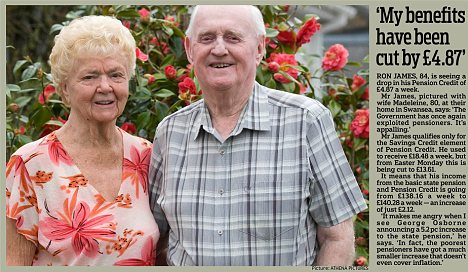
UK: Two million pensioners face cuts to vital benefits

LONDON, England / The Daily Mail / Money / April 3, 2012

Why did we spend our lives saving?


By Lauren Thompson


Almost two million pensioners are facing a cruel trap that threatens to deprive them of the biggest ever rise in the state pension and vital .elderly benefits.

Savage cuts to Pension Credit for pensioners who saved for their retirement have all but wiped out what Chancellor George Osborne boasted was the ‘largest-ever cash increase’ in the state pension, which takes effect this week.

And the cuts risk barring hundreds of thousands of pensioners from vital discounts, council tax and housing benefit, cold weather payments, and help with heating costs from energy suppliers.


The change has come as a shock to many pensioners who received the news in letters from the Department for Work and Pensions revealing their state pension for the new tax year.

It comes just a fortnight after the Chancellor announced changes to pensioners’ tax allowances — the so-called ‘granny tax’ — which could leave pensioners on incomes of little more than £11,000 a year £323 worse off.

Michelle Mitchell, director-general of charity Age UK, says: ‘It is unfair that older people on low incomes are having their benefits reduced. 

‘The Treasury is giving with one hand and then immediately taking with the other.’


Associated Newspapers Ltd
____________________________________________________________ 
Credit: Reports and photographs are property of owners of intellectual rights.
Seniors World Chronicle, a not-for-profit, serves to chronicle and widen their reach.

March 25, 2012

SRI LANKA: Central Bank defines senior citizens at 55 years

COLOMBO, Sri Lanka / The Sunday Times / Business Times / March 25, 2012


The Central Bank (CB) has directed commercial and specialised banks that senior citizens should be considered as those who are 55 years and above, after most institutions used 60 years as the threshold age.

In a March 19 directive to these institutions, the CB said that, “The Monetary Board having observed that licensed banks and licensed finance companies use different thresholds of age to identify senior citizens when conducting banking operations has decided to request licensed banks to use the common threshold of 55 years of age in identifying senior citizens.”

Copyright 1996 - 2012 | Wijeya Newspapers Ltd
___________________________________________________
Credit: Reports and photographs are property of owners of intellectual rights. 
Seniors World Chronicle, a not-for-profit, serves to chronicle and widen their reach.

March 20, 2012

NIGERIA: Fayemi signs Social Security Bill into law

ADO AKITI, Nigeria / The Nation / News / March 20, 2012

Ekiti State Governor Kayode Fayemi at the weekend signed the Social Security Bill into Law.
He said the law was borne out of his administration's concern for the welfare of the elderly. 


Fayemi said the social security scheme, which offers indigent elderly citizens a monthly stipend of N5,000, is not a vote-catching gimmick as is being insinuated in some quarters. 

He spoke on Friday at the Executive Council Chambers of the Governor's Office in Ado-Ekiti, the state capital, while signing the law. The governor said it was important for the scheme, which started six months ago, to have a legal backing, in order to ensure its sustainability.

The Ekiti Social Security Scheme, which is the first in Nigeria and West Africa, was announced by the governor on October 1, 2011. Payment of the monthly stipend commenced on October 25.

Fayemi said: "When we initiated the scheme, sceptics thought it was a vote-catching gimmick of a typical opportunistic and desperate politician. "Even to genuine admirers, the realisation of this dream was unfathomable, given the limited resources available in our state. Now that the goal is realised, it is the beginning of the fulfillment of our campaign promise to provide for our elderly.

He said: "It is noteworthy that a number of states, as well as the Federal Government, have shown interest in this scheme and we are glad to have pioneered it. The question my colleagues always ask at the Governors' Forum is how we manage to do all this, given our 35th position on the revenue table."

House of Assembly Speaker Adewale Omirin said: "We are here today making history as the first state in West Africa to initiate a social security system for the aged. We know the critical roles senior citizens play in our lives and the society at large.

"We must always emphasise custom and history as components of social engineering mechanism for development. It is our custom to take care of our aged."

Omirin said the scheme has challenged the Federal Government to start the process of establishing a national social security scheme.

Commissioner for Labour, Productivity and Human Capital Development, Wole Adewumi said the state began paying stipends to 10,084 beneficiaries last October. He said another round of registration has begun to update the database and increase the number of beneficiaries to 20,000.


Source: The Nation, Lagos
____________________________________________________________
Credit: Reports and photographs are property of owners of intellectual rights. 
Seniors World Chronicle, a not-for-profit, serves to chronicle and widen their reach.


March 5, 2012

CANADA: Saskatchewan looking for answers after seniors’ sudden eviction

TORONTO, Ontario / The Globe and Mail / National / News / March 5, 2012

Saskatchewan Health Minister apologizes after seniors home eviction

Jennifer Graham
Regina— The Canadian Press


Health Minister Don McMorris is apologizing to 10 residents who were evicted from a Saskatchewan seniors home. The residents were in a form of assisted living at St. Mary's Villa in Humboldt when they were given less than a week to move out.

Saskatchawan Health Minister Don McMorris Paul Daly - Saskatchawan Health Minister Don McMorris | Paul DalyMr. McMorris said that's not what should have happened in a patient-centred health-care system. “There are seniors that went through some pretty trying times probably through that weekend and even issues through the move that just are not satisfactory,” Mr. McMorris said Monday in the legislature. “I apologize because no one should have to go through that. We should have handled that better.”
St. Mary's Villa moved the seniors to make space for 32 other patients, with higher medical needs, who lived in part of the facility where structural problems were found. A draft engineering report said the flooring on their unit is deteriorating.
The Saskatoon Health Region has said there are no imminent safety risks, but it also said the 32 patients needed to be relocated by the end of March to ensure their continued well-being. The health region helped move the 10 seniors, most of them to a private seniors housing complex. Family members complained that the situation was stressful for the seniors who thought they'd made their final move. The families said their loved ones were getting the “bum's rush to the door.”
Some families also raised concerns that many of the residents were moved to a complex that costs more than twice as much as the villa. They said that cost would probably be impossible for most of the residents who rely solely on their pensions.
Mr. McMorris said asking seniors to turn over their lives on such short notice is not appropriate. “What they needed really ... was more time to adjust or more support through that, if it was a week, through that week period, more support to answer the questions that they had,” he said. “I don't think that was necessarily the case. They were searching for answers (and) didn't have the support to get those answers.”
Mr. McMorris hopes the province's ombudsman will provide the answers. Kevin Fenwick has been asked to investigate and to make recommendations so nothing similar happens again.
“We felt that it was appropriate that we would call in the ombudsman to have a greater look at this and see where the mistakes were made, because obviously there have been mistakes, definitely on the communications side for sure.”
© Copyright 2012 The Globe and Mail Inc
____________________________________________________________
Credit: Reports and photographs are property of owners of intellectual rights.
Seniors World Chronicle, a not-for-profit, serves to chronicle and widen their reach.

CHINA: China to further reform medical, health care services

BEIJING, China / China.org.cn / Xinhua / March 5, 2012

China will further reform its medical and health care services in 2012 to better people's well-being, Premier Wen Jiabao said in his government work report delivered at the annual parliamentary session Monday. [Highlights of government work report]
Premier Wen Jiabao delivers a report on the
work of the government at the opening meeting.
[Photo/Xinhua]
"We will move faster to improve the medical insurance system covering the whole population, consolidate and expand the coverage of basic medical insurance, and enhance our capability to provide and manage basic medical services," Wen told the Fifth Session of the 11th National People's Congress opened Monday.
China would raise subsidies for medical insurance for non-working urban residents and the new type of rural cooperative medical care system to 240 yuan per person per year, according to the report.
The figure is up from 200 yuan in 2011 and a total of 832 million people are benefiting from the program that refunds as high as 70 percent of a patient's treatment fees.
China also encourages participation of foreign investors to diversify the country's medical care system.
"We will encourage and guide nongovernmental investment in hospitals, and speed up the creation of a system of hospitals with diversified ownership that is open to foreign participation," Wen said.
The State Council, China's cabinet, issued a circular in 2010 asking governments at all levels to simplify procedures to facilitate private and foreign investment in the health care sector dominated by public hospitals.
The reform of public hospitals will be pushed forward so that medical care is separated from pharmacy operations, a practice that have long been blamed for the country's excessive medicine prices, according to the report.
Also, China will extend the medical insurance to cover more diseases such as uraemia and lung cancer to provide aid for their treatment.

Xinhua
____________________________________________________________ 
Credit: Reports and photographs are property of owners of intellectual rights. 
Seniors World Chronicle, a not-for-profit, serves to chronicle and widen their reach.
February 14, 2012

CANADA: Seniors' advocate part of sweeping changes for elderly

VICTORIA, British Columbia / Times Colonist / Life / February 14, 2012

By Cindy E. Harnett and Rob Shaw, timescolonist.com


A new advocate to protect seniors from abuse and exploitation was introduced by the B.C. government Tuesday as part of a new seniors action plan.

“We want to ensure that seniors and families have avenues to raise complaints and concerns and to have them handled in a respectful and timely manner,” Health Minister Mike de Jong said.

The seniors’ advocate is just one of the reforms to seniors care introduced Tuesday — a response to a report tabled the same day by B.C. Ombudsperson Kim Carter, following her three-year investigation into the care of seniors in B.C.

Her report makes 143 findings and 176 recommendations for improvements to home and community care, home support, assisted living and residential care.

“Today, we are committing to a plan for immediate action” to improve the lives of seniors, their families and their caregivers, de Jong said. “We hear the frustration. We hear the concern and we intend to act,” he told reporters.

The changes include a new “one stop” toll-free phone number by June 2012 for seniors to file complaints about any type of care; standardizing regulations province-wide for public and private care homes; and expanding community services to keep seniors in their homes.
The new seniors’ advocate office won’t be operational for up to six months to allow for public consultation, the government said.

NDP leader Adrian Dix said legislation to create an independent seniors’ representative was introduced in 2007 by former NDP leader Carole James.

“And now they want to study it for six more months?” Dix said. “If they want to go ahead they can meet with us and we can pass it by the end of next week.”

The government said it must decide upon an unprecedented scope of responsibilities that could allow the advocate to investigate everything from health care issues, to care homes, housing issues, and even consumer protection of private business transactions.

The health minister cited the case of Sidney’s Rickie Spooner, who battled in August to get back thousands of dollars from a care home after his wife of 74 years died before the couple could move in.

The government’s changes to seniors care fall under six “action” themes:
• Concerns and complaints: includes the seniors’ advocate.
• Information: includes a pledge to improve the SeniorsBC.ca website by September 2012 (it made the same promise after the last ombudsperson’s report on seniors care in 2009) as well as online access to detailed residential care and assisted living inspection reports by September 2012.
• Standards and quality management: the government’s fragmented system of standards and regulations will be streamlined under a uniform standard for public and private care homes.
• Protection: Includes $1.4 million for elder abuse prevention to the. B.C. Association of Community Response Networks.
• Flexible services: $15 million to the United Way on the Lower Mainland to expand non-medical home support services in up to 65 B.C. communities over the next three years.
It builds on a pilot project underway in five B.C. communities that offers seniors access to non-medical support services such as snow shoveling, housekeeping, and transportation.
The government has again promised to establish policies — by September — that will make it easier for elderly couples with different care needs to stay together in assisted living and residential care facilities.
• Modernization: Making the community and home care system sustainable.

rfshaw@timescolonist.com
ceharnett@timescolonist.com

____________________________________________________________
Credit: Reports and photographs are property of owners of intellectual rights. 
Seniors World Chronicle, a not-for-profit, serves to chronicle and widen their reach.

February 1, 2012

INDIA: National Council for Senior Citizens to be constituted

NEW DELHI / Prime Minister's Office / Press Release / February 1, 2012


Prime Minister has approved the constitution of a National Council for Senior Citizens. The Council would advise the Central and State Governments on issues related to welfare of senior citizens and enhancement of their quality of life with special reference to (a) policies, programmes and legislative measures; (b) promotion of physical and financial security, health and independent and productive living, and (c) awareness generation and community mobilization.

The Council would be chaired by the Minister of Social Justice & Empowerment. Other members of the Council include the Minister of State, Social Justice & Empowerment, the oldest Members of Lok Sabha and Rajya Sabha, representatives of 5 State Governments (one each from the North, South, East, West & North Eastern Regions) and 1 Union Territory by rotation, 5 representatives each from Senior Citizens’ Associations, Pensioners’ Association, NGOs working for Senior Citizens and Experts, and five senior citizens who have distinguished themselves in various fields.

The Council would be anchored in the Ministry of Social Justice & Empowerment.

Source: Prime Minister's Office
____________________________________________________________
Credit: Reports and photographs are property of owners of intellectual rights.
Seniors World Chronicle, a not-for-profit, serves to chronicle and widen their reach.

January 18, 2012

UK: No funding crisis in social care, says minister

LONDON, England  / The Guardian / Social Care / January 17, 2012


Government accused of burying its head in the sand after Paul Burstow says funding shortfall should have been closed

By David Brindle

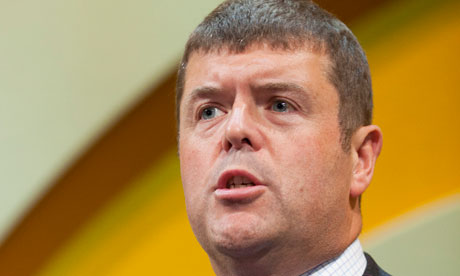
Paul Burstow said there 'need not be a gap' in social care funding. Photograph: Martin Argles for the Guardian
Charities and council leaders have reacted with disbelief after a government minister said there was no crisis of funding in the social caresystem and no identifiable gap between the needs of elderly and disabled people and what the state provides.
Paul Burstow, the care services minister, told the Commons health select committee that the government had taken sufficient steps to ensure that a funding shortfall inherited by the coalition had been closed.
"There is no gap in the current spending review period on the basis of the money that we are putting in plus efficiency gains through local authorities redesigning services," the minister said. If councils failed to pass on the money or to make efficiency gains, that was their choice, he said.
Burstow's comments appear to fly in the face of a widely held assumption that the social care system in England is underfunded and in urgent need of radical reform that would bring in more resources, both from state funding and private savings or insurance.
Cross-party talks on reform have reopened and the government is due to publish in the spring a progress report on its thinking, including a response to the Dilnot commission, which last year called for extra state spending of an initial £1.7bn to help underwrite a revamped system based on a cap of £35,000 on individual lifetime care costs.
Burstow, who arrived at the select committee fresh from the cross-party talks, seemed anxious to play down expectations. He maintained that Dilnot was "not about levering in more state resources" but about "enabling more private wealth to be levered into the system".
The minister agreed that the current system was a "broken model" and unfit for the future, but he denied it was in crisis. After identifying a funding gap, he said, ministers had committed an additional £7.2bn for councils over the next four years. In addition, councils were expected to make efficiency savings of up to 3%. Taken together, the two measures had closed the gap, he said.
Asked about unmet need for care and support, Burstow said there was no reliable or agreed way of calculating numbers of people who could benefit from services but were not getting them. It was "territory to be explored".
Pressed several times by members of the committee, the minister adjusted his position only slightly. He said initially that there "need not be a gap", and later that there "should not be a gap", adding: "But then there is a decision that all local authorities have to make."
Several recent reports have pointed to a continuing shortfall in funding of the social care system, under which most councils restrict services to people whose needs are judged to be "substantial" or "critical".
Independent research for the care services provider Bupa suggested there would be a £286m funding gap in 2012-13.
Oliver Thomas, the UK director of Bupa care homes, said: "We don't see any sign of additional government funding coming through – in fact, some local authorities are pushing to cut fees by as much as 20%."
Carers UK put the funding gap nearer £1bn. Emily Holzhausen, the charity's director of policy, said: "If we had sufficient money in the system we would not be seeing families struggling without basic services."
The Local Government Association, representing councils, accused the government of burying its head in the sand. David Rogers, chairman of its community wellbeing board, said: "It is deeply worrying that despite the best efforts of councils, leading charities and the government's own experts, the message that we are facing a financial crisis still doesn't seem to be getting through."
Credit: Reports and photographs are property of owners of intellectual rights. 
Seniors World Chronicle, a not-for-profit, serves to chronicle and widen their reach.

January 6, 2012

VENEZUELA: 87,000 Seniors Register in 'Greater Love' Mission

CARACAS, Venezuela / Venezuela Analysis.com / News / January 5, 2012


By Rachael Boothroyd,  VenezuelaAnalysis.com

More than 87,000 senior citizens have signed up to the government’s
new mission since registration began on December 20. (CdO)
The Venezuelan government has announced that since December 20, over 87,000 senior citizens have registered in the state’s new social program, the “Greater Love” mission, designed to tackle extreme poverty within the nation’s older generation.
Women over the age of 55 and men over the age of 60 are eligible to register in the mission, which was announced in early December last year. The new mission seeks to expand the number of Venezuelan senior citizens who have access to a pension, currently equal to the national minimum wage of 1,548 Bolivars per month (US$360).
“This mission is a benefit for us. Here there is someone who thinks of the grandparents, because they have always been abandoned” said Maria Araque, 62.
Previously only senior citizens who had made social security contributions were eligible to receive a full pension from the IVSS, (Venezuelan Institute of Social Security), excluding those who worked outside of the official public and private sectors.
“This is the first time that senior citizens are receiving help, and in my case I need it, because I have always been self-employed and I don’t have a pension” stated Luis Araque from Caracas.
Although some senior citizens are able to claim benefits of up to 60% of the national minimum wage from the Institute of Social Services (INASS), there are currently an estimated 400,000 older citizens living in extreme poverty throughout the country.
“How many older people are there who worked their whole lives in family homes, washing and ironing, and then after turning 60 or 70, they don’t have a pension? We’re going to give them their full pension” declared Venezuelan President Hugo Chávez.
For her part, Commune and Social Protection Minister, Isis Ochoa, confirmed that the 203,000 senior citizens currently receiving 60% of the minimum wage from INASS will be upgraded to receive their full pension.
There are currently 163 registration points across the states of Miranda, Vargas and the Capital District, which will be extended to include 13 states across the nation as of next week. A family member or a friend may register on behalf of those citizens who are unable to leave the house for reasons of immobility or disability.
Senior Citizen Committees
According to the Venezuelan press, more than 6,600 “Senior Citizen Committees” have also been formed as part of the mission, with the intention of incorporating the nation’s older generation into the country’s educative, health and social security systems.
Made up of 104,000 senior citizen volunteers, the committees will work in conjunction with their local communities in the following areas; preventative healthcare, education for self-liberation, sustainable agriculture, communications (social networks) and politics.
“The senior citizen of today isn’t the same sad and solitary person of the past, they’re upbeat, alert and motivated to participate in the different activities” explained Dinora Jiménez, a member of one of the committees.
During his appearance on “Up Front”, a television programme on Venezuelan state television channel VTV, Manuel Gonzales, official spokesperson for the Great Patriotic Pole, also praised the government’s policies for improving the lives of the nation’s elderly, describing how older generations were no longer viewed as “scrap metal”.
Gonzales also contrasted the government’s latest mission for older people with the neo-liberal policies currently being implemented by governments in the West, which he said were restricting older citizens’ access to a pension.
“We have to remember that before the revolution, there were only 367,000 people in the country who were receiving a pension, which was only 10% of the minimum wage. Now there are 1,900,000 of us enjoying a pension equivalent to the minimum wage” he said.
Although the Chavez administration has managed to decrease extreme poverty from 29.8% in 2003 to 6.8% in 2011, the government recently set itself the task of further reducing this figure. As well as announcing the creation of the “Greater Love” mission in December of last year, the Sons and Daughters of Venezuela mission was also initiated, aimed at alleviating extreme poverty amongst children, children with disabilities and teenage mothers.
____________________________________________________________ 
Credit: Reports and photographs are property of owners of intellectual rights. 
Seniors World Chronicle, a not-for-profit, serves to chronicle and widen their reach.