Remember ME - You Me and Dementia

Showing posts with label Malaysia. Show all posts

April 27, 2012

MALAYSIA: Love and wedded bliss in their 70s

PENANG, Malaysia / The Star / Nation / April 27, 2012

By Kow Kwan Yee


GEORGE TOWN: At an age when most senior citizens would be complaining of aches and pains, septuagenarians Goh Ah Bah and Ch'ng Kheng Hoon fell in love and decided to get hitched.
Newly-weds Goh, 72, and Ch'ng, 73, who are residents of the Silver Jubilee Home for the Aged in Sungai Dua, decided to seal their love after “dating” for about a year.
“Age should never be a barrier to true love,” said the couple, who met at the home in 2010.
The couple said their romance blossomed after they started chit-chatting in the television room after dinner everyday.
True love: Goh (right) holding Ch’ng lovingly at their honeymoon suite in
Shangri-La’s Rasa Sayang Resort & Spa in Batu Ferringhi yesterday.
Ch'ng, a widow who does not have any children from her previous marriage, said she found Goh to be a good companion.
Her husband died at the age of 85 two years ago.
“One day, while taking a stroll in the home's garden, I asked him whether we could get married,” Ch'ng recalled.
When asked how he responded to her proposal, Goh smiled shyly and said he accepted whatever Ch'ng said.
“I was single and had never thought of getting married until I met Ch'ng.
“When you find your true love, you should just go for it and not overthink it,” he said, adding that he and Ch'ng had never considered old age as an obstacle to getting married.
Goh, who looked resplendent in his black suit as did Ch'ng in a red cheong sam, were at the Shangri-La's Rasa Sayang Resort & Spa yesterday for their honeymoon stay. The one-day stay was sponsored by the hotel.
Earlier, the couple held a simple wedding luncheon at the home where they cut a five-tiered cake before some 200 residents.
Copyright © 1995-2012 Star Publications (M) Bhd
___________________________________________________________
Credit: Reports and photographs are property of owners of intellectual rights. 
Seniors World Chronicle, a not-for-profit, serves to chronicle and widen their reach.

April 25, 2012

MALAYSIA: Auntie Ooi Rallies Senior Citizens For Fair Elections


KUALA LUMPUR / Malaysian Digest / News / April 25, 2012 
Anne Ooi, better known as ‘Auntie Bersih', has called on senior citizens to come out in force this Saturday to support Bersih's push for clean and fair elections, Malaysiakini reported.

In a video clip posted on Facebook last Sunday, Ooi, 66, calls on elderly Malaysians who are like her to rise to the occasion, saying she hopes to see more senior citizens take a stand on pressing issue.

"I am asking the senior citizens, today, please rise! Don't leave the younger people to it. The police will always go after them," she quips.

Despite getting into the campaign for electoral reform at her age, Ooi is firm in expressing her commitment to the movement.

"I'm all in. I have gone straight in and won't stop. It is like I am impatient. We have to know thoroughly what is happening and react quickly, because there is no time," she says in Bahasa Malaysia in the video interview.

National laureate A Samad Said, 77, is also featured in the clip and he says that the experiences of age can be used wisely as well.

"Although our age is advanced, with wisdom we can help as well," Samad says.

Asked if she was "obsessed", Ooi brushes off the notion and stresses that the need for electoral reform could not be ignored.

"Once you know, you cannot just sit quietly anymore," she exclaims.

"Mana ada masa lagi bagi kita? Mana ada masa lagi?" (Where is there any time left for us? Where is there more time?) she asks.

According to the posting, the video was recorded when Ooi spoke at a Bersih forum in Kuala Terengganu on Jan 20 before the Bersih 3.0 rally was formally announced.

Meanwhile, DAP has called on its members and supporters to gather at Jalan Sultan at noon on Saturday, before proceeding to Dataran Merdeka for the Bersih rally which is slated to begin at 2pm.

In a Facebook posting, DAP calls on its "yellow soldiers" to gather at the designated area before marching together to the iconic public square in the city centre.

"Let us open a new chapter to illuminate our dreams," it says.

Last Friday, the Kuala Lumpur City Hall (DBKL) rejected Bersih's application to hold the ‘Duduk Bantah' (sit-in) protest at Dataran Merdeka on the grounds that the square can only be used for "national events".

The police have also stated that they will not allow the rally, citing "safety reasons" for their decision.

The government, which has said that the protest is not considered a security threat, has offered four other locations - all of which are sport stadiums outside the city centre - for the rally.

However, Bersih remains adamant about holding the sit-in for clean and fair elections at Dataran Merdeka, declaring it a people's constitutional right to gather at a place which belongs to all Malaysians.

Copyright © 2009 malaysiandigest.com 
____________________________________________________________
Credit: Reports and photographs are property of owners of intellectual rights. 
Seniors World Chronicle, a not-for-profit, serves to chronicle and widen their reach.

March 3, 2012

MALAYSIA: Blogger, 65, inspires senior citizens to enjoy life

PENANG, Malaysia / The Star / Metro / March 3, 2012

By YIP YOKE TENG
Photo by LOW LAY PHON

Retired teacher Lily Fu is the embodiment of the young-at-heart. Her energetic vibes are contagious, rippling through the community.
At 64 years old, she is possibly one of the most productive bloggers in the country.
Blogging every other day, her three-year-old blog — SeniorsAloud — boasts more than 600 articles on issues pertaining to senior citizens. Still, she has a long list of topics she intends to cover.
The content is backed by reliable sources attained through voracious reading, as well as her eager visits to workshops including in Singapore, and in-depth chats with experts she met there. That is in addition to being a part-time lecturer at a local university.
Full of energy: Fu blogs and reads voraciously about seniors’ issues. She preaches and exemplifies youthful aging on her website.
Copyright © 1995-2012 Star Publications (M) Bhd 
____________________________________________________________
Credit: Reports and photographs are property of owners of intellectual rights. 
Seniors World Chronicle, a not-for-profit, serves to chronicle and widen their reach.

MALAYSIA: Old folk BR1Mming with joy

PENANG, Malaysia / The Star / Metro / March 3, 2012

Special bonus: Chamunni, Khairul and Choo were all smiles after receiving the RM500 BR1M aid at Rukun Tetangga Mahsuri Bayan Baru.
A GROUP of senior citizens beamed with joy as they redeemed their RM500 Bantuan Rakyat 1Malaysia (BR1M) at the Rukun Tetangga Mahsuri Bayan Baru in Penang.
The aid came in handy for A. Chamunni, 88, as the retiree had been wanting to purchase two new pairs of spectacles, for himself and his wife, for several months now.
“I have been wearing the same pair of spectacles for the past two years, and cannot see clearly now.
“The money is sufficient to buy a pair for myself and another for my wife,” he said.
Choo Choon Huah, 60, said he would save the money for emergency purposes.
Khairul Anwar Abdul Mazab, 37, a father of three, said the money would be spent solely on his children, especially for his seven-year-old daughter to buy academic materials.
They were among 170 recipients from the fourth batch to receive the cash aid at the Rukun Tetangga on Wednesday.
Pantai Jerejak Barisan Nasional coordinator Wong Mun Hoe said more than 6,000 people in his constituency had received BR1M since it was first given out on Jan 15.
The BR1M initiative is aimed at alleviating the burden of low-income households earning below RM3,000 a month.
There was more joy at the Little Sisters of the Poor Home in Penang as residents received their BR1M.
Siblings Lau Kook Fok, 69, and Liew Yet Moy, 77, said they were very happy with the aid.
“I will use the money to buy some necessary items like food, clothes and shoes,” said Liew.
They were among the 38 residents who received the aid from Paya Terubong Barisan Nasional coordinator Koh Wan Leong and Air Itam Barisan coordinator Jackson Teoh at the home on Lorong Batu Lanchang on Thursday.
“We came here to help deliver the money to the senior citizens, for their convenience,” said Koh.
Teoh said 7,805 applicants had successfully received the aid in Air Itam while Koh added that 4,560 applicants had successfully received the aid in Paya Terubong.
Copyright © 1995-2012 Star Publications (M) Bhd
____________________________________________________________ 

Credit: Reports and photographs are property of owners of intellectual rights.
Seniors World Chronicle, a not-for-profit, serves to chronicle and widen their reach.

February 6, 2012

MALAYSIA: Healthy life helps lifespan extend to 73 years

MIRI, Sarawak, Malaysia / Borneo Post / February 5, 2012


The lifespan of women nowadays has increased to an average of 76 years and 73 for men in the country. This was stated at an event here to mark the Chinese New Year.

All senior citizens deserve to enjoy themselves during their golden years by participating in healthy activities which they loved, said Assistant Minister of Communications Datuk Lee Kim Shin.

“Reserve some golden moments for yourself as you deserve to enjoy your golden years. After all, you have worked hard in your younger days,” he said at a Chinese New Year dinner hosted for about 80 senior citizens at Golden Restaurant here recently.

Lee congratulated Miri Riam Senior Citizens’ Club for successfully establishing a club as a place for its members to share and exchange their experiences in a healthy environment.

“Stay healthy always as health and happiness are inter-related.”

Lee noted that the lifespan of women nowadays had increased to an average of 76 years and 73 for men in the country. This, he said, was due to vastly improved technology and medical facilities. “The national public healthcare is also very cheap, starting from as little as RM1, thanks to the government’s efforts to extend these benefits to the people.” However, Lee said it was not wise to simply rely on the doctors to take care of their health.

“The best way is to continue to practise an active and healthy lifestyle by participating in healthy and active activities such as singing and dancing.”

Copyright 2010-2011 BorneoPost Online.
____________________________________________________________ 

Credit: Reports and photographs are property of owners of intellectual rights.
Seniors World Chronicle, a not-for-profit, serves to chronicle and widen their reach.

January 17, 2012

MALAYSIA: Children and senior citizens study under one roof

PETLANG JAYA, Selangor / MySinChew Daily / January 17, 2012


MyKampung
Children and senior citizens study under one roof

A group of people have been perseveringly learning English in Kg Perting, Bentong. Aged from 10 to 76, the group learns the language in a public library once a week.
Chen Ti An is the English teacher of the class. As a vegetarian, he believes that human should practice a healthy diet and share knowledge with others. He symbolically charges his students only RM10 a month and the money is actually meant to spend on treating the students dinner.
Chen said that English is an international language used in all places and occasions.
He said that most of his students are senior citizens and undeniably, they understand and learn slower compared to young people. Moreover, some of them are too shy to speak in English or ask questions. These affect their learning. However, they still worked very hard to learn. Such a spirit should be learned by the younger generations.
Chen said that it is not a problem to learn slowly as what he wants is actually to train them make sentences in English, so that that can later communicate in English. Vocabulary, grammar, as well as the ability to read and listen are important in learning English.
He said that there is also another way to learn the language, namely listening to English songs. Therefore, he teachers his students an English song every time before the class ends.
He believes that singing is a good way to remember English words.

Translated by SOONG PHUI JEE
Sin Chew Daily


Copyright © 2012 MCIL Multimedia Sdn Bhd
____________________________________________________________
Credit: Reports and photographs are property of owners of intellectual rights. 
Seniors World Chronicle, a not-for-profit, serves to chronicle and widen their reach.

January 16, 2012

MALAYSIA: Foodstuffs, hampers gifted to 16,000 seniors

KUALA LUMPUR / New Straits Times / January 16, 2012

By Masriwanie Muhamading

Sports Toto Malaysia Sdn Bhd is giving ang pow and mini hampers to about 16,000 needy senior citizens throughout the country.

Deputy Women, Family and Community Development Minister Datuk Heng Seai Kie
and Deputy Agriculture and Agro-based Industry Minister Datuk Chua Tee Yong
distributing ang pow and mini hampers to senior citizens.

There are 10 types of foodstuffs and essential items in the hampers, including mandarin oranges. 

Sports Toto Malaysia Sdn Bhd executive director Vincent S.P. Seow said the Chinese New Year Ang Pow Donation Campaign would cost at least RM750,000.

"As in the previous years senior citizens, aged 60 years and above, of all races,  will be the beneficiaries of the charity campaign."

The campaign is in its 24th year. It was launched by Deputy Women, Family and Community Development Minister Datuk Heng Seai Kie at the Kuala Lumpur and Selangor Chinese Assembly Hall recently.

Also present was Deputy Agriculture and Agro-based Industry Minister Datuk Chua Tee Yong.   


Copyright © 2011 The New Straits Times Press (Malaysia) Berhad
____________________________________________________________
Credit: Reports and photographs are property of owners of intellectual rights. 
Seniors World Chronicle, a not-for-profit, serves to chronicle and widen their reach.

January 4, 2012

MALAYSIA: Confusion on medical insurance coverage

KUALA LUMPUR, Malaysia / Malay Mail / Health / Insurance / January 4, 2012

Many aren’t aware of what exactly is covered under Hospital and Surgical Insurance or some of its major limitations


By The Malay Mail Team

In general, the Hospital & Surgical Insurance (HSI) policy covers you against expenses incurred whilst you are hospitalised, due to a covered illness or as a result of an accident.
Generally, you would only be covered as an in-patient unless it is an emergency out-patient treatment due to an accident. In addition, day surgeries are also covered for certain procedures nowadays, like cataract operation, whereby you need not stay overnight at the hospital. With the “Day Surgery” benefit, you need not purposely stay a night to qualify for the coverage and this reduces your total medical costs.

A HSI policy usually covers hospital accommodation and nursing expenses, surgical expenses (surgeon’s fees & costs associated with surgery), physicians’ expenses and in-patient tests.

This policy sometimes includes overseas cover, accidental death benefit and out-patient tests or consultation. HSI policies usually exclude any hospitalisation / treatment charges as a result of pregnancy related conditions, congenital abnormalities, cosmetic surgery, non accidental related dental treatment , sexually transmitted diseases, routine medical check up’s and psychiatric related illnesses.

One common exclusion under a HSI policy is that of pre-existing conditions or illnesses that existed before the effective date of a HSI policy, for which you are receiving treatment or have shown symptoms.

If you consulted a medical doctor for any pain or discomfort in connection with the condition, it would be regarded as a symptom of a disability and will be excluded from your policy.

There is also a list of specified illnesses for which you will not be covered if the illnesses have been treated or occurred during the first 120 days from the commencement of your policy, irrespective of whether you were aware or them or not.

For example, you may only discover that you have a cyst in your abdomen two months after you purchased the HSI policy and was advised to remove it. You’ll not be covered for this procedure as it is one of such specified illnesses and is still within the 120 days period.

Therefore, you may want to check through this list of illnesses to prevent any future dispute or misunderstanding.

Take note that you will not be eligible for any claim arising from any medical or physical conditions within the first 30 days of the cover, except for accidental injuries. Again, this is irrespective of whether you were aware of such conditions or not.

However, this does not necessarily mean that you’d be automatically covered after the first 30 days as you’re still subjected to the 120 days waiting period for certain specified illnesses and the pre-existing condition exclusion.

It is also important that at policy application you truthfully disclose all your relevant medical information. Insurance companies have the right to reject a medical claim if they have evidence that the insured did not disclose any material information at time of purchasing the policy.

Most HSI policies today extend their coverage to age 80 and some even up till 100. However, there’s always a last entry age and be sure to get into the plan before that stipulated age and never let it lapse. Otherwise, you’d not have the cover when you need it most.

Also, while a typical HSI policy may cover overseas treatment, the benefits would be limited to reasonable, customary and medically necessary charges for such equivalent local treatment in Malaysia and shall exclude the cost of transport to the place of treatment.

For example, let’s say a typical appendicitis operation here costs RM2,000 but you had to undergo the operation in Singapore which cost you S$3,000. You’d then be reimbursed for RM2,000.

Further, if you were to live or travel out of Malaysia for more than 90 consecutive days, no benefits will be payable for medical treatment outside Malaysia. Therefore, if you do not plan to be back in Malaysia for more than 90 consecutive days, you may need to get another HSI plan in the country where you’d be residing.

However, the moment you step back into Malaysia, your HSI coverage will resume until such time you are out of Malaysia again for more than 90 consecutive days.

This article is provided purely as an advisory. For specific details, please consult an insurance professional by contacting any life insurance company listed in the Life Insurance Association of Malaysia (LIAM) official website at www.liam.org.my
Copyright 2009 Malay Mail Sdn. Bhd
.____________________________________________________________
Credit: Reports and photographs are property of owners of intellectual rights. 
Seniors World Chronicle, a not-for-profit, serves to chronicle and widen their reach.

December 21, 2011

MALAYSIA: Ugandan grandmother sentenced to death

GEORGE TOWN, Penang / The Star / News / Courts / December 21, 2011

Death penalty for Ugandan
By Christopher Tan

A Ugandan grandmother was sentenced to death after she was found guilty of trafficking in 2,329gm of methamphetamine at the Penang International Airport.

Nabweteme Hadija, 56, was seen wiping away tears after the High Court interpreter explained the decision to her.

Judicial Commissioner Mohd Amin Firdaus Abdullah in his decision said the defence had failed to raise a reasonable doubt against the prosecution’s case, and therefore, he had no choice but to impose the mandatory death sentence.

To the gallows: Nabweteme being led by the police after the High Court passed the death sentence.
Nabweteme, a handicraft trader, was found guilty of trafficking in the drugs at the airport in Bayan Lepas on Sept 9, last year.

She was convicted of the offence under Section 39B of the Dangerous Drugs Act 1952.

Mohd Amin Firdaus said it defied common sense that Nabweteme did not know or was not suspicious about the hard compartment at the base of the luggage.

“She was going on a long journey and had packed her own clothes. How did she not suspect something wrong with the luggage?” he questioned.

He also said that arresting officer Chief Insp Balber Singh and two police corporals who were on their rounds at the airport, had noticed Nabweteme behaving in a suspicious manner at the airport’s arrival hall at about 11.30pm on Sept 9 last year.

“The accused was seen pulling the luggage and behaving suspiciously. She was asked to go through a luggage scan.

“The Customs officers found something suspicious at the base of the luggage and when Chief Insp Balber cut it out, he found the packages (containing the drugs) which were cellophane-taped,” he said.

Defence counsel S. Yagoo appeared for Nabweteme while Deputy Public Prosecutor Mohd Amril Johari prosecuted.

Yagoo told reporters outside the courtroom that he would file an appeal.

Copyright © 1995-2011 Star Publications (M) Bhd
  ____________________________________________________________
Credit: Reports and photographs are property of owners of intellectual rights.
Seniors World Chronicle, a not-for-profit, serves to chronicle and widen their reach.

December 13, 2011

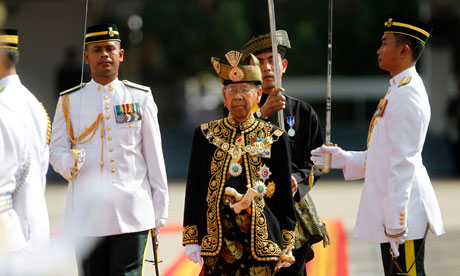
MALAYSIA: Sultan, 84, crowned Malaysia's new king

LONDON, England / The Guardian / World News / Malaysia / December13, 2011

Abdul Halim Mu'adzam Shah, an avid golfer and Frank Sinatra fan, becomes oldest constitutional monarch in Malaysian history

Malaysia's new king, Sultan Abdul Halim Mu’adzam Shah, at a welcoming ceremony 
in Parliament Square, Kuala Lumpur. Photograph: Bazuki Muhammad/Reuters

KUALA LUMPUR, Malaysia / Associated Press

An 84-year-old Malaysian state sultan has ascended the throne to become the oldest constitutional monarch in the country's history.

Abdul Halim Mu'adzam Shah took his oath of office in a nationally televised ceremony attended by hundreds of dignitaries in Malaysia's new federal palace.

Under a unique system maintained since Malaysia's independence from Britain in 1957, nine hereditary state rulers take turns as the country's king for five-year terms.

The monarch's role is largely ceremonial, since administrative power is vested in the prime minister and parliament. But the position is highly regarded, particularly among the ethnic Malay Muslim majority, as the supreme upholder of Malay tradition and symbolic head of Islam.

"The king is the umbrella to the people and the people are the pillars of the king," Sultan Abdul Halim said in comments issued through the national news agency, Bernama. "The king's greatest role is to ensure there will be no cruelty and destruction to the people and to the country."

Wearing black and yellow regalia, the king was sworn in after inspecting a military honour guard and receiving a 21-gun salute at parliament.

His roles include appointing cabinet ministers and senior judges on the advice of the prime minister. He also appoints top Islamic clerics and is considered the highest ranking figure in the armed forces.

Public criticism of the king and state sultans is more or less illegal. Under Malaysian sedition laws people who incite "hatred or contempt" towards the monarchy can be imprisoned for three years.

Abdul Halim, an avid golfer and sports fan, is the constitutional ruler of Malaysia's northern Kedah state, nicknamed the country's rice bowl because of its vast paddy fields.

Besides being Malaysia's 14th and oldest king, Abdul Halim is the first to ascend the throne twice. He was also king between 1970 and 1975, when the father of Malaysia's current prime minister, Najib Razak, was premier. He succeeds Sultan Mizan Zainal Abidin, 49, who was one of Malaysia's youngest kings.

The new king is in robust health for his age. In 2006 he walked more than a mile to a stadium to watch his state's football team in a tournament because his car was caught in traffic.

Abdul Halim, who was installed as ruler of his state in 1958, has been described by his family as a caring leader and a fan of Frank Sinatra, Dean Martin and Nat King Cole.

Malaysian media noted that when Abdul Halim became king in 1970 he had to travel by train from Kedah to Kuala Lumpur, Malaysia's largest city.

On Tuesday he took a flight and was bid farewell by an estimated 30,000 people who thronged the roads to Kedah's airport.

© 2011 Guardian News and Media Limited ______________________________________________________________
Credit: Reports and photographs are property of owners of intellectual rights. 
Seniors World Chronicle, a not-for-profit, serves to chronicle and widen their reach.

November 28, 2011

MALAYSIA: Elderly go green to stay active

PENANG, Malaysia / The Star / Metro / November 28, 2011

By Aida Ahmad


BEING an octogenarian does not stop environment-conscious Ang Chui Pek from mowing his lawn and tending to his garden.

The 85-year-old retired school headmaster from SS2 Petaling Jaya believes staying physically and mentally active is important for one’s well-being.

“I cut the grass myself as it keeps me active and is a form of exercise. At the same time, I also cut cost when I do these chores myself.

“My wife and I also compost garbage and use it as fertiliser for our fruit trees,” said Ang, whose household is among the 49 households who took part in Petaling Jaya City Council’s (MBPJ) Low-Carbon Green Rebate Assessment Scheme.

Ang has turbine ventilators to help regulate the temperature of his house.
Spending time wisely: Ang composts garbage at home and plants his own fruit trees.

The pilot project, which was kicked off by the council in the middle of the year gives applicants rebates of up to RM500 for incorporating energy-efficient methods or follow a green lifestyle.

Six categories — energy, water, household waste management, transport and biodiversity, were taken into account in the scheme.

Ang took part in the programme under the categories of energy, waste management and biodiversity.

Practices such as composting, using a solar water heater or collecting rain water for washing are considered “green”.

MBPJ One-Stop Centre chief Lee Lih Shyan said the programme promoted the green efforts of residents and rewarded those who incorporated energy-efficient equipment in their homes.

“We would also be carrying a similar project next year to reward house owners who live a green lifestyle,” said Lee during a site visit to the applicants’ homes to evaluate their green efforts.

Accompanying Lee was a team of independent consultants each specialising in waste management, energy, transportation, biodiversity and water consumption.

“After visiting the homes, we will have a meeting on Nov 30 to determine the applicants’ entitlement for the rebates,” added Lee.

Independent evaluator specialising in waste management Dr Theng Lee Chong, who accompanied Lee to 12 houses in SS2, said some residents still needed to grasp the overall concept of energy conservation.

“Although there are many who use solar panels, their electricity bill is still high.

“We will need to integrate new criteria next year to ensure the applicants can achieve the overall green concept.

“In terms of waste management, composting needs to be done properly and people need to segregate their rubbish and use environment-friendly products,” said Theng.

SS2B Rukun Tetangga (RT) chairman Lee Kwee Cheng has planted a variety of fruit trees and herbs in her garden.

She also said she used public transport as much as she could and drove a hybrid car.

Copyright © 1995-2011 Star Publications (M) Bhd ____________________________________________________________
Credit: Reports and photographs are property of owners of intellectual rights.
Seniors World Chronicle, a not-for-profit, serves to chronicle and widen their reach.

November 27, 2011

MALAYSIA: The aging prostrate

PENANG, Malaysia / The Star / Health / November 27, 2011

AGE WELL
By Tee Shiao Eek

With the expected increase in the numbers of elderly men in the country, certain health issues are going to become even more important.

MALAYSIA, like many other high- and middle-income countries in Asia and around the world, is preparing for the population boom of older people (above aged 65) in this decade.

From the perspective of men’s health, this ageing trend brings about unique challenges as we struggle to maintain the health and well-being of an ageing population. An ageing population riddled with illness and disability will not be constructive for society – socially, or in terms of productivity.

Since 2000, the Malaysian Men’s Health Initiative (MMHI) has recognised that men’s health issues require a dedicated research focus and a multi-disciplinary perspective that takes into consideration the complexity of men’s health.

Over the years, the MMHI has published close to 200 pieces of research work on various aspects of men’s health, including epidemiology, clinical, psychobehavioural and basic science studies.


For the first time, these findings have been compiled into a single publication, Managing Men’s Health: Improving Men’s Health Through Research, written in easy-to-understand language for the benefit of the public, medical and allied health professionals, policymakers, researchers and pharmaceutical companies.

One of the most common prostate problems faced by ageing men is benign prostatic hyperplasia (BPH), or enlarged prostate. It causes difficulty in urinating, dribbling after urination, or frequent urination, especially at night.

This article is the third in a series highlighting some of the findings from the book, which began with erectile dysfunction and testosterone deficiency syndrome. This week’s article will look at prostate diseases among men in Malaysia.

Prostate diseases in Malaysia

Prostate diseases or lower urinary tract symptoms are quite common among ageing men, but they are also often brushed off as “old man’s problems”.

On the contrary, these lower urinary tract problems, including problems related to storage of urine, urination and post-urination, are not benign issues. There is a known correlation between these prostate diseases and many urological and non-urological conditions, including prostate cancer, urinary tract infections and diabetes.

MMHI’s research into the prevalence of prostate diseases in Malaysia is significant, as it offers a better understanding of men’s overall health risks as they age.

One of the most common prostate problems at this age is benign prostatic hyperplasia (BPH), or enlarged prostate. It causes difficulty in urinating, dribbling after urination, or frequent urination, especially at night. Some men find that they only have a weak stream and a small amount of urine each time they go, and they still feel the urge to urinate even after they have finished.

Another form of prostate problems is overactive bladder, which is linked to urinary incontinence. Overactive bladder occurs when there is a problem with the bladder storage function, thereby causing a sudden urge to urinate. If you cannot suppress the urge, overactive bladder often leads to involuntary urination.

How common are prostate diseases?

The MMHI looked at the prevalence of prostate diseases in the 2006 Subang Men’s Health Study, and the prevalence of overactive bladder in the 2008 Subang Aging Male (SAM) study.

The 2006 Subang study found that roughly a third of the men who participated suffered from some form of lower urinary tract symptoms.

The SAM study found that 12.7% of the men suffered from overactive bladder. The study also revealed that symptoms of such prostate problems are not trivial and, in fact, reduce men’s quality of life significantly. The participants of the study reported that their physical activity and participation in daily life was limited due to physical and emotional discomfort and stress.

Prostate diseases and other conditions

The findings of both studies were especially instrumental in confirming the disturbing trend of a strong correlation between prostate diseases and certain serious diseases, like metabolic syndrome and erectile dysfunction (ED). These findings are extremely meaningful for physicians and men in Malaysia, as it points towards the imperative to screen men with lower urinary tract symptoms for ED, cardiovascular disease and diabetes.

More information about the link between prostate diseases and chronic conditions can be found in the book.

Future research

In the book, MMHI lays out its plans for future research into prostate diseases, which promises to provide more insight into ways of managing these significant conditions in ageing men.

It is time to change the way we view prostate diseases. They are not merely tiresome side effects of ageing, but important harbingers of other co-morbidities that could affect quality of life and life expectancy among senior men.

‘Managing Men’s Health: Improving Men’s Health Through Research’
can be obtained by writing to perandro@streamyx.com

Copyright © 1995-2011 Star Publications (M) Bhd
____________________________________________________________
Credit: Reports and photographs are property of owners of intellectual rights.
Seniors World Chronicle, a not-for-profit, serves to chronicle and widen their reach.

July 31, 2011

MALAYSIA: Eight senior citizens cover 5,634 km in 21-day adventure

BORNEO / The Sunday Post / Adventure / July 31, 2011

Senior citizens on Borneo expedition
By Wong Hin San, Wong Tuck

How many of you have driven the whole of Sarawak, Brunei, Labuan and Sabah?

A group of eight of us from West Malaysia and Kuching began a Borneo expedition from Kuching, taking in most of Sarawak, Brunei and Sabah in 21 days over a distance of 5,634km.

We covered the northern-most tip of Borneo at Tanjung Simpang Mengayau, Kudat, Sabah, as well as the southern-most tip at Matang, Sarawak. Our team of senior citizens, all past their 60’s, survived the bumpy journey with no mishaps and none the worse for wear and tear.

It all started when a friend and relative in Kuching suggested we make an overland trip through the whole of Borneo. Eager for adventure, we welcomed the idea.

The day finally came when we set foot in the Land of Hornbill – the first time for some of us – and were met on arrival at Kuching International Airport by our soon-to-be driver-cum-expedition leader.

That night in the state capital, we were treated to a scrumptious dinner of local seafood. We also had midin, a local crispy and delicious fern. For breakfast the next day, we had kolo mee and Sarawak laksa. A city tour was arranged for those in the group who have been to Kuching before.

Not to be missed are the cat statues, the Kuching Waterfront, the Sarawak Museum and a whole row of souvenir shops along Main Bazaar. The Chinese Museum is also a must-visit – well-equipped, informative and organised.

We met at our expedition leader-cum-driver’s house the next morning before embarking on the expedition. We loaded our luggage into his 8-seater MPV vehicle and were told to sit back and enjoy the sights.

The first town we passed through was Serian which has a huge durian emblem at the roundabout. This must be the right place to hunt for the irresistible King of Fruits!

We stopped for tea at Sungai Tenggang, a one-street town. After bypassing Pantu, we stopped at Lachau. There is a tamu here selling local items such as titbits, local rice and barley and handicrafts. The people here are mostly Ibans and the local Chinese are fluent in the Iban language. Our cameras clicked away at the array of goods on display.

The next town we passed was Sri Aman, situated away from the trunk road. There were other smaller towns along the route such as like Engkilili, Lubok Antu and Betong.

We had lunch at Sarikei, a predominantly-Foochow town in the Sixth Division, and famous for its sweet pineapples. Towards the central part of Sarawak is Sibu where we stayed the night. We went to stretch our legs at Bukit Aup, a recreation park before visiting the night market. After dinner, we called it a day and rested our weary limbs at a budget hotel.

Early start: On the second day, we were up and about before dawn and looking forward to our next destination – Mukah, a coastal town about three and a half hours by road from Sibu and populated mainly by the Melanaus. Melanaus of Mukah. Photo courtesy: Azgforever Blog

The road to Mukah was in terrible shape, not tarred and full of potholes. Mukah is the place for sago and all sago-based products like tebaloi, a type of thin cracker made from sago flour. We also tried umai, a Melanau delicacy. It is what Sashimi is to the Japanese.

We spent the night in Bintulu, famous for its belacan and cincaluk. Being the main producer of LNG, Bintulu is developing at a tremendous pace.

Travelling north, we arrived in Miri, the second largest city in Sarawak with a population of over 260,000. Petroleum remains the major industry here. The expedition would not be complete without a visit to Canada Hill, site of the about 30m high Grand Old Lady, Malaysia’s first inland oil-drilling platform and one of Sarawak’s most important historical monuments. The petroleum museum is also worth a visit.

The Grand Old Lady is the first oil well in Malaysia and situated at Canada Hill, Miri.

Irony: We spent a few nights in Miri before proceeding to Limbang. The irony was that we had to pass through another country – Brunei – to get there. There is a new Malaysian custom and immigration complex at Pandaruan in Limbang which provides drive-through services.

Pandaruan is on Malaysia side and Puni on Brunei side. Both towns – or villages rather – are separated by the very narrow Batang Pandaruan connected by a ferry service. In one day, we had our passports stamped four times. After all the hassles at the immigration and customs departments, it was already dark and we managed to spend only a short time in Limbang (for the night). We continued our journey the next day, passing through towns like Lawas, Sipitang and Beaufort before reaching Kota Kinabalu.

Land below the wind: Kota Kinabalu with a population of over 600,000, is the capital of Sabah. And Sabah or ‘The Land below the Wind’ with a population of 3.1 million as of 2010, is the third most populated state in Malaysia after Selangor and Johor.

There are over 30 different indigenious groups, including Kadazan, Dusun, Rungus, Murut, Sungat and Lundayeh, in Sabah. The indigenous population makes up about 60 per cent of the population. The Kadazan Dusun, the most dominant ethnic group, are found in western, northern and central Sabah. The Rungus re-side in the northern part while the Muruts in the southwest interior.

A traditional Rungus Longhouse in Sabah is worth a visit.


Apart from the beautiful beaches, we found the Philippines Market to be the main attraction in Kota Kinabalu. There are many stalls and it’s safe to say what-ever you wish to eat or buy is probably available here.

Before heading to Kudat, we made a stop at the foot of Mount Kinabalu, two hours’ drive from Kota Kinabalu. Conquering this awesome mountain was out of the question for our group. But we enjoyed travelling the winding route through hush countryside dotted with traditional village houses against a backdrop that is unforgettably scenic.

Towards Kudat, we chanced upon a beautiful Rungus longhouse along the way and stopped to observe the culture of the indigenous tribe. We also had the rare opportunity to view Simpang Mengayau or The Tip of Borneo. It was a sight to behold! The scenery was simply breath-taking.

Kampung Simpang Mengayau, the tip of Borneo. Photo courtesy: Staronline


To quench our thirst, we stopped at a nearby eatery managed by a European, Howard Stanton. On request, he asked his local staff, Lorraine, a sweet local Sabahan lady, to sing the very popular ‘Jambatan Tamparuli’ with the others, including Stanton, dancing the Sumazau in unison.

From Kudat, we proceeded southeast to Sandakan, some 500km away. Sandakan – known as ‘little Hong Kong’ – is Sabah’s second largest town. Seafood here is aplenty and relatively cheap and fresh. The main local tourist attraction is the Sepilok Orang Utan Sanctuary and the Labuk Bay Proboscis Monkey Sanctuary.

After a good rest of two days in Sandakan, we continued our expedition to Lahad Datu, Kunak, Semporna and finally Tawau at the southern tip of Sabah.

Real adventure: From Tawau, the real adventure started. The road to Keningau was horrendous. The unsealed road was very bumpy and partly muddy due to the rainy weather. We were held up at one area because a heavy logs-laden lorry could not make it up the muddy slope and had to be towed by an excavator. The steel cable tied to the lorry snapped mid-way and the vehicle simply slipped down the slope. It was a frightening sight as the slope is flanked by ravines.

After the lorry was safely pulled up by the excavator, it was our turn to drive through. It seemed an impossible task. With silent prayers in our hearts, we sat tight and watched our daring and skilful leader manoeuvre the MPV along. With one acceleration, we were through. Our driver got a thunderous applause.

Truly, it was a nerve-racking experience. We were lucky, according to the locals who frequently had to camp by the roadside, or sleep in the car that got bogged down. After the ordeal, everyone of us had a good night sleep in Keningau, a hillside town.

Off to Labuan: The next morning, after giving our MPV a thorough clean up, we set off to our next destination – Labuan, comprising one triangle-shaped island and six smaller ones and proclaimed a federal territory of Malaysia in 1984. Labuan, covering an area of 95 sq km, is a duty-free port.

Arriving at the jetty to take the ferry to the island, we were dismayed to find that it was already full. It looked like we had to wait for the next ferry later that night.

We were about to leave the counter when, out of the blue, appeared the ferry owner who happened to be an acquaintance of our leader. Seeing our forlorn faces, he got us ‘emergency tickets’ – and that instantaneously lifted our spirits.

We visited a few prominent tourist attractions in Labuan, such as The Chimney, the Marine Museum, the Bird’s Park and the Financial Park.

The Chimney is an artefact from Labuan’s coal mining era (1847-1912). It is believed built when Labuan was used as a coaling station for ships.

The Financial Park, on the other hand, is a shopping paradise where duty-free shops are located. Liquors and chocolates are fairly cheap here. We had a fabulous seafood feast that night – courtesy of our leader’s sister and her husband.

Back to Sarawak:  It was time to return to Sarawak. Again we had to pass through Brunei and put up with tedious immigration procedures to reach Miri. After a night in Miri, we went to explore Niah Caves at Batu Niah. Photo courtesy: mundo-trotteur.net

Though it is not an extensive cave system compared to others in Sarawak, we were amazed that the cave is a pre-historical site where human remains dating to 40,000 years have been found. It is the oldest recorded human settlement in East Malaysia.

The long haul from Miri to Kuching is about 800km – so we had a few rest stops along the way.

As we had covered some of the towns before reaching Sabah earlier, we proceeded straight to Betong and stayed a night there. Betong is a small town but has major government offices to administer the newest Division of Sarawak.

To complete our journey, we were taken to the Matang Wildlife Rehabilitation Centre, about 40 minutes’ drive from Kuching. There are so many animals here – orang utans, sun bears, bear cats, civet cats, sambar deer, barking deer, porcupines and crocodiles, as well as a large variety of birds such as the must-see hornbills and sea eagles.

All of these animals can be viewed in spacious natural enclosures and large aviary houses. Although short, the excursion gave us the opportunity to snap a few final photographs of the orang utans – we missed the feeding time of the primates in Sepilok, Sabah.

After that, we drove to Lundu for lunch and continued to Sematan, a seaside town, and then headed back to Kuching with a stop at Bau.

Twenty-one days of some bumpy and unpleasant rides through potholed and partial gravelled roads, hilly terrain, bright sunshine and heavy rain made the expedition memorable. But meeting extremely friendly people and experiencing the multi-racial cultures of Sarawak and Sabah during the journey gave the expedition a priceless tag.

Sarawak Cultural Village is tucked away on the foothills of Mount Santubong at Damai Beach, 35 km north from Kuching. It is also known as a living museum.


Our most heartfelt appreciation to the expedition leader, a strong-willed person and a very experienced driver who took 21 days of driving in his stride – at least four hours a day, once covering a gruelling 500km in seven hours with no petrol stations in between but only a restaurant for rest in the middle of nowhere.

Different races of Sarawak. (mylot.com)

We hope our experience will encourage people to discover Sarawak, Brunei, Labuan and Sabah. If we senior citizens can do it, surely can everyone else!

East Malaysia has so much to offer – adventure, culture, food, history, people and shopping. It was a truly memorable and incredible journey for us.

Copyright 2010-2011 BorneoPost Online
___________________________________________________________
Credit: Reports and photographs are property of owners of intellectual rights.
Seniors World Chronicle, a not-for-profit, serves to chronicle and widen their reach.

July 29, 2011

MALAYSIA: Filial duties rewarded

PENANG, Malaysia / The Star / News / July 28, 2011

OVER 400 beneficiaries of deceased senior citizens in Seberang Prai received RM1,000 each from the Penang Government as part of its senior citizens’ appreciation programme.

Among the recipients, 290 were from the central Seberang Prai district while 115 recipients were from south Seberang Prai.

Chief Minister Lim Guan Eng gave away the funds to recipients from central Seberang Prai at the multi purpose hall in Taman Chai Leng near Butterworth on Sunday.

“This is a sincere appreciation reward for taking care of your parents until their last breath without sending them to welfare homes,” Lim said in his speech before the presentation.

“I appreciate your sacrifice in taking care of your parents who brought you up.”

He added that the RM1,000 could reduce their burden of the funeral expenses.

Lim said the presentation was in its second year and would be ongoing while Pakatan Rakyat ruled the state.

He said until May 31, 120,095 senior citizens had registered for the appreciation programme.

“The number of those who registered has been increasing, which reflects the support given by Penangites towards the programme.

“However, there are 13% of senior citizens in the state who have yet to register for the programme, and I urged them to do so,” said Lim.

Among those present were Deputy Chief Minister (I) Datuk Mansor Othman and (II) Dr P. Ramasamy, Senator Datuk Mustafa Kamal Mohd Yusoff and several state executive councillors and assemblymen.

Lim later presented similar funds to recipients in the south Seberang Prai district at the multi purpose hall in Jawi near Nibong Tebal.


Copyright © 1995-2011 Star Publications (M) Bhd
____________________________________________________________
Credit: Reports and photographs are property of owners of intellectual rights.
Seniors World Chronicle, a not-for-profit, serves to chronicle and widen their reach.

July 25, 2011

MALAYSIA: Senior citizens dedicate their time as volunteers during recent KL Marathon

PENANG, Malaysia  / The Star / Metro / Central / July 25, 2011

SENIOR citizens came to the fore as volunteers at the recent Standard Chartered KL Marathon run.

Ng Keng Hoong or better known as Uncle Sunny, 68, the oldest among the veteran volunteers, was in charge of packing and distribution.

“I found out about volunteering from the official Standard Chartered KL Marathon website three years ago and since I have been volunteering in sporting events like the Commonwealth Games, KL and F1 Races, I thought that this would be fun,” said the retiree who was a former employee of the EPF.

“On top of that, I’ve already run 16 full marathon races in total. I thought it’s time for me to utilise my experience in marathon running and contribute back to the running community,” he added.

Active veterans: The volunteers posing with Standard Chartered KL Marathon project director Rainer Biemans (back).

Conversely, Madam Leong, the youngest of the veteran volunteers in her 50s, joined the team for first time this year for the same task.

“My friends encouraged me to join them this year and, since I am an avid runner, I decided to do both!” said the 10km participant.

These gung-ho senior citizens, are part of a huge community that dedicate their time to volunteering for small and large scale events around the country.

Tan Swee Huah, in her 60s, has been volunteering since the inception of Standard Chartered KL Marathon in 2009. “With free time on our hands after retirement, volunteering seems like the best option to fill our time with a worthy cause. It is also a good way to meet like-minded people and expand our social circle,” said Tan who completed the 10km race.

She added: “One would think we old ladies get tired easily but we lead active lives. We run each morning before our volunteer shifts which starts at 10am to 8pm. So it was not challenging at all to volunteer full time.”

“I believe that youths should start to volunteer to get a real sense of the world and to learn values such as teamwork, responsibility, punctuality and humility. Volunteering can also help the young people expand their social circle and adds value to their resume,” said Tan.

“Organisers should go to schools and colleges to meet students and highlight the benefits of volunteering. It would be great to have some age variety in volunteers in the next marathon,” said Madam Leong.

The volunteers, mostly passionate and experienced runners themselves, were able to anticipate the needs of the running community.

Additionally, volunteering was their way of giving back to the running community to ensure participants were able to have a successful run.

“This year, the marathon event was by far the best compared with the past two years. I definitely noticed positive changes, like the venue and booths were more conducive.

“The organisers made it a point to listen to our feedback and took them into consideration,” said Ng Ka Heng during an appreciation luncheon organised by Golazo Sdn Bhd, the organiser of the marathon.


Copyright © 1995-2011 Star Publications (M) Bhd
__________________________________________________________
Credit: Reports and photographs are property of owners of intellectual rights.
Seniors World Chronicle, a not-for-profit, serves to chronicle and widen their reach.
July 22, 2011

MALAYSIA: One woman's altruism and earnestness brings shelter and care to 107 homeless and seniors

TRIANG, Pahang / Bernama / July 21, 2011

Yap Yoke Moey, 51, continues to run an electrical appliance store in the rural town of Triang. However, the altruism of this Chinese lady, who speaks in her mother tongue and broken Malay, has earned her great admiration.

Since her youth, Yap was deeply concerned about the fate of homeless people and senior citizens.

So, even as she operated her business on the ground floor, she offered rooms on the upper floor of her shop-house to the homeless and senior citizens.

As time went by, more people sought shelter at Yap''s home, and there was no longer any room left to accommodate their growing numbers.

Realising there were more people in need of help, Yap began looking for other available options.

After contemplating a charity home for a while, in 2003, with the encouragement of her husband, Chen Sik Kwong, and a long-time acquaintance, Jamil Karim, Rumah Kebajikan Warga Emas Sang Riang (RKWESR) was established.

The charity house that started with eight Chinese residents, now has 107, including the homeless and the aged. It is virtually a 1Malaysia charity house, given the various races living under the same roof.

Surmounting Challenges

Yap was well aware of the challenges in setting up the charity home, especially given that she could hardly read or write. Therefore, she enlisted Jamil''s help to complete the paperwork and correspondence with authorities and other parties. Jamil has, since, had a large part to play in establishing and running RKWESR.

Jamil’s experience working in the public and private sector has been very relevant to his work at RKWESR. Additionally, since he had known Yap for long, he helped Yap manage her shop, as well.

Transcending Racial Barriers

Jamil recalls that the biggest challenge in setting up the charity home was financing. This was made worse by the fact that people they approached did not understand their objective. There were some who dismissed their endeavour as a waste of effort.

"Some agreed to help, on the condition that the centre be reserved for a particular community, only," said Jamil, explaining the hurdles they had to face.  However, Yap's altruistic nature and perseverance led her to remain faithful to her principle of helping everyone, regardless of their origins.

Small Beginnings

Jamil said the charity home was established on Yap''s land, using a capital of RM100,000, including the RM50,000 she borrowed from her mother in-law. The first block had six rooms for residents, a room for a volunteer doctor, a kitchen and a management office.

As demand grew, more rooms and facilities such as exercise equipment, a TV room, and reflexology walk were added.

Since accommodating its first batch of residents in 2004, RKWESR has grown into the pride of the Bera district, in which the town is located.

The centre's management is headed by Yap and assisted by Jamil. Although it is located in a remote town, the centre has attracted interest and visitors from all over the country.

Among those who visited the charity home were the Tengku Puan Pahang, Tengku Azizah Almarhum Sultan Iskandar, Pahang''s State Secretary Datuk Seri Muhammad Safian Ismail, Kulai Member of Parliament Tan Sri Ong Ka Ting, and Pahang Puspanita Chairperson Datin Jamaliah Zainal Abidin.

Apart from this, RKWESR also receives visits from undergraduates, students, temple committees, non-governmental organisations (NGO), and corporations from within and outside the country.

Comfort for all

The 107 residents of RKWESR include 25 Malays, 74 Chinese and 8 Indians. They come from all parts of the country. While 65 of them are men, the rest are women. Most residents are senior citizens, with the oldest aged 98. The remaining are homeless people or vagrants, often referred to the charity house by the

Social Welfare Department

As the residents’ backgrounds differ, their needs, too, differ. Other than providing basic necessities like food, clothing and a comfortable place to stay, the charity house''s management also helps the residents fulfill their spiritual obligations.

"We provide space for the residents to carry out their religious obligations. There is a worship place for Muslims, Buddhists, Hindus and Christians, here."

"Apart from that, we also invite religious group representatives to talk on their religion to their respective followers," said Jamil.

Jamil said the charity house has a separate kitchen to prepare meals for Muslim residents, and a special room for Muslim funeral arrangements.
RKWESR also ensures that residents who die there are given funerals according to their religions.

The Dialysis Centre

There seems to be no end to Yap''s selflessness.  After starting the charity house, Yap found that people here lacked the facility to undergo dialysis. With fortitude, she endeavoured to establish a dialysis centre.

The Sang Riang Haemodialysis Centre (PRHSR) opened its doors in 2008, and now serves those needing the service in Triang. The centre, with 20 dialysis machines, including two reserved for those with Hepatitis B and C, is a welcome relief for the community in Triang.

According to Jamil, prior to the establishment of PRHSR, those needing dialysis had to go to Hospital Temerloh, an hour’s drive from here.

"We do not want to burden those who come here for treatment. The treatment is provided free of charge for the residents of RKWESR, and for the patients from outside, a minimum charge is imposed based on the patient''s ability to afford it. Government servants or retirees can use the services through a guarantee letter (GL)," she said.

One Person's Altruism

RKWESR and PRHSR are the outcome of Yap''s altruism and compassion for fellow human beings, regardless of race or creed. Despite Yap’s and Jamil’s efforts, much remains to be done, and this is where others can help.

"The cost of running the charity home is about RM21,000 per month. We also have to maintain the facilities, apart from adding more to take in more residents," said Jamil.

The management of RKWESR and PRHSR welcome cash donations, food, vehicles, support and expertise.

Those keen to help can contact RKWESR on the web site http://www.sanniang.org/.

Rumah Kebajikan Warga Emas Sang

Copyright © 2011 Yahoo! Southeast Asia Pte Ltd.
__________________________________________________________
Credit: Reports and photographs are property of owners of intellectual rights.
Seniors World Chronicle, a not-for-profit, serves to chronicle and widen their reach.

July 16, 2011

MALAYSIA: Seniors can still be useful

PENANG, Malaysia / The Star / Focus / July 15, 2011

Rueben Dudley, Petaling Jaya

THE 60s song by English rock band The Beatles, asks: “Will you still need me, will you still feed me, when I’m 64?” Hopefully, the answer is “yes”.

The global consensus is that senior citizens should be needed and provided for in the 21st century, not simply because they are the dependent elderly or the doting grandparent but because they are, today, better educated, live longer and stay healthy longer and can – and do – make greater contributions to society than ever before.

A 2007 study by Oxford University’s Institute of Aging with 21,000 respondents across all the continents in 20 countries, including Malaysia, showed that one in 10 people in their 70s still works, either self-employed or for an employer.

July 11 marked the 25th annual United Nations (UN) World Population Day in which individuals and organisations around the globe conceptualise the significance of population trends – most specifically the enormity of the world’s population expected to hit seven billion by the end of 2011.

Award-winning photograph of elderly Kelabit woman from Bario, Sarawak ©  by Wan Ahmed Lotfi

The fastest growing population segment today is the 60 years and over age-cohort and by 2050, for the first time in history, the world will contain more people over 60 than under 15, with developing countries facing the greatest increase in the number of older persons.

Global ageing has been identified by the UN as one of the most important socio-economic issues of the century. It is recognised that the benefits and value of meeting the specific needs of the 60+ age-group and the contribution they can make to societies and nations should be integrated into all development and planning strategies.

Women, Family and Community Development Minister Datuk Seri Shahrizat Abdul Jalil recently said that life expectancy in Malaysia is expected to rise from 72.6 years in 2010 to 74.2 by 2020 for men and from 77.5 years to 79.1 years for women.

Consequently, the number of senior citizens in Malaysia, currently numbering 2.1 million or 7.3% of the total population, according to UN projections, is expected to rise to 15% by 2030.

Shahrizat further elaborated that “as early preparation in facing the situation of an ageing population, the ministry will submit to the Cabinet, a proposal paper on the issue.

“We need to have a strategic plan on how to make use of senior citizens as a useful resource for the country’s development. They must be seen as a resource and not as a burden”.

The Senior Citizen’s Policy and Plan of Action, approved earlier this year, and other initiatives being contemplated by the Government, including a more comprehensive social security programme and an optimum number of geriatricians and day-care facilities for the elderly, are certainly helpful and necessary steps in catering for our senior citizens.

Let us equally be aware that contrary to the commonly held belief that older people are draining state – and possibly family – resources, they are in fact more independent and active in social and economic life than previously thought.

People in their 60s and 70s and even older are making a tremendous contribution to society, not only in almost all fields of employment but also by willingly carrying out several community and family tasks on a voluntary basis – they care, teach, advise, counsel, guide, help, serve, officiate and perform a host of other functions with love, dedication and satisfaction at no charge.

The older generation, in addition, provides a sense of family and community, and encourages continuity and reinforces values as they pass on history and traditions.

This also helps in enhancing the quality of human capital so vital for a nation’s development with people who are enlightened, productive and patriotic.

Unfortunately, senior citizens and their contributions to society are largely undervalued and unrecognised, even if not deliberately perhaps they are simply taken for granted.

It is necessary that governments and societies should do more to ensure that policies and attitudes meet the 21st century challenges of a growing older population and provide the opportunity that will enable our senior citizens to continue contributing, given the knowledge, abilities, experience and, indeed, wisdom they have gained over the years.

The challenge is to build a society for all in which neither older people, nor any other person, on account of age, gender, health, race or religion, feels excluded.

A country that fails to offer the means for its senior citizens to actively participate and contribute is a country missing a valuable opportunity

Copyright © 1995-2011 Star Publications (M) Bhd __________________________________________________________
Credit: Reports and photographs are property of owners of intellectual rights.
Seniors World Chronicle, a not-for-profit, serves to chronicle and widen their reach.