Remember ME - You Me and Dementia

Showing posts with label Employment. Show all posts

December 31, 2011

USA: More Americans put retirement on hold

SEATTLE, WA / The Seattle Times / December 31, 2011

The troubled economy is just the latest factor in a growing phenomenon in the American workplace: Workers staying on the job past the conventional "retirement age" of 65.

By Jack Broom
Seattle Times staff reporter

Ted Tomita, 67, of Bellevue, wouldn't mind a little more time for travel and golf, but has no plans to retire soon from the 82-year-old printing business started by his father and uncle, and now run by Tomita and his younger brother. John Lok / The Seattle Times


At 68, Joy LaJeret has applied for enough jobs to recognize some of the code phrases potential employers use.
They don't come right out and say, "You're too old."
But they might say something subtle such as: "We're looking for someone who would grow with the company."
She's even heard this: "With all your experience, you'd probably be bored with a job like this."
But LaJeret, of Redmond, has kept working part-time office jobs while training for something better. She believes she has no choice. She can't afford to retire.
And she's not alone. Americans, in ever-increasing numbers, are staying on the job past the traditional "retirement age" of 65.
The percentage of senior citizens working has nearly doubled in the past two decades. Now roughly one in seven Washington residents 65 years and older is employed.
The trend is expected to accelerate as more baby boomers approach retirement age. Workers 55 and older accounted for less than 10 percent of the state's workforce in 1990, but more than 20 percent by the end of 2010.
In some professions, such as teaching, veteran workers staying on the job reduces the number of openings for new candidates. And in some entry-level jobs, such as fast-food restaurants and coffee houses, senior citizens are doing work that used to be done by teenagers.
What keeps them working: the pull and push
Employment Security Department economist Scott Bailey says older workers are influenced by "pull" factors, the reasons they'd want to keep working, and "push" factors, the reasons they can't retire. Some examples workers have voiced:
Pull
• Good health
• Enjoyment of job
• Work is less physically demanding
• Newer opportunities for women
• Work provides structure, validation
Push
• Low savings rate
• Fewer workers covered by pensions
• 401(k)s took a hit
• Still paying for kids' college education
• Can't downsize: Kids have come back home
• Worries about Social Security/Medicare
• Divorce sends mom back into the workforce

Dale Burdett, 78, likes the paycheck and interaction
with customers he gets at the Edmonds grocery
where he's worked for 15 years.
"I think if my legs hold up, I'll be OK.
John Lok / The Seattle Times
For the first time on record, senior citizens outnumbered teens in the U.S. labor force in 2010, according to a compilation by Bloomberg News of data dating to 1948.
The reasons people work past 65 are varied: Some love their work. Some hesitate to walk away from the security of a paycheck or health coverage. And some stay because the troubled economy of the past few years pulled the rug out from under them.
"Unless I win one heck of a big lottery, I'd like to keep doing this," said Randy McDougall, 65, taking a break from directing big trucks up the loading ramps at the Washington State Convention Center, a part-time job he's had since early 2010. For 17 years, McDougall worked at a small company that specialized in aerial photography. The firm's most dependable customers, he said, were companies doing large-scale developments in commercial or residential real estate.

"When the bottom fell out of real estate, it hit us hard," said McDougall, who was laid off in 2008.
Different challenges
At the convention center, his hours vary greatly: He worked 97 hours in November, and then just 45 in December, typically a slow month for big events.
McDougall likes the activity, the teamwork and the positive energy that comes with helping transform a vast empty space into the venue for a lively convention or trade show drawing tens of thousands of people.
He's also taking classes to expand his computer skills, which he hopes will add to his part-time opportunities.
McDougall and his wife, who tracks case outcomes at the Fred Hutchinson Cancer Research Center, are still paying on a mortgage and car loan and aren't sure when retirement will be feasible.
At the convention center, workers 65 and older make up 17 percent of the 211-member staff, and are valued for their dependability, positive attitude and ability to work flexible hours.
"They bring a wealth of life experience and that benefits us," said Jeffrey Blosser, the center's chief executive officer (CEO). "They like to be helpful and it shows. We get a lot of great reviews from our clients about how friendly our staff is."
Older workers have a lower unemployment rate than the overall workforce, but when they do lose jobs, they take longer to get new ones.
November data from the Bureau of Labor Statistics put the national unemployment rate for 65-and-older workers at 6.7 percent, below the overall mark of 8.2 percent, not seasonally adjusted.
But senior citizens out of work took an average of 62.7 weeks to find a new job, compared with the overall average of 41.1 weeks.
Paul Valenti, a job counselor with the Seattle Mayor's Office for Senior Citizens, said seniors are scrambling to update their computer and technology skills, required in an increasing number of fields.
But a greater challenge for many, he said, is their unfamiliarity with how the job market has changed and how important networking has become.
Some older workers, he said, have a "tendency to take rejections personally, get discouraged, and then depressed, all of which can lead to giving up on the effort."
Questions about the future of Social Security weigh on those approaching retirement age. As the baby-boom generation exits the working world — many to survive well into their 80s and beyond — a smaller pool of workers will be available to generate the funds paid out in Social Security benefits.
"Full retirement age" for Social Security has gradually increased from 65 for people born before 1938 to 67 for those born in 1960 and later.
"Push" and "pull"
At West Coast Printing on Rainier Avenue South, Ted Tomita, 67, isn't retiring, but has cut back his working hours to between 55 and 60 a week. That's down from 75 to 80 hours earlier in his career.
Such is the lot of the small-business owner. Tomita and his younger brother took over the business their father and uncle started in 1930. They've printed everything from menus to newsletters to stationery to books — even fortunes for fortune cookies.
"I've been doing this so long, it's like breathing," Tomita said. He has a couple of younger employees who can help with heavy lifting, but otherwise he can still do just about anything in the shop.
Although he's never had a specific retirement age in mind, he has tried to save money for when that day comes. "I wish I had saved more," he said.
These days, money is tight. Not only has the recession cut the amount his customers have to spend, but many organizations now do their own small-job printing. "We've been hit pretty hard," Tomita said. "Quite a few print shops have gone under."
The payoff comes when he completes a project like the book he recently printed for The Wing Luke Museum on the history of the venerable Higo Variety Store in the Chinatown International District.
"When someone calls you up and says, 'It's great. You did a beautiful job,' that's what really makes it."
Scott Bailey, an economist with the state Employment Security Department said older people keep working because of "pull" factors, which are reasons to stay on the job, and "push" factors, reasons they can't retire.
"I definitely have both," said Dale Burdett, 78, of Edmonds. He's at work by 7 a.m. every weekday, stocking the dairy section at Petosa's Family Grocer, where he also runs a check stand at busy times.
He's been at the store 15 years, and enjoys being active, useful and connecting with customers. "I've seen too many people retire and then go home and kind of fade away."
Working doesn't bother Burdett. Never has. When he was 12, growing up in Edmonds, he and his two brothers popped popcorn to sell at the ferry dock for 10 cents a bag. As teens, they helped clean up a cafe their mother ran.
Their father worked until 80 as a salesman for Darigold.
Before the grocery-store job, Burdett put in more than 20 years as "rack jobber."
That's the music-business version of a door-to-door salesman who calls on stores with records, tapes and CDs. The job provided a small pension, but Burdett said some of his investments have suffered over the years in volatile stock markets.
His wife retired 20 years ago from work in grocery and department stores.
"This job has really helped keep us above water," Burdett said. And there's another benefit: "My doctor said I look better now than I did three or four years ago."
Denise Klein, CEO of Senior Services, said her agency is hearing from more people older than 65 who are staying on the job — or looking for jobs — to meet basic financial needs.
But besides money, many find a "sense of meaning and purpose" in their careers, Klein said.
Today's 65-year-olds are healthier and will live longer than those of a generation ago, and have a lot to contribute, she said.
For her part, Klein, 69, had no interest in retiring at 65. "I've always thought work was a very positive experience, and why wouldn't I want to do it as long as possible?"
Impact of divorce
Alice Fabre, of Seattle, is 62, but already knows she'll need to work past 65 "just to have something to live on."
Fabre, who is African-American, said news stories about the employment picture often fail to note the higher jobless rates for people of color. Nationally, the unemployment rate for African-American workers was 14.9 percent in November, more than double the rate for whites.
In her last job, Fabre worked in the billing department of a cardiology practice, a job that ended last summer when the doctors joined a hospital.
She has supported herself since a divorce in the 1970s, doing a variety of administrative jobs. Her favorite was a Seattle schools post in the 1980s, coordinating a project to help at-risk teen girls — a job that ended when federal funding ran out, she said.
As she contemplates working past 65, Fabre considers herself fortunate that her 22 years in the Army Reserve and National Guard qualify her for lifelong health care.
She'd love to find a job with a nonprofit social-service agency that has a direct impact in the community. "I want to be vital, vibrant, interacting with people," she said. "I want to keep my mind sharp and alert. I don't want to just deteriorate."
A divorce was also a major career-shaper for LaJeret, sending her to college for the first time at 33 as a mother of five. At that point, she said, "I'd never given a thought to being on my own."
She has since earned a bachelor's degree in sociology and a master's in political science, with a minor in criminology and law. Through a federal program to retrain older workers, she's taken classes at Bellevue College to become certified to teach online
For now, she's working 16 hours a week at a student help desk at the college, and in an unpaid internship, she's working on a curriculum for a criminal-justice class, experience that will help prepare her for teaching.
Her current husband was laid off from Boeing in 1999, has worked a succession of other jobs and is in a warehouse job scheduled to end in February.
LaJeret said that over the years, her jobs have typically been part time or low-paying, so she doubts Social Security will be a big help in her retirement years.
"I've never paid enough in to be able to take enough out," she said. "I'm looking at working for as long as possible."
News researcher Miyoko Wolf contributed to this report. 
Jack Broom: E-Mail jbroom@seattletimes.com
Copyright ©2012 The Seattle Times Company
____________________________________________________________ 
Credit: Reports and photographs are property of owners of intellectual rights.
Seniors World Chronicle, a not-for-profit, serves to chronicle and widen their reach.

December 27, 2011

JAPAN: Women Beat Men to Jobs as ‘Mancession’ Spurs Deflation

OSAKA, Japan / BusinessWeek / December 27, 2011

Bloomberg

By Aki Ito and Toru Fujioka


Three times a week, Seiya Ogawa bikes to an unemployment center in Kadoma, home to Panasonic Corp., looking for work to help pay for his son’s final year at college.

“At this point, I’m willing to take any job,” said the 49-year-old, who assembled electronic circuit boards in what was once a bustling manufacturing suburb of Osaka, Japan’s third- largest city. This month, it’s officially one year since he first signed on at the center, and “it’s like my humanity’s been stripped from me,” he said.

Ogawa and his son rely on the incomes of his wife and daughter, a social role reversal that is spreading in Japan as factories and building companies fire workers and services that hire mostly women add employees. The new jobs pay lower average wages, making it harder for Prime Minister Yoshihiko Noda to spur consumer spending and pull the world’s third-largest economy out of a decade of deflation. The increasing burden as breadwinners also gives women less incentive to marry and have children early in a country that already has the fastest-aging population in the developed world.

“With Japanese companies increasingly moving abroad and a shrinking population making growth in construction work unlikely, these sectors just can’t absorb male workers the way they used to,” said Toshihiro Nagahama, chief economist at Dai- Ichi Life Research Institute in Tokyo. “Nominal wages are falling and falling as a result. This mancession is far from over.”

National Pride

Japan’s economy is shifting from monozukuri, or making things -- which the nation prides itself on -- to services, especially those catering to the 29 million seniors over age 64. Manufacturing and building industries, where seven out of 10 staff are male, will lose 4 million positions this decade, according to Tokyo-based Works Institute, funded by employment- services provider Recruit Co. Health care, 74 percent female, added people at the fastest pace across all industries in the past three years, growing 16 percent, Labor Ministry data show.

The shift is accelerating, thanks to a near record-high currency that’s wiping out profits at exporters including Panasonic and Sony Corp., giving the government no time to ease the transition. Panasonic forecast its biggest annual loss in a decade this fiscal year, while Sony estimated it will lose 90 billion yen ($1.2 billion).

Panasonic and Sony shares have slumped 45 percent and 53 percent this year, helping pull the benchmark Topix index 21 percent lower. At the same time, Message Co., the nation’s second-biggest operator of nursing homes by number of rooms, has risen 2.3 percent, and Nichii Gakkan Co., operator of the largest number of homes, is up 25 percent.

‘Future of Japan’

Services such as nursing and health care are “the future of Japan,” said Curtis Freeze, founder of Honolulu-based Prospect Asset Management Inc., who is considering adding Message to the $300 million that Prospect manages because its employment policies may reduce staff-turnover costs. Manufacturers “are in the middle of restructuring, and they’re going to struggle. It’s the smaller services companies that will do most of the hiring.”

Health care, with 19 percent of working women, isn’t the only field to add jobs in the past three years: Education -- another profession where women outnumber men -- as well as research, restaurants and real estate also have grown, even as Japan lost a net 12.1 million positions.

Forty-two percent of people employed in 2010 were women, the highest share since the Labor Ministry made comparable data available in 1973, when the figure was 38.5 percent.

‘Really Tough’

“It’s really tough right now,” said Reiko Sato, 31, at the government employment office near her home in Tokyo. “It’s the end of the year, so there are lots of short-term positions at department stores or restaurants that everyone’s competing to get. It’s easier for the girls, because that’s who the stores want. I just feel bad for the men who have to come here. They probably won’t have something in time for the New Year.”

Manufacturing, where men outnumber women by more than 2-to- 1, is still Japan’s largest employer, accounting for about 16 percent of its 62.5 million workers. In construction, the ratio of men to women is 6-to-1. Since October 2008, the former shrank payrolls by 9 percent and the latter by 11 percent. Meanwhile, the health-care workforce will grow 32 percent from 2010 to 2020, according to Works Institute.

Pay Gap

As a result, one of the developed world’s biggest gender- pay gaps -- second only to South Korea and roughly double the average in the Organization for Economic Cooperation and Development -- is narrowing. Women between 30 and 34 earned an average 2.99 million yen last year, 69 percent of the 4.32 million yen for men, according to National Tax Agency data. That’s up from 55 percent in 1978.

The increase may help shift consumer spending toward services women prefer, such as traveling and dining out, and away from durable goods including cars and electronics, said Kyohei Morita, chief Japan economist at Barclays Capital in Tokyo. HIS Co., Japan’s largest listed travel agency, has risen 3.7 percent this year, to 2,128 yen.

“It’s because I work that I can go on these trips and buy my favorite makeup,” said Ayumi Ohtaki, a 27-year-old call- center operator in Tokyo who earns 240,000 yen a month. While she’s in no hurry to marry, she said she would want to keep her job after her wedding to ensure she could continue to buy the things she wants.

“If the money’s just from my husband, I wouldn’t be able to do anything fun,” she said.

Birth Rate


With women like Ohtaki marrying later and delaying starting a family, and more men struggling to find work, Japan’s falling birth rate is likely to get worse, said Mary Brinton, a sociology professor at Harvard University in Cambridge, Massachusetts, who studied the lives of young Japanese men shut out of well-paid, full-time work in the 1990s.

The number of babies born in 2010 was 1.07 million, down from 1.19 million in 2000, according to the Health, Labor and Welfare Ministry.

“This so-called mancession is going to cause continuing problems for the marriage rate and birth rate,” she said. “Many young Japanese men say they want to have a stable job before they consider marrying.”

Even so, the shift toward more female employees isn’t likely to boost overall consumer spending because the factory jobs being lost paid more than the newly created service positions. Social services and nursing paid an average 229,732 yen a month last year, 63 percent of the 362,340 yen for factory workers and 62 percent of the 373,288 yen earned in construction, according to the labor ministry.

“The reality is that women get paid less,” Morita said.

Global Trend

The trend of women replacing men in Japan’s workforce mirrors a similar shift in other developed nations as companies cut back payrolls. Last year, the average male unemployment rate among the OECD countries was 8.5 percent, compared with 8.1 percent for women, according to the organization’s website. In 2000, the situation was reversed, with 5.8 percent of men jobless and 6.8 percent of female workers.

Japan’s unemployment rate in 2010 was 5.4 percent for men and 4.6 percent for women, a record gap. Joblessness may rise to 7.1 percent for men and 5.9 percent for women by 2020, Works Institute estimates.

That’s a bleak outlook for Ogawa, who lives alongside Kadoma’s rusting, shuttered factories, which once drew laborers from across Japan as they boomed with the Panasonic headquarters they surround. He says the stagnation has changed the attitude of young people in their 20s like his son and daughter, who hoard the money they earn rather than spending it.

“It’s hard to tell them to aim high when I’m struggling to find a job,” Ogawa said. “I don’t dare talk about my good times when I was their age; they just wouldn’t understand.”

With assistance from Kanoko Matsuyama and Eleanor Warnock in Tokyo. Editor: Adam Majendie, Melinda Grenier. To contact the reporters on this story: 
Aki Ito in Tokyo at aito16@bloomberg.net; Toru Fujioka in Tokyo at tfujioka1@bloomberg.net
To contact the editor responsible for this story: Paul Panckhurst at ppanckhurst@bloomberg.net

©2011 BLOOMBERG L.P.

____________________________________________________________
Credit: Reports and photographs are property of owners of intellectual rights. 
Seniors World Chronicle, a not-for-profit, serves to chronicle and widen their reach.

December 23, 2011

USA: Unemployed Seniors Struggle to Find Work

NEW YORK, NY / The Uptowner / December 22,2011

By Lucy Pawle


Jabir Elamin searches employment websites at the Department of Labor in Harlem
(Photo by Lucy Pawle)
Sitting in the waiting room on the fourth floor of the New York Department of Human Resources in Harlem, Mozel Williams, 77, is applying for food stamps for the first time in her life. “I was always able to provide for myself. This is the first time I’ve had to apply for anything,” she says, her eyes watering. Pulling a handkerchief from her pocket, she takes off her glasses and wipes away tears.

A short African-American woman in an oversized black coat, Harlem native Williams retired from housekeeping in 2004 after 32 years, but the cost of living means she needs a job again. The $930 Social Security payment she receives each month has become increasingly inadequate. “The rent I’m paying overrides anything coming in. It’s over $1,000,” she says.

But eight months of job-hunting has proved unsuccessful, which is why Williams is here. “I need help badly,” she says.

Her problems are not unusual. Around 2.2 million Americans over 55 are unemployed, double the number in 2007. That represents 15.7 percent of total unemployment, according to October data from the Bureau of Labor Statistics. New York City currently has 8.8 percent unemployment.

While recent layoffs account for the majority of unemployed seniors, re-entrants into the workforce have also risen substantially and account for almost a quarter, according to an October 2010 Congressional Research Service analysis.

Older workers aren’t targeted in layoffs; in fact they are often the last to go, says Dean Baker, co-director of the Center for Economic and Policy Research in Washington. “Employers typically lay off people with the least seniority, which is more typically the younger people,” he says.

But the rise in job-hunting seniors is pushing up their unemployment rate. In some cases, debt has forced their return to work. Thirty percent of unemployed seniors have more credit card debt than retirement savings and 41 percent have as much, according to a November 2010 report from the Sloan Center on Aging and Work at Boston College.
                                                                      

Williams needs to work because of the rising cost of living. Her rent is “cleaning me out of everything,” she says, increasing $150 a month this year. Health costs and rising food prices concern her too.

Such issues are familiar to staffers at Single Stop, an anti-poverty program with two Harlem centers; it launched an initiative this year specifically targeting the elderly. “There’s a disparity between the flat-lining of Social Security income and the skyrocketing medical expenses,” says communications director Grace Lichtenstein. Single Stop monitors seniors’ poverty rate, which this year jumped from 9 to 16.1 percent when the Census Bureau began including medical expenses and other costs.

Older unemployed workers not only give up things that they want, but things that they need, says Carl Van Horn, director of the John J. Heldrich Center for Workforce Development at Rutgers University. “They are particularly hurt by giving up on health care,” he says, “and they also cut back on food and other essentials.”


Jabir Elamin, 59, walks into the Labor Department on West 125th Street early on a Monday morning. He got laid off in 2008, so he’s there three times a week to use the Internet for job-hunting “You’ve got to be proactive,” he says.

But the job fairs advertised on the department’s website have passed and Elamin has already applied for the one suitable position he finds. “No one ever got back in touch with me,” he says. But he writes down the contact details again anyway.

While seniors may not be the first fired, they are often the last hired. They take nine weeks longer to find work than younger competitors, says the Bureau of Labor Statistics, their searches averaging just over a year.

“There’s a lot of ageism out there,” says Maria Serrano, program director of the Senior Employment Program at the New York City Department of Aging. “There’s enormous competition with the younger workers, workers from other parts of America, and from all over the world now.”

Baker agrees. “It’s formally illegal to discriminate against people on age but people do it,” he says. “I’d be surprised if an employer was more likely to pick a man in his 50s.”

This isn’t news to Elamin. “I’ve found discrimination against my age on a daily basis,” he claims, “but I think it’s very foolish.” A licensed real-estate broker for 21 years, among many other jobs, he feels his age should count in his favor. “Experience is just as important as education and will sometimes take you further,” he says.

Serrano says technology presents the biggest barrier for older job-seekers. “Many of the seniors are not conditioned with the computer skills that are necessary,” she says. “We trying to help people to do the cross-over, but it’s a challenge.” The program had 1,200 participants last year and applicants have increased significantly since 2008. But this year brought 25 percent cuts in federal funding, “slowing us down a little bit,” Serrano says diplomatically.

These government programs are simply inadequate, however, for the problems seniors now face, says Van Horn. “Many are designed for short and shallow recessions. This is neither,” he says.

Elamin enrolled in the department’s program for four months, doing computer training while earning $7.50 an hour, 12 hours a week. But he has doubts about its usefulness. “I learned things that I hadn’t known before, but it didn’t get me a job,” he says. He blames employers who are “insensitive to the needs and to the values that the elderly can bring to the table,” not the Department of Aging.

Baker shares Elamin’s skepticism. “There just aren’t enough jobs,” he says. “So far as these programs can give workers skills, that’s good, but it’s just shuffling musical chairs.”


A lack of Internet access compounds the problem for many job-hunting seniors. Neither Williams nor Elamin has a computer, so they’re forced to go to the Labor Department office. But seniors’ job-searching skills are less sophisticated than younger workers’, says Van Horn. “Their use of social networking and Internet job-searching words is much lower,” he says.

Elamin uses the Internet regularly, however, to little avail. Wearing a three-piece brown suit with matching suede shoes and a trilby hat, and carrying a briefcase, he certainly looks ready for the office. “I am always prepared,” he says. “Always looking for an opportunity.”

He organizes his day with military discipline. “I wake up at 5:30 every morning,” he says. “I start out by researching jobs on the Internet, then I make face-to-face contacts with prospective employers. I spend the other part of my day researching about starting my own enterprise.”
Jabir Elamin notes the contact details of a prospective employer (Photo by Lucy Pawle)
Many unsuccessful job seekers end up living with family in multi-generational apartments. Elamin lived with his mother before she had a stroke. Megan Sergi, Single Stop’s uptown director, says this can put a further strain on seniors. “Sometimes their Social Security is the sole provider for paying the rent or supporting the grandchild,” she explains.
For some the strain proves too much. “I’ve seen people as old as 75 trying to find work,” Elamin says. “It’s outrageous and absurd. They shouldn’t have to be looking for it!”
Williams clearly feels the same. “Do you think I should be working at this age?” she simply asks, raising her eyebrow.
Older workers’ horizons are shorter, Van Horn adds, and “the financial and psychological blows they’re taking at that age are harder to recover from. When you’re in your 20s or 30s you’ve got your whole life still ahead.”
What Elamin misses most about his old life is the recreation he could afford. “I used to buy books every week and had quite an extensive library. I can’t do that now,” he says. “I used to love going to shows and concerts but I don’t do that any more either.”
Unsurprisingly, 35 percent of the city’s seniors say their single biggest concern is finances and employment, according to an AARP 2010 survey. Elamin isn’t destitute – he’s better off than many — but his fruitless search for work has had a clear emotional impact.
“It’s frustrating and it’s humiliating because I’ve worked all my life. When this happens and you’re not working it affects you, emotionally and spiritually,” he says. “Because you can’t function properly.”
With the unemployment rate uptown usually double the city’s average, the horizon looks grim for people like Elamin, lacking a college degree, or Williams, without even a high-school diploma.
“The unemployment rate by education is huge,” Baker says. He says their best bet is restaurants and retail, two expanding low-skilled sectors that offer just above the minimum wage. But, he acknowledges “it’s going to be very, very hard for those people.”
Nevertheless, Elamin feels optimistic. “I’m going to be in sales as an independent contractor,” he says confidently.
By setting out as an entrepreneur, he may be wise. The 1.5 million jobs being created a year only accommodate those entering the workforce. “It doesn’t help with the enormous backlog of those who are already unemployed,” Baker says.
Weeks earlier, Elamin was displaying the contents of his briefcase filled with bottles of perfume and stacks of make-up. “I’m thinking about the retail selling of cosmetics and selling them on the Internet,” he said. “I’m also thinking of starting a consulting business.”
Now he says he will probably join an existing “telecommunications energy service company” as an independent representative.   “I’ve got a meeting in December and I expect I’ll be working with them early in the new year,” he says.
But today, after an hour at the Labor Department, he gives up. He’s searched four websites for work without any luck and leaves before his allotted time is up. “It’s like searching for gold,” he says. But he’ll be back later this week, just in case.

____________________________________________________________ 

Credit: Reports and photographs are property of owners of intellectual rights. 
Seniors World Chronicle, a not-for-profit, serves to chronicle and widen their reach.

December 21, 2011

CANADA: Nun took a vow of poverty – but is suing for pay

TORONTO, Ontario / The Toronto Star / News / December 21, 2011

It’s unclear why Victoria Ivantchenko left the monastery, but in her lawsuit she alleges slander, invasion of
privacy and intentional infliction of mental suffering.  
Rob Griffith/AP
“Monastic work is for God and not for people. It is not a career,” the Church contends

By Laura Stone, Staff Reporter

For 14 years, Victoria Ivantchenko lived as a nun at a Greek Orthodox Monastery in Bolton, Ont.

Now she wants to get paid for it.

A secular court must decide whether she, as a nun, was an employee of the monastery or a volunteer servant to God.

Ivantchenko is suing the Sisters of St. Kosmas Aitolos Greek Orthodox Monastery — including the Mother Superior — as well as the Greek Orthodox Metropolis of Toronto for “wrongful constructive dismissal.”

It’s unclear why Ivantchenko even left the monastery, but in her lawsuit she also alleges slander, invasion of privacy and intentional infliction of mental suffering. She is seeking damages and back pay.

“This is a unique case. It’s been a terrible ordeal for my client and given that she is a nun, the unpleasantness is very difficult for her,” said Ivantchenko’s lawyer, Norman Epstein, who declined to elaborate on his client’s history at the monastery for legal reasons.

The crux of the case stems from the question of whether Ivantchenko can be considered an employee at all.

A motion by the monastery and church to have the case thrown out without a trial was dismissed by Ontario Superior Court Justice Peter Lauwers. He said there wasn’t enough evidence on which he could rule, and the issues should be decided at trial. He also added he was “especially troubled by the profound ambiguity” of a January affidavit from the Mother Superior on the nature of the monastery.

Lauwers’ comments point to the difficulty in dealing with religious matters in civil court. Religious organizations vary widely in their practices on whether those serving them are paid as employees.

“Courts are reluctant to become involved in the internal affairs of a religious organization,” Lauwers said in his reason for the decision.

The lawyer representing the monastery declined to comment, and the lawyer for the Greek Orthodox Metropolis did not return calls.

According to the affidavit from Mother Superior Anastasia Voutzali, Ivantchenko came to live at the monastery on Feb. 26, 1996. Three years later, she became a “Rassaphore,” the second stage of her development as a nun. She left the monastery in May 2010 and began her civil suit that August.

“The obligation of a nun in this type of monastery is to strive to keep, for the love of Christ and for spiritual progress, the monastic vows of poverty, chastity and obedience,” reads the Mother Superior’s affidavit.

“Monastic work is for God and not for people. It is not a career.”

But for Ivantchenko, it appears it was.

She said she performed tasks that would be seen in the secular world as “work,” including sewing religious vestments and doing embroidery, for which the monastery received compensation.

The Mother Superior asserts that these tasks — including daily chores, tending to elderly or sick sisters, hospitality and crafts — fall within the ordinary responsibilities of a nun. She said the sisters in the monastery sign no contract, receive no salary or pay, and don’t take vacations.

“At no time was it stated, or implied, that she was working, in any way for pay,” she said.

But Ivantchenko’s lawyer argued that these activities show Ivantchenko is an employee for civil law purposes and is entitled to sue for wrongful dismissal.

In 2007, a case from the Queen’s Bench for Saskatchewan also looked at the issue of nuns as individual employees and a religious corporation as the employer.

A group of adults who were abused as children by nuns at an orphanage claimed Sister Servants of Mary Immaculate, known as Sisters, was responsible for the conduct of individual nuns. Sisters, however, claimed as a corporation it did not have an employer-employee relationship with individual nuns.

In the end, the judge ruled a class action lawsuit could proceed against Sisters. 
© Copyright Toronto Star 1996-2011
____________________________________________________________
Credit: Reports and photographs are property of owners of intellectual rights. 
Seniors World Chronicle, a not-for-profit, serves to chronicle and widen their reach.

December 19, 2011

USA: Oldest Baby Boomers Face Jobs Bust

NEW YORK, NY / Wall Street Journal / Economy / December 19, 2011

By E.S. Browning

Many older Americans fear they will be working well into their 60s because they didn't save enough to retire. Millions more wish they were that lucky: Without full-time jobs, they are short of money and afraid of what lies ahead.

Deborah Kallick was a professor of biomedical chemistry at the University of Minnesota until she ventured into the private sector in 2000 with a job in genome research. She is now one of more than four million Americans aged 55 to 64 who can't find full-time work. That number has nearly doubled in five years, according to U.S. Department........

Continue reading....

Copyright ©2011 Dow Jones & Company, Inc. ____________________________________________________________
Credit: Reports and photographs are property of owners of intellectual rights. 
Seniors World Chronicle, a not-for-profit, serves to chronicle and widen their reach.

December 18, 2011

USA: Why More Seniors Are Starting Companies

WASHINGTON / The Atlantic / Business / December 17, 2011

MARC FREEDMAN - Marc Freedman is founder and CEO of Civic Ventures, a San Francisco think tank on baby boomers, and the author of The Big Shift: Navigating the New Stage Beyond Midlife.


Old Dogs, New Tricks: Why More Seniors Are Starting Companies

In the "Indian Summer" of their lives, more Americans between 50 and 75 are working well into years that used to be exclusively for the retired. Should we cheer them?


615_300_Elderly_Working1_Reuters.jpg
Reuters
Marion Jackson's airy, light-filled studio is filled with Brazilian art and sculpture. It sits on the third floor of a five-story, 100,000-square-foot industrial building in downtown Detroit that opened in 1927 to house the service department for Pontiac. The Corvette was later designed there. But that was before the U.S. auto industry declined, and the neighborhood became a wasteland of abandoned buildings.
Not anymore. Today, 250 start-up companies inhabit the renovated building, which is the centerpiece of a business incubator called TechTown. Jackson's venture, Con/Vida--in Spanish, "with life"--sells indigenous art from Latin America and curates exhibitions for galleries and museums. Jackson, 70, retired as an art-history professor at Detroit's Wayne State University last year and applied her knowledge of northeastern Brazil to the pursuit of a second career as Con/Vida's codirector.

This new chapter in Jackson's work life, much like the building the studio inhabits, amounts to a kind of adaptive reuse--of skills instead of space. In this, she has company. TechTown is run by Randal Charlton, a 71-year-old former jazz impresario and serial entrepreneur, whose human-tissue company was the resurrected building's first tenant. TechTown, an independent nonprofit, was launched a decade ago by Wayne State--which recently hired 77-year-old Allan Gilmour, a former Ford Motor chief financial officer, as its president.

By the prevailing definitions, all three of them are in old age--often portrayed as a wasteland of its own. We're set to become "a planet that's a whole lot more crowded--with old people," Phillip Longman, a senior research fellow on health policy at the New America Foundation, lamented in the September/October issue of Foreign Policy. He and other scholars who predict the "hyper-aging" of the developed world--when walkers will outnumber strollers--worry about too few working-age adults having to support too many children and retirees.

But economists such as Stanford University's John Shoven find these gloomy forecasts "deeply flawed" because, he has written, of "the misleading way in which we measure age" as longevity becomes reality for more and more Americans. Our notions of old age are themselves old-fashioned, reflecting a time when the typical 60-something was physically worn out from laboring in an auto plant or some other factory. In recent years, scholars in a range of academic disciplines report seeing signs of a new stage of life between the prime working years and full retirement. Sara Lawrence-Lightfoot, a Harvard education professor, calls this phase the "third chapter," after childhood and younger adulthood, defining it as "the generative space" between 50 and 75 years old. Cultural anthropologist Mary Catherine Bateson--Margaret Mead's daughter--labels the period "Adulthood II."

The creation of a new stage of life may seem counterintuitive. However, phases of life aren't natural phenomena, like the seasons of the year, but rather social constructions. Consider adolescence. The concept didn't exist until 1904, when G. Stanley Hall, a 60-year-old psychologist emerging from his own midlife crisis, wrote a book of more than 1,000 pages titled Adolescence. He was describing an extended period between childhood and adulthood free from grown-up responsibilities. The concept had a romantic tinge, but it grew out of fears that in a period of rapid industrialization, urbanization, and immigration, these minors would be running wild--anxieties that inspired laws requiring high school attendance and banning child labor. Adolescents began to be called "teenagers" after Seventeen magazine began publishing in 1944.

Hall, as it happens, also introduced the idea of a new stage on the other side of midlife. In a book published in 1922, he described an "Indian summer" between the middle years and old age. Humans, he reflected, "rarely come to anything like a masterly grip til the shadows begin to slant eastward." The book's title, Senescence, may help explain why the concept didn't catch on.

But will it now? That's hard to say. Before the Great Recession struck, the Bureau of Labor Statistics predicted a more than fivefold gain in labor-force participation by Americans over 55, compared with younger age groups. The economic downturn has intensified this pressure to extend working lives, while in other ways it has hurt. The unemployment rate for Americans age 55 and older was only 6.4 percent in November. But those who do lose their jobs tend to be unemployed far longer than younger workers. Fewer than a quarter of workers over 50 who lost their jobs from mid-2008 through 2009, the Urban Institute reported, found work within a year.

Even so, older Americans appear to be trying to fashion a working life beyond the middle years--and often succeeding. Entrepreneurship, for one thing, is rising. For 11 of the 15 years from 1996 to 2010, Americans between the ages of 55 and 64 had the highest rate of entrepreneurial activity of any age group, according to the Ewing Marion Kauffman Foundation. Twice as many founders of U.S. technology companies were over age 50 as were under 25.

Across the socioeconomic spectrum, 9 percent of Americans ages 44 to 70 have launched "encore" careers, according to a 2011 study by Penn Schoen Berland. Their paying jobs, part- or full-time, are often in the public sector--as teachers, nurses, home health aides, and the like--or with nonprofit groups.

The practical idealism of these late careers may reflect a shift in values as people mature and focus more on activities meant to contribute to society's greater good. Such late-stage jobs fit nicely within the socially beneficial lines of work that Northeastern University economist Barry Bluestone has predicted will need more labor: education, health care, nonprofit community groups, religious organizations, and government.

An encore career may entail some preparation. The number of over-50 Americans entering divinity school has doubled since 1990. A Catholic seminary near Milwaukee, the Sacred Heart School of Theology, specializes in training second-career priests--widowers, mainly. This past fall, high-tech billionaire Steve Poizner and former Hollywood studio executive Sherry Lansing announced a $15 million partnership with the University of California (Los Angeles) to launch the Encore Career Institute, a program of continuing education aimed at baby boomers. The American Association of Community Colleges has started an initiative to accommodate the growth of the over-50 student population, which increased by 17 percent from 2007 to 2009.

These things are happening without much of a push from Washington. After World War II, the GI Bill helped ex-soldiers gain an education and thrive. Nowadays, the federal Troops to Teachers initiative helps military personnel, many of them retired, earn a degree in education. But aspiring encore careerists can't look to the government for much more help. A 2009 law promoting national service established Encore Fellowships for adults who want to move into nonprofit or public-sector employment, but Congress hasn't appropriated a cent to fund them.

Unless Washington summons up the desire--and money--to urge this transition along, the future of encore careers will depend on the private sector. And on a generation's entrenched culture. As baby boomers live longer and wrestle with retirement, they won't accede easily. The willful generation that Time magazine named as its Man of the Year--"25 and Under," in 1966--never has.

COPYRIGHT © 2011 BY THE ATLANTIC MONTHLY GROUP.


____________________________________________________________
Credit: Reports and photographs are property of owners of intellectual rights.
Seniors World Chronicle, a not-for-profit, serves to chronicle and widen their reach.

November 17, 2011

USA: In A Brutal Economy, Boomers Rewrite The Next Chapter

NEW YORK, NY / Forbes Magazine / Personal Finance / November 16, 2011

Deborah L. Jacobs, Forbes Staff

This story appears in the Dec. 5 Investment Guide issue of Forbes Magazine.
Click here for the full Investment Guide 2012 special report.


Two years ago, on her 50th birthday, Lori Bitter got fired from her job at JWT, a subsidiary of WPP, the world’s largest ad agency. Nothing personal, mind you, but JWT had decided to eliminate JWT Boom, the unit she ran focused on marketing to mature consumers. She spent that weekend with her husband, on a long-planned birthday jaunt to Sedona, Ariz. “I hung out in the red rocks and pondered my existence,” she says.

The pondering didn’t last long. Bitter and three laid-off colleagues quickly decided to sink their severance pay into their own 40-plus marketing firm, Continuum Crew. Working at first from their homes, they scrambled (with JWT’s consent) to keep their old clients and even won two entirely new accounts in their first month.

Lori Bitter and three laid-off colleagues sunk their severance pay into their own 40-plus marketing firm.

Today, with Bitter as president, Continuum has 15 people and offices in Emeryville, across the Bay from San Francisco. The partners are now trying to raise capital to expand—without raiding their own retirement funds.

Being the boss gives Bitter the flexibility to spend more time with her husband (a 30-year veteran of IBM), adult children and grandson. “When boomers get over the fear of losing the corporate parent and all the benefits, they may find that what’s on the other side fits them better,” she says.

That might sound like marketing spin to other fiftysomethings who get laid off. Picture an executive whose house value dropped 30% while his company pension was frozen. Then the stock market shrank his 401(k), and his kid with no job and $25,000 in student debt moved back home.

But Bitter has a point. Baby boomers—the 78 million Americans born between 1946 and 1964—are used to being coddled. Music and culture changed with them, universities made way for them and corporations embraced them.

Now they’ve been cut loose. They need to manage their own pension money in volatile markets, plan for the unexpected and perhaps even start their own businesses in a brutal economy. With these steps they can make it work.

Be ready to do a quick “scratch startup” …
By most measures, the boomers have (on average) suffered less than younger folks from the housing market collapse, the Great Recession and the anemic recovery. As of October only 7% of those 55 and over were unemployed, compared with 14% of 20- to 24-year-olds and 8% of those 25 to 54.

But here’s the catch: When older workers lose their jobs, they have a harder time finding new ones. Those 55 and up who were unemployed in October had been out of work for an average of 53 weeks, compared with 37 weeks for younger workers, according to an AARP analysis.

Why? Maybe potential employers think older workers cost too much, are too set in their ways or won’t work well with younger bosses. Maybe it’s age discrimination.

Regardless, get ready for what Arlington Heights, Ill. new-business consultant Jeff Williams has dubbed the “scratch startup.” Williams counsels “desperation entrepreneurs”—laid-off fiftysomethings who have finally realized they aren’t getting back into the corporate world. He advises them: Don’t waste retirement savings on lavish offices or buying an existing business or a franchise. Instead, work from home, selling a skill or a product you already know.


2011 Forbes.com LLC™
__________________________________________________________
Credit: Reports and photographs are property of owners of intellectual rights.
Seniors World Chronicle, a not-for-profit, serves to chronicle and widen their reach.

November 14, 2011

UK: Training scheme sees 900% rise in apprenticeships for over-60s

LONDON, England / The Guardian / Education / November 14, 2011

More elderly are taking up government skills programme, but youth unemployment is expected to hit one million

Allegra Stratton, political correspondent

More elderly people are taking up apprenticeships to learn new skills. 
Photograph: Frank Baron/The Guardian
The government's £1.4bn skills training scheme, intended to ameliorate youth unemployment, has seen a near 900% increase in the number of apprenticeships begun by those aged 60 and over.

The news comes ahead of figures to be published on Wednesday which are expected to show the numbers of young people out of work hitting one million.

Analysis of data published at the end of October shows that over the last year there has been an increase of 18% for apprenticeships begun by 18-year-olds and a 22% rise in those begun by people aged 19-24.

But the rises for those not regarded to be in the apprenticeship age bracket are larger. For those aged between 25 and 34, there has been a 179% increase; a 283% increase for those between 35 and 44; and for those aged 45-59, a 396% increase, according to analysis by the specialist publication Further Education Weekly.

For those aged 60 and over, there has been an 878% increase – from 400 signing up in the year 2009-10, to 3,910 in the last year.

The October figures showed a huge jump, with 163,000 more apprenticeships beginning in the last academic year compared with the previous one. In May the scheme was placed central to government attempts to tackle youth unemployment.

A speech by deputy prime minister Nick Clegg on the subject scheduled for Monday has, however, been pushed back.

The Institute of Public Policy Research thinktank has joined the ranks of those concerned the policy is not sufficiently targeted, claiming employers are "using apprenticeship funding to subsidise training for workers over the age of 25" and arguing for the apprenticeship "brand" to be reserved for young people.

The IPPR report says that over the last year 40% of apprenticeships went to over-25s and that out of the 126,000 apprenticeships created in that period, just 37,000 went to people aged 16-24. The report includes a chapter by the minister in charge of the policy, John Hayes.

The prime minister recently told the Commons: "We want to make sure that apprenticeship schemes are aimed at young people who need work and also aimed at the higher level – people going on to get degree-equivalent qualifications – so it is not seen as a second best."

In a leaked Department for Business document, seen by the Guardian, officials acknowledged that the profusion of apprenticeships for different age groups could "undermine the brand".

The chancellor, George Osborne, is thought to be anxious about the low numbers of 16- to 18-year-olds among the increased numbers of apprentices and that the largest increase has come in low skilled placements. The leaked document admits: "Older learners [are] a key reason why a much larger number of starts could be achieved in academic year 2010-11."

The business secretary, Vince Cable, has let it be known he is not overly concerned with the current spread of age groups beginning apprenticeships.

IPPR director Nick Pearce said: "Apprenticeships can help young people break out of the unemployment trap by offering additional general education, the chance to learn the 'soft skills' that employers often demand and specific job-related training.

"But employers have become increasingly reluctant to hire school-leavers. Employers need more support to set up apprenticeship programmes, particularly when they are hiring apprentices for the first time."

© 2011 Guardian News and Media Limited
__________________________________________________________ 
Credit: Reports and photographs are property of owners of intellectual rights. 
Seniors World Chronicle, a not-for-profit, serves to chronicle and widen their reach.

November 7, 2011

USA: Older Americans are 47 times richer than young


NEW YORK, NY / CNNMoney / November 7, 2011
By Annalyn Censky


One of the most basic tenets of the American Dream is being called into question by recent economic data. Can each new generation do better than the one before it? So far, today's young people aren't off to an encouraging start.

According to analysis by the Pew Research Center released Monday, younger Americans have been left behind as the oldest generation has seen wealth surge since the mid-1980s.
While it's typical for older generations to hold more wealth than younger ones who've had less time to save, the gap between the two age groups has widened rapidly.


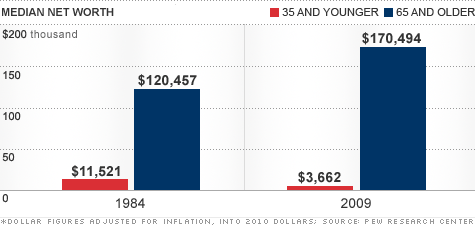
In 1984, households headed by people age 65 and older were worth just 10 times the median net worth of households headed by people 35 and younger.
But now that gap has widened to 47-to-one, marking the largest wealth gap ever recorded between the two age groups.
"We don't know how the story ends, but we know how the story is beginning," said Paul Taylor, executive vice president of the Pew Research Center. "At the beginning, today's young people are not doing better than yesterday's young adults."

The 53%: We are NOT Occupy Wall Street

Households headed by adults ages 35 and younger had a median net worth of $3,662 in 2009. That marks a 68% decline in wealth, compared to that same age group 25 years earlier.
Over the same time frame, households headed by adults ages 65 years and older, have seen just the opposite. Their wealth rose 42%, to a median of $170,494.
So why the growing chasm?
Whether by choice or due to the weak economy, today's young people are getting their independent lives started later in nearly all respects, taking out more debt, living with parents longer and putting off key milestones like employment, marriage and home ownership longer.
Some of those trends come hand in hand with more young people attending college, which can be a double-edged sword.
While those college credentials could lead to income gains for many young people down the road, surging tuition costs are also leaving them burdened by more student loans than prior generations.
Overall, 37% of the young households held zero or negative net worth in 2009, up from 19% in 1984.
Grandpa still works, kids can't find jobs
Perhaps the biggest factor leading to the wealth gap between the ages though, is the housing market, the Pew Center said.
While rising home equity helped drive wealth gains for the older generation over the long-term, younger people had less time to ride out the housing market's volatility -- especially its most recent boom and bust.
"Most of today's older homeowners got into the housing market long ago, at 'pre-bubble' prices," the report said. "Along with everyone else, they've been hurt by the housing market collapse of recent years, but over the long haul, most have seen their home equities rise."
"For young adults who are in the beginning stages of wealth accumulation, there has been no such luck, at least so far."
Net worth includes the sum of a household's assets (like equity in a home, car and savings and retirement accounts) minus its debts (like mortgage, car and student loans and credit card debt). To top of page
© 2011 Cable News Network
__________________________________________________________

Credit: Reports and photographs are property of owners of intellectual rights.
Seniors World Chronicle, a not-for-profit, serves to chronicle and widen their reach.