Remember ME - You Me and Dementia

Showing posts with label Policies Politics. Show all posts

April 15, 2013

Senior Citizens to Impact 250 Loksabha Seats in coming Election


MUMBAI , INDIA / POLITICS / APRIL 15th , 2013 

By Sailesh Mishra

Indian Politics ‘Newest’ Vote Bank: Senior Citizens to Impact on 250 Loksabha Seats in coming Election


Taking a cue from recent study “Social Media & Lok Sabha Elections”, by IRIS Knowledge Foundation and supported by the Internet and Mobile Association of India (IAMAI), on how Facebook and other social media will impact 160 seats in coming Election, what immediately came to my mind was Elder Population impact on Indian Democracy. I have been trying to market this idea since launch of Silver Innings in April 2008. 

As on 2012 Senior Citizens Population in India is 100 million (10 crore) that comes to roughly 10% of Total Population.  But when we take into account the Total Voting Population i.e. 18+ age group, then Senior Citizens becomes roughly 26% of Voting Population, here I have not taken into account Senior’s influence on Family voting. 

Indian Parliament has 543 constituencies / seats and this 26% strong Vote Bank of Senior Citizens will surely impact more then 250 constituencies. This ‘new’ Senior Citizens Vote bank always existed but no one including elders ever realised their strength . This time 2013/14 Parliamentary and State Election will be change in new thought process towards our elders , they deserved to be respected and cared for as our great tradition need to travel in this new speed changing society . 

I would be happy if any research agency or students take up this interesting subject of ‘Senior Citizens Voting Impact on Indian Politics‘. 

In recent times, since last 3 years there has been contestant activity by most of the political parties to woo Senior Citizens by organising onetime events, trips, goodies etc , but they have failed to make a concrete Long Term Policy & Programme for doubling Ageing population . Government , Politicians and Political parties are Ageing but they don’t bother about Ageing population , which many demographer describe as ‘ Silver Tsunami ‘ , which will have huge economic and social impact on India’s growth . Not to forget the same story will repeat in most of the developing countries. 

Due to advocacy and awareness campaign like ‘ 16th August National Protest Day’  by organization’s like AISCCON, Silver Inning Foundation and a united front called Join Action Committee (JAC) since 16th August 2010 , of more than 32 All India organisation’s working for and with Senior Citizens and newly formed  Pension Parisad ; there has been marked improvement in channelizing & mobilising Senior Citizens as united group demanding basic rights from central and state governments . Senior Citizens pan India, has been slowly realizing their strength and can’t be fooled any more by this goodies of politicians.

Social Media including Facebook and Twitter, has added new type of activism and in fact renewed the whole advocacy movement, Silver Innings a pioneer in social media usage for ageing and many youth and elders have taken this technology route for outreach and mobilising elders and their family.

Iam happy that , Elders like always will give shape to our Future , whatever they demand today will be for betterment of more then 85% of total population. This strengthen my firm view that ‘Our Elders Are Change maker’s ‘, the change we all want to see.


About Author: 
Sailesh Mishra is Founder President of 'Silver Innings' a socail enterprise and Silver Inning Foundation, a NGO working with Senior Citizens and has more then 6 years hard core activist experience in Ageing domain . His unique PR and ICT tool usage for Ageing has made him Internationally known Gerontology Consultant.  He may be contacted at silverinnings@gmail.com


________________________________________________________
Credit: Reports and photographs are property of owners of intellectual rights.
Seniors World Chronicle, a not-for-profit, serves to chronicle and widen their reach.

November 3, 2012

INDIA : A piece of Mumbai at the UN

MUMBAI , INDIA / THE METROGNOME / SOCIETY / OCT 20, 2012

By Vrushali Lad 

A slight and unassuming man, Sailesh Mishra (45) comes across as soft-spoken and pliable. But then he begins to describe how he got associated with the senior citizens episode on Aamir Khan’s TV show Satyameva Jayate. “I got a call from Aamir Khan Productions in September 2011. A woman called saying that she wanted to meet me for an episode they were shooting on senior citizens for the show. Since we get many such requests (at his Mira Road-based NGO Silver Innings), I asked them to send me a letter and then we’d see.

      Sailesh Mishra talks about representing India at the UN, and refusing to do Satyameva Jayate’s senior citizens episode in its original format.
The letter was brought the very next day, while the director of the show explained the concept of the episode in detail. But I soon realised that they were planning an episode to show elderly people as sad, abused, dependent human beings. I immediately told the lady, ‘Please tell Mr Khan that if this is what you want to portray on the show, I don’t want to be a part of it.”

Sailesh has always been a champion of the “happier side of old age”, which was why he started his NGO, Silver Innings, in 2008, as a means to help create a “sustainable gerontology”. He explains, “We often berate those who we feel are not taking care of the elders in the family. But you must understand, most children are not bad, they don’t wilfully neglect their parents. It is just that there are not enough options created by the government and society when it comes to elder care. Unlike in the West, we don’t have such services as assisted help for the elderly, or a service to provide groceries, or cooked food, or do other chores. We don’t even have enough NGOs that work for the causes of the elderly.”

Sailesh’s NGO was registered with the United Nations’ Open Ended Working Group (OEWG) on Ageing convention held annually in New York, last year, owing to the efforts of Susan Somers of the International Network for the Prevention of Elder Abuse (INPEA). “I got the opportunity of participating in the 3rd such OEWG held this year. On the opening day, the Indian ambassador gave a rosy picture of the current scenario of health care for the elderly in India. He even had the nerve to say, ‘Why do the elderly need rights? Their development is the responsibility of the society and their families. What can the government do?’”

To Sailesh’s huge amazement, he got the chance to make a statement on the floor of the House. “Only six people got a chance to speak that day, and I was the first,” he beams. “I gently but firmly refuted what the Indian ambassador had said, and I stressed the need for the government to be more proactive in implementing several schemes for the elderly in India. I didn’t see him for three days after that!” (Read Sailesh’s statement made on the floor of the House here.)

Of the member states, Costa Rica and Argentina were the most passionate about promoting the cause of gerontology, he says. “These two would even hold a briefing for NGOs every morning. But the EU and the US were extremely against the state having a stake in elders’ care, because they do not want to spend on it.”

An interesting dimension to this issue, he says, is that the Western countries, while reducing budgets assigned to social welfare, are aggressively studying the family concepts prevalent in south Asian countries, where parents and their children live together all their lives. “But by contrast, we in India are going towards the Western concept of nuclear families and even smaller units. Where does that leave our elders?”

But what he took away from his UN outing was the “inspiration” he felt after meeting people who had been working for the cause of elder care for decades. “Meeting such dedicated people tells you that you are on the right track, and that you still have so much to learn,” Sailesh says.


His own brush with the elderly

In 2004, Sailesh was working with the Dignity Foundation, a time that he says was when he “accidentally came into this field.” He says, “Through the Foundation, I was sent to Neral to help in the building of the elders’ township. I found that getting the architecture changed to be senior citizen-friendly was an uphill task. The architect just couldn’t understand why I wanted land gradients to be gentle, why appliances and cabinets needed to be at eye level, why the fittings and fixtures had to easy to use,” he remembers.

He stayed on as a resident at the township, monitoring its daily working and putting in work at the 24-hour dementia centre there. “I had varied experiences while dealing with sufferers of dementia. Many times, we didn’t know how to deal with them. That set me thinking. Nobody discussed this issue, and there was nothing written about it.” He started writing articles about his experiences, posting them on the Internet. “I think I would have found this cause at some point in my life,” he muses. “I come from a family of 100 people, and we all stayed at a waada at Palghar. But when I was very young, my mother told me, ‘Don’t join in the family business. Do something different with your life. Everybody works for themselves, you should work for others.’”

He finally started Silver Innings and found the inner peace he had been looking for. “I give talks at several places, hold a lot of workshops, travel all over the country. But I never talk about the NGO. That was not why I started it. The focus has to be on the issue, and it is my job to plant the idea in as many people’s minds as I can.”


Engaging the young to help the old

Sailesh is a passionate user of social networking to further his cause, the rationale of which has been questioned by many. “People ask, ‘How many senior citizens use social networking? How will you reach them on the Internet?’ But I am actually targeting the youth and the middle-aged persons in industry. If I can convert them, they will go home and talk to their parents, or devise ways to reach out to the elderly,” he says.

A major problem facing India’s elderly is that their numbers are only set to rise in the coming years. “How are we, as a country, going to accommodate these huge numbers of people? It is time, and it has to be done right away, that the government actively think up ways to utilise this mass of people’s life experience, their working knowledge and their skills. What is the sense in forcing a person to retire at 60 years of age, if he or she is able to work? Also, there is an urgent need for industry to provide services to this huge untapped population. You can have small businesses that deliver cooked meals to elders living alone, or get elders in an area registered with a trusted firm that supplies domestic helps, repair mechanics and others. There is also a need to modify our architecture and infrastructure to become more elder-friendly. Most importantly, we need more old age homes (there are just six in Mumbai) and all of them should be inside the city, not banished to the outskirts.”

Sailesh Mishra can be contacted on silverinnings@gmail.com / sailesh@silverinnings.com. His NGO ' Silver Inning Foundation ' also runs an ageing centre, organises memory camps and runs an elder helpline, among other things.

© 2012 The Metrognome

________________________________________________________
Credit: Reports and photographs are property of owners of intellectual rights.
Seniors World Chronicle, a not-for-profit, serves to chronicle and widen their reach.

May 11, 2012

UK : The crisis in social care , Indifferent Civilised Society

LONDON UK / Mail Online / Society / May 8, 2012

By Dominique Jackson

The parallel universe of geriatric care is not somewhere most people visit willingly, nor regularly, if they can help it. Most of us cannot even begin to imagine the burgeoning twilight universe which exists alongside ours. After all, the care system only really hits the headlines when brave whistle blowers expose particularly shocking cases of neglect and abuse.
                                                                                                                                       
                     This is a terrifying indictment of how poorly we value the achievements of the older generation and of how quickly and how conveniently we forget the huge debt we owe them

I am not quite sure why most of us choose to remain so blinkered about the crisis in social care? After all, we are all going to get old one day; thus, someone, somewhere is probably going to have to help look after us and somehow, that care is going to have to be paid for. 

Today’s open letter, begging the Prime Minister to open his eyes to the care crisis, is signed by 78 charities and campaign groups, who are all working on the grim, often fraught and woefully under-funded frontline of care provision for the frail, elderly, disabled and otherwise most vulnerable members of society. They know all too well what they are talking about.

Surely, social care is the litmus test of a civilised society? The current crisis, both in funding and provision, is a terrifying indictment of how poorly we value the achievements of the older generation and of how quickly and how conveniently we forget the huge debt we owe them.

I sincerely hope that Mr Cameron takes a few minutes off from his busy day out with Mr Clegg, relaunching the aims of the coalition from a factory in Essex. I hope he takes enough time to read this important letter, to digest what it means and to decide to take some action.

Two years ago, when Messrs Clegg and Cameron stood side by side in the Downing Street Rose Garden, charities and the elderly lobby felt they had some cause for optimism. The coalition soon published a white paper on health care reform which promised “a sustainable legal and financial framework for adult social care” by the second session of parliament.

Yet today we are frustratingly no further on and the government looks increasingly out of touch with its growing numbers of elderly, and vocal, voters in the wake of the “Granny Tax” debacle.

The Queen’s Speech tomorrow is expected to include a vague nod to the importance of social care reform, but there will be no bill brought forward in this session. Thus, we have no hope of any realistic overhaul in long term elderly care for at least another two years.

This is two years too long for a shocking majority of elderly people and their family members, many of whom work as unpaid carers, and a huge number of whom are currently struggling to fund, or even to find, appropriate and adequate support and care. 

Tens of thousands of elderly pensioners are forced to sell their homes to pay for residential care. Many more thousands of senior citizens who do not have that option are trapped in the postcode lottery of care I wrote about on this forum only last week when I highlighted the plight of 99-year-old war veteran and dementia patient Bill Sandford, unable to move close to his daughter and her family because of a shortfall in local council funding.

The Commission on Funding of Care and Support, chaired by economist Andrew Dilnot, called for a limited liability model of social insurance, in which any individual’s liability for the cost of care would be capped at around £35,000, with the state coming in at this threshold.

However, implementing Dilnot’s proposals has reportedly been held up by rows within the Treasury over how to pay for the reforms. A much delayed White Paper on long term care will finally appear next month but is expected to focus mainly on issues such as improving service quality, safeguarding vulnerable patients and on personal budgets to allow greater freedom of choice. How on earth we are expected to pay for all of this is not expected to be directly addressed at all.

This is particularly bad news for those of our poorest senior citizens. Two thirds of the 400,000 pensioners in the country’s care homes are funded by the state and recent cuts to council funding have led inevitably to a drop in levels of staffing, recruitment criteria, provision of training and thus in standards of care.

A report on transforming social care for the poorest elderly people from the Centre for Social Justice think tank is also published today. It argues that the current means-tested system of funding is at breaking point and that the proposed Dilnot reforms ignore the plight of the war time generation who simply do not have any assets to sell.

The CSJ, which was established by work and pensions secretary Iain Duncan Smith while he was in opposition, hopes its findings may influence the politicians who are considering their response to Dilnot in cross-party talks ahead of the White Paper’s appearance in June. 

All this research and all these recommendations are all very well but what we really need  now is some joined-up thinking and some immediate action. We need an open and honest debate about the needs of the elderly and we should all, every single one of us, be involved. After all, we will all be elderly one day.

Our population is ageing and ageing fast. Almost 20 per cent, 11.8 million, of us are now over the retirement age. Of these, 1.3 million are already over the age of 85. Our rapidly ageing population means swiftly rising rates of dementia and growing legions of frail and vulnerable seniors, who are, whether they like it or not, dependent on younger generations.

It should not have to fall to a coalition of charities to have to highlight the scale and urgency of the challenge of social care reform but now that they have bravely brought the debate back into the headlines, it is high time for the government to wake up to this demographic time bomb and act.

© Associated Newspapers Ltd
 
________________________________________________________
Credit: Reports and photographs are property of owners of intellectual rights.
Seniors World Chronicle, a not-for-profit, serves to chronicle and widen their reach.
April 27, 2012

MALAYSIA: 'Home Help Services' Shows Govt Cares for Seniors

KUALA LUMPUR, Malaysia  / The Borneo Post / Nation / April 27, 2012

The ‘Home Help Services’ implemented by the Women, Family and Community Development Ministry recently proves that the government cares about the welfare of senior citizens.

Deputy Minister Datuk Heng Seai Kei said the service focused on senior citizens who were poor and staying alone, or with family but in need of assistance.

“Volunteer workers will attend a course to provide them knowledge, skill and understanding in various aspects,” she said in response to a question from Senator Norliza Abdul Rahim.

Heng said after completing the course, participants would be made volunteer workers and would visit old folks homes to do the daily routine, like cleaning the place, keeping the inmates company, doing shopping, paying the bills and providing health care for the inmates there. 


– Bernama
Copyright 2010-2011 BorneoPost Online
____________________________________________________________
Credit: Reports and photographs are property of owners of intellectual rights. 
Seniors World Chronicle, a not-for-profit, serves to chronicle and widen their reach.

April 19, 2012

NICARAGUA: Senior citizens threaten hunger strikes

GRANADA, Nicaragua / The Nicaragua Dispatch / News / April 17, 2012

Demanding Pensions: thousands of senior citizens are threatening hunger strikes if the government doesn't comply with its promise to provide social security pensions (Photo/ Tim Rogers)
Some 15,000 senior citizens will march on the National Assembly tomorrow to demand the Sandinista government comply with its aging promise to provide social security pensions.
Porfirio García, president of the National Union of Senior Citizens (UNAM), says if the lawmakers don’t attend to the group tomorrow, thousands of elderly Nicaraguans will declare an indefinite hunger strike in the street in front of the National Assembly.
García said Sandinista lawmakers Edwin Castro and Gustavo Porras and Social Security Institute director Roberto López promised the senior citizens in October 2011 that the State would start to pay social security pensions in the first months of 2012. But five months later, the government has yet to pay any pensions and is now ignoring requests to meet with the senior citizen group.
As a result, García’s said his group is resorting to the only form of protest that the government responds to: massively disruptive street demonstrations.
García said 15,000 elderly will be in the streets tomorrow and the protest will last indefinitely until the government responds to their demands.
NicaraguaDispatch.com © 2011 ____________________________________________________________
Credit: Reports and photographs are property of owners of intellectual rights. 
Seniors World Chronicle, a not-for-profit, serves to chronicle and widen their reach.

April 5, 2012

MYANMAR: Aung San Suu Kyi’s win is humiliation for the army

YANGON, Myanmar / The Economist Asian Edition / World / April 5, 2012

Aung San Suu Kyi: The Lady of all landslides 

Aung San Suu Kyi, born 19 June 1945

THE boisterous, joyful scenes throughout the evening of April 1st outside the headquarters in Yangon of the National League for Democracy (NLD) said it all. Myanmar’s main opposition party was on course for a huge victory in the day’s historic by-elections. Every ten minutes or so news of yet another unfeasibly good result would be posted up on a digital display screen facing the street, provoking even more ecstatic cheering from the huge crowd gathered outside. These were extraordinary scenes in a country that just over a year ago was a hushed and fearful military dictatorship.
Over the following days the government confirmed the NLD’s landslide. The party contested 44 of the 45 seats on offer to the federal parliament in Naypyidaw. These were the first elections it had taken part in since 1990, and it won 43 of them.....

Miss Suu Kyi, modest in victory, has helped. She insisted her supporters not indulge in triumphalism. But now it is up to the officers whether Myanmar is truly to enjoy the “new era” Miss Suu Kyi proclaimed the day after her triumph. Everyone knows where she now stands: just outside the presidential palace.

This is an extract. Click here for full report

Copyright © The Economist Newspaper Limited 2012

____________________________________________________________
Credit: Reports and photographs are property of owners of intellectual rights. 
Seniors World Chronicle, a not-for-profit, serves to chronicle and widen their reach.
April 4, 2012

UK: Two million pensioners face cuts to vital benefits

LONDON, England / The Daily Mail / Money / April 3, 2012

Why did we spend our lives saving?


By Lauren Thompson


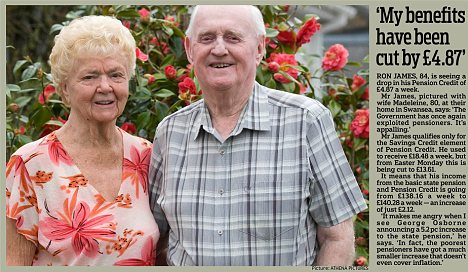
Almost two million pensioners are facing a cruel trap that threatens to deprive them of the biggest ever rise in the state pension and vital .elderly benefits.

Savage cuts to Pension Credit for pensioners who saved for their retirement have all but wiped out what Chancellor George Osborne boasted was the ‘largest-ever cash increase’ in the state pension, which takes effect this week.

And the cuts risk barring hundreds of thousands of pensioners from vital discounts, council tax and housing benefit, cold weather payments, and help with heating costs from energy suppliers.


The change has come as a shock to many pensioners who received the news in letters from the Department for Work and Pensions revealing their state pension for the new tax year.

It comes just a fortnight after the Chancellor announced changes to pensioners’ tax allowances — the so-called ‘granny tax’ — which could leave pensioners on incomes of little more than £11,000 a year £323 worse off.

Michelle Mitchell, director-general of charity Age UK, says: ‘It is unfair that older people on low incomes are having their benefits reduced. 

‘The Treasury is giving with one hand and then immediately taking with the other.’


Associated Newspapers Ltd
____________________________________________________________ 
Credit: Reports and photographs are property of owners of intellectual rights.
Seniors World Chronicle, a not-for-profit, serves to chronicle and widen their reach.

March 18, 2012

SAUDI ARABIA: Medical insurance soon for all Saudi citzens

DUBAI, United Arab Emirates / Zawya / Healthcare / March 18, 2012

MAKKAH - All Saudi citizens can be covered by medical insurance for a cost that does not exceed SR19 billion, said Dr. Fahd Al-Eneizi, chairman of the Shoura Council's medical insurance committee.

The Ministry of Health's budget is SR70 billion, he said, pointing out that citizens complain about the inability of the ministry to provide them with the necessary healthcare services.

"The ministry should play a monitoring role only and ensure the quality of healthcare services provided to citizens. It's difficult for the ministry to provide medical healthcare services and at the same time monitor the quality of these services," he said, according to a report in Al-Sharq Al-Awsat newspaper.

Dr. Al-Eneizi said that the Health Services Council, the Ministry of Health and the Cooperative Health Insurance Council are studying a health insurance program that is expected to be implemented in the next four years.

King Abdullah, Custodian of the Two Holy Mosques, wants to protect citizens and does not want them to feel financially-burdened, Dr. Al-Eneizi added. The program will be studied well and a report will be sent to the Minister of Health and the Chairman of the Health Services Council, he added.

Free medical healthcare programs have become rare and many countries do not have them anymore, he said pointing out that in over 150 countries healthcare is provided through insurance companies.

No matter how generous direct financing is, it cannot meet all the healthcare sector's needs, he said. 

Financing through insurance is more effective and will help healthcare centers to rely on the revenue earned from insurance to operate and provide high-quality services to attract more insured people, he added.

"This approach will also make public and private hospitals compete with each other to provide the best service. 

The country will also benefit from the revenue earned by the hospitals," he added.

© The Saudi Gazette 2012
____________________________________________________________
Credit: Reports and photographs are property of owners of intellectual rights. 
Seniors World Chronicle, a not-for-profit, serves to chronicle and widen their reach.

March 7, 2012

EUROPE: Proposed reforms in social protection will deepen gender gap in old age income

BRUSSELS, Belgium / AGE Platform Europe / March 7, 2012


International Women’s Day: ‘Equal Pay for Work of Equal Value’

On the eve of International Women’s Day and on the occasion of the EP Interparliamentary Committee meeting on 8 March on ‘Equal Pay for Work of Equal Value’, AGE Platform Europe and the European Women’s Lobby join forces to call for strong measures to meet the needs of older women in light of current reforms in social protection systems particularly with regards to pensions. 

“Calling for equal pay for work of equal value is important but not enough to ensure that women also enjoy equal rights to a fair and decent pension income. The gender pay gap and the gender pension gap are two sides of the same coin, stressed Cécile Gréboval, Secretary General of EWL. We must look at a care credit system which takes into account time spent outside of the labour-market for caring responsibilities for the benefit of the whole of society. Both women and men must be able to be workers and carers at different moments in their lives without being sanctioned in old age”, she said.   

EU leaders are increasingly pushing to align effective retirement age with life expectancy. While most countries are increasing the number of years to contribute to a full pension, little is done to compensate for the career breaks mostly taken by women take to care for dependent relatives.

“With the on-going drastic cuts in subsidised child and eldercare services, the burden of informal care on women will increase and women will face even greater difficulties to build adequate pension rights. This will aggravate the gender gap in old age income”, warned Anne-Sophie Parent, Secretary General of AGE Platform Europe, adding “the European Union has a key role in this field and its proposal for legal provisions on carers’ leave at EU level is most needed”.

Older female workers today face additional risks of poverty in old age as a result of the strengthened link between pension contributions and benefits. Unless transitional measures are introduced to avoid blaming these women for the career breaks they took to raise their children when no alternative was available, the gender gap in pensions will increase very severely for these cohorts. 

Another detrimental trend for gender equality is the increasing reliance on supplementary pensions to ensure an adequate replacement rate. This again will lead to a greater risk of poverty in old age if nothing is done to address the discrimination that women suffer in these schemes due to various reasons, including women having lower incomes, labour market segmentation and uncompensated career breaks for time spent out of the labour market caring for dependents. 

Europe's  economic recovery depends on its ability to make the best use of its human capital.  When reforming their employment, pension and care systems, Member States must ensure that all together their systems will contribute to  gender equality for all age groups and empower women to take a more active role in the labour market through age and gender-friendly labour markets and social protection systems.

Source: AGE Platform Europe
____________________________________________________________
Credit: Reports and photographs are property of owners of intellectual rights. 
Seniors World Chronicle, a not-for-profit, serves to chronicle and widen their reach.

March 4, 2012

MYANMAR: Suu Kyi tells rally she is back to health

BANGKOK, Thailand / Bangkok Post / Breaking News / March 4, 2012


Myanmar's opposition leader Aung San Suu Kyi 
during her campaign in Mandalay in central Myanmar 
on March 3. Suu Kyi insisted she was back to health 
on Sunday as she pressed on with her election campaign 
despite falling ill during a huge rally a day earlier. 
Myanmar's opposition leader Aung San Suu Kyi, 66,  insisted she was feeling better on Sunday as she pressed on with her election campaign despite falling ill during a huge rally a day earlier.


A tired-looking Suu Kyi was hailed by crowds of well-wishers shouting "May Daw (Aunty) Suu be in good health!" as she toured the region around the second biggest city Mandalay on her second day in the area. "I did not feel well yesterday but because of the people's kindness I feel better today. I am well now," she told tens of thousands of people who had gathered to hear her speak in Sagaing city, about 20 miles (32 kilometres) from Mandalay.


On Saturday the 66-year-old, who is travelling with two personal doctors, was forced to take a break during a speech to more than 100,000 people -- the largest crowd of her election campaign so far. Sources from her party said she had vomited several times before returning to the stage.
Suu Kyi's decision to run for parliament in April 1 by-elections is seen as the clearest sign yet of reform in Myanmar although, with only 48 seats up for grabs, the opposition cannot threaten the ruling party's majority.
Myanmar's new regime has embarked on a series of dramatic changes since it replaced decades of outright junta rule last year, including freeing political prisoners and trying to strike ceasefire deals with ethnic rebels.
Suu Kyi is widely expected to be ushered into parliament by the April vote, which observers say could legitimise a legislature still dominated by the army and former generals who kept her locked up for almost two decades.
The Nobel laureate told supporters that she was willing to reach out to the unelected soldiers who make up a quarter of the parliament to help her party in its attempt to change parts of the constitution.
"I believe we will succeed if we ask the military representatives inside the parliament to join with us in the interest of the people," she said.
Suu Kyi warned that changing legislation could be a slow process.
"We have to try. I believe that success will come step by step. Because the people are very firmed behind these changes."
Suu Kyi used her illness on Saturday as an opportunity to discuss the policies of her National League for Democracy (NLD) party.
"We would like to give a better healthcare system to the people," she said of the country's chronically under-invested health service.
The international icon has had a punishing travel schedule ahead of the by-elections and her campaign has already taken her across the country, even though she is running for a seat in a constituency near her hometown of Rangoon.
Last week she hit the campaign trail in the northernmost state of Kachin, where she appealed for unity among the country's disparate ethnic groups and called for an immediate end to conflict between the regime and Kachin rebels.
The NLD won a landslide victory in an election in 1990 while she was under house arrest, but the ruling junta never accepted the result.
April's vote will be scrutinised by observers after a 2010 election was marred by widespread complaints of cheating and by the absence of Suu Kyi.
Copyright The Post Publishing PCL 1996-2012
____________________________________________________________
Credit: Reports and photographs are property of owners of intellectual rights. 
Seniors World Chronicle, a not-for-profit, serves to chronicle and widen their reach.

February 24, 2012

USA: Obama's "Sneak Attack" on Senior Citizens

NEW YORK, NY / Forbes / ProsperNow / February 24, 2012

Strategies
By John Mariotti

Image via Wikipedia
There are a lot of senior citizens in the US now. The number is increasing by 10,000 every day as Baby Boomers turn 65—and start applying for Medicare and then shortly after that, for Social Security. These are the folks who once thought this would be the “Golden Years” when their years of hard work and savings and pension plans would let them live the good life, in places that are sunny and warm.
Then came the financial crisis and the stock market crash, the recession, and the “non-recovery.” Whatever “nest egg” they thought they had suddenly was mostly gone. Panicked, they sold their portfolio of securities on the way down, and then fearful of what came next, they didn’t buy back in on the way up. Thus they missed out on the stock market growth over the past 18-24 months. They are left with a much smaller “nest egg,” or none at all, and their pensions are either broke or being discontinued too.
As bad as that sounds, it’s not the “worst news.” The “worst news” is that President Barack Obama plans and policies constitute a multi-faceted “sneak attack on seniors.” Obama cleverly conceals this “sneak attack” while he assures seniors citizens he’s going to take care of them—and “nothing will change” for them. Nonsense!
Consider these actions, all planned or already created by Barack Obama and his minions:
1. Depress Interest Income: Interest rates have been held unnaturally low (by the Fed) for a very, very long time. Thus any money that senior citizens have in safe places like savings accounts, money market funds, and even most bonds, earns very, very little interest—between 0.3% and 2%.
2. Draining Remaining Social Security Funds: In his desire to show some economic growth and “buy votes” Obama created the “Payroll Tax Holiday,” which was supposed to be for a short time—like 6 months—because reducing the employee’s portion of payroll taxes by 2% takes that money directly out of what is used to fund Social Security. And now he has “gallantly” decided to do it again—for a year this time. This further drains a Social Security System which the president has refused to “fix and fund,” and continues to ignore as it becomes more and more insolvent.
But that’s not all. There’s more. Of course these are all part of the President’s grand plan to keep the (lukewarm) recovery going artificially until he can be reelected to a second term.
3. Dry Up Dividends, Gut Capital Gains: Obama’s latest tax proposal includes doubling the tax rate on dividends and capital gains, which is his way of paying for the irresponsible spending that is creating $5 trillion in deficits just four years. Every year Obama has been in office spending has exceeded revenue by more than a trillion dollars. The only way to over that is with tax increases, and while he talks about taxing the rich—a part of the taxes involved doubling the tax rate on dividends and capital gains. These two of the primary sources of retirement income for seniors, will be taxed more heavily and thus less desirable for companies to pay dividends.
4. New Taxes Hidden in Obamacare: There are hidden surprises in Obamacare—the massive health care bill that was supposed to fix everything—but doesn’t. The most notable one is a 3.8% tax on “unearned income,” which includes dividends, interest, and proceeds from the sale of a home (which many seniors are downsizing, and would use as a source of assets for retirement income.

5. Reduced Funding in Medicare and Rationing Health Care: This one might help seniors by shortening the time they’d have to endure the others, because part of the economic justification of Obamacare was to cut Medicare benefits by $500 billion over a period of years. How? By rationing health care—and refusing to pay for medical expenses incurred by people whose lives were nearing the end anyway. Medicare is already insolvent, and President Obama has not done anything to try fixing it—except take more money away from it.
After all, it doesn’t make sense to spend a lot on medical needs for really old people does it? Not to Barack OBAMA and his minions it doesn’t. They will do a “cost benefit analysis,” and if the medical costs are too high, their appointed commissioners will simply refuse to pay the benefits and let the older, more infirm senior citizens die (sooner). After all, seniors incur more than70% of their lifetime health care expenses in the last few years of their lives.
What the heck, Obama’s got a plan for everything. Save on interest rates, collect more taxes, depress dividend payments and capital gains, and sneak a few more hidden taxes in the 2000+-page Obamacare bill. If rationing health care reduces the number of people who live long enough to need that extra retirement income, it doesn’t matter that the first four steps in the Obama Economic Plan cuts the income of seniors so much their lives wouldn’t be very pleasant anyway.
To top things off, Obama keeps wasting money on high risk “green energy” projects like Solyndra, meanwhile blocking oil and gas exploration, stopping drilling and development of delivery projects like the Keystone pipeline. So what if America sends billions over to the Middle East for oil? So what if the cost of gas goes over $5/gallon. Seniors on reduced fixed incomes, with untreated medial conditions (under rationing) don’t need to be driving around anyway.
What a wonderful country full of HOPE and CHANGE that Barack Obama has planned for us senior citizens. Now hee wants four more years, so he can “finish the job”—or “finish us off”—or both.
I am not making this stuff up. It comes right off the reports about Obama’s plans. You might want to share this with all your senior citizen friends, to make sure they know who and what they will be voting for in 2012.
———-
John Mariotti is an internationally known executive and an award-winning author. His newest book, co-authored with D. M. Lukas, Hope is NOT a Strategy: Leadership Lessons from the Obama Presidency will be available early in March 2012 at www.amazon.com . Mariotti’s 2008 book, The Complexity Crisis was named one of 2008’s Best Business Books.
2012 Forbes.com LLC™
____________________________________________________________
Credit: Reports and photographs are property of owners of intellectual rights. 
Seniors World Chronicle, a not-for-profit, serves to chronicle and widen their reach.