Remember ME - You Me and Dementia

Showing posts with label China. Show all posts

May 3, 2012

CHINA : New homes for the old , Caring for the elderly

HANGZHOU / The Economist / Life/ Apr 21, 2012

Old-people’s homes are full, as attitudes to the elderly change

 EIGHTY-nine-year-old Zheng Jixuan is thrilled with the place where he will live out his dotage: a small but comfy room in the newly built wing of an old-people’s home in the city of Hangzhou, 180km (110 miles) south-west of Shanghai. Though Mr Zheng’s son lives in the same city, he does not have time to care for his father, so old Mr Zheng has moved into the Hangzhou City Christian Nursing Home. As a retired doctor, he cheerfully tends to the minor ailments of other residents. The home is “better than in America,” he says, and good value at just $250 a month, paid from his pension.
All together now


Mr Zheng’s nursing home draws together within its walls two profound changes in urban China: the growing number of old people whose children cannot or will not take care of them, and a government willingness to allow religious groups to take on the task. The Hangzhou home enjoys a subsidy from the local government of 10,000 yuan ($1,600) for each new bed. Funding has also come from Christian donors, and the deputy director, Zhou Wenjie, says any new resident must be a Christian or at least open to becoming one.

Non-government institutions account for about 20% of the 33,000 beds for the elderly in the city, says Sun Xiaodong, deputy director of another nursing home, the government-run Hangzhou Social Welfare Centre. But, he says, supply cannot keep up with demand. When Mr Sun’s nursing home opened in 1999, the first phase of 500 beds took four years to fill. Now, with a total of 1,400 beds, it has a waiting list of more than 1,000 names. Another 2,000-bed home is already being built, and there are plans for one that will house 5,000 pensioners.

Shifting attitudes to the elderly in China’s cities have created a huge market opportunity. Mark Spitalnik, an American who runs China Senior Care in Hangzhou, began forming a business plan five years ago for a nursing home that would charge nearly $5,000 per month. He did his market research on the golf course. (“Any guy that’s playing golf in China is in my target market, right?”)


Mr Spitalnik says that if he told his Chinese golfing partners the idea for his business on the first tee, they would say it did not make sense, because China’s tradition of filial piety requires children to look after their parents. He says he could usually persuade them otherwise by the sixth tee. Today, he says, such persuasion is no longer necessary. Other American care-providers are now rushing in too.


Mr Sun, the care-home director, believes the government should encourage more private nursing homes, including those run by religious charities, because the need is so great. Central-government policy may be helping. In late February the government issued a document that seemed to encourage religious groups to do charity work. The proposal applies only to officially approved religious organisations, and the Communist Party remains cautious about the influence of religious groups. But it is also aware of the growing needs of society, and its own inability to meet them.

Copyright © The Economist Newspaper Limited 2012.
________________________________________________________
Credit: Reports and photographs are property of owners of intellectual rights.  
Seniors World Chronicle, a not-for-profit, serves to chronicle and widen their reach.

April 28, 2012

CHINA: Huang Magan, 107, is one of this county's 81 centenarians

SHANGHAI, China / Shanghai Daily / Life / April 28, 2012

Six of 500 residents in this Longevity Town are centenarians


Huang Magan, 107, works on a loom at her home in Bama County in southern China's Guangxi Zhuang Autonomous Region yesterday. The county, known worldwide as a longevity town, has 81 centenarians. This number includes six in Huang's village of about 500 residents. Her husband died in 1999 at the age of 96. Huang only gave up farm labor several years ago when her children talked her out of it fearing she would have an accident. But she is still active in embroidery and loom work and household chores such as washing clothes. Her home is also popular with tourists who she greets almost every day. Corn porridge is a main part of her diet.


Copyright © 2001-2012 Shanghai Daily Publishing House

____________________________________________________________
Credit: Reports and photographs are property of owners of intellectual rights. 
Seniors World Chronicle, a not-for-profit, serves to chronicle and widen their reach.

CHINA: At 90, master holds 1st solo exhibition

SHANGHAI, China / Shanghai Daily / Art / April 28, 2012

"Contend"
By Wang Jie

PAINTER Zhang Gongque has never sought the limelight or pursued money and fame. He never held a solo exhibition in China. And he seldom sells a work of art, preferring to keep it at home.

Today, at the age of 90 and at the urging of former students, he is holding his first solo exhibition in China at the Shanghai Art Museum through May 4.

Sixty recent canvases are on display.

Zhang, a Shanghai native, was tutored by Wu Dayu and Lin Fengmian during his study at the National Art Academy in Hangzhou in the 1940s. The academy, known for teaching Western art concepts, nurtured Wu Guanzhong, Zao Wou-Ki and Chu Teh-chun, all big names in the history of contemporary art.

Unlike many of his peers, Zhang is very low-key and low-profile and he doesn't hob-knob with other artists, critics or gallery owners. He sells very few works and doesn't push to sell.

"I enjoy a private rendezvous with art," he says. "I enjoy the sunlight while painting in my garden. Art is something to be savored and I prefer to isolate myself with the outside world."

Early in the 1940s, Zhang started to pursue an abstract style and created a painting titled "White Wrapped by Dark." But during the "cultural revolution" (1966-1976), Zhang had to destroy many of his works to avoid physical attacks because of his bourgeois preferences.

He used a pair of scissors to cut "White Wrapped by Dark' into pieces but he kept the pieces, and in 1990 when he was invited to a joint exhibition in the United States, he retrieved the pieces and put them together to create a new work.

He stores his paintings at home, like treasures.

But his former students, all still admirers, organized the exhibition as they thought Zhang's art should be appreciated by the public.

"Zhang refuses fame and money, which is rare today on China's art scene," says Shi Jianbang, a noted art critic. "I am not only amazed at his veteran brushwork but his reverence and passion for art as well."

His subjects range from landscapes to animals and flowers, all rendered by implication.

He has been compared with the French Impressionists, but the artist sharply disagrees.

"I never, never think that my paintings derived a lot from Western art styles, my art originated purely from the traditional Chinese art style," Zhang says. "True, the medium of oil comes from the West, but in my eyes, medium means nothing, it's only a way to achieve what one wants to reflect.

Zhang still paints every day.

"Many people say that I appear younger than I am," he says. "Perhaps painting is my own way to build up my body and constantly keep my mind running."

Shui Tianzhong, vice chairman at the Art Theory Commission of the Chinese Artists' Association, says, "Zhang reveals the same rhythms that paralleled the great artists of his generation. In his latest works, free-hand writing replaces shaping and overlapping, which leads to a more spiritual and ideal level of art."


Copyright © 2001-2012 Shanghai Daily Publishing House. 

____________________________________________________________
Credit: Reports and photographs are property of owners of intellectual rights. 
Seniors World Chronicle, a not-for-profit, serves to chronicle and widen their reach.

April 22, 2012

CHINA: Medication recall order


SHANGHAI, China / The Shanghai Daily / Live in Shanghai/April 22, 2012


The Ministry of Health yesterday ordered all medical institutions to recall 13 types of medication reported to be contained in contaminated capsules.

It also required the medical institutions to stop using the medicines listed by the State Food and Drug Administration (SFDA) as being possibly polluted, according to a notice issued by the ministry yesterday.

The capsules were exposed by media to be made of industrial gelatin. This contains a greater amount of chromium than edible gelatin and can be toxic if ingested in excessive amounts.

The SFDA said yesterday more inspection teams have been sent to investigate the incident and find out those responsible.

Inspection teams from several departments, including the police, health authorities and supervision agencies, have been sent to Zhejiang, Hebei and Jiangxi provinces to supervise the investigation.

Those who refuse to cooperate in the investigation and try to cover up malpractice will be severely punished, it said.
Source: Xinhua

____________________________________________________________
Credit: Reports and photographs are property of owners of intellectual rights. 
Seniors World Chronicle, a not-for-profit, serves to chronicle and widen their reach.

April 19, 2012

CHINA: Secom to build luxury nursing homes for elderly in China

OSAKA, Japan / The Daily Yomiuri / Business / April 19, 2012

Jiji Press

Major Japanese security company Secom Co. said Wednesday it will launch a luxury nursing home business in China in partnership with a local real estate developer.

Secom Medical System Co., a Secom subsidiary, will set up a joint venture with Shanghai Lujiazui Finance & Trade Zone Development Co. The business will operate from 2015 in Shanghai, which has a large population of elderly people.

It will be the first elderly care facility operated by Secom in China.

Secom intends to create similar facilities in 18 Chinese cities, including Beijing and Guangzhou, where the company operates a security business for corporate clients.

The new company will be established with capital ranging from 100 million yen to 2 billion yen, of which at least 70 percent will be shouldered by Secom Medical System and the rest by the Shanghai-based partner.


© The Yomiuri Shimbun.
____________________________________________________________
Credit: Reports and photographs are property of owners of intellectual rights. 
Seniors World Chronicle, a not-for-profit, serves to chronicle and widen their reach.

March 25, 2012

CHINA: China Faces Challenge of an Aging Society

MONTEREY, California / The Women's International Perspective / March 24, 2012 


By Cesar Chelala 


Parallel to its economic development, China is facing the challenge of a rapidly aging population. This is happening at a time when urbanization and industrialization is quickly increasing in the country. It is a trend which has weakened traditional family support networks, particularly for the elderly. New policies are necessary to face this situation.

In 1979, China adopted a one-child policy to limit population growth and ensure economic stability. As a result, with fewer children and better living standards, the proportion of the elderly in the population has grown substantially and will continue to do so in the coming years. According to one study, within 20 years China will have 350 million citizens over the age of 60, more than the current U.S. population.

This situation will present special problems but also unique opportunities. This century’s leading countries will be those that consider their aging population not as dependent and disabled, but that will empower them to still be active participants in the country’s economic growth. This is what some people now call “active aging.”

In this regard, the IMF reported last year that China’s economy should surpass the U.S. economy in real terms in 2016. In spite of this, one of China’s greatest fears is that the country will grow old before it grows rich. As stated in UNFPA’s The State of World Population 2011, Professor Jiang Xiangqun, a gerontologist at Renmin University in Beijing has argued that when developed countries initially entered a period of significant population aging they had a much higher level of per capita income.

The situation of older people was also affected when state-owned enterprises trimmed their ranks of tens of millions of old workers who were let go with small pensions and were replaced by younger ones. The vast majority of retired older workers now have extremely low pensions which are almost irrelevant and, in many cases, make them unable to meet some basic needs. As a result, the vast majority of older Chinese live with their families, a situation that responds not only to the Confucian tradition of respect for age and experience but also to a law that was passed in 1996 making it a legal obligation to take care of the elders in the family.

According to some estimates, 98 percent of old people in China remain in their homes, or try to do so. Many remain mostly by themselves in “empty nests,” as their children migrate to cities for work or to start their own families in single-generation homes. Some researchers have called this phenomenon the 1-2-4 problem: one child taking care of two parents and four grandparents.

However, as China’s population ages rapidly, the young workforce available for economic growth diminishes. This may hinder not only the development of the country but also the quality of life for its senior citizens, since the young will be less able to support their elders. This is happening while the ratio of elderly dependants to people of working age will rise sharply. It is estimated that over the next few decades this ratio will rise from 10% in 2012 to 40% by 2050.

As the numbers of caregivers fail to keep pace with the growing elderly population more of them, particularly those with poor health, will seek care in specialized institutions. The proportion of elderly who develop diseases such as diabetes, heart disease, and different kinds of dementia will increase. It has been estimated that the total medical cost for treating these diseases could reach almost nine percent of China’s domestic product by 2025.

The government has responded to the challenge of elders’ care by constructing more nursing homes. However, most of these homes are located mainly in big cities, and their quality varies widely. Also, they only provide basic health care and services, and mostly lack trained social workers.

As things stand now, the Chinese government has to devise new strategies to deal with the demographic challenge of a rapidly aging population. It is necessary to improve a social security system to cover both rural and urban areas, improve the overseeing of welfare institutions and address old people’s special needs, not only physical but also provide them with mental health support. China’s health care system will have to address the shifting disease burden of an older population, such as the rising tide of non-communicable diseases.

At the same time, it is critical to increase the training of social workers through special courses that teach them to understand and deal with the needs of older people. It is also important to increase the retirement age, which is now 60 for men and 50 for women, taking into account that today’s life expectancy is now 73. With medical advances, people now can still be productive at later ages. How the government meets this challenge will be a measure of the kind of society China intends to build in the future.

Cesar Chelala, MD, PhD, is an international public health consultant. 


____________________________________________________________
Credit: Reports and photographs are property of owners of intellectual rights. 
Seniors World Chronicle, a not-for-profit, serves to chronicle and widen their reach.

March 7, 2012

CHINA: Elders' Problems – China and U.S.

LAKE OSWEGO, Oregon / The Elder Storytelling Place/ TimeGoesBy / March 7, 2011
By Johna Ferguson

As we age, we encounter different problems. Some of us lose weight while others gain for no apparent reason. Our eating habits haven’t changed that much, we think, so it must be something else like worry or stress maybe.

Then there is hair loss which has been covered by Ronni in one of her articles. It’s maddening, but nothing to do about it; either shave one’s head, wear a wig or just live with it. I think that’s what most of us have decided to do, like it or not.

Then there is the constant worry about increasing wrinkles. Some of us try face cream as a way to soften our looks but it’s never long-lasting.

Of course, there is always the alternative, a face lift or two or three like many women in the limelight have. But you know, pretty soon they can’t even smile and their faces have lost all their character.
Then there is the treatment that just fills in lips or whatever, but it isn’t long lasting either. I guess wrinkles are just another thing about aging that we must accept but perhaps unwillingly.

Another annoying thing is age spots. I almost want to hide my hands in gloves rather than have all those big brown spots show. When they were small I could pretend they were freckles, but now that is no longer possible. I have read they have whitening cream but I decided if that’s what’s supposed to happen as I age, I might just as well bite the bullet and accept them.

But how about all those protruding veins on the back of my hands? One look at them and one certainly knows I’m old as there is no way to camouflage them. Some have even popped out on my legs along with the brown spots.

And now with weight loss, I even have wrinkles on my legs if you can imagine. Oh, what bad shape I’m in. The only problem being I don’t feel like I’ve aged any for at least 20 years. Dream on, is what I say daily.
But now the last problem, incontinence. It’s one of those subjects no one wants to talk about but it may happen to many of us. Thankfully, I’m still okay but down the line who knows.

But I did bring an article from The China Daily, the English language paper in Beijing. The title of the article is, “How to Make an Adult Diaper Fashionable and Comfortable.”

The picture with the article is of four older Chinese woman models wearing cheongsams, those tight fitting long dresses with short sleeves and mandarin collars and slits up almost to one’s panty level. They were modeling in the Depend Cup, sponsored by Kimberly-Clark and 300 models paraded, from age 55 to 87 years old.

China Daily

There are 178 million people rapidly approaching old age in China, about 13 percent of the population and they are becoming increasingly more susceptible to conditions that cause incontinence: diabetes, prostate problems, Alzheimer’s and other chronic conditions.

Because of this, 481 million adult diapers were sold in China in 2010. The average price for an adult paper diaper produced by local companies is about 55 cents U.S. (4 yuan) when purchased in Chinese supermarkets. (An American factory worker earns on the average U.S.$23 an hour while the Chinese worker earns U.S.$8-$10 an hour and works 20 hours more a week.)

But in addition to the cost, comfort, convenience and practical use are also important factors. Elderly incontinent people want to maintain their normal lives when using these products.

Thus, this fashion show with many of the models wearing paper diapers, was a way for China to not only boost sales of its own products but also a way for the average Chinese woman to learn more about these products.

We’ll all grow old, like people all over the world, but somehow we will survive and with dignity.

© 2012 Ronni Bennett.
____________________________________________________________
Credit: Reports and photographs are property of owners of intellectual rights.
Seniors World Chronicle, a not-for-profit, serves to chronicle and widen their reach.

CHINA: Drinks tycoon sparkles on list of the world's wealthy

BEIJING, China / Shanghai Daily / Feature / March 7, 2012

By Lu Nengneng 


Zong Qinghou. File Photo October 2010 courtesy: Chine Informations
THE 67-year-old founder of a soft drinks company was yesterday named as the richest person on the Chinese mainland. 

According to the Hurun Global Rich List 2012, Zong Qinghou, CEO of Hangzhou-based Wahaha, is worth US$10.5 billion. Zong replaces heavy machinery mogul Liang Wengen, 55, founder of the Sany Group, as the mainland's wealthiest person.

The beverage tycoon ranks 78th on a list topped by Carlos Slim, Bill Gates and Warren Buffet, and is the only mainlander to have amassed a fortune of more than US$10 billion.

The Hurun Research Institute's list of those worth more than US$10 billion comprises 83 individuals with an average age of 66 and an average wealth of US$18 billion.

Besides Zong, the five other Chinese worth more than US$10 billion are all from Hong Kong, led by real estate and ports magnate Li Ka-shing, 84, who ranks 13th globally with US$24 billion.

His personal wealth shrunk a little following an 8 percent slump in the Hong Kong stock market. In contrast, Cheng Yu-tung, 87, ranking 49th, saw his fortune soar to US$14 billion after his self-founded jewelry brand, Chow Tai Fook, went public on the Hong Kong stock exchange last year.

The other Chinese billionaires worth more than US$10 billion are all property tycoons - brothers Thomas, 61, and Raymond Kwok, 60, ranking 25th with US$19.5 billion, and Lee Shau Kee, 85, ranking 32nd with US$18.5 billion. Real estate is the main source of wealth for China's billionaires, according to Hurun, but the sector ranks just seventh globally and contributes a mere 7 percent of the total wealth of the whole list.

Hurun said the finance and investment industry produced 18 percent of billionaires' wealth, the most among all sectors, followed by information technology businesses with 13 percent.

Slim, 73, a Mexican telecoms giant with extensive holdings in mining and banking, sits top of the list with a US$55 billion fortune.

Next comes Microsoft founder Gates, 57, who is still worth US$50 billion after selling shares in the company to fund his charitable work.

Investing magnate Buffet, 82, is third on the list with US$48 billion despite an 8 percent slump in the value of his investment arm Berkshire Hathaway over the past year.

Two-thirds of the billionaires on the list are self-made while a third became rich through inheritance, including all the 10 women listed.

The United States still holds the lion's share of the wealthy with 27 people worth more than US$10 billion living there. Russia has 10 and Germany 7. China and India tie for fifth place.

"It won't be long before entrepreneurs from countries like China and India become more dominant," Rupert Hoogewerf, Hurun's chairman, said. 

Copyright © 2001-2012 Shanghai Daily Publishing House

 ____________________________________________________________
Credit: Reports and photographs are property of owners of intellectual rights. 
Seniors World Chronicle, a not-for-profit, serves to chronicle and widen their reach.

March 5, 2012

CHINA: China to further reform medical, health care services

BEIJING, China / China.org.cn / Xinhua / March 5, 2012

China will further reform its medical and health care services in 2012 to better people's well-being, Premier Wen Jiabao said in his government work report delivered at the annual parliamentary session Monday. [Highlights of government work report]
Premier Wen Jiabao delivers a report on the
work of the government at the opening meeting.
[Photo/Xinhua]
"We will move faster to improve the medical insurance system covering the whole population, consolidate and expand the coverage of basic medical insurance, and enhance our capability to provide and manage basic medical services," Wen told the Fifth Session of the 11th National People's Congress opened Monday.
China would raise subsidies for medical insurance for non-working urban residents and the new type of rural cooperative medical care system to 240 yuan per person per year, according to the report.
The figure is up from 200 yuan in 2011 and a total of 832 million people are benefiting from the program that refunds as high as 70 percent of a patient's treatment fees.
China also encourages participation of foreign investors to diversify the country's medical care system.
"We will encourage and guide nongovernmental investment in hospitals, and speed up the creation of a system of hospitals with diversified ownership that is open to foreign participation," Wen said.
The State Council, China's cabinet, issued a circular in 2010 asking governments at all levels to simplify procedures to facilitate private and foreign investment in the health care sector dominated by public hospitals.
The reform of public hospitals will be pushed forward so that medical care is separated from pharmacy operations, a practice that have long been blamed for the country's excessive medicine prices, according to the report.
Also, China will extend the medical insurance to cover more diseases such as uraemia and lung cancer to provide aid for their treatment.

Xinhua
____________________________________________________________ 
Credit: Reports and photographs are property of owners of intellectual rights. 
Seniors World Chronicle, a not-for-profit, serves to chronicle and widen their reach.

February 26, 2012

CHINA: Charm pervades nooks, crannies in memory lanes off beaten track

SHANGHAI, China / The Shanghai Daily / Feature / February 25, 2012

AFTER exhausting all the well-known scenic spots in Minhang, some people develop aesthetic fatigue and complain there's nothing of interest left to explore.

That's not necessarily true. As the French sculptor Rodin once noted: "Beauty is everywhere. It is not that she is lacking to our eye, but that our eye fails to perceive her."

So let's open our eyes to the hidden beauty just around the corner and continue our tour of interesting old streets off the beaten track.

Our meandering along cobblestone paths and beside carved stone bridges took us last month to Duhang, Zhudi, Jiwang, Hexiangqiao and Maqiao streets. This time, our journey continues on to Chenhang, Zhuanqiao and Caohang streets, which also have plenty of old tales to whisper in our ears.

Zhuanqiao Street, faded past

The name Zhuanqiao originated from an eponymous stone arch bridge (qiao means bridge in Chinese) dating back to ancient times. The bridge, once the center of Zhuanqiao, was dismantled in 1969, but its memory remains in an area filled with interesting nooks and crannies. 

The street is not easy to find, which adds to its charm. There are a number of branch roads on Zhuanjian Road, and the north and south sections of Zhuanqiao Old Street are among them. They are filled with small grocery stores, a post office, street vendors and residences.

The best guide to the street are the old grey roof tiles still seen on buildings dating back to the Qing Dynasty (1644-1911). Nobody is quite sure anymore who once lived in the buildings.

The north section and south section of the street are divided by Zhuanjian Road, but there are signs at the entrance of the street to help you find your way.

It is a narrow street. Local residents are few and close-knit.

A visitor with a camera is immediately spotted as an "outsider" and may arouse a bit of curiosity. This area is off the tourist route, but strollers will find the local people warm-hearted and eager to serve as guides to their neighborhood.

The north section of the street is very short. You can see its end while standing on one side. Zhuanqiao Shuchang (a place for people to enjoy storytelling) is a two-story building.

It looks a bit worse for wear, though it's been renovated several times. The building was constructed during the Qing Dynasty.

Zhuanqiao Shuchang, founded in 1979, and was once a bustling place. It has seating for 240 and played host to huju operas and pingtan musical storytelling performances in its heyday.

Its owner, who declined to be identified, said sadly that the site was closed last year because of difficulty making ends meet.

"A performer of shuoshu (storytelling) charges 100 yuan (US$15) a day, and we can no longer afford it," he said. Admission to a two-hour performance usually costs about 2 yuan or less.

Shuoshu is a traditional one-man artistic form of storytelling - a great favorite of older people.

Now, the banister bearing woodcarving patterns is crumbling, the corridor is littered with rubble and old furniture lies randomly around. The owner said they will be burned as firewood.

The building is divided into several single rooms and rented out.

There is a teahouse near Zhuanqiao Shuchang. For local people, it's a place where the past survives. For decades, from dawn to dusk, people would congregate there to sip tea and talk.

Zhao Genyu, 78, a retired farmer, has been patronizing the teahouse for more than 50 years.

"I can sit here for hours and chat with others," he said. "It's my favorite pastime."

His house is 15 minutes away by foot.

"I like taking a stroll on the street everyday," he said as he sipped green tea. His distinctive Minhang dialect seemed smartly at home in the mottled old building.

In the past, there were shuoshu performances in the teahouse. Zhao said he used to enjoy them very much because they swelled on historical themes.

* Caohang Street, fine food and hip clothing shops
* Chenhang: three families
* Old streets bear silent witness to yesteryear 

Copyright © 2001-2012 Shanghai Daily Publishing House
____________________________________________________________
Credit: Reports and photographs are property of owners of intellectual rights. 
Seniors World Chronicle, a not-for-profit, serves to chronicle and widen their reach.

February 15, 2012

CHINA: Physicist, 92 and architect, 89, win top national award

BEIJING / People's Daily / China Politics / February 15, 2012

Chinese President Hu Jintao (C) poses for a photo with physicist Xie Jialin (R) and architect
Wu Liangyong (L) after presenting to them the 2011 State Top Scientific and Technological
Award at a ceremony held at the Great Hall of the People in Beijing. (Xinhua/Ju Peng)
Two Chinese scientistsphysicist Xie Jialin and architectWu Liangyongwere both given China's top science and technology award Tuesday morning at a high-profile annual ceremony held to honor excellent scientists andresearch achievements.

Attended by President Hu JintaoPremier Wen Jiabao and senior leaders LiChangchun and Li Keqiangthe eventstaged in the Great Hall of the Peoplesaw thetwo each conferred the State Top Scientific and Technological Award and awarded 5million yuan (794,900 U.S.dollars).

President Hu Jintao delivered certificates to the two top scientistsshook their handsand congratulated them on their achievements. Read more

Copyright by People's Daily
____________________________________________________________
Credit: Reports and photographs are property of owners of intellectual rights. 
Seniors World Chronicle, a not-for-profit, serves to chronicle and widen their reach.

January 24, 2012

CHINA: Facing Demographic Shift as Population Ages

WASHINGTON / The Washington Post /  Business / January 24, 2012


Bloomberg's Margaret Conley reports on China's aging population, its implications for the nation's economy, and the investment opportunities it may create. The latest government census shows 178 million Chinese were over 60 in 2009. That figure could reach 437 million, one third of the population, by 2050, the United Nations forecasts. While the elderly were looked after in the past by their children, urbanization and the nation's one-child policy have eroded the tradition of family care. (Source: Bloomberg)(Bloomberg)
____________________________________________________________
Credit: Reports and photographs are property of owners of intellectual rights.
Seniors World Chronicle, a not-for-profit, serves to chronicle and widen their reach.

January 7, 2012

CHINA: Senior couples celebrate golden wedding anniversary in Beijing

BEIJING /China Economic Net / Life / January 7, 2012

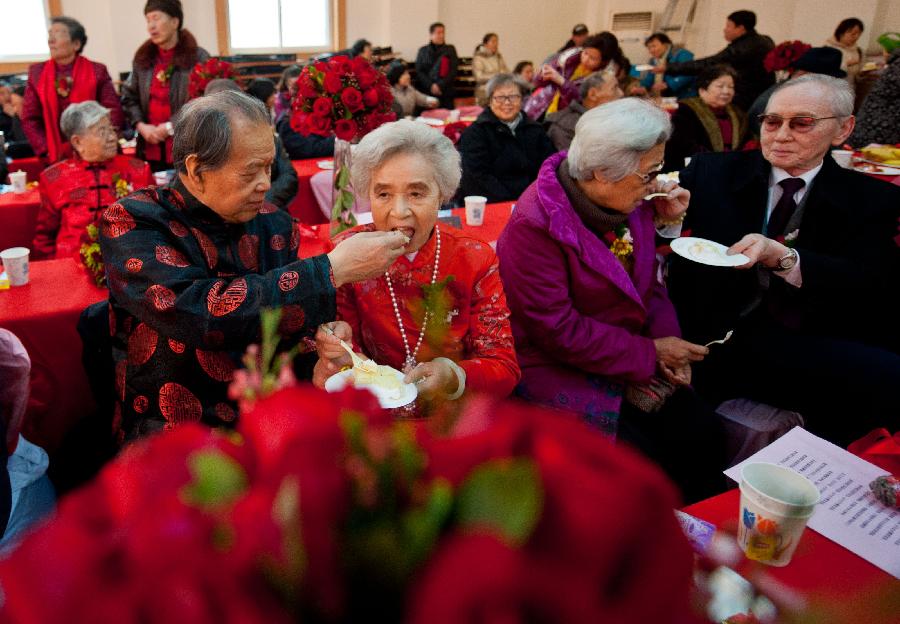
Couples Couples of senior citizens who have been married for over 50 years enjoy cakes in Beijing, capital of China, Jan. 6, 2012. More than 38 couples of citizens who have been married for more than 50 years attended a gathering to celebrate their anniversary of wedding in Beijing on Friday. (Xinhua/Zhang Yu)


Source: Xinhua
____________________________________________________________
Credit: Reports and photographs are property of owners of intellectual rights. 
Seniors World Chronicle, a not-for-profit, serves to chronicle and widen their reach.

December 26, 2011

CHINA: Stressed Chinese fight back -- with pillows

SHANGHAI / Reuters / December 26, 2011

A whirlwind of pillows bearing the names of bosses and teachers filled the air as hundreds of Chinese gathered to blow off stress in Shanghai, staging a massive pillow battle.

The annual event marked its fifth year with such a surge in interest from stressed young office workers and students that organizers held two nights of pillow fighting before Christmas Day and plan another for Dec 30.

"Nowadays there are many white collar workers and students that are facing huge pressures at work and at school, so we hope to give them an outlet to release their stress before the end of the year," said Eleven Wang, the founder and mastermind behind the epic pillow fights.

"Sometimes we have pressure on us by our bosses, teachers and exams, so today we can go crazy. Everyone will get to write onto the pillows the names of their bosses, teachers and exam subjects, and enjoy and vent to the maximum," he added.

"After releasing the stress, we can once again face our daily life with joy."

Pillows were handed out at the door as participants entered, then emotion stoked by a rock concert, with many on the floor of the huge event space rocking and waving their pillows in time to the music.

Then came the fighting.

Pillows filled the air, with many combatants opting for throwing rather than using them to whack opponents. A few hapless participants shielded their heads with as many pillows as they could hold, but most ventured eagerly in to the fray.

"I really enjoyed the fight, but my friend was useless. He joined in for two ticks and could not go on, he was afraid of getting beaten by other people," said 24-year-old Chen Yi.

"I thought it was pretty meaningful. I've just been working so much (at the office) and never get to break out in a sweat, so it felt really good."

Others gamely said they enjoyed the experience even though they ended up as attackees rather than attackers.

"I don't know who pushed me, but all of a sudden I was in the pile of pillows, where I became the target of many people, and was beaten by all sorts of people," said university student Zhu Shishan. "Very meaningful."

Reporting by Shanghai Newsroom;
Editing by Elaine Lies

Reuters
____________________________________________________________
Credit: Reports and photographs are property of owners of intellectual rights.
Seniors World Chronicle, a not-for-profit, serves to chronicle and widen their reach.

CHINA: Swindler nabbed after plastic surgery and 5 years in hiding

SHANGHAI / Shanghai Daily / Odd News / December 26, 2011

By Pan Zheng

A 52-year-old woman who had a plastic surgery and went hiding five years ago after cheating people of more than 2 million yuan (US$316,015) has been arrested, Chinese Business Morning View reported today.

Police in Anshan City, northeastern Liaoning Province said they received a report from the victim surnamed Liu in November 2006, saying she had been defrauded by a woman surnamed Ma in Beijing.

According to Liu, Ma said she could help Liu's daughter enroll in a Beijing university and charged her 300,000 yuan for this help. But it turned out to be a lie and Ma disappeared after taking the money.

Through investigations, police found Ma used to live in Beijing and had cheated victims of at least 2 million yuan, but they had no clues to her whereabouts.

A breakthrough came in October when police learned from Ma's mother that Ma was living in Zhengzhou in central Henan Province under the name Cheng Linlin.

Ma was caught on November 21 in suburban Beijing. Police said she looked like in her 30s and had a young boyfriend. They could hardly believe that she was the one they were hunting.

Ma told the police that she got to know her boyfriend on the Internet and she lied to him that she was born in the 1980s. The boy, also born in the 1980s, was completely taken in.

According to her confession, most of the money she defrauded had been used to buy a car and pay the daily expenses of her boyfriend.

Copyright © 2001-2011 Shanghai Daily Publishing House
____________________________________________________________
Credit: Reports and photographs are property of owners of intellectual rights. 
Seniors World Chronicle, a not-for-profit, serves to chronicle and widen their reach.

December 20, 2011

CHINA: My Mornings

LAKE OSWEGO, Oregon / The Elder Storytelling Place / TimeGoesBy / December 19, 2011

By Johna Ferguson

I don’t know how you start your day off; everyone has a different routine, that’s for sure. But this is mine in China.

First up at 7AM. For some reason my circadian clock is set at that time no matter where I am. A quick trip to the bathroom and then to my computer, but it takes time for mine to warm up and get through all its business.

While that happens I go to the kitchen and pour myself a big glass of orange juice and down my morning pills. Then back to the computer which is up and running and into the Post Intelligencer, the Seattle morning paper.

To start the day I think everyone needs a laugh so I first look at the comic strip Zits, about a high school boy and his mother and dad and then on to reading the local news.

I change to the Wall Street Journal to see how the stock market is doing, not that I can do a thing about it, and glance at the top new stories. Then on to The New York Times to read national news and then to Spiegel, the German news to get a different slant on it all and lastly, the China Digital to read their views on the latest world happenings and those in China.

Yes, I can look at all those newspapers here but occasionally, an article might be missing due to censors.

Then it’s time to tune into Time Goes By. I am an Independent, voting for whomever I think is best, so I don’t always agree with Ronni’s views, but I read them and listen thoughtfully to her messages. Finally on to her sub-blog, The Elder Storytelling Place.

But before I read that, I get up and get my bowl of instant oatmeal, a cereal available here. I also pour boiling water from the hot pot onto the coffee grounds in my French press. It will sit and get more flavorful while I eat my cereal, all the while reading the wonderful essays you have submitted.

Some I cry over, others I am amazed at the descriptive vocabulary you have used and many bring a chuckle and often an outright laugh.

They all refresh me in some way. They give me that little boost I need to start on my own writing with my second cup of coffee and a small piece of dark chocolate. Yes, I can’t break this habit and luckily my daughter-in-law keeps me well supplied, even here in China.

It was a long plane trip to Beijing and train trip to Qingdao and we felt just like cattle being herded into the pen for slaughter so this will be my last trip here. After all, I’ve been making this trip for 30 years, back and forth. Therefore I must cram in lots of memories now so I have more stories to write about in the future that might be of interest to you all.

But I have enjoyed my stay with my friendly magpies who daily visit our yard for food I leave them and being back with Chinese friends and families I lived with and lastly, feeling a little safer here from terrorists and protestors who have been so successful at scaring us Americans in my homeland. But enough is enough.

Here are some pictures of our little abode: my favorite rocking chair for relaxing with a good book, a little of our Chinese style furniture and lastly our office where I spend much of my time.

Johna's Rocking Chair
Johna's Furniture
Johna's Office
© 2011 Ronni Bennett.

Enjoyed reading this? Here's another Story by Johna Ferguson
____________________________________________________________
Credit: Reports and photographs are property of owners of intellectual rights.
Seniors World Chronicle, a not-for-profit, serves to chronicle and widen their reach.

December 18, 2011

JAPAN: Al-Qaida criticizes Japan, China over how they treat elderly

TOKYO, Japan / Japan Today / National / December 17, 2011

WASHINGTON

An al-Qaida magazine has criticized Japan and China over their treatment of the elderly, in a bid to promote the Islamic model, a website that monitors extremist sites said.

In a rare reference to East Asia by a movement usually focused on the West, the magazine of al-Qaida in Afghanistan highlighted an unspecified broadcast news report that said that theft by “isolated” elderly Japanese was increasing.

The Vanguards of Khorasan magazine, quoted by the U.S.-based SITE Monitoring Service, said that the trend showed how Japan has embraced “purely materialistic Western culture” since becoming a top global economy.

In the article titled “They Ate Their Meat and Spit Out Their Bones,” the magazine also voiced alarm about suicide rates in China among the elderly and city dwellers, saying that the Chinese had traditionally taken care of elders.

“If those poor people had been blessed with Islam, their state would have been different, whereas the elderly would receive appreciation, respect and good treatment,” the magazine’s editor Hossam Abdul Raouf wrote.

“They would enjoy the easy life and would not have to ask for money or resort to evil to get it, or commit suicide out of despair of the situation ever improving,” he said, according to the monitoring service.

He said that Islamic societies would protect even non-Muslims in old age, writing: “This is the greatness of Islam of which the ignorant are unaware and that the tricksters and stubborn refuse to acknowledge.”

It was unclear which reports the al-Qaida editor was citing and he did not appear to follow East Asia closely.

Explaining Japan, he wrote that the country “suffers from the problem of inflation,” while in fact Japanese policymakers have been battling deflation for much of the past two decades.

Japan has one of the world’s oldest populations, with the elderly enjoying high longevity and many younger people putting off having children.

China is also expected to face a major demographic shift as a result of its policy that restricts most families from having more than one child.

Al-Qaida in the past has threatened Japan over its dispatch of forces to Iraq and vowed to avenge deaths of Muslim Uighurs in China, but the militant group issues far more statements about the West.

© 2011 AFP
____________________________________________________________
Credit: Reports and photographs are property of owners of intellectual rights.
Seniors World Chronicle, a not-for-profit, serves to chronicle and widen their reach.
December 9, 2011

CHINA: No pause at menopause


BEIJING / China Daily / Life / December 9, 2011 

By Chitralekha Basu, China Daily

No pause at menopause
Author Xu Xi has portrayed Hong Kong, where she was born and grew up, as a backdrop and theme in many of her works.
Provided to China Daily

A new collection of short stories from Xu Xi focuses on themes close to the author's heart -namely mature women, sex and Hong Kong. Chitralekha Basu reports.

Chinese-American novelist Xu Xi's new book is a collection of 13 short stories, titled Access, inwhich the distinguished academic, author of nine books and the editor of three anthologies about Hong Kong is largely concerned with middle age.

Her band of menopausal women - who appear as central characters in most of these tales - are often angsty and insecure as they teeter on the brink of losing husbands/boyfriends, jobs,security and the meaning of life. But they are also capable of rising above their situations -sometimes, inexplicably, reconciling with them.

For most of these women - often confident, sassy and powerful, even if they might have their unguarded moments - there's no pausing at menopause.

"Perhaps the stories reflect the fact that I'm 57," Xu says, in a phone call from Hong Kong. The woman, who "inhabited the flight path connecting New York, Hong Kong and the South Island of New Zealand" until about two years ago, is more or less stationed in Hong Kong now. That's to be close to her twin concerns - a 92-year-old mother suffering from Alzheimer's and a fledgling writing school focused on writing from Asia. 

"I'm around people nearing retirement age. I'm interested in what aging does to the body, mind and spirit," Xu says.

For some of her women protagonists, menopause seems to accelerate desire, and how! They love their husbands but sleep with their friends' husbands, without apology (in the story Anon).They take off for Europe to have clandestine rendezvous with their boyfriends who are married to someone else, but when the date does not show up, they take a walk down the back streets of Stockholm, reflecting on the way their lives have panned out (Iron Light).

There is a lot of sex, and it comes in various forms, sometimes violent, illicit and even incestuous.

"There's always a lot of sex in my novels," Xu says, laughing. "It's probably the reflection of aworld in which nothing sexual is held sacred anymore, the way it was before the coming of the Internet."

Her engagement with sexuality - which Xu says began with a curiosity to find out about unusualsexual phenomena when she was still quite young - has opened up newer vistas, pushing her to explore spaces in which desire blurs the lines between gender identities.

No pause at menopause

"What gender we are is not a very clear-cut idea anymore, physically or otherwise," Xu says. "We have allowed homosexuals to come out. Women are no longer just seenas baby-making machines.

"This new openness has changed our ideas of society.Now we can use sexuality as a tool to explore humanity abit more provocatively. It's one part of ourselves we're nolonger totally in control of."

In the story Lady Day, the protagonist's apparently aberrant sexuality is a "deformity" that sets off a chain of personal disasters - being disowned by family and abusedby bullies in a British public school - but is turned into a weapon, a source of power, later in life.

As a posh hermaphrodite prostitute who services business tycoons and Saudi princes in her plush apartment not too far away from Wall Street in New York, Lady Day lives lifeon her own terms, even as her high-profile clients take a tumble after a journalist runs an expose. She even gets herrevenge on the high school bullies.

The great thing about Xu's protagonists is that none ofthem ends up a loser, although they could easily have done so, as the situations they find themselves in arepotentially lethal.

In Crying With Audrey Hepburn, a danseuse past her prime is relegated to taking part in cheap striptease shows. She had married for love, but her dancer husband could notcope with the strains of having to prostitute his art and committed suicide. Her solitary existence is fraught withlonging as well as an understated sense of betrayal.

"But even she doesn't feel like it's the most terrible thing to have happened to her," Xu says.

"She's not unhappy with her life. There is a sense of being at peace with her state."

Xu's protagonists are as disparate as they come - amasseur, an MIT graduate-turned-gambling pro, a 75-year-old proprietor of a New York-based financial magazine trying to hang on to the old order while coping with the tide of new-age marketing strategies.

The settings vary, too. They shift from a sprawling house with an un-weeded garden on theeast coast of New Zealand's South Island to the opulently laid-out Plaza Suite in New York.Often, the setting becomes a character invested with a role.

Hong Kong, of course, remains the pivot. It's where Xu keeps coming back in her stories, just asshe does in real life.

Born to Chinese-Indonesian parents - a businessman and a pharmacist, who always encouraged her to write and indulged her curiosity about things - Xu grew up in Tsim Sha Tsui district.

Although the city has featured both as backdrop and theme in most of her previous works -Evanescent Isles, Overleaf  Hong Kong, The Unwalled City, Hong Kong Rose, Chinese Walls -Xu finds Hong Kong an inexhaustible repository of stories.

The most significant change since Hong Kong's reunification with the mainland in 1997, Xusays, is that "Hong Kong feels like it's lost its way. It probably needs 'access'".

Hong Kong is also something of "a cliche in the Western world", she says.

"It is associated with cheap plastic flowers from the 1960s. Whatever informs our image of places also misinforms our ideas about them. It's this difference that's interesting to watch."

For her, watching Hong Kong seems like a lifelong occupation.

Copyright 1995 - 2010 China Daily Information Co.
____________________________________________________________
Credit: Reports and photographs are property of owners of intellectual rights. 
Seniors World Chronicle, a not-for-profit, serves to chronicle and widen their reach.

December 5, 2011

CHINA: Aging nation creates nursing home boom

BEIJING, China / The China Daily / Business / December 5, 2011

By Tania Lee (China Daily)

Increasing elderly population, burgeoning wealth open up market

Of all the unexpected things in Chinese society, moving into a nursing home is one of the most unusual.

Nursing homes in China may appear very large and glamorous on the outside, but sometimes what's on the inside reveals a totally different picture. Unlike those in some developed Western countries, experts say many nursing homes in China are overcrowded, receive inadequate government funding, have poor amenities and are often staffed by rural migrant workers with no professional training in the care of the elderly.

Chinese people feel ashamed or embarrassed to put their relatives "away" in nursing homes, but in many cases, it is the last or only resort.

The family structure in China is changing: Women, who once supported the family at home, have entered the work force in greater numbers. Chinese society has become much more educated. People who have better jobs and busier lives as a consequence are among those who have strayed from the strong tradition of filial piety and are thus helping to create the nursing home phenomenon.  

A senior citizen eats lunch beside a temple wall in Nantong, in East China's Jiangsu province. China's increasingly aging population has led to rising demand for nursing homes. [Photo/China Daily] 

This is where East meets West. Global investors have caught on to China's boom in care for the elderly. Given the country's enormous population, this socio-demographic shift symbolizes an opportunity for companies and investors to move into an increasingly lucrative and relatively untapped market.


The statistics

According to the National Bureau of Statistics, China now has more than 178 million people aged 60 or older, approximately 13 percent of the population. By 2042, the elderly will account for more than 30 per cent of the population and China will have the biggest aging-society problem of any country in the world, exacerbated largely by its one-child policy. The average lifespan of a Chinese citizen is now 73 years.

"The main issue is not that the population will age - that's a given," said Gordon Orr, director at McKinsey & Co, a global management consultancy. "It's how the government can afford to pay older workers, in terms of pension and other healthcare benefits."

Local governments are discovering that demand far exceeds supply. In rural China, 40 million elderly people will be living on their own during the 12th Five-Year Plan period (2011-2015) because their children are working elsewhere, testing the country's social services and insurance system.

Aging nation creates nursing home boom

Wu Yushao, deputy director of the Office of China National Committee on Aging, says the situation poses a huge challenge for China. "Services for the elderly are too weak to handle the situation and the welfare system is still backward and a large number of senior citizens in rural areas are not included," the Xinhua news agency quoted Wu as saying.

Nonetheless, the majority of care homes in rural China are funded and, in most cases,operated by local governments.

Until recently, the central government's focus had predominantly been on the lower socio-economic group in rural areas, an argument that explains why there hasn't been muchprofessional development in the sector.

"The reason why we have not done more work in China is because there was little provision inthe middle-income groups and very little in the high-income area," said David Lane ofThomsonAdsett & Partners Pty Ltd, an Australian consulting company that has worked in thesector in Asia since the 1990s.

"Most of them (developers and operators) can only really support the employment of localarchitects with very limited international assistance," he said.
Aging nation creates nursing home boom
Now, with China facing an aging population, the government has welcomed private and foreigninvestors to help cover the shortfall in facilities for care of the elderly. Private companiesdominate the nursing home sector in most major cities.

Copyright 1995 - 2010 .China Daily Information Co (CDIC).
____________________________________________________________
Credit: Reports and photographs are property of owners of intellectual rights.
Seniors World Chronicle, a not-for-profit, serves to chronicle and widen their reach.

December 2, 2011

CHINA: "I find people more interesting than chemistry," says comedian

SHANGHAI, China / The Shanghai Daily / Feature / Vibe / December 2, 2011

Funny man makes serious points

Students queue up as chemist-turned-comedian Joe Wong appears 

at Fudan University on Monday night, not for stand-up but for what was 
billed as an inspirational lecture about his life.

JOE Wong was living a Chinese immigrant's dream in America: a PhD in molecular biology from a prestigious university and a high-paying job with a pharmaceutical company. Then, to everyone's shock and dismay, he decided to do stand-up comedy.

His parents in China and Chinese friends in America thought he was crazy to "throw away" achievements, status and security and insane to try to amuse Americans by poking fun at them. American comedians told him Americans weren't interested in Chinese immigrants and their take on America. They said the language and cultural barriers were too high. They predicted he would bomb.

Today Joe Wong, who became a US citizen in 2008 and riffs about it, is a successful comedian in America, though less so in his homeland where US cultural-specific jokes (like one on parallel parking) are difficult for most people to understand. If his jokes need footnotes to be understood, then they aren't very funny, some Chinese say.

But here's one that works everywhere:

"Like many other immigrants, we want our son to become president of the United States. We try to make him bilingual, Chinese at home and English in public. But he said, 'Hey Dad, why do I have to learn two languages?' I said, 'Son, once you become the president, you will have to sign legislative bills in English and talk to debt collectors in Chinese." Big laughs.

"One of my motives for being a comedian is to tell immigrants' stories," said Wong who spoke to students at Fudan University this week, delivering an "inspirational lecture" that got a lot of laughs.

Bespectacled, 41-year-old Wong, who is somewhat geeky looking (a stereotypical Chinese scientist), was a hit on the David Letterman show in 2009 and again in September this year. He got a standing ovation at the White House Correspondents' Dinner for 2,400 guests last year and has appeared a number of times on the Ellen DeGeneres Show. Last year he placed first in the Great American Comedy Festival. His heavily accented English is not a turn-off.

The native of northeastern Jilin Province struggled in comedy for years but last summer finally quit his cancer research day job at a pharmaceutical company in Boston and devoted himself full time to comedy.

"I find people more interesting than chemistry," he said.

Wong's strength is his immigrant's perspective and insight - he landed in America when he was 24, with a huge vocabulary and fear of speaking aloud. After he got used to the culture shock and overcame the stage fright, he used his ethnic take on things to poke fun at America and American culture. He also challenged the stereotype of Asian immigrants as diligent but awkward and lacking in humor.

Wong describes his comedy as intelligent and observational, he doesn't do much physical comedy (though he did put on a show for photographers). "A lot of ethnic comedians in America make fun of their ethnic roots - Asians make fun of Asians," he said in his talk. "My comedy is slightly different. It's more about observing American culture from an immigrant's point of view, which US comedians may not think of."

In his newly released Chinese autobiography "The Tao of Humor," he writes: "My comedy is like a mirror. Americans can see their own society through the mirror."

On Monday night, there was a long queue outside as the chemist-turned-comedian appeared at Fudan University not for a show but for what was billed as an inspirational lecture about his life - part of his book tour. It was packed and standing-room-only as he walked to the lectern, wearing jeans and a dark red T-shirt. People started to laugh before he said a word, and the event turned out to be pretty funny, with lots of laughs, exchanges and applause throughout his 90 minutes. Wong spoke to reporters beforehand on the last stop on an eight-university tour in China.

Copyright © 2001-2011 Shanghai Daily Publishing House.
____________________________________________________________
Credit: Reports and photographs are property of owners of intellectual rights. 
Seniors World Chronicle, a not-for-profit, serves to chronicle and widen their reach.