Remember ME - You Me and Dementia

Showing posts with label End Of Life Issues. Show all posts

March 1, 2012

NETHERLANDS: Mobile euthanasia units to make house calls

LONDON, England / The Guardian / World News / Netherlands / March 1, 2012


New scheme called 'Life End' will respond to sick people whose own doctors have refused to help them end their lives at home

 in Berlin


Dutch euthanasia organisation Life-End will be offering its home services 
free of charge to Dutch citizens. Photo credit:  AP
A controversial system of mobile euthanasia units that will travel around the country to respond to the wishes of sick people who wish to end their lives has been launched in the Netherlands.
The scheme, which started on Thursday , will send teams of specially trained doctors and nurses to the homes of people whose own doctors have refused to carry out patients' requests to end their lives.
The launch of the so-called Levenseinde, or "Life End", house-call units – whose services are being offered to Dutch citizens free of charge – coincides with the opening of a clinic of the same name in The Hague, which will take patients with incurable illnesses as well as others who do not want to die at home.
The scheme is an initiative by the Dutch Association for a Voluntary End to Life (NVVE), a 130,000-member euthanasia organisation that is the biggest of its kind in the world.
"From Thursday, the Life End clinic will have mobile teams where people who believe they are eligible for euthanasia can register," Walburg de Jong, a NVVE spokesman, said.
"If they do comply, the teams will be able to carry out the euthanasia at patients' homes should their regular doctors be unable or refuse to help them," he added.
The Netherlands was the first country to legalise euthanasia in 2002 and its legislation on the right to die is considered to be the most liberal in the world.
But doctors cannot be forced to comply with the wishes of patients who request the right to die and many do refuse, which was what prompted NVVE to develop a system to fill the gap.
Sick people or their relatives can submit their applications via telephone or email and if the patient's request fulfils a number of strict criteria, the team is then dispatched.
Legal guidelines state that the person must be incurably sick, be suffering unbearable pain and have expressed the wish to die voluntarily, clearly and on several occasions.
According to De Jong, the team will make contact with the doctor who has refused to help the patient to die and ask what his or her reasons were.
More often than not, he said, the motivations are religious or ethical, adding that sometimes doctors were simply not well enough informed about the law.
If the team is satisfied that the patient's motives are genuine, they will contact another doctor with whom they will start the euthanasia process.
"They will first give the patient an injection, which will put them into a deep sleep, then a second injection follows, which will stop their breathing and heart beat," De Jong said.
Every year 2,300 to 3,100 mercy killings are carried out in the Netherlands, although opponents of the practice claim the figure is much higher because many cases are not registered. The Royal Dutch Medical Association (KNMG) supports euthanasia in principle if there is no alternative, but has distanced itself from the NVVE initiative, arguing that giving it the name Life End will foster the idea that it is for those who it said are simply "weary of life" rather than those who are sick.
It has also questioned whether Life End doctors will have the chance to forge the necessary relationship with a patient to be able to ascertain whether or not his or her life should be ended.
But Jan Kuyper, of the Life End Clinic Foundation, said: "We're not trying to push any boundaries here." He said it was quite possible that the mobile teams would not end up carrying out a mercy killing, either due to medical questions about the case or if doubt is cast on the patient's motives.
Little is known about the Life End teams. But one of the team leaders is believed to be a 67-year-old retired doctor who carried out 20 mercy killings during his medical career.
The teams would be limited to one house visit a week to minimise the psychological burden on them.
In neighbouring Germany, where mercy killings are strictly illegal, euthanasia opponents were particularly vocal in expressing their outrage at the developments. "This is an inhumane proposal," said the German Hospice Foundation, while the group Life Rights for Everyone called it a "warped understanding of [the meaning of] autonomy".
____________________________________________________________
Credit: Reports and photographs are property of owners of intellectual rights. 
Seniors World Chronicle, a not-for-profit, serves to chronicle and widen their reach.

February 21, 2012

USA: At end of life, why is it so hard to let go?

MADISON, Wisconsin / The Capital Times / Opinion / February 21, 2012

By Craig Bowron

I know where this phone call is going. I’m on the hospital wards, and a physician in the emergency room is talking to me about an elderly patient who needs to be admitted. The patient is new to me, but the story is familiar: He has several chronic conditions — heart failure, weak kidneys, anemia, Parkinson’s and mild dementia — all tentatively held in check by a fistful of medications. He has been falling more frequently, and his appetite has fallen off, too. Now a stroke threatens to topple this house of cards.
The ER physician and I talk briefly about what can be done. The stroke has driven the patient’s blood pressure through the roof, aggravating his heart failure, which in turn is threatening his fragile kidneys. The stroke is bad enough that, given his disabilities related to his Parkinson’s, he will probably never walk again. In elderly patients with a web of medical conditions, the potential complications of any therapy are often large and the benefits small. It’s a medical checkmate.
I head to the ER. If I’m lucky, the family will accept the news that, in a time when we can separate conjoined twins and reattach severed limbs, people still wear out and die of old age. If I’m lucky, the family will recognize that their loved one’s life is nearing its end.


But I’m not always lucky. The family may ask me to use my physician superpowers to push the patient’s tired body further down the road, with little thought as to whether the additional suffering to get there will be worth it. For many Americans, modern medical advances have made death seem more like an option than an obligation. Our culture has come to view death as a medical failure rather than life’s natural conclusion.
These unrealistic expectations often begin with an overestimation of modern medicine’s power to prolong life, a misconception fueled by the dramatic increase in the American life span over the past century. To hear that the average U.S. life expectancy was 47 years in 1900 and 78 years as of 2007, you might conclude that there weren’t a lot of old people in the old days. But average life expectancy is heavily skewed by childhood deaths, and infant mortality rates were high back then. In 1900, the U.S. infant mortality rate was approximately 100 infant deaths per 1,000 live births. In 2000, the rate was 6.89 infant deaths per 1,000 live births.
The bulk of that decline came in the first half of the century, from simple public health measures such as improved sanitation and nutrition, not open heart surgery, MRIs or sophisticated medicines. Similarly, better obstetrical education and safer deliveries in that same period also led to steep declines in maternal mortality, so that by 1950, average life expectancy had catapulted to 68 years.
For all its technological sophistication and hefty price tag, modern medicine may be doing more to complicate the end of life than to prolong or improve it. If a person living in 1900 managed to survive childhood and childbearing, she had a good chance of growing old. According to the Centers for Disease Control and Prevention, a person who made it to 65 in 1900 could expect to live an average of 12 more years; if she made it to 85, she could expect to go another four years. In 2007, a 65-year-old American could expect to live, on average, another 19 years; if he made it to 85, he could expect to go another six years.
Mass urbanization hasn’t been the only thing to alienate us from the circle of life. Rising affluence has allowed us to isolate senescence. Before nursing homes, assisted-living centers and in-home nurses, grandparents, their children and their grandchildren were often living under the same roof, where everyone’s struggles were plain to see. In 1850, 70 percent of white elderly adults lived with their children. By 1950, 21 percent of the overall population lived in multigenerational homes, and today that figure is only 16 percent. Sequestering our elderly keeps most of us from knowing what it’s like to grow old.
This physical and emotional distance becomes obvious as we make decisions that accompany life’s end. Suffering is like a fire: Those who sit closest feel the most heat; a picture of a fire gives off no warmth. That’s why it’s typically the son or daughter who has been physically closest to an elderly parent’s pain who is the most willing to let go. Sometimes an estranged family member is “flying in next week to get all this straightened out.” This person may think she is being driven by compassion, but a good deal of what got her on the plane was the guilt and regret of living far away and having not done any of the heavy lifting in caring for her parent.
With unrealistic expectations of our ability to prolong life, with death as an unfamiliar and unnatural event, and without a realistic sense of how much an elderly patient is suffering, it’s easy for families to keep insisting on more tests, more medications, more procedures.
When families talk about letting their loved ones die “naturally,” they often mean “in their sleep” — not from a treatable illness such as a stroke, cancer or an infection. Choosing to let a loved one pass away by not treating an illness feels too complicit; conversely, choosing treatment that will push a patient into further suffering somehow feels like taking care of him. While it’s easy to empathize with these family members’ wishes, what they don’t appreciate is that very few elderly patients are lucky enough to die in their sleep. Almost everyone dies of something.
Craig Bowron is a hospital-based internist in Minneapolis. 
E-Mail: craigbowronmd@gmail.com
This column first appeared in The Washington Post. Illustration by courtesy: LetMeGo.com
Copyright 2012 madison.com
____________________________________________________________
Credit: Reports and photographs are property of owners of intellectual rights. 
Seniors World Chronicle, a not-for-profit, serves to chronicle and widen their reach.

January 20, 2012

USA: Dignity therapy allows terminally ill patients to recount lives

SEATTLE, Washington / The Seattle Times / Health /January 19, 2012

Dignity therapy on upswing
CHICAGO — Peyton "Pete" Dralle wasted little time after he learned doctors could do no more to treat his throat cancer. He took spur-of-the-moment trips, got his affairs in order and, when he finally agreed to care at San Diego Hospice, he documented his life story.
Digital Vision
Using a technique called dignity therapy, psychologist Lori Montross interviewed Dralle five months before his death about meaningful life moments, lessons he'd learned and those he wished to pass on to loved ones. She transcribed their audio recordings, then read the transcript aloud to Dralle, who edited it to his liking. 
The resulting 14-page "legacy document" was bundled into a leather binder for him to bequeath to whomever he pleased.
Dralle's longtime partner, Lisa Amparan, remembers the sense of importance Dralle felt in being able to contribute something in his ailing state, and the relief he felt when it was finished, as though he'd gotten something off his plate.
"He got to tell his own story in his own words, and no one had to tell it for him," said Amparan, 48, who this month marks the anniversary of Dralle's death. She keeps the binder, which she decorated with photos, on a bedroom bookshelf, and leafs through it when she misses him most.
Dignity therapy, an exercise that aims to give terminally ill patients a sense of meaning, closure and posterity in their final days, has experienced a surge of interest recently thanks to research showing it improves quality of life more effectively than other methods of end-of-life care.
A study published this summer in the journal Lancet Oncology found patients who underwent dignity therapy were significantly more likely to report enhanced sense of dignity, better spiritual well-being and feeling more helpful to their families than those who underwent standard palliative care or client-centered care, which is when clinicians work one-on-one with a patient on current issues.
Earlier studies have shown dignity therapy also provides comfort to grieving families.
Study author Dr. Harvey Chochinov, a Canadian psychiatrist who developed the technique a decade ago and holds annual training sessions in Winnipeg, Manitoba, said he added training sessions this year in San Diego and Australia to accommodate rising demand. In December he published "Dignity Therapy: Final Words for Final Days," the first book to lay out a blueprint for his technique.
Although hospices for decades have engaged patients in reflective "life review," what distinguishes dignity therapy is that it provides training and a framework for helping patients produce a tangible legacy document, and there's empirical evidence that it's beneficial, said J. Donald Schumacher, president and CEO of the National Hospice and Palliative Care Organization.
"I think it's a very, very, very notable and useful technique, and I hope it does get adopted by many of the practitioners out there," Schumacher said.
Although published research on the effectiveness of dignity therapy has so far focused on patients with less than six months to live, a forthcoming study on the frail elderly shows similar outcomes, plus benefit to the health care workers who care for them, Chochinov said.
Chochinov, a psychiatry professor at the University of Manitoba, said he was inspired to learn more about the role of dignity in end-of-life care because Dutch studies had found "loss of dignity" to be the most frequently cited reason terminally ill patients pursued euthanasia to hasten death.
A host of factors can undermine dignity as people succumb to illness, including a loss of personhood, a loss of purpose and, prominently, perceiving themselves to not be appreciated by others, Chochinov said. Often there is fear that their lives won't have a ripple effect.
By asking probing questions — "When did you feel most alive" "Are there specific things you want your family to know about you?" — trained dignity therapists aim to capture what really makes a person tick. They also focus on generativity, a psychological term that describes the desire to guide the next generation.
"You can be in conversations with people where they may in essence be speaking to great-great-grandchildren they will never meet," said Montross, who trained with Chochinov and now is assistant director of the Palliative Care Psychiatry Research Program at the Institute for Palliative Medicine at San Diego Hospice.
Unlike a lot of psychotherapy, which pushes people to confront painful issues of their past, dignity therapy meets people where they are, so they can address the topics they consider most pertinent and write their own stories.
Sometimes the conversations are heartbreaking. Chochinov remembers an elderly patient who said it was too late to ask for forgiveness after drinking away his relationships, but he wanted his grandchildren to know who he had been so that they could choose better paths. Another dying man wanted his wife to know it was OK with him if she fell in love with someone new.
Sometimes reconciliation is more important than facts. Montross remembers a patient who said nasty things about his estranged sister during their interview, but upon hearing his words read back to him, he revised his comments to be kinder.
Strikingly, the most prominent topic that graces every conversation is love, Montross and colleagues found in a study on the logistics of implementing dignity therapy in hospice communities, published last year in the Journal of Palliative Medicine. Another universal theme was lessons learned in life, the most common being to accept and acknowledge one's own imperfections, Montross said.
Dralle's parting thoughts may have left a greater ripple than he realized.
"To be honest," said Montross, who spent 10 hours interviewing Dralle, "he held more grace in his dying 90-pound frame than men twice his size or half his age."
Can family help?
While everyone should be encouraged to have meaningful conversations with loved ones, dignity therapy is a technique designed for trained professionals who can handle emotionally intense interviews and respond appropriately if a patient's sentiments are potentially hurtful to others, said its creator, Dr. Harvey Chochinov.
Not all patients should participate, Chochinov said. People who are so ill that it is affecting their cognition, or who are so severely depressed that it is warping their perceptions of themselves and their past, should not undergo dignity therapy because they could create distorted memories.
Copyright ©2012 The Seattle Times Company
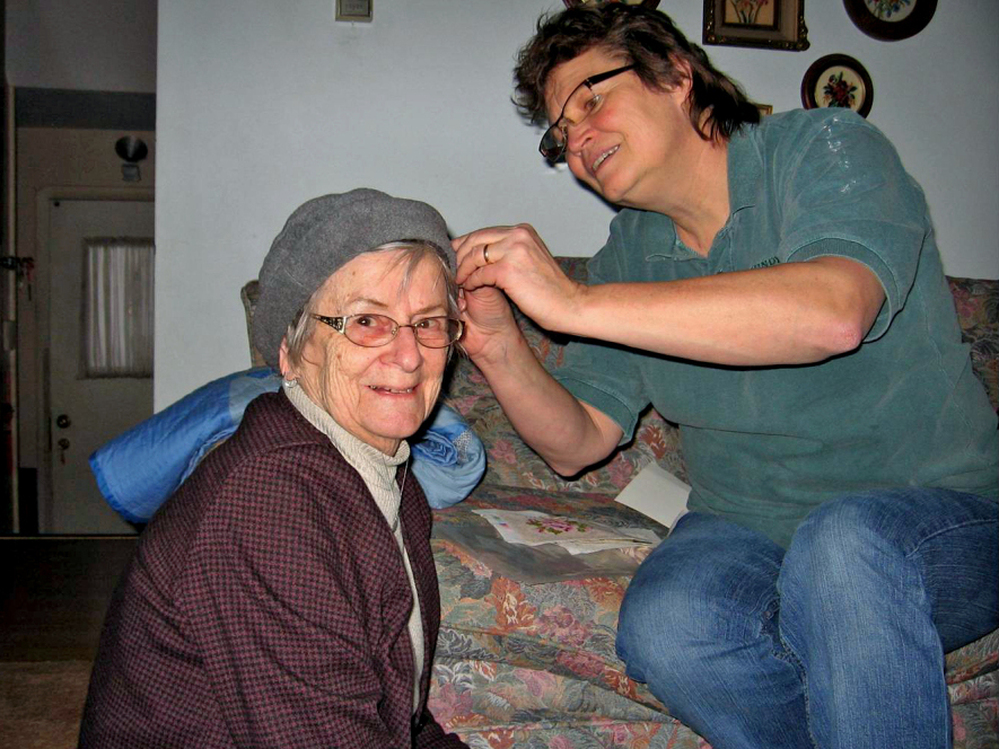
Kate Frego pins the turban of her mother, Aida Essenburg. Before Essenburg 
died in July of this year, she sat down with a dignity therapist to record 
the history of her life in what became a 50-page document.
Courtesy of Kate Frego

____________________________________________________________
Credit: Reports and photographs are property of owners of intellectual rights.
Seniors World Chronicle, a not-for-profit, serves to chronicle and widen their reach.

January 5, 2012

UK: Allow assisted suicide for those with less than a year to live

LONDON, England / The Telegraph / FrontPage / January 5, 2012

LAW AND ORDER


Doctors should be allowed to help terminally ill patients kill themselves – but only if they have less than a year to live, under proposals published in a major report today.


By , Social Affairs Editor

The independent Commission on Assisted Dying, whose members include several prominent peers and medics, wants GPs to be able to prescribe lethal doses of medication for dying people to take themselves.
Lord Falconer, chairman of the Commission on Assisted Dying Photo: Christopher Pledger
The report, published today, calls for the “inadequate and incoherent” law against assisted suicide to be scrapped following a series of high profile cases where patients have used the Dignitas suicide clinic to take their own lives.
Although helping someone to die is punishable by up to 14 years’ imprisonment and police still investigate all cases, there have been no prosecutions since landmark guidelines were set out almost two years ago.
The Commission says the situation is “very distressing” for families, “uncertain” for health workers and place a “deeply challenging burden” on police and prosecutors.
Under its plans, doctors would be allowed to prescribe drugs to end the lives of terminally ill patients who have fewer than 12 months to live provided they are judged to have the mental capacity and clear desire to die. 
If implemented, it could mean more than 1,000 people a year being helped to die in England and Wales.
The year-long inquiry admits legalisation would create a “real risk” of pressure on vulnerable people to end their lives, either from family members or a sense that they were a burden on society.
It says that to safeguard the vulnerable, disabled people and those suffering from dementia or depression would not qualify for help in killing themselves.
It also recommends that two independent doctors’ opinions are required before deciding that a patient should be entitled to assisted suicide, and that they should have a “cooling off” period of up to two weeks before being given the drugs that they must take themselves.
In addition, the report calls for better end-of-life care in hospitals and hospices across the country, as well as more open discussion about death.
The final report of the Commission, chaired by the former Labour minister Lord Falconer, concludes: “There is a strong case for providing the choice of assisted dying for terminally ill people.
“Even with skilled end of life care, the Commission finds that a comparatively small number of people who are terminally ill experience a degree of suffering towards the end of their life that they consider can only be relieved either by ending their own life, or by the knowledge that they can end their life at a time of their own choosing.”
Its recommendations are likely to be discussed in Parliament, with one of the commissioners, the Tory MP Penny Mordaunt, calling for a Westminster Hall debate rather than a Commons vote.
She added: “I think if it was a motion asking the Government to consider the Commission’s report and was limited to terminally ill people who met the criteria, I think you would get a much more positive response.”
No political leaders have publicly backed scrapping the law, not least because it would prompt claims that the Government wanted to kill off the elderly and ill at a time of cutbacks in health and social care.
Yet polls suggest that public opinion is moving towards a change, particularly among those who have watched loved ones suffer in their final days. A new survey highlighted by Dignity in Dying found that 61 per cent of people questioned would want Parliament to debate “the issue of Britons travelling abroad for help to die”.
There is also widespread agreement that the current regime in England and Wales, under which assisted suicide is illegal but perpetrators are not prosecuted if they act out of compassion, is unfair.
It favours those people with the money or practical support to travel to places where the practice is allowed, such as the “suicide clinic” Dignitas in Switzerland, while the poor or physically disabled are often reduced to botched suicide attempts at home.
Grieving relatives, and health workers who may have discussed suicide with patients, must deal with the threat of arrest and prosecution.
The new 415-page report, published on Thursday, represents the first detailed model of how a relaxed system could work.
It would allow assisted suicide to over-18s with less than 12 months to live, who have the mental capacity to decide to die and who have not been coerced into it.
This would mean that Debbie Purdy, the right-to-die campaigner who has Multiple Sclerosis but is not terminally ill, would not qualify for help, nor would Daniel James, the paralysed teenage rugby player who chose to end his life at Dignitas rather than live a “second-class existence”.
Sir Edward Downes, the former BBC Philharmonic conductor who died at Dignitas, would not have been given help to end his life but his wife, who had terminal cancer, would have been.
It would mean a regime more like that of Oregon, where “physician-assisted suicide” is allowed for those who have less than six months to live, than the Netherlands, where children as young as 12 are eligible for euthanasia, as are those experiencing “unbearable suffering” rather than a terminal disease.
Police would still be able to investigate cases where the criteria were not met.
The new proposals place much of the responsibility on doctors. They would have to check that a patient was eligible, tell them about possible treatment for their condition, ensure the lethal prescription was delivered safely, be “on hand” during the death, provide bereavement services to relatives, co-operate with police and give data to a national monitoring service.
But many medics fear it would compromise their relationships with patients and their duty to preserve life, with one expert telling the Commission: “The health service is not the environment for a death service.”
A spokesman for the British Medical Association, the leading doctors’ union, said: “"While there is a spectrum of views on assisted dying within the medical profession, the BMA believes that the majority of doctors do not want to legalise assisted dying.”
The Commission itself has faced accusations of bias as it was funded by Sir Terry Pratchett and chaired by Lord Falconer, both long-standing supporters of assisted suicide.
Several organisations, including the BMA, declined to attend its evidence hearings.
Dr Peter Saunders, Campaign Director of Care Not Killing said: “These recommendations if implemented will place vulnerable people under increased pressure to end their lives so as not to be a burden on others. This pressure can be especially intense at a time of economic recession when families and the health service are already feeling the pinch. The so-called right to die can so easily become the duty to die.”
One of the 11 commissioners, the Rev Canon Dr James Woodward, also said he was unable to back the report's conclusions.
"I believe that a broader societal debate is required before any attempt is made to move to a change in the law on assisted dying."
© Copyright of Telegraph Media Group Limited 2012
____________________________________________________________
Credit: Reports and photographs are property of owners of intellectual rights. 
Seniors World Chronicle, a not-for-profit, serves to chronicle and widen their reach.

November 27, 2011

CANADA: Critical care - Spending 10 weeks with patients facing death

TORONTO, Ontario / The Globe and Mail / Health & Fitness / End of Life / November 26, 2011

By Lisa Priest


Harriet Maclean at her partner's bedside in the ICU ward at Sunnybrook Hospital. Rheo Eybel was diagnosed with Glioblastoma, an aggressive form of brain tumour. (Moe Doiron/The Globe and Mail)


This is part of the Globe's in-depth series on the agonizing decisions surrounding end-of-life care in the 21st century. For the complete series, click here
Rheo Eybel was singing Brown Eyed Girl, gazing at his own brown-eyed partner on the dance floor. He was trying to ignore the karaoke singer on stage belting out the Van Morrison song – he’d gulped down enough liquid courage to get up and dance, but there wasn’t enough beer in the world to get him in front of a microphone.

MORE RELATED TO THIS STORY


Later that night in July, Mr. Eybel and his girlfriend, Harriet MacLean, walked back to the income property they were renovating that summer in Guelph, Ont., a half-hour north of their home in Fergus.

Mr. Eybel’s neck had started to ache. Whether he had hurt himself working on the house or at his job making truck parts, he couldn’t be sure. But a week later, the legs that had been dancing with abandon were going numb. By the month’s end, he wasn’t feeling a thing when he urinated.

“I knew then,” he said later, “that I was in trouble.”

That trouble was confirmed in a biopsy in Toronto on Aug. 1, when spine surgeon Joel Finkelstein opened Mr. Eybel’s neck to find “the most aggressive tumour possible of the spinal cord.”

And just like that, Mr. Eybel, then 44, faced a death sentence: A glioblastoma had infiltrated his spinal column, rendering him a quadriplegic. There was no effective treatment, no cure.

Placed on a ventilator in the critical-care unit at Toronto’s Sunnybrook Health Sciences Centre, Mr. Eybel could not speak, yet decisions on how and where he was to die were being rushed at him with urgency. He had quickly given Ms. MacLean his power of attorney.

The news was devastating. “I don’t know what we’ve done so wrong,” said Ms. MacLean, a straight-talking woman with a blond bob.

Nurse Bill Bisley, with blond spiky hair and a gold hoop in his left ear, tried to comfort her. These events were random tragedies, he told her, not the patients’ faults – he had seen that, in this unit, time and again.

So had everyone in the critical-care centre at Sunnybrook, the hospital with more intensive-care beds – 120 – than any other site in Canada. Here, death is a constant, almost routine event, claiming one in five patients who enter. Yet few who come to units like this have given advance directions, written or verbal, about how they wanted to be cared for in the event of a crisis.

For two-and-a-half months, a Globe and Mail reporter and photographer were granted unique access to one 20-bed unit here. They followed the cases of four patients and their families especially closely, both in the unit and for months afterward: Some had made decisions in advance and others had not, but all faced choices they could hardly have imagined before.

It is an increasingly vital matter for all Canadians. Historically a place for those who’d suffered traumatic injuries, this kind of unit is becoming a more universal place of last chances. Cancer patients, the frail elderly and those with progressive, underlying diseases are going out not with a bang but with the bleep, bleep, bleep of machines – the 21st-century way of death.

Too few of us talk about the consequences of our tendency to seek high-tech interventions, even in the face of Canada’s aging population: How much treatment is too much? When do you withdraw life support – “pull the plug”? And who decides?

“I worry that as we have put medicine out there as a potential saviour and, in fact, almost a new religion over the last 100 years,” said Rob Fowler, one of about 20 critical-care physicians here, “people have increasingly bought what we’ve sold: that cancer can be beaten and every death is a preventable death – that every death is, in some way, a failure.”
© Copyright 2011 The Globe and Mail Inc
__________________________________________________________
Credit: Reports and photographs are property of owners of intellectual rights. Seniors World Chronicle, a not-for-profit, serves to chronicle and widen their reach.