Remember ME - You Me and Dementia

Showing posts with label Family. Show all posts

June 19, 2020

Sailesh Mishra Creating an Elder Friendly India

Watch, listen and learn


Sailesh Mishra a Social Entrepreneur, Mentor and the Founder of Silver Innings Group a community dedicated to Senior Citizens in India joins Lori La Bey on Alzheimer's Speaks Radio. Silver Innings has worked towards creating an Elder Friendly World making aging a positive and rewarding experience. Sailesh has also published a Dementia Self Help book called 'Remember ME- You Me and Dementia'.

Also Please like and share this uplifting information here : https://alzheimersspeaks.wordpress.com/2020/06/18/sailesh-mishra-creating-an-elder-friendly-india/


Alzheimer’s Speaks Radio – shifting dementia care from crisis to comfort around the world one episode at a time by raising all voices and delivering sounds news, not just sound bites since 2011.


________________________________________________________
 Credit: Reports and photographs are property of owners of intellectual rights. Seniors World Chronicle, a not-for-profit, serves to chronicle and widen their reach.

May 16, 2012

USA: 'All About Family': Living In Multigenerational Households

CONCORD , NEW HAMPSHIRE / New Hampshire New / Family / May 14, 2012


The emotional and financial costs of caregiving have been a central theme in Morning Edition's special series called "Family Matters: The Money Squeeze." It profiles three families struggling with the complexities of living in multigenerational households and facing difficult financial decisions: how to afford care for an elderly relative while paying for college and saving for retirement.
"There's all these life milestones that we go through and caregiving is one of them. Yet it's often overlooked," says Denise Brown, who runs Caregiving.com, a online community for caregivers.
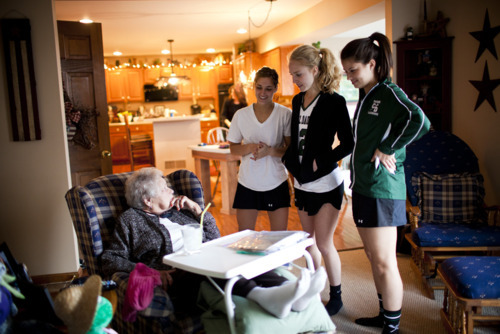
    AnnaBelle Bowers, 87, talks to her granddaughter Carley, 17 (right), and her friends
According to AARP, nearly 44 million Americans are taking care of an older family member at any given time. And, as the nation's baby boomers age, this number will only increase. In fact, as the population ages, the average worker will be a caregiver, according to Cheryl Matheis, senior vice president for policy at AARP. She recently spoke with Morning Edition host Steve Inskeep.
Currently, the average caregiver is female, 49 years old and working, and she spends roughly 20 hours a week on caregiving duties. And, the impact on the caregiver's life can be significant.
"[Caregivers] lose on average $325,000 in lifetime income in lost wages, lost social security, and lost pensions," Matheis says.
The National Alliance for Caregiving found nearly 70 percent of working caregivers reduced their work hours, took a leave of absence or chose early retirement due to their caregiving duties. According to a Pfizer-ReACT/Gallup poll, when caregivers did come to work, they were less productive than non-caregivers.
Many of our listeners wrote in about their own caregiving experiences.
Melissa Fitzpatrick wrote: "Thank you so much for this series! It really speaks to me. My mother-in-law, who has moderate dementia, moved in with us 1 1/2 years ago (shortly after I went through a particularly harrowing caregiving stint with my own mother when she was going through chemotherapy). Trying to figure out how to provide my mother-in-law with the care she needs, while also balancing taking care of my kindergartner and working has been tough."
Rebecca Hansbrough wrote: "These individuals family profiles strike a cautionary tale, not just for the senior members but for the middle aged children as well. One of the little spoken and ugly secrets is the fact that many of us will require long term care at some point in our lives and Medicaid won't cut it... I applaud these families for their ability to adjust in order to provide their loved ones with a caring and supportive environment."
Hank Scott wrote: "For me, it is a joy and a form of self reward to care for my elders, see to it there is a roof over their heads, food in the [fridge]. All the things they did for me as a young one. I have to admit without some aid from the government in the form of Social Security and Medicaid/Medicare, it would be almost impossible for me. So I not only appreciate the safety net, but willingly participate in it. The only sad part is the cost of all things has risen so much it makes it harder every year."
Ginger Hilgenberg wrote: "I am a caregiver for my mom who is 92 and still lives on her own. When she was in her seventies, she cared for her aunt... Now it is my turn to help, but it is very difficult some days. I am 52 and have one son in college, one still in high school. My husband is supporting us all as I am a stay-at-home mom. It's all about family, not politics, or money. Do the best with what you have. Isn't that what our mothers taught us as children?"

Copyright 2012 National Public Radio


________________________________________________________
Credit: Reports and photographs are property of owners of intellectual rights.
Seniors World Chronicle, a not-for-profit, serves to chronicle and widen their reach.

April 29, 2012

JAPAN: Japanese families on endangered list

TOKYO, Japan / The Japan Times / Life in Japan / April 29, 2012

By Michael Hoffman


The family is humanity's oldest and most universal institution. But its shape, size, aims and ideologies seem infinitely variable. Japan's families down the ages have been polygamous and monogamous, multigeneration and single-generation, swarming with children or comparatively, if not entirely, devoid of them.

Through vast changes over vast stretches of time, the family has transmuted but endured. It was sacred. One didn't argue whether it was a good thing or a bad thing, whether it worked or not; it simply was. The wonder is that now, when no thing simply is, when everything is open to question, the family as an institution survives. Will it indefinitely? 

It faces two main challenges. The first is the need for, and a felt entitlement to, self-fulfillment. Are mating, procreating and assuming responsibility for offspring the best of what life has to offer? Maybe an unmarried life of unfettered freedom offers broader horizons? That many Japanese have come to think so is suggested by a swelling pool of lifetime singles.
The second challenge is economic. Gadgetry proliferates and technological empowerment soars, but gradual middle-class impoverishment is a fact of early 21st-century life. Are marriage and a family, even if desired, affordable? Earlier generations, though far poorer, never asked themselves that question. It would have been tantamount to asking if life was affordable.
But life has changed, and so have priorities. Single, a low-salaried worker can live reasonably comfortably. Married, the lifestyle young adults have grown up taking for granted is often no longer possible without — sometimes even with — two incomes. Japan lags far behind other developed societies in opening career paths to women in general, and to mothers in particular. Most women are still compelled to choose — career, or motherhood? Sixty percent of working women quit their jobs prior to giving birth, the weekly Josei Jishin reports. No wonder career-minded women are increasingly turning their backs on marriage.
The Japanese symbol for infidelity. 
Courtesy:  Japanese-symbols.org

Regarding self-fulfillment and its possibilities within marriage, Spa! magazine had an interesting piece last month on something relatively new — or is it merely a new name for something agelessly old? The usual Japanese word for marital infidelity is furin. An alternative expression gaining currency is kongai ren'ai — literally, "romantic love outside marriage."
The article's centerpiece is a survey of 100 people, men and women, aged 30-45. Have they experienced kongai ren'ai? Yes, say 24 percent of the men and 20 percent of women. That implies a healthy stability for marriage — 76 percent of men and 80 percent of women haven't experienced it. But Question 2 in the survey, addressed to those who haven't, is: Why not? Fear of exposure, say 31 percent. Because it's morally wrong, say 21 percent. Coming a distant third (15 percent) is the only answer that would seem to justify all the hope and excitement that even a cynical and jaded age like ours invests in marriage: "Because I really like my spouse."
The perception that emerges from this survey, as from so many others, is that marriage is long but satisfaction is fleeting. You fall in love and think it's forever, yet the facts speak otherwise. Forty percent of Spa!'s kongai ren'ai men, and 38 percent of the women, say they sought romance outside marriage because of "sexlessness or sexual incompatibility." A typical elaboration comes from a 36-year-old woman: "After our child was born our relationship turned entirely family-oriented, and we stopped having sex."
So why bother? Why doesn't civilization finally outgrow the lovely illusion of marriage and embark on some other form of adult life, one based on harsh but solid reality? Here's one answer of sorts: "I want to enjoy ren'ai (romantic love) while maintaining my family as a foundation for my life," say 42 percent of Spa!'s philandering men, and 34 percent of the women.
When the heartland flounders, the countryside shows the way — sometimes. Mention Fukui Prefecture and the inevitable association, post-March 11, 2011, is with nuclear reactors — there are more of them there than anywhere else in Japan. But Fukui claims another distinction. It is considered Japan's happiest prefecture — partly because of the economic boost those now-sinister reactors have provided; partly also, as Josei Jishin magazine explains, because of its apparently seamless fusion of tradition and modernity — tradition as represented by three-generation households, once but no longer the norm throughout Japan; modernity by working wives and mothers. So many Fukui women work that those who don't invite disapproving comment. When it comes to women combining careers and motherhood, Fukui ranks No. 1 nationwide.
And the birthrate has risen accordingly. Fukui has its own local way of measuring birthrate: Not children per woman, the standard elsewhere, but children per employee, female or male, and at least seven maternity-friendly companies in the prefecture boast rates of 2.0 or more — the highest is 2.48 — well above the stagnant national birth-per-woman average of 1.39.
What constitutes maternity-friendliness? An easy return to work after maternity leave is one feature; flexible work schedules allowing working parents to attend to their children is another. Some companies Josei Jishin introduces have childcare facilities on the premises.
And the three-generation household, of course, means there's generally a baby-sitter at home, to say nothing of seasoned older people to whom younger family members can turn in times of crisis.
Has one of Japan's most traditional prefectures solved some of the country's most modern problems? Happiness and a rising birth rate are hard to argue with. So, however, is the fact that the nuclear family arose in the first place out of inter-generational tensions that had grown intolerable. Those tensions are encapsulated in a saying which Josei Jishin quotes in passing: "You don't need two women in one house." Have Fukui wives and mothers-in-law really learned the secret of coexistence? Should Japan as a whole be looking to Fukui for a solution to the endangered Japanese family?
(C) The Japan Times
____________________________________________________________
Credit: Reports and photographs are property of owners of intellectual rights. 
Seniors World Chronicle, a not-for-profit, serves to chronicle and widen their reach.

January 17, 2012

USA: The Truth About Your Grandkids' Parents

NEW YORK, NY / Grandparents.com / Family / January 17, 2012
There are all kinds, and they all bring challenges
by Georgia Witkin, Ph.D.

The Modern Grandparent's Handbook: The Ultimate Guide to the New Rules of Grandparenting, 
written by Senior Editor, Dr. Georgia Witkin, 
has been published by New American Library.
Here's an excerpt from Georgia's chapter, "The Truth About the Parents," a field guide to modern moms and dads:
The Panicky Parent
Today's parents are smart. They may even betoosmart — too keenly attuned to every possible danger that their children face. It's no wonder they're always on alert; 24-hour news channels fill the screen with constant updates about every abduction, accident, illness outbreak, schoolyard danger, and bus disaster. There are specials on children's learning problems, emotional problems, drug problems, allergies, and eating disorders. Talk shows discuss kids sexting, drinking, cyberbullying, and getting pregnant. The information is so abundant and immediate that our adult children are aware of everything that could ever happen to any child — and many are fearful it could happen to theirs. These fears can turn them into hovering "helicopter dads" and overprotective "smother mothers," ready to swoop in and rescue their children from every scraped knee or hurt feeling.

As grandparents, we can give our grandchildren's parents some perspective. We've been through it. When they were young, they survived riding bikes and climbing trees, viruses and infections, bullying and dead fish.Tell them!Remind parents that safety products like helmets and car seats work, that toys are much safer now, and that medicines have childproof caps. Help your children become more realistic about their children's lives by remembering their own childhood. Only you can do that. You were there then, and you're here now. Sometimes being a grandparent means parenting your grandchildren's parent all over again.
The Child-Centered Parent
Many parents today put their children at the center of the family. This doesn'tsoundlike a bad thing. Putting the kids ahead of their own needs, even ahead of their marriage, may seem child-friendly, but when it becomes extreme, it can lead to complications.
When a child is the absolute center of the family, she can grow up without boundaries. This can lead to a demanding, entitled kid and, eventually, a demanding, entitled adult. Some acting out might be accepted from a child, but future bosses and spouses will not be so tolerant.
Furthermore, being the center of the family is too much pressure for a child. Kids cannot fulfill all their parents' emotional needs and it's not fair to expect them to. Children in this position often feel they need to parent their parents — and that's not their job. It's yours. Be there for your children when they become parents. Remind them to take time for themselves and their spouses or partners. Offer to babysit. They can have a date night or weekend getaway, and you can spend extra time with your grandkids.
The Distracted Parent
Every grandparent can see it: When parents are stressed, children are stressed. It's like a virus that spreads from grown-ups to children. Children learn by watching, so when they don't get to see their parents relax, they're not learning stress management. They are learning to do what their parents do —distractthemselves instead of relax themselves. When parents spend time at the computer, playing with apps, watching TV, so do their children. Here's how to help your distracted child and your grandchild at the same time:
1. More Face Time.When the family is at your house, ban TV, texting, or answering e-mail at dinner or during "family time." Tell your child that you don't want to miss out on precious moments, and that you don't want your grandchild to think that they can distract themselves from the family, either. You're giving them an island of peace, and giving them ideas about family time that they can take back to their own home. And when your grandchildren are with you alone, give them as much face-to-face time as you can. Researchers find that face-to-face time from grandparents correlates with less anxiety in young children and less delinquency in teens.
2. Less Junk.Sometimes our children are so busy that they say yes to junk food without even realizing it, or pass it out as a pacifier or reward. (Actually, sometimes we grandparents do this, too.) But the Centers for Disease Control warns that child and adolescent obesity has more than tripled in the past 30 years, and that our grandchildren are chugging down three times as much soda as our children did.
Help your child and grandchild by fighting the urge to say yes to junk. I know that as grandparents we want every visit to be "the best," and so we treat our grandchildren to their favorites, including fast-food lunch. Think twice. Go just once in a while. At least you'll save your child from hearing your grandchildren say, "But Grandma lets us have candy!"
3. More Manners.Teaching children manners takes time, so manners are becoming scarcer as parents become more distracted. We may understand and sympathize, but we're also upset about watching some children run wild in supermarkets and talk back to their parents.
Politeness, kindness, respect for others, generosity, and empathy will all help children in life, so we want our grandchildren to develop these virtues sooner rather than later. Helping children learn manners is one area where grandparents rarely get flak. Most parents are thrilled if their child comes home from grandma's neater or more polite.
Parenting our children doesn't stop when they become parents. In fact, when they are stressed and distracted, they need us more than ever. We know what worries them and how to reassure and comfort them. We know what they are going through, because we've been there and done that. We know what we needed when we were harried parents, and what our parents might have done to helpus. Now we can pass it on. After all, when we are parenting our adult children, we are grandparenting at our best too!
Copyright © 2007-11 Grandparents.com LLC 
____________________________________________________________
Credit: Reports and photographs are property of owners of intellectual rights. 
Seniors World Chronicle, a not-for-profit, serves to chronicle and widen their reach.
December 27, 2011

INDIA: Abuse of senior citizens on rise

COIMBATORE, Tamil Nadu / Deccan Chronicle / December 27, 2011

By Pradeep Damodaran - DC - Coimbatore

While the gruesome attack on 90-year-old Rengarajan who was killed by his grandson at their family home in R. S. Puram might be a rare incident, the abuse that elderly citizens undergo within the confines of four walls of their home is quite common and prevalent, say psychiatrists and senior geriatricians.

Chennai-based senior geriatrician Dr Natarajan , who has been practicing for the last 30 years, pointed out the elders go through three kinds of abuse at homes. “The first one is verbal abuse wherein the caregiver screams at their grandparents or great grandparents and is quite common. The second and the most common form of abuse is psychological abuse while physical assault is rare, at least in urban areas,” Dr Natarajan said.

He said over the last 30 years of practice he has noted a steep rise in psychological abuse.

“Almost 50 per cent of patients I receive these days complain of psychological abuse. Although, youngsters these days stay in joint families for the sake of society, they isolate and neglect elders,” he said.

Many of the joint families remain broken where the grandfather or grandmother is confined to the car shed or some corner of the home.

Even the food they serve senior citizens is worse than what is given to a pet, the doctor point out. “I have had patients who come with ailments and when I suggest medications and scans, their children come to me and suggest that I give some cheap medicines and send the old man or woman back. They are not really keen on treating the ailment on most occasions,“ he said.

Copyright © 2011 Deccan Chronicle.
  ____________________________________________________________
Credit: Reports and photographs are property of owners of intellectual rights. 
Seniors World Chronicle, a not-for-profit, serves to chronicle and widen their reach.

December 25, 2011

SRI LANKA: Aging Parents A Burden To Some Children

RATMALANA, Sri Lanka / The Sunday Leader / Opinion / December 25, 2011


“How sharper than a serpent’s tooth it is to have a thankless child!”
William Shakespeare, King Lear

By Nirmala Kannangara 

Sanhinda elder’s home and
Sumana Weerasinghe, 72
Today is Christmas Day – a very special day to show love and compassion towards all beings.

For parents whether they are rich or not, this is the time they think more about their children than themselves and try to provide the best for their children.

So why is it that once they grow up, many children find that caring for their aging parents is a burden?

The number of elders’ homes is increasing in the country indicating that more and more children are unwilling or unable to care for their parents in their own homes.

The Sunday Leader visited Sanhinda Elders’ Home in Pita Kotte and spoke to a few occupants and these are their stories.

Although Mallika Senanayake (76) was happy in the company of the other occupants, her eyes filled with tears when she talked about her life- the good old days. Her heartache began after the death of her beloved husband. 

She said, “I should not be spending the latter part of my life in an elders’ home. My husband provided me with all the comforts and ensured life interest for me in our family home. Our house was gifted to our younger son, but both he and his wife ill-treated me after my husband’s death. We have two sons and lived at Epitamulla in Pita Kotte. My husband was an Accountant in a private firm and my sons studied at a leading Buddhist school in Colombo. Her elder son is living overseas. On hearing about Mrs. Senanayake’s suffering, her sister took her to her residence and later at the request of Mrs. Senanayake her sister placed her in the elders’ home.

She summed up her heartbreak by saying, “If this is my destiny I have to face what life places before me. At least I am happy to have given birth to my elder son who is very concerned about me. He calls me often and visit me whenever he is in town,” she said. But as only a mother would, she still loves her younger son, although he has forgotten his obligations to his mother.

Sumana Weerasinghe (72) of Rajagiriya too had to come to Sanhinda Elders’ Home since her children have failed to look after her.

“I have a son and a daughter. My daughter lives with her in-laws and I was living with my son. I was left alone all the time and they did not bother to take care of me. They even did not send their children to see me which hurt me immensely. Since I could not bear the ill-treatment and loneliness I asked my sister to put me into a elders’ home and I am very happy to have come to this home where I have loving and supportive friends, she added.

When asked whether her children visit her, Mrs. Weerasinghe said that her daughter comes whenever she can but not her son.

Nanda Dep (75) is unmarried and has lived with her sister after the demise of their parents.

“I am very happy that I looked after my parents and that was why I could not get married. I have spent all my money offering alms in memory of my beloved parents. After their death I lived with my sister and when she passed on I came here,” she said.

Edwin Perera Gunasena (89) was a Civil Servant. He stays in private quarters at Sanhinda Elders Home. “I have four daughters and two sons. Two are Doctors (Ph.D), one is a Lawyer and the other is an Accountant. One daughter is a Professor in Peradeniya University and lives in Kandy and the rest are in the US and Australia. I have travelled all over the world and now I am confined to this room,” said Gunasena.
When asked as to whether he wish to be with his children he said that he wishes so but does not want to trouble them. “Even when I was admitted to Durdans Hospital during a cardiac arrest, it was my nephew who was with me right throughout. My son in the US and one daughter from Australia visited me but my daughter living in Kandy did not come to see me. I think she may be busy with her research work and that is why she could not come to see me. But she pays my ‘home’ bill,” claimed Gunasena.

Joy Perera is yet another father who is spending his winter years in this elders’ home. He regrets giving all his properties to his only child, his son, without keeping life interest.

“My son was an obedient child. He got married of his own wish and wanted me to transfer the house to his name to apply for a loan. Since my son and daughter-in-law were so caring I did not have any doubts but wrote the deed without keeping life interest. That was where I went wrong,” he said with deep sorrow.
According to Perera, he was ill-treated by his son and daughter-in-law and if not for his nephew – a high ranking CID officer he would have committed suicide long ago.

“My wife is well looked after as she is their baby sitter. If not for that my son would have chased her out as well. I am not trying to take legal action against my son and get back my property. My wife visited me twice with some money which my son had given, but I did not accept a cent as I do not want anything from them,” said this grieving father.

F. N. Abeywickrema is the father of a famous singer in the country. Despite the strong messages Abeywickrema’s vocalist son gives to society through his songs, his hypocrisy is evident through the neglect of his father.

“My eldest son is a singer and because he ill-treated me I went to my second son after my wife’s death. He took all my money promising to return it but did not and asked to me leave his house,” he said. According to Abeywickrema, he has given instructions to Sanhinda Elder’s Home about his final rites.

“My children should not be informed of my death and my body should be handed over immediately to the medical college. I do not want any of my children to see my corpse as there is no necessity for that. If they could not look after their father when he is alive what is the purpose of showing them a dead body?” asked Abeywickrema.

Bertil Ranasinghe is yet another occupant living in paying quarters. He is unmarried and waiting to see his younger brother on Christmas Day.

“I am waiting for him today. I am a Catholic and studied at St. Joseph’s College Colombo and a classmate of Prof. Carlo Fonseka,” he said.

Although Ranasinghe is waiting to see his brother today (Christmas Day) he is not aware that his brother is no more in this world. But he is expecting to see the brother and has many plans to go to England with him like in the old days when he used to travel to the UK very often.

All the occupants of the Sanhinda Elder’s Home, (both paying and non-paying) are looked after very well there. The occupants are full of praise for the management for providing the best of everything for them. The tidy halls and the well-maintained lawns speak volumes as to how these elderly persons are looked after.

editor@thesundayleader.lk
____________________________________________________________
Credit: Reports and photographs are property of owners of intellectual rights. 
Seniors World Chronicle, a not-for-profit, serves to chronicle and widen their reach.

December 16, 2011

SAUDI ARABIA: King Abdullah, 87, Honored with Parenthood Award

JEDDAH, Saudi Arabia / Arab News / December 16, 2011


On behalf of Custodian of the Two Holy Mosques King Abdullah, Saudi Ambassador to Egypt Ahmed Kattan, right, receives on Thursday the Arabian Parenthood Award from United Nations Ambassador for Humanitarian Services Elham Harasani in Cairo. (SPA)


CAIRO: The children of the Arab world have awarded Custodian of the Two Holy Mosques King Abdullah the Arabian Parenthood Award in appreciation of the king’s pioneering role in building a new generation that loves peace and virtue in the Arab world.

On behalf of King Abdullah, Saudi Ambassador to Egypt Ahmed Kattan received the award from United Nations Ambassador for Humanitarian Services Elham Harasani at a function organized by the Arab League in Cairo on Thursday.

Arab League Secretary-General Nabil Elaraby, former Egyptian President Essam Sharaf and former Premier Ali Lutfi were also present at the occasion, the Saudi Press Agency reported.

Elarabi commended Saudi Arabia’s role under the leadership of King Abdullah in spreading the ties of family affinity in the Arab world, which, in turn, has served as the basis for social awakening and progress.

“King Abdullah has been supporting comprehensive developmental plans covering family, education, culture and information, which resulted in higher levels of living and prosperity for the Arab and Saudi people,” Elarabi said.

The secretary-general also noted with appreciation the Saudi plan to host a Social, Economic and Developmental Summit in Riyadh in 2013.

Speaking after receiving the award, Ambassador Kattan said it was an honor for him to receive the award on behalf of the king from the children of the Arab countries.

“The award is an expression of the love and appreciation of all people in various parts of the world for King Abdullah’s kind and just deeds and policies stressing nonviolence and peace everywhere,” Kattan said in his speech.

The Saudi ambassador also highlighted the remarkable achievements of the king in spreading the spirit of peace including the launch of the interfaith dialogue on a global level.

The Kingdom under the leadership of King Abdullah donated $1 billion to support global efforts to root out illiteracy and provide compulsory primary education for all children by 2015, the ambassador said.

Saudi Arabia also allocated $500 million in loan assistance for educational projects in developing and less developed countries, Kattan said.

He added the king also allocated $500 million to lighten the burden of rising fuel prices in poor countries and $1 billion to support developmental projects in developing countries.

While the Kingdom allocated $500 million to the World Food Program, it waived debts worth $6 billion from poor countries, a move far ahead of international efforts to make similar concessions.

The ambassador also outlined the king’s efforts to achieve greater social progress with better school curricula and higher spending on general and higher education besides the development of hospitals and health care centers across the Kingdom.

© 2010 Arab News
____________________________________________________________
Credit: Reports and photographs are property of owners of intellectual rights.
Seniors World Chronicle, a not-for-profit, serves to chronicle and widen their reach.

December 15, 2011

GREECE: He invented 19 fictional offspring to claim benefits

ATHENS, Greece / Reuters / Life / December 15, 2011

ODDLY ENOUGH

A former Greek policeman who invented 19 fictional offspring to claim benefits for what would have been the largest family in Greece has been arrested for benefit fraud, police said.


FAMILY LIFE: This scene at a home in Crete shows two pillars of Greek culture: food and family. Paradoxically,
there is no word for "family" in ancient Greek. 
Oikos, the word for household, is the closest equivalent,
encompassing family, property, and animals. 
Photograph by Reagan Wheeler, My Shot.
Illustrative photograph by courtesy of National Geographic
The former police officer, divorced and with no children of his own, quit his 1,000-euro-a-month ($1,300) job in 2001 and has been living solely on benefits ever since, police said on Thursday.

Using photographs of children he found online, the 54-year-old man forged birth certificates and other documents needed to claim benefits for at least one child a year since 1996.

Police estimate he made at least 150,000 euros in claims over 15 years, but the actual amount is probably much higher.

The fraud was so expert, police said, that they only realized something was amiss when they noticed his was the only Greek family with that many children. The average Greek family usually has two or three children.

"We have never seen (a scam) like this before," said a police official who declined to be named because he was not authorized to speak to the press.

The former policeman, who under Greek law cannot be named, was arrested Wednesday as he was about to collect 8,000 euros in benefits from an Athens branch of Greece's employment agency OAED. He was taken to the prosecutor's office Thursday.

Widespread fraud, a generous welfare state and a notoriously inefficient public sector have been blamed as root causes of Greece's financial trouble that threatens to break apart the euro zone.

A team of tax investigators recently discovered that a seemingly humble Greek farmer on the island of Thasos, who owned a red Ferrari and a Porsche, was in fact into loan sharking. ($1 = 0.7721 euros)


Reporting by Karolina Tagaris and Tatiana Fragou; Editing by Michael Roddy

Copyright: Thomson Reuters
____________________________________________________________
Credit: Reports and photographs are property of owners of intellectual rights. 
Seniors World Chronicle, a not-for-profit, serves to chronicle and widen their reach.

December 12, 2011

UK: Rocketing bills boost rise of the live-in grandparents

LONDON, England / The Daily Mail / Money / December 12, 2011

Three-generation households

By Jo Thornhill

The growing cost of long-term care, rocketing household bills and the inability of first-time buyers to get on the housing ladder will lead to a growth in the number of extended family households.

But such arrangements can have implications for the funding of long-term care and inheritance tax, so experts are warning families to get advice.

Only two per cent of the population live in households where there are three generations or more. This was among the findings in a report by the new Centre for the Modern Family, a research initiative by insurer Scottish Widows. 

Family ties: Joanna and Andy Caswell-Russell with their son and Joanna's parents

But analysts say tough economic conditions are likely to cause more families to consider this as a way of cutting costs. Joanna Caswell-Russell’s household in Littlehampton, West Sussex, does not fit the standard pattern.

Joanna, 42, and her husband, Andy, 43, made the decision seven years ago to invite Joanna’s parents, Barbara and Laurie Caswell, to live with them. At the time, Barbara, 78, and Laurie, 79, were retiring from the shoe shop business they ran in Gerrards Cross, Buckinghamshire. But it meant they lost their leased flat above the shop.

Faced with the prospect of going into costly rented accommodation, they accepted the suggestion from Andy, a systems analyst, that they should move in with him and Joanna. The couple now have a five-year-old son, Lawrence.

‘We were moving house and it made sense to find somewhere slightly bigger and get mum and dad to join us,’ says Joanna, 42, an English teacher. ‘They would have struggled on their State pension.’

Joanna says while they all get on well, the two couples also have their own space. ‘Our home is a four-bedroomed town house over three floors and we have divided it up so that we still have some independence from each other,’ says Joanna.

‘We have also converted the garage to give mum and dad their separate living room.’

Although Barbara and Laurie have saved money on rent and their household bills, Joanna says the arrangement is mutually beneficial as her parents are on hand to help look after Lawrence.

‘Mum and dad have saved us thousands of pounds in childcare costs,’ she says. ‘And Lawrence has benefited from having his grandparents around.’

But while offering a parent a place in your home is often done with good intentions, it can have far-reaching consequences and families should get financial advice.

Philippa Gee at Philippa Gee Wealth Management in Church Stretton, Shropshire, says: ‘There’s a lot of guilt around elderly parents and nursing homes. More families are considering looking after older generations at home.

‘The phenomenon will grow as care becomes more expensive, but people need to consider the consequences – not just now but in the future.’

If elderly parents gift money or property to their children when they move in with them, this has inheritance tax implications, says John White at accountant RSM Tenon in central London.

He says: ‘The seven year rule on gifts applies – after this the gift is considered to be outside your estate for IHT, though taper relief applies after four years.’

And if an elderly parent sells their property to move in with their child and gifts a lump sum to that child, this could be viewed as ‘deliberate deprivation’ by local authorities if that parent later needs to go into care.This is because authorities will assess a person’s wealth and assets when awarding State funding for care.

Grown-up children who move in with an elderly parent could also leave themselves vulnerable if that property becomes their only home. If the parent needs to go into care, the local authority could demand the property be sold to pay for the care. And if there are other siblings in the family when the parent dies, the property may need to be sold to split the estate.

‘It is vital to communicate and ensure everyone in the family knows what is happening,’ says White. ‘Get advice and keep records of gifts made or the share of a property.’

He warns that those giving away part of their property to their child need to ensure that they have specialist advice to protect their rights.

‘For instance, you don’t want to get booted out of your home if your child divorces and needs to sell,’ he says.

Copyright Associated Newspapers Ltd
____________________________________________________________
Credit: Reports and photographs are property of owners of intellectual rights.
Seniors World Chronicle, a not-for-profit, serves to chronicle and widen their reach.

December 1, 2011

AUSTRALIA: Old people's stories more boring. shows study

SYDNEY, NSW / Sydney Morning Herald / Life & Style / November 30, 2011


By Amy Corderoy


Impatient children have long complained about it but now it seems scientists agree: older people really do tell longer, more boring stories.

Australian researchers have found people aged over 65 seem to lack the ability of their younger counterparts to tell stories efficiently and clearly.

Their study found when younger people tell a story repeatedly, they become more efficient, cutting the number of words they use. But older people don't - and it's not because they add important details.

The author of the study, Lauren Saling, said older people were also more likely to contradict themselves.

Old man with grandson
WIND IT UP, GRANDPA: Old people used an average of 100 words to 
tell a story that younger people could tell in 70. Getty Images


''They were not keeping in mind what they had said previously ... and they didn't pick that up at all so there was no self-correction,'' she said. ''What they were actually doing was telling a story that was not coherent.''

The study of 30 healthy people aged over 65 and 30 aged between 18 and 49 found the older group used about 100 words to tell a simple story about a cowboy who had a trick played on him and this did not change after four tellings. The younger group used about 80 words, decreasing to about 70 by the fourth telling.

Only 50 per cent of the older group told the complete story, compared with 96 per cent of young adults.

''Even with repetition, these participants were not presenting the required narrative, much less an elaborated narrative,'' Dr Saling wrote in the journal Acta Psychologica.

Dr Saling, a lecturer at Charles Sturt University, said storytelling required the teller to form a mental representation of the facts of the story, as well as its overall point. ''That's where they seem to be falling down.''

If older adults were less able to tell coherent stories, they could have trouble receiving information in important situations, such as medical consultations.

Copyright © 2011 Fairfax Media
___________________________________________________________
Credit: Reports and photographs are property of owners of intellectual rights.
Seniors World Chronicle, a not-for-profit, serves to chronicle and widen their reach.
November 23, 2011

UK: Vulnerable elderly abused by their carers, says inquiry

LONDON, England / The Telegraph / Elder Health / November 23, 2011

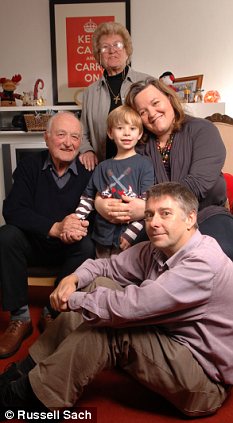
Hundreds of thousands of elderly people are suffering abuse and neglect in their own homes from care workers who treat them like pieces of "meat", a watchdog will warn today.


Hundreds of thousands of elderly people are suffering abuse and neglect in their own homes.
Photo: REX

By Tim Ross, Political Correspondent

A year-long inquiry into standards of care for the elderly at home has uncovered "appalling" evidence of pensioners being deprived of food and drink, handled roughly, humiliated and even robbed.

Many incidents amounted to "abuses of human rights", which left elderly people feeling profoundly depressed, in tears and even expressing "a desire to die", the report said.

The Equality and Human Rights Commission warns that care workers often spend just 15 minutes with an elderly person, ticking off pre-arranged "tasks" in an approach that displayed "chronic disregard" for their dignity. In one case, an elderly blind man said two council carers were talking to each other over his head, leaving him feeling like "a lump of meat". In another, a 76-year-old woman with advanced cancer was told her care worker could not prepare her a microwave meal because of "health and safety" rules.

Baroness Greengross, the commissioner responsible for the report, toldThe Daily Telegraph that 250,000 vulnerable pensioners in England were receiving "poor or very poor" standards of care at home.

But the true figure may be far higher because many are "too frightened to complain", she said.

The findings represent the latest scandal to hit care for elderly people in England. A series of damning inquiries by inspectors highlighted the failure of NHS hospitals to treat older patients with dignity, leaving them dehydrated and malnourished.

The 115-page report estimated that half of the 500,000 people receiving home help with tasks such as washing, dressing and cooking were satisfied with the quality of their support.

But "significant shortcomings" in the way councils commissioned services from private care firms and nursing agencies led to breaches of basic human rights for "hundreds of thousands" of frail pensioners, it said.

The report, which gathered evidence from 1,254 individuals, local authorities, care providers and other groups in England, found:

• Older people were not being given adequate support to eat and drink, while a shortage of time for visits meant some were suffering "neglect".

• Money was "systematically stolen over a period of time" in some cases.

• Carers showed "chronic disregard for older people's privacy and dignity".

• Staff were "talking over" older people, sometimes on mobile phones, or patronising them.

• Examples of "physical abuse" included "rough handling" and "unnecessary force".

Lady Greengross condemned "disgusting" examples of age discrimination in the way councils organised care for vulnerable elderly people. While young disabled adults were often taken out of their homes on trips, the elderly were almost always left for hours alone at home, she said.

"We are talking about a quarter of a million people who are getting either very poor or poor care. Some of them are too frightened to complain. Some of them wouldn't know how to."

Lady Greengross warned that too often care workers were restricted by a "task-oriented" system, in which they are allocated no more than 15 minutes for a visit. This meant many pensioners were being deprived of "basic social interaction".

The commission called for a loophole in the Human Rights Act to be closed to require councils to agree human rights clauses in contracts with groups providing care workers.

Paul Burstow, the care services minister, said he would not "tolerate" poor services of home care. "I am determined to root out ageism and bad practice to drive up quality and dignity in care," he said.

The Local Government Association blamed the failures on a lack of funding for elderly care, exacerbated by Coalition cuts, and said the system needed "urgent reform".

Last month, The Daily Telegraph disclosed figures that showed £1.3 billion in real terms had been cut from councils' spending on care and support for frail pensioners, a reduction of almost a fifth since the Coalition came to power.

The charity Age UK condemned the "shameful" findings, while Liz Kendall, the shadow minister for care, said the report portrayed "a service stretched to the limit". She urged ministers to join cross-party talks to devise a solution.

© Copyright of Telegraph Media Group Limited 2011____________________________________________________________
Credit: Reports and photographs are property of owners of intellectual rights.
Seniors World Chronicle, a not-for-profit, serves to chronicle and widen their reach.

November 20, 2011

USA: Growing senior population accelerates need to plan for care

PORTSMOUTH,New Hampshire / Seacoastonline.com / Life / November 20, 2011

By Lisa Ganem 

Having spent the past 10 years caring for more than 1,200 clients in the state of New Hampshire and providing support and guidance to their families, I have come to realize that care options, and cost of care is not widely understood. Nor is the average consumer aware that planning for care is similar to planning for a child's education; there is a need to plan ahead or you may not end up where you want to be or end up paying too much.


The need for planning is becoming more important as our nation's demographics are evolving to a situation that has never been seen before. The nation's population of senior citizens is about to rise to historic levels. Some 78 million men and women — the generation known as the baby boomers — were born between 1946 and 1964. The first wave of boomers started turning 65 on Jan. 1, 2011, at a rate of more than 8,000 a day. By year's end, the nation's senior population will grow by almost 3 million, to a total of 49 million. By 2025, the senior population, which was 35 million in 2000, will have more than doubled to 72 million.

As older adults continue to age, many will experience various health problems such as impaired mobility, strokes, Alzheimer's disease and other dementias, to name a few. Some ailments will be long lasting, and some will occur in combinations. In fact, 80 percent of the nation's current seniors have one chronic health condition, and 50 percent have at least two.

Additionally, studies show that's about 90 percent of American seniors have said they want to remain in their own homes for as long as possible.

Historically, as families were planning for a loved one's care there were only two options — to move in with a loved one or be placed in a nursing home. In the last two decades, there has been a proliferation of care options, which has created a spectrum of choices. New options include family care, senior centers, adult day centers, non-medical care at home, medical care at home, retirement and independent living communities, assisted living communities, skilled nursing homes and continued care retirement communities. Choices allow for a family's care plan to be more dynamic and cost effective as one can receive assistance only as needed, when needed.

Researching the options and pricing is best left with you, the consumer. To do this it is important to educate yourself on the available care options; the costs associated with each option; and understand when it's appropriate to use. Getting advice from additional sources is advisable, preferably more than one is recommended. Ask questions; realize no one source is the authority on all care and find what is best for your family. Having done your homework upfront, you will better know how to use the advice and information you gather.

The most successful way to manage the cost of care is to only purchase what you need when you needed it. What does this mean? Years ago, it was not uncommon for a person to sell the family home and move into a community for seniors long before any care was needed. Although downsizing initially may seem attractive, you must consider that a move to such a senior community costs a person on average between $40,000 and $60,000 per year. If services and the monthly costs associated exceed one's needs, then those dollars are wasted, and could be better saved for future care. Considering the primary source of pay for senior care is private pay dollars, the potential of any wasted dollars should not be overlooked. There are other resources available to augment care, such as long-term care insurance, VA Benefits, state grants, Medicare and Medicaid.

Additionally, it is important to understand the beginning signs of aging which include: losing track of medications; losing interest in meals; declining personal hygiene; declining driving skills; scorched pots and pans; signs of depression; missed doctors' appointments and social engagements; household bills piling up and an unkempt house. Early intervention can also help to lower cost of care in the long run and provide for an overall higher quality of life.

The cost of senior care can be daunting, but if you do a little homework, you can help to reduce the overall cost by planning ahead, seeking resources and information, and educating yourself about the care options that are available. That way, you can find what options are best for you to ensure the highest quality, affordable care for you and your family.

Lisa Ganem is owner of Home Instead Senior Care of Seacoast and Southern New Hampshire. Home Instead Senior Care has served more than 1,200 clients and families and employed more than 850 staff. 
Lisa Ganem
E-mail: lisaganem@homeinstead.com


Copyright © 2011. Dow Jones Local Media Group, Inc
_____________________________________________________________
Credit: Reports and photographs are property of owners of intellectual rights. 
Seniors World Chronicle, a not-for-profit, serves to chronicle and widen their reach.

October 7, 2011

MOLDOVA : Life At Grandma's, Without Dad and Mom

PARIS, FRANCE / Courier International / October 7, 2011

Life at Grandma's, without Dad and Mom

By Natalia Radoulova,  Ogoniok Weekly

Forced to migrate to find work, fathers and mothers leave their children with grandparents who raise them. Natalia Radoulova reports from the land of Grandmas, and children almost orphaned, in the Russian weekly Ogonyok.

© Drawing Boligán, El Universal, Mexico City
"My mom works in Italy, and my dad is in Moscow"

She knows about it and tiny Sniejana lives this kind of everyday life. She is 6 years old and lives with her grandmother in a village in Moldova. When at school she is asked to write essays on "My family", she certainly begins with this sentence: "My mom works in Italy, and my dad is in Moscow." Her parents are part of the generation of immigrant workers that enables the Moldovan economy not to sink and every year they send $ 1.5 billion to their families back home.

"Every month they send us 500 dollars," says Sniejana's grandmother Anna Viktorovna. "This will be more than enough, because I also have to plan my retirement."

Sniejana was concieved by the young couple during their honeymoon. The groom was already working in Moscow. He had taken leave. Few weeks of happiness and love in the sun of Indian summer, new wine, the Brynza [feta cheese], apples, and nine months later came a baby of 3.6 kg.

Anna Viktorovna removes the seeds of a watermelon slice before handing it to her granddaughter, and explains what happened thereafter:

"First, she wanted to stay here with the daughter. Then one of her friends suggested she go to Italy with her husband, than vegetate here penniless. I did not try to dissuade her. Most women in the country have ended up employing for themselves out there. It is convenient as far as the language. Italian is close enough to Moldova. She thought a while and then she decided. And she was right, rather than stay here to wait to see her husband just once a year. 

Difficult to know how much Sniejana's parents earn totally. They do not say. They send something to provide for their daughter, that is most important. Maybe the rest they use to cover their own expenses, and can not put anything aside.

At home, in Moscow, life is expensive, said the grandmother. I hear that to rent an apartment it is nearly 1000 dollars a month. It's crazy. Here with that kind of money you can buy two cows. Her father shared a studio with other masons. Not true, Sniejanotchka?  He says it is very small.

The girl looks up from the watermelon slice and her face lights up with a smile: "Let him come here, he will make his bed in the lounge."

It is in the living room of Anna Viktorovna that the couple were sleeping when they met. In the beginning it was uncomortable, both for the couple and for their daughter. By the time they got used to it, they had to pack up, they had to leave.

"I wish Mom and Dad lived with us, but there is no work here," laments Sniejana.

True, there is no work there, and so many parents do not see Moldovan their children grow up.

"Most of Sniejana's girl friends also live with their grandmothers, says Anna Viktorovna. Here it is like that. "

This may be the reason that inspired Moldova four years ago to create the Festival of Grandmothers, "to affirm the respect and recognition of the company for the contribution of grandmothers in education of the younger generation and maintenance of national and family values.

"In the case of Sniejana it is indeed the grandmother who protects and binds the family. It is the grandmother who make at home a man and a woman living in different countries and regard this place as their home, where they may finally return in a few years. They will then know for good. They will try to live together. Here they take care of their grandchildren, children born to their daughter Sniejana, if it in turn she becomes a migrant worker.

And they will celebrate this sacred day, the Feast of grandmothers, every last Saturday of September.

BENCHMARK Statistics
A million Moldovans of an estimated population of 4 million, live abroad and work in jobs lower than their qualifications. The Moldovan Ministry of Labour, like Unicef, has estimated the number of children of migrants who are left to the care of grandparents in the country to be 200,000. Sociologists believe that the biggest problem in this situation is not financial, the parents are sending money to their children. This lifestyle leads to more depressive syndromes and school dropout..

Neighboring Romania is in the same situation: In 2009 there were more than 350,000 children were left at home. The "home-alone generation" often makes headlines because of children in this situation choose to commit suicide. In addition to children already abandoned, the number of parents refusing all contact with their children is increasing. The media now speak of Euro-orphans.
Translated from French via Google

© Courrier International 2011
__________________________________________________________
Credit: Reports and photographs are property of owners of intellectual rights.
Seniors World Chronicle, a not-for-profit, serves to chronicle and widen their reach.

September 21, 2011

ITALY: Court help sought to get Italian man, 41, to leave the nest

VENICE, Italy  / Agence France Presse / Entertainment News / September 21, 2011

The sun sets in Venice. AFP Photo

After several failed attempts to convince their 41-year-old son to leave the nest, a Venetian couple have hired a lawyer in a last resort bid for domestic peace and quiet, Italian media reported Tuesday.

The parents, whose names were not published, were said to be exhausted by fending for their adult offspring, cooking his meals and doing his washing and ironing.

"We cannot do it anymore. My wife is suffering from stress and had to be hospitalised," said the father, who approached the legal department of a consumer association, ADICO, for help.

The son "has a good job but still lives at home. He demands that his clothes be washed and ironed and his meals prepared. He really has no intention of leaving."

Reports said the son also had aggressive tendencies.

ADICO lawyer Andrea Camp said a letter was sent to the son, advising him to leave the house within six days or face legal action.

If he refuses, lawyers will ask a court to issue a protection order to the parents against their son.

ADICO says hundreds of Italian families face similar difficulty getting rid of their adult children.

The latest couple turned to ADICO two weeks ago after hearing of a similar case in which the association had convinced a son to abandon the family cocoon -- after which his parents changed the locks.

© 2011 AFP / Copyright © 2011 Yahoo! Inc
__________________________________________________________
Credit: Reports and photographs are property of owners of intellectual rights.
Seniors World Chronicle, a not-for-profit, serves to chronicle and widen their reach.

September 18, 2011

INDIA: Economic growth leads to break-up of joint family, hits elderly

NEW DELHI / Agence France Presse / September 18, 2011

Homes not 'home' for India's elderly

By Abhaya Srivastava (AFP)

Ejected from the house of his son and daughter-in-law, Brij Mohan Garg looks around the spartan surroundings of his state-subsidised old age home in Delhi with a mixture of despair and disbelief.

"After doing so well in life I find myself here," said the 72-year-old retired government official, shaking his head and gesturing at the dirty upholstery covering a well-worn sofa in the home's "visitors' room".

Garg's predicament is in many ways a direct result of India's rapid economic growth, which has brought enormous social change -- including the gradual break-up of the traditional extended family.

For elderly people like Garg, the "joint" family, where parents, children and grandchildren all live under one roof, was once a dependable safety net of comfort and companionship in their old age.

But rising costs, shrinking living spaces and increased job mobility mean the aged are increasingly left alone and forced to turn to some form of assisted living, the quality of which varies hugely depending on their means.

Latest census figures show that the average family size in India has dropped from seven members to five in the last 10 years.

"This reflects large-scale migration," said Mathew Cherian, the head of the non-profit group, HelpAge India.

"Rural youngsters are migrating to urban areas for employment, and those in the cities are either moving to a bigger one or going abroad for better economic prospects, leaving their parents behind," Cherian told AFP.

The socio-economic shift in family structure comes at a time of equally rapid demographic change as India's overall population ages.

In 2000, the number of Indians over 60 years of age stood at nearly 80 million, or roughly eight percent of the population. (AFP/File, Sajjad Hussain)

According to UN forecasts, that number will reach nearly 170 million by 2025 and 325 million -- or 20 percent of the population -- by 2050.

For those with modest incomes and no family support, their limited retirement options will include homes run by state-funded charities -- similar to the one where Garg has spent the past five years.

The facilities are frugal: rows of small, dingy rooms with rickety beds, cramped cupboards and creaking ceiling fans. Some have sewing machines, donated by welfare groups.

Food and lodging is provided free of charge by the charity which estimates its costs at around 5,000 rupees ($100) a month per person and which relies on donations from wealthy businessmen and non-profit organisations.

"My son has visited me once in five years," said Garg, who manages to find some comfort in living with other pensioners who have been similarly abandoned.

"At least I am not dependent on anybody and spend my time with other people who are like me and understand my pain," he said.

At another charity old-age home nearby, Mariam Lyall, 85, bitterly recalls the events that saw her fulfilling life as a nurse in Mumbai reduced to an old-age of state dependency. "I loved my job and lived with my nephew. But as age caught up with me, he started ill-treating me. He told me that I was a burden and that he couldn't take care of me any longer," she said.

Rising costs, shrinking living spaces and increased job mobility mean India's aged are increasingly left alone (AFP/File, Sajjad Hussain)

"There is no respect for us here," said Lyall's friend Angelina Lal. "I don't have any family. I have no choice but to rot in misery."

The plight of the elderly left to fend for themselves has provided a potentially lucrative market opening for privately-run homes which provide high-end care at a cost.  (AFP/File, Sajjad Hussain)

One such facility is the Golden Estate, a 19,000 square-foot retirement community which offers "'privileged living for senior citizens" in the Delhi satellite town of Faridabad.

The home, which is due to open in January, provides everything from laundry to round-the-clock medical care, yoga classes and high-speed Internet connections.

Amit Vaidya, director of UCC Care Pvt Ltd, the company behind the project, insists the home is a genuine option for retirement living, rather than a last resort for abandoned pensioners.

"We realised that India desperately needed a quality old age home option, what with more disposable incomes, rising life spans and poor social security," Vaidya said.

"There are many well-to-do people of the silver generation who are suffering from loneliness. This facility is for children who love their parents and want to give them a happy and secure old age," he said.

Rooms are air-conditioned and come with flat-screen TV sets, while common areas include a dining room, a library and a gymnasium, all equipped with anti-skid flooring, grab bars and emergency alarms.

Monthly charges come to around 30,000 rupees, but there is also a security deposit of up to 2.7 million rupees.

Of the 70 units available, 35 percent have already been booked.

"There is lot of interest from those who are settled abroad but whose parents are still in India," Vaidya said.

The business opportunities are bringing in big players with big plans.

India's fourth-largest mortgage lender, LIC Housing Finance, recently completed a 98-unit retirement facility in the southern city of Bangalore and a 200-unit home in the eastern city of Bhubaneshwar.

"We expect to make the care homes business a fully contained, listed entity in the next three to five years," said chief executive officer V.K. Sharma.

Copyright © 2011 AFP
__________________________________________________________
Credit: Reports and photographs are property of owners of intellectual rights.
Seniors World Chronicle, a not-for-profit, serves to chronicle and widen their reach.