Remember ME - You Me and Dementia

Showing posts with label Transition. Show all posts

April 29, 2012

JAPAN: Incredible Shrinking Country

NEW YORK, NY / The New York Times / Sunday Review / April 29, 2012

By Ross Douthat


“THE Children of Men,” P. D. James’s 1992 novel, is set in a future where the world’s male population has become infertile, and an aging Britain is adapting to the human race’s gradual extinction. Women push dolls in baby carriages. Families baptize kittens. There are state-run “national porn shops” to stimulate the flagging male libido. Suicide flourishes. Immigrants are welcomed as guest laborers but expelled once they become too old to work. The last children born on earth — the so-called “Omegas” — have grown up to be bored, arrogant, antisocial and destructive.
Josh Haner/The New York Times
Ross Douthat
James’s book, like most effective dystopias, worked by exaggerating existing trends — the plunge in birthrates across the developed world, the spread of voluntary euthanasia in nations like the Netherlands and Switzerland, the European struggle to assimilate a growing immigrant population.
But one developed nation is making “Children of Men” look particularly prophetic. In Japan, birthrates are now so low and life expectancy so great that the nation will soon have a demographic profile that matches that of the American retirement community of Palm Springs. “Gradually but relentlessly,” the demographer Nick Eberstadt writes in the latest issue of The Wilson Quarterly, “Japan is evolving into a type of society whose contours and workings have only been contemplated in science fiction.”
Eberstadt has spent years writing about the challenges posed by declining fertility around the globe. But Japan, he notes, is a unique case. The Japanese birthrate hovers around just 1.3 children per woman, far below the level required to maintain a stable population. Thanks to increasing life expectancy, by 2040 “there could almost be one centenarian on hand to welcome each Japanese newborn.” Over the same period, the overall Japanese population is likely to decline by 20 percent, with grim consequences for an already-stagnant economy and an already-strained safety net.
Japan is facing such swift demographic collapse, Eberstadt’s essay suggests, because its culture combines liberalism and traditionalism in particularly disastrous ways. On the one hand, the old sexual culture, oriented around arranged marriage and family obligation, has largely collapsed. Japan is one of the world’s least religious nations, the marriage rate has plunged and the divorce rate is higher than in Northern Europe.
Yet the traditional stigma around out-of-wedlock childbearing endures, which means that unmarried Japanese are more likely to embrace “voluntary childlessness” than the unwed parenting that’s becoming an American norm. And the traditional Japanese suspicion of immigration (another possible source for demographic vitality) has endured into the 21st century as well. Eberstadt notes that “in 2009 Japan naturalized barely a third as many new citizens as Switzerland, a country with a population only 6 percent the size of Japan’s and a reputation of its own for standoffishness.”
These trends are forging a society that sometimes evokes the infertile Britain in James’s dystopia. Japan has one of the highest suicide rates in the developed world, and there were rashes of Internet-enabled group suicides in the last decade. Rental “relatives” are available for sparsely attended wedding parties; so-called “babyloids” — furry dolls that mimic infant sounds — are being developed for lonely seniors; and Japanese researchers are at the forefront of efforts to build robots that resemble human babies. The younger generation includes millions of so-called “parasite singles” who still live with (and off) their parents, and perhaps hundreds of thousands of the “hikikomori”—“young adults,” Eberstadt writes, “who shut themselves off almost entirely by retreating into a friendless life of video games, the Internet and manga (comics) in their parents’ home.”
If there’s any reason for real optimism in this picture, it’s for Americans, rather than for Japanese. Twenty years ago, when declinists predicted that the United States would soon cede global leadership to Japan, they cited the same domestic trends that pessimists (this columnist included) often cite today: our unsustainable deficits and our fraying social fabric, our decadent culture and our uncompetitive economy.
These problems are still with us, and some of them are worse then ever. But they haven’t left us in anything like the plight the Japanese are facing. Our family structures are weakening, but high out-of-wedlock birthrates may be preferable to no births at all. We assimilate immigrants more slowly than we should, but at least we’re capable of assimilation. American religion can be shallow, narcissistic and divisive, but our religious institutions still supply solidarity and uplift as well. Our economy is weak and our deficits are large, but at least we aren’t asking the next generation to bear the kinds of burdens that today’s under-30 Japanese will someday have to shoulder.
There is one modern world, but every civilization takes a different route through it. For all our problems, 21st-century Americans should be thankful that we aren’t headed toward the same sunset as Japan.
© 2012 The New York Times Company
____________________________________________________________
Credit: Reports and photographs are property of owners of intellectual rights. 
Seniors World Chronicle, a not-for-profit, serves to chronicle and widen their reach.

March 29, 2012

INDIA: Live-in mela for senior citizens on April 15

RAJKOT, Gujarat / The Times of India / March 29, 2012

City's Arvind Maniyar Hall is likely to become the epicentre for a social change. For the first time, a mass programme for senior citizens to choose live-in partners will be held here on April 15.

The first-ever public function to help 50-plus men and women in Saurashtra region to find a companion will be organized by Natubhai Patel, who runs Vina Mulya Amulya Sewa, an organization created to help arrange marriages of lonely senior citizens in the country.

"After the success of similar live-in relationship functions in Ahmedabad last year, we are now going to organize this in Saurashtra region," said Patel.

He said that the concept of live-in relationships has interested a lot of elderly, who are shy of getting married again and don't want to embarrass their children.

"We are expecting more than 300 elders (males) to come from across the country. The event is being held in Rajkot, but people can come from across the country to take part to find their companion for live-in relationship in their autumn years,'' Natubhai told TOI.

Interestingly, the ratio of elderly women's participation in such live-in relationship mela is about 20 per cent. "In order to encourage women to participate, we are offering females free of cost travelling from any part of the country as well as accommodation in Rajkot. We will also gift a sari to each woman participant," said Patel.

"Our experience says that live-in relationship for elder is the need of the hour. It is better that a lonely person finds a partner in their last span of life instead of staying in old-age home when your children are not taking care. Also, in many cases, even children have happily agreed to get their parents married," he added.

The criteria for a male participant are that he should have monthly income of above Rs 10,000 and his age should be above 50 years.

Patel said all men and women above 50 years of age including divorcees, widows and single are eligible to join the meet. He said that women above 40 years can also take part in the meet.

Copyright © 2012 Bennett, Coleman & Co. Ltd.
____________________________________________________________
Credit: Reports and photographs are property of owners of intellectual rights. 
Seniors World Chronicle, a not-for-profit, serves to chronicle and widen their reach.

February 26, 2012

CHINA: Charm pervades nooks, crannies in memory lanes off beaten track

SHANGHAI, China / The Shanghai Daily / Feature / February 25, 2012

AFTER exhausting all the well-known scenic spots in Minhang, some people develop aesthetic fatigue and complain there's nothing of interest left to explore.

That's not necessarily true. As the French sculptor Rodin once noted: "Beauty is everywhere. It is not that she is lacking to our eye, but that our eye fails to perceive her."

So let's open our eyes to the hidden beauty just around the corner and continue our tour of interesting old streets off the beaten track.

Our meandering along cobblestone paths and beside carved stone bridges took us last month to Duhang, Zhudi, Jiwang, Hexiangqiao and Maqiao streets. This time, our journey continues on to Chenhang, Zhuanqiao and Caohang streets, which also have plenty of old tales to whisper in our ears.

Zhuanqiao Street, faded past

The name Zhuanqiao originated from an eponymous stone arch bridge (qiao means bridge in Chinese) dating back to ancient times. The bridge, once the center of Zhuanqiao, was dismantled in 1969, but its memory remains in an area filled with interesting nooks and crannies. 

The street is not easy to find, which adds to its charm. There are a number of branch roads on Zhuanjian Road, and the north and south sections of Zhuanqiao Old Street are among them. They are filled with small grocery stores, a post office, street vendors and residences.

The best guide to the street are the old grey roof tiles still seen on buildings dating back to the Qing Dynasty (1644-1911). Nobody is quite sure anymore who once lived in the buildings.

The north section and south section of the street are divided by Zhuanjian Road, but there are signs at the entrance of the street to help you find your way.

It is a narrow street. Local residents are few and close-knit.

A visitor with a camera is immediately spotted as an "outsider" and may arouse a bit of curiosity. This area is off the tourist route, but strollers will find the local people warm-hearted and eager to serve as guides to their neighborhood.

The north section of the street is very short. You can see its end while standing on one side. Zhuanqiao Shuchang (a place for people to enjoy storytelling) is a two-story building.

It looks a bit worse for wear, though it's been renovated several times. The building was constructed during the Qing Dynasty.

Zhuanqiao Shuchang, founded in 1979, and was once a bustling place. It has seating for 240 and played host to huju operas and pingtan musical storytelling performances in its heyday.

Its owner, who declined to be identified, said sadly that the site was closed last year because of difficulty making ends meet.

"A performer of shuoshu (storytelling) charges 100 yuan (US$15) a day, and we can no longer afford it," he said. Admission to a two-hour performance usually costs about 2 yuan or less.

Shuoshu is a traditional one-man artistic form of storytelling - a great favorite of older people.

Now, the banister bearing woodcarving patterns is crumbling, the corridor is littered with rubble and old furniture lies randomly around. The owner said they will be burned as firewood.

The building is divided into several single rooms and rented out.

There is a teahouse near Zhuanqiao Shuchang. For local people, it's a place where the past survives. For decades, from dawn to dusk, people would congregate there to sip tea and talk.

Zhao Genyu, 78, a retired farmer, has been patronizing the teahouse for more than 50 years.

"I can sit here for hours and chat with others," he said. "It's my favorite pastime."

His house is 15 minutes away by foot.

"I like taking a stroll on the street everyday," he said as he sipped green tea. His distinctive Minhang dialect seemed smartly at home in the mottled old building.

In the past, there were shuoshu performances in the teahouse. Zhao said he used to enjoy them very much because they swelled on historical themes.

* Caohang Street, fine food and hip clothing shops
* Chenhang: three families
* Old streets bear silent witness to yesteryear 

Copyright © 2001-2012 Shanghai Daily Publishing House
____________________________________________________________
Credit: Reports and photographs are property of owners of intellectual rights. 
Seniors World Chronicle, a not-for-profit, serves to chronicle and widen their reach.

December 18, 2011

USA: Why More Seniors Are Starting Companies

WASHINGTON / The Atlantic / Business / December 17, 2011

MARC FREEDMAN - Marc Freedman is founder and CEO of Civic Ventures, a San Francisco think tank on baby boomers, and the author of The Big Shift: Navigating the New Stage Beyond Midlife.


Old Dogs, New Tricks: Why More Seniors Are Starting Companies

In the "Indian Summer" of their lives, more Americans between 50 and 75 are working well into years that used to be exclusively for the retired. Should we cheer them?


615_300_Elderly_Working1_Reuters.jpg
Reuters
Marion Jackson's airy, light-filled studio is filled with Brazilian art and sculpture. It sits on the third floor of a five-story, 100,000-square-foot industrial building in downtown Detroit that opened in 1927 to house the service department for Pontiac. The Corvette was later designed there. But that was before the U.S. auto industry declined, and the neighborhood became a wasteland of abandoned buildings.
Not anymore. Today, 250 start-up companies inhabit the renovated building, which is the centerpiece of a business incubator called TechTown. Jackson's venture, Con/Vida--in Spanish, "with life"--sells indigenous art from Latin America and curates exhibitions for galleries and museums. Jackson, 70, retired as an art-history professor at Detroit's Wayne State University last year and applied her knowledge of northeastern Brazil to the pursuit of a second career as Con/Vida's codirector.

This new chapter in Jackson's work life, much like the building the studio inhabits, amounts to a kind of adaptive reuse--of skills instead of space. In this, she has company. TechTown is run by Randal Charlton, a 71-year-old former jazz impresario and serial entrepreneur, whose human-tissue company was the resurrected building's first tenant. TechTown, an independent nonprofit, was launched a decade ago by Wayne State--which recently hired 77-year-old Allan Gilmour, a former Ford Motor chief financial officer, as its president.

By the prevailing definitions, all three of them are in old age--often portrayed as a wasteland of its own. We're set to become "a planet that's a whole lot more crowded--with old people," Phillip Longman, a senior research fellow on health policy at the New America Foundation, lamented in the September/October issue of Foreign Policy. He and other scholars who predict the "hyper-aging" of the developed world--when walkers will outnumber strollers--worry about too few working-age adults having to support too many children and retirees.

But economists such as Stanford University's John Shoven find these gloomy forecasts "deeply flawed" because, he has written, of "the misleading way in which we measure age" as longevity becomes reality for more and more Americans. Our notions of old age are themselves old-fashioned, reflecting a time when the typical 60-something was physically worn out from laboring in an auto plant or some other factory. In recent years, scholars in a range of academic disciplines report seeing signs of a new stage of life between the prime working years and full retirement. Sara Lawrence-Lightfoot, a Harvard education professor, calls this phase the "third chapter," after childhood and younger adulthood, defining it as "the generative space" between 50 and 75 years old. Cultural anthropologist Mary Catherine Bateson--Margaret Mead's daughter--labels the period "Adulthood II."

The creation of a new stage of life may seem counterintuitive. However, phases of life aren't natural phenomena, like the seasons of the year, but rather social constructions. Consider adolescence. The concept didn't exist until 1904, when G. Stanley Hall, a 60-year-old psychologist emerging from his own midlife crisis, wrote a book of more than 1,000 pages titled Adolescence. He was describing an extended period between childhood and adulthood free from grown-up responsibilities. The concept had a romantic tinge, but it grew out of fears that in a period of rapid industrialization, urbanization, and immigration, these minors would be running wild--anxieties that inspired laws requiring high school attendance and banning child labor. Adolescents began to be called "teenagers" after Seventeen magazine began publishing in 1944.

Hall, as it happens, also introduced the idea of a new stage on the other side of midlife. In a book published in 1922, he described an "Indian summer" between the middle years and old age. Humans, he reflected, "rarely come to anything like a masterly grip til the shadows begin to slant eastward." The book's title, Senescence, may help explain why the concept didn't catch on.

But will it now? That's hard to say. Before the Great Recession struck, the Bureau of Labor Statistics predicted a more than fivefold gain in labor-force participation by Americans over 55, compared with younger age groups. The economic downturn has intensified this pressure to extend working lives, while in other ways it has hurt. The unemployment rate for Americans age 55 and older was only 6.4 percent in November. But those who do lose their jobs tend to be unemployed far longer than younger workers. Fewer than a quarter of workers over 50 who lost their jobs from mid-2008 through 2009, the Urban Institute reported, found work within a year.

Even so, older Americans appear to be trying to fashion a working life beyond the middle years--and often succeeding. Entrepreneurship, for one thing, is rising. For 11 of the 15 years from 1996 to 2010, Americans between the ages of 55 and 64 had the highest rate of entrepreneurial activity of any age group, according to the Ewing Marion Kauffman Foundation. Twice as many founders of U.S. technology companies were over age 50 as were under 25.

Across the socioeconomic spectrum, 9 percent of Americans ages 44 to 70 have launched "encore" careers, according to a 2011 study by Penn Schoen Berland. Their paying jobs, part- or full-time, are often in the public sector--as teachers, nurses, home health aides, and the like--or with nonprofit groups.

The practical idealism of these late careers may reflect a shift in values as people mature and focus more on activities meant to contribute to society's greater good. Such late-stage jobs fit nicely within the socially beneficial lines of work that Northeastern University economist Barry Bluestone has predicted will need more labor: education, health care, nonprofit community groups, religious organizations, and government.

An encore career may entail some preparation. The number of over-50 Americans entering divinity school has doubled since 1990. A Catholic seminary near Milwaukee, the Sacred Heart School of Theology, specializes in training second-career priests--widowers, mainly. This past fall, high-tech billionaire Steve Poizner and former Hollywood studio executive Sherry Lansing announced a $15 million partnership with the University of California (Los Angeles) to launch the Encore Career Institute, a program of continuing education aimed at baby boomers. The American Association of Community Colleges has started an initiative to accommodate the growth of the over-50 student population, which increased by 17 percent from 2007 to 2009.

These things are happening without much of a push from Washington. After World War II, the GI Bill helped ex-soldiers gain an education and thrive. Nowadays, the federal Troops to Teachers initiative helps military personnel, many of them retired, earn a degree in education. But aspiring encore careerists can't look to the government for much more help. A 2009 law promoting national service established Encore Fellowships for adults who want to move into nonprofit or public-sector employment, but Congress hasn't appropriated a cent to fund them.

Unless Washington summons up the desire--and money--to urge this transition along, the future of encore careers will depend on the private sector. And on a generation's entrenched culture. As baby boomers live longer and wrestle with retirement, they won't accede easily. The willful generation that Time magazine named as its Man of the Year--"25 and Under," in 1966--never has.

COPYRIGHT © 2011 BY THE ATLANTIC MONTHLY GROUP.


____________________________________________________________
Credit: Reports and photographs are property of owners of intellectual rights.
Seniors World Chronicle, a not-for-profit, serves to chronicle and widen their reach.

November 20, 2011

WORLD: Odd as it may seem, 2011 is proving to be a year of rebirth

LONDON, England / The Guardian The Observer / November 2011

Something deep and impressive is going on in the new generation who have an innate sense of justice and fairness


Comment is free
By Henry Porter


When New York's mayor, Michael Bloomberg, sent stormtrooper cops – equipped with batons, pepper spray and ear-splitting pain compliance devices – to sweep the Occupy protesters from Wall Street, he was attacked by the American TV commentator Keith Olbermann as "a smaller, more embarrassing version of the tinpot tyrants who have fallen around the globe this year".

That will have pricked Bloomberg's technocratic vanity, yet there he is, three months away from his 70th birthday and worth approximately $19.5bn, ordering his police chief, Ray Kelly, who has already hit 70 but is still, incidentally, a familiar figure on the Manhattan party circuit, to unleash a shocking level of force against young people who were simply agitating for a better economic system, more equity and transparency.

It is not a good look in a country where, as Joseph Stiglitz revealed inVanity Fair, 1% of the population now takes nearly 25% of the nation's income. Justly or not, Bloomberg will be lumped with that international class of rich, often kleptomaniac, elderly men who have been brought down or who are looking shaky as demands for reform circle the world in what I believe to be a surge of optimism and, crucially, reason.

The Age of Downfalls, inaugurated when the 74-year-old President Ben Ali of Tunisia flew into exile and a coma, has claimed a surprising number of his generation. And it's not just the toppling of tyrants such as Ben Ali, the 83-year-old former President Mubarak of Egypt, or the 69-year-old Muammar Gaddafi, but also the demise of such men as Silvio Berlusconi (75), the former head of the IMF Dominique Strauss Khan (62) and the variety of threats faced by many Middle Eastern leaders, Rupert Murdoch (80) and the president of Fifa, Sepp Blatter (75).

Obviously, the same forces are not responsible for each man's troubles, but a year ago each of them seemed bombproof. We had no inkling that the world was about to be remade in such astonishingly short order; that history would decide, for whatever reason, that these men have had their time and the pathetic fiction of the dictator's hair dye would no longer work. If neutrinos can travel the length of Italy faster than the speed of light, calling into question our most fundamental assumptions about the universe, just about anything can happen.

One of the important traits of the Age of Downfalls is the exposure of myths and lies, a characteristic established in its initial months last winter by Wikileaks, which told us how things really were – that Saudi Arabia urged the US to bomb Iran; that the CIA tried to collect the UN general secretary's DNA; that China ordered the hacking of Google; that Ben Ali's family were looting Tunisia.

Much more has followed – a proper understanding of Greece's fraudulent application to join the euro; the revelations about oil companies owned by the Koch brothers paying for inaccurate and misleading information on climate change; the relentless uncovering of News International's evasions about hacking and police corruption; the protests when China started burying the wreckage of a train crash; and the exposure of the hopeful falsehood of the euro project, which suggests countries with widely varying economic performance and different cultures can unite in a single currency.

Whether through the market or the media, the internet or the instincts of the masses, truth has become the revolutionary weapon in the Age of Downfalls. That is surely a cause for optimism.

Indeed, the reason for hope is reason itself. Across the world, millions have demonstrated for fairness and enlightenment values. The chants of young people that echoed through the cities of Tunisia, Egypt, Libya, Yemen, Dubai, Syria, Greece, Spain, Italy, Israel, Chile, America and Britain are very similar – they are about freedom, self-determination, fairness, justice, access to education and jobs, as well as the corruption, mismanagement and greed of their elders.

In Burma, demand for reforms have led to Aung San Suu Kyi's announcement that she will stand in the next election. Even in Pakistan, a country generally regarded as beyond repair, Imran Khan's recent rally in Lahore struck the familiar notes of the Arab Spring. According to Tariq Ali in the London Review of Books, Khan's limited programme to end corruption, institute a strict tax regime, restore public services and terminate the servile relationship with the US was cheered as loudly by "young women in jeans and T-shirts… as those in hijabs". It is now possible to believe that Khan and Suu Kyi may both end up bringing a very different eye to the government of their peoples.

Reason has not won the battle against mythomaniac religions and greedy interests, particularly with the right of American politics, which embraces both these menaces as an article of national pride. Yet something deep and impressive is going on in the new generation, who have come of age. it seems. with an almost innate understanding of justice and fairness, and are – significantly – managing their religious convictions in the context of wanting improved societies.

Barely a week has gone by this year when I have not thrilled at the turn of events and pinched myself at some new surprise. A small example is the latest crime survey for the US, released by the FBI in the summer. Murder, rape, robbery and other serious crimes have fallen to a 48-year low. The murder rate has halved and robberies are down 10%, following an 8% fall in 2009. Canada shows the same fall (without locking up the vast numbers the US has) and England and Wales recorded an overall drop of 4%, with violence causing injury and firearms offences both down by 9%. We are perhaps better than we know, or at least better than governments give us credit for.

The key question seems to be this: will all the hopes of the year evaporate as we revert to type? Are we basically limited by human nature? Recent Swiss research published by the New Scientist suggests that each of us is programmed to behave like Ben Ali or Putin, or the corporate monsters, Berlusconi and Murdoch. If a person is given power over people and has more to gain from underhand dealings, abuse almost always follows. Yet research shows that a very few individuals will defy the pattern and set an example and that culture and institutions restrict corruption and the abuse of power.

That is the vital point: millions are calling not just for fairness and justice, but a reform of the institutions that will guard against the crimes and corruption of the few against the many. This is an amazingly important step for humanity and it is one of the reasons that despite the sense of impending crisis, I take heart from the Age of Downfalls.

© 2011 Guardian News and Media Limited
__________________________________________________________
Credit: Reports and photographs are property of owners of intellectual rights. 
Seniors World Chronicle, a not-for-profit, serves to chronicle and widen their reach.

July 4, 2011

INDONESIA: Elderly find comfort in nursing home

JAKARTA, Indonesia / The Jakarta Post / July 2, 2011

By Elly Burhaini Faizal, The Jakarta Post

Umi Solechah, a 65-year-old widow, says she did not think her senior years would be spent in a nursing home.

“Life is just a mystery. You don’t know where it will lead you,” Umi told The Jakarta Post during a recent visit to Budi Mulia 4 nursing home in Radio Dalam, South Jakarta.

Umi, who worked with the Indonesian Embassy in Washington DC, the United States, for ten years, recalled serving Indonesian diplomats including former ambassadors Soesilo Soedarman and Arifin Siregar.

Her life changed when she had to return in 1998 to treat her sick mother.

“I spent nearly all my riches treating my mom before she died,” said Umi who worked in the US from 1989 to 1997.

Her husband then passed away.

Umi did not elaborate on why she went to a nursing home aside from saying, “I was abandoned by my brothers and sisters despite my contributions to them.”

Lukman Syam, 68, was a marathon athlete. He won a silver medal at the national sports competition in 1967 before running a furniture business.

He said a family conflict ruined his business and his marriage.

Lukman said after he was abandoned by his family, including his own children, he became homeless before local people found him at a mosque in Pesanggrahan, South Jakarta.

They reported him to the local district official who sent him to Jakarta’s Social Affairs Department. Lukman was then sent by the department to Budi Mulia 4.

“I’m happy to live here since I have many friends. I don’t feel lonely anymore,” said Lukman.

In an article titled “Facing the geriatric wave in Indonesia: Financial conditions and social support”, a group of researchers from the University of Indonesia mentioned a survey by the National Commission for the Elderly that stated only 3.91 percent of Indonesia’s elderly in 2006 could rely on their monthly pension fund.

It said this drove about 50 percent of female elderly to rely on their children and children-in-laws while 29 percent of elderly men are also classified in this category. Photo: WN/Trigedia

Those with family can live with them while the remainder go to nursing homes.

Farah Darojati, who heads Budi Mulia 4’s nursing department, said that in many cases the elderly were abandoned by their children or other family members due to low income; therefore, many of them begged.

Farah said treating depression in the elderly who live in nursing homes can be difficult due to the fact that about 90 percent of the elderly had low-income backgrounds, including beggars and homeless people.

“Most elderly people who used to live on the streets suffer from stress and depression because of malnutrition and sickness,” Farah added.

She said many had illnesses caused by unhealthy living conditions, such as tuberculosis, hypertension and scabies.

“They must be treated before they can interact with healthy residents,” said Farah.

Elderly people suffering from Alzheimer’s disease are also isolated, she said.

Budi Mulia 4 is one of five nursing homes provided by the Jakarta administration for the elderly who are homeless or those abandoned by their families.  Four homes are provided for the elderly who are healthy and can perform daily activities independently, while Husada Mulia 5 at Cengkareng has been designed for the sick.

Copyright © 2008 The Jakarta Post
__________________________________________________________
Credit: Reports and photographs are property of owners of intellectual rights.
Seniors World Chronicle, a not-for-profit, serves to chronicle and widen their reach.

June 30, 2011

HONG KONG: Nothing to do, no place to go

BEIJING / The China Daily / Hong Kong Focus / June  30, 2011

By Guo Jiaxue (HK Edition)

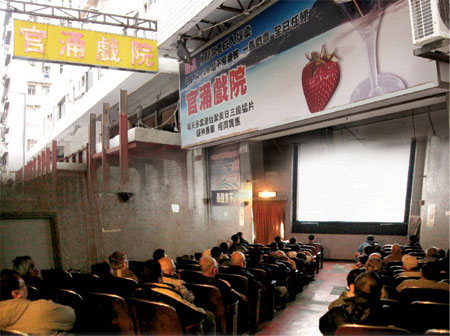
The signboard of the Kuwn Chung Cinema, now being torn down.
Guo Jiaxue / China Daily)

For the grassroots elderly people of Hong Kong, life has resolved into an enduring extension of days of nothing to do and no place to go. The situation doesn't appear to be improving - actually it is getting worse as demands for urban expansion overtake the places where those on limited income may gather. Guo Jiaxue reports.

Kwun Chung Street is an old, undistinguished, residential lane, all but lost around the corner from Tsim Sha Tsui, one of Hong Kong's busiest areas. It's hard to identify what shops are here from any distance, since the street serves as a convenient parking lot for long queues of commercial vans that block store fronts from view.

From a birds' eye view, the neighborhood is an oddity, squeezed in between the lavish environs of West Kowloon to the west and busy Nathan Road crammed with gold shops and tourists to the east. Grassroots elderly from the neighborhood don't even belong in those adjacent neighborhoods. They have no money. According to government population statistics in 2006, more than 6,000 families in Yau Tsim Mong District were earning less than HK$2,000 a month.

Here the observer is confronted with an isolated island of impoverishment, lost amid a sea of commercialism.

The sunlight strains but dimly down to the pavement on this narrow street. Passersby are mainly people who live in the apartments up above the commercial shops. Nighttime sees the street darker and even more deserted.

One shop that draws more notice than others is vacant. At the front is a sign emblazoned with the word: "Leasing". Still, people stop here and snap photographs, evidently indulging some nostalgic urge. Up until March this year, there was a pornographic cinema here, although the establishment hardly merited the name cinema. Video room probably would be more apt.

It's is difficult to fathom why this evidently unpromising locale saw commercial property rentals leap 80 percent in recent times.

"I don't know it exactly, but it's more or less 80 percent," Hui Tak-leung, a Yau Tsim Mong district councilor, said, trying to recall the rent increase that drove out the cinema. "The shop owner believed there was huge business potential ... Time has changed, the property prices are climbing up constantly."

The rent hike spelled the end of the 18-year tenure of the cinema on Kwun Chung street. Business had been poor anyway. But it may have been Hong Kong's last cinema featuring pornographic films. And that made the vacant premises a draw for nostalgia buffs to come and take pictures.

People in the neighborhood are reluctant to talk about the old movie house.

"They don't wanna talk. It's like, 'I went to watch porn movies', equals to 'I am a randy old goat'," said Hui.

Nevertheless the old dirty pictures establishment is missed. Some people feel its absence, anyway.

"Old people who live here play chess at parks. They go to the cinema on hot days. What's most important is for them to have a place to meet and chat," he said.

Hui believes the sense of loss in the wake of the porn cinema closure reflects the lack of elderly facilities in Hong Kong, especially in old districts like Yau Tsim Wong.

"You see many old people sitting in parks - very few of them play cards or chess - most just sit, have nothing to do, just sitting there for a whole day. And they are all male."

So, the cinema was not strictly about pornography. It was an air-conditioned refuge for the old folks on hot days.

Places like Kwun Chung Cinema were "suitable" for them. A HK$40 ticket was the price of admission for the whole day. They could sit and chat in the coolness of the air-conditioned space, watch movies, even doze off, the district councilor said. They couldn't get away with that in a modern multiplex cinema.

"But now they've lost the place," said Hui.

That's the thing. These grass-roots elderly don't really have much choice about where to go in neighborhoods like these. Most of the crowded old residential structures are more than 40 years old. The people are getting old. "Young people are moving out," Hui said.

"Community features." Hui shrug his shoulders, "It's sad, seeing so many old people on the street all day long, don't know where to go, and no one talk to them."

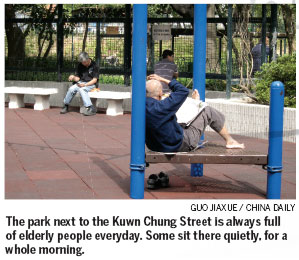
That social reality cannot be overstated. The King George V Memorial Park, just one block away from the Kwun Chung Street, is full of the elderly everyday. There is barely an empty seat, especially during cool and comfortable days in spring. Only a few can be seen reading newspapers or taking exercise. Most just sit, staring into the distance, apparently disinterested in everything.

Ching who lives nearby is one. The 70-year-old spends a lot of time in the park.

"Too many cars, people, and tail gas too. There is no room outside," he said slowly. He sits to escape the cacophony of automobile engines. He has no hobbies. "Mahjong? No. It costs money..."

The onset of summer makes sitting in the park nearly intolerable. Ching tries to escape to the shopping malls of Tsim Sha Tsui, where he finds relief under the Arctic blast of the air-conditioning.

These elderly, idle people leading empty lives eagerly embrace almost anything that gives them something to do. A few steps farther along Kwun Chung Street, from the old porn cinema, is a shop called Carrot House. It opened early this year. Elderly folk can be seen waiting in long queue every morning, waiting for the shop to open. The doors open. The people are let in. The doors are closed. Music and muffled voices over a microphone can be heard. But the place has no window to the outside world, nor perspective from the outside looking in.

Googling "Carrot House" reveals a business that has engaged in the sale of expensive so-called health food to elderly people for years.

But cheap gathering places for elderly folk are becoming more and more rare. Kwun Chung Street appears on the verge of a real estate boom. The demise of the old cinema is simply an early sign of changing times.

The high-speed rail link terminal, the West Kowloon Cultural District, and more luxury properties are all under construction just next to the old district.

"Once the high-speed rail starts to run, the commercial value will be much higher," Hui said.

The ground-floor shops under these old buildings have already begun to show their values.

The local barber shop moved away from the street in April. Austin Road, connecting Kwun Chung Street to the south, has totally transformed. Eight property agency shops have blossomed there, at one side of the street, extending a distance of two blocks. Quite spectacular, they are. The high-powered lights emanating from the agency shops are bright enough to turn night into day.

Another shop selling tableware closed, replaced by a glittering Sasa cosmetics shop.

To that degree, the convenient location is no convenience for people who live there. The neighborhood is not out of the way, in the fashion of public estates.

"For example, in Wong Tai Sin and Lok Fu, there are malls and plazas where they can stay and sit. But we can't sit as we like in private places," Hui said.

The district councilor called for the government to build some in-door public facilities in these old districts like Yau Tsim Wong so that the elderly can stay as long as they want. (photo on left)

"Maybe a multi-floor, multi-purpose center ... That would be good for the neighborhood," he said.

Copyright 1995 - 2011 China Daily Information Co (CDIC)
___________________________________________________________
Credit: Reports and photographs are property of owners of intellectual rights.
Seniors World Chronicle, a not-for-profit, serves to chronicle and widen their reach.

June 28, 2011

USA: If baby boomers stay in suburbia, analysts predict cultural shift

WASHINGTON, DC / The Washington Post / PostLocal / June 28, 2011

By Carol Morello


The nation’s suburbs are home to a rapidly growing number of older people who are changing the image and priorities of a suburbia formed around the needs of young families with children, an analysis of census data shows.

Although the entire United States is graying, the 2010 Census showed how much faster the suburbs are growing older when compared with the cities. Thanks largely to the baby-boom generation, four in 10 suburban residents are 45 or older, up from 34 percent just a decade ago. Thirty-five percent of city residents are in that age group, an increase from 31 percent in the last census.


During the past decade, the ranks of people who are middle-aged and older grew 18 times as fast as the population younger than 45, according to Brookings Institution demographer William Frey, who analyzed the 2010 Census data on age for his report, “The Uneven Aging and ‘Younging’ of America.” For the first time, they represent a majority of the nation’s voting-age population.

The political ramifications could be huge as older voters compete for resources with younger generations.
“When people think of suburban voters, it’s going to be different than it was years ago,” Frey said. “They used to be people worried about schools and kids. Now they’re more concerned about their own well-being.”

The nation’s baby boomers — 76 million people born between 1946 and 1964 — were the first generation to grow up in suburbia, and the suburbs is where many chose to rear their own children. Now, as the oldest boomers turn 65, demographers and local planners predict that most of them will not move to retirement areas such as Florida and Arizona. They will stay put.
“If you ask younger boomers, who are 45-ish, a lot say they expect to move and retire elsewhere,” said John Kenney, chief of aging and disability services with the Montgomery County health department. “But as people get to 65 and 70, whether because of choice or default, they end up staying. We are planning on people being here.”

Local governments are starting to grapple with the implications. As part of its 50 Plus Action Plan, Fairfax County has converted its pedestrian traffic signals to countdowns so people can gauge whether they have enough time to cross.

The county has held forums on kitchen and bath remodeling designs that make the areas accessible for wheelchair users. It collaborated with George Mason University in a course on coping during retirement. And a police unit has been formed to focus on financial fraud committed against the elderly.

About 1.5 million people, or 27 percent of the Washington area, are part of the baby-boom generation. The largest concentrations are in Fairfax, with about 310,000 boomers; Montgomery, with 275,000; and Prince George’s County, with 225,000.

“Clearly, the age wave is coming,” said Pat Herrity (R-Springfield), a county supervisor who heads the 50-plus committee.

In Montgomery, where 11 residents turn 65 every day, the county two years ago held a summit on the needs of its elderly residents.

Since then, it has developed a Web site listing all of the services available to seniors. It has helped several neighborhood groups establish “villages” in which younger residents volunteer to help drive their elderly neighbors to appointments. And to meet seniors’ growing need for income after the stock market faltered, it has staged job fairs.

“Retirement used to be the golden years,” said Kenney. “No more.”
Read on..

© 1996-2011 The Washington Post
______________________________________________________  
Credit: Reports and photographs are property of owners of intellectual rights.  
Seniors World Chronicle, a not-for-profit, serves to chronicle and widen their reach.
UK: Facebook flourishes among over-50s

LONDON, England / The Independent /  Media / Online / June 28, 2011

By Richard Hall

The domination of Facebook by young people could soon be over. The use of the social networking site by over-50s is rising faster than any other group.  Membership grew by 41 per cent between 2009 and 2011, but among older users, the figure was 84 per cent, according to a study by research firm Nielsen.

Photo courtesy: BBC News


The research suggests that Facebook, which was originally created by founder Mark Zuckerberg exclusively for students, is being invaded by an army of parents eager to follow the exploits of their children.

The research contradicts separate studies released earlier this month which suggested that the site's popularity in the UK was on the wane.

A website called Inside Facebook was the first to make the claim, backed up by research carried out by Brilliant Media, which used data from Google.

The new study, which based its information on the behaviour of a panel of internet users, concluded that 26.8 million people in the UK visited Facebook during May. Only Google was more popular.

Twitter also enjoyed a record month, with 6.14 million unique visitors – a 34 per cent increase on the previous month. The number of women aged over 65 using the site grew by 96 per cent over the same period.

Business networking site LinkedIn had 3.59 million unique UK visitors in May, 57 per cent more than in April.

©independent.co.uk
______________________________________________________  
Credit: Reports and photographs are property of owners of intellectual rights.  
Seniors World Chronicle, a not-for-profit, serves to chronicle and widen their reach.
June 26, 2011

WORLD: A world of 10 billion

TORONTO, Ontario, Canada / Macleans.Ca / Environment / June 15, 2011

A world of 10 billion

Mass extinctions, water shortages, dwindling oil reserves, grinding poverty. Can the Earth sustain every one of us?
By Charlie Gillis and Kate Lunau.


For the world, as for his family, the birth of Adnan Nevic was cause for celebration. No less an eminence than the secretary-general of the United Nations attended his arrival, posing with the swaddled child as camera strobes lit a maternity room in central Sarajevo. He was born four minutes past midnight on October 12, 1999, and Kofi Annan had made his way to the hospital like a wise man following a star. There were 5.999999999 billion people on the face of the planet, depending on whose “population clock” you went by. The time had come to designate a six billionth.

The challenges that lay before this infant reflected those of human populations around the globe. His parents, Jasmin and Fatima, were poor. The family lived cheek by jowl in a bleak apartment. His father needed work. Ethnic conflict remained a dormant but ever-present threat to their country. The UN chief offered words of hope, saying this “beautiful boy in a city returning to life should light a path of tolerance and understanding for all people.” But a long and happy life? For that, Adnan Nevic would need a few breaks.

Today, as demographers look ahead to a 10-billion-strong global population, the future of No. 6,000,000,000 is no less clouded. By day, he is an apple-cheeked sixth-grader who loves dogs and cheers on the fabled Spanish soccer team, Real Madrid. At night, he watches over a father stricken by bowel cancer, and sleeps in the same bedroom as his parents in their two-room flat in Visoko, a run-down town 28 km outside Sarajevo. Adnan’s plight could never really stand in for that of all humanity. But it does, to borrow the UN boss’s trope, illuminate the road we will travel over the course of his life.

By 2050, according to the UN’s mid-range estimates, Adnan will count among some 9.3 billion people on the face of the Earth, and 10.1 billion if he lives to see the turn of the next century. Each new addition will pose the same challenges he does. Can we feed, clothe and house them? School them? Provide them with health care and drinkable water?

Do continue to read.....Click here
Source: Macleans.Ca
______________________________________________________  
Credit: Reports and photographs are property of owners of intellectual rights.
Seniors World Chronicle, a not-for-profit, serves to chronicle and widen their reach.

June 25, 2011

UK: Breast cancer prostate drug hope

LONDON, England / BBC News / Health / June 25, 2011

-

Drugs used to treat prostate cancer in men may also be useful for difficult to treat breast cancers in some women, say researchers.

Hormone treatments such as tamoxifen and aromatase inhibitors are ineffective against up to 30% of breast cancers.

Breast cancers can be driven by oestrogen

The study, in The EMBO Journal, suggests some of these tumours may respond to drugs for male cancers.
Cancer Research UK said the findings were a "great surprise".

Hormones can switch on genes which lead to cells dividing uncontrollably and developing into tumours.
In women, breast cancers can be driven by the female sex hormone oestrogen. In men, prostate cancer can be driven by male sex hormones - androgens.

Breakthroughs have been made in treatments for breast cancer by developing drugs which interfere with the oestrogen's action, halting the tumour's progress.

However, tumours which are not driven by the hormone have been harder to treat.
 
Prostate to breast
Researchers at the Cancer Research UK Cambridge Research Institute found that some of these oestrogen negative tumours were instead influenced by male hormones. 

The same genes which were switched on by female sex hormones in oestrogen responsive tumours were activated by the male sex hormones.

It raises the prospect that drugs already developed for prostate cancer could help some women.

While androgens, such as testosterone, are typically associated with male development, they are also present in women.

The lead researcher Dr Ian Mills said: "This important discovery suggests that patients with a type of oestrogen-receptor-negative breast cancer may potentially benefit from therapies given to prostate cancer patients, which could transform treatment for this patient group in the future.

"But at the moment this laboratory research is still at an early stage."

Researchers said this could apply to up to 5% of all breast cancers.

Dr Lesley Walker, from Cancer Research UK, said: "Prostate cancer depends on the androgen receptor for growth so it's a great surprise that a type of breast cancer might also be fuelled by this protein."

Dr Caitlin Palframan, policy manager at Breakthrough Breast Cancer, said: "This fascinating research opens the door to personalised treatment for a small group of breast cancer patients.

"Women with oestrogen receptor negative disease have fewer treatment options and new ways to tackle it are urgently needed.

BBC © 2011
______________________________________________________
Credit: Reports and photographs are property of owners of intellectual rights.
Seniors World Chronicle, a not-for-profit, serves to chronicle and widen their reach.
WORLD: Wake Up! Your Life Just Changed!

MUMBAI, India / Ravi Chawla / Comment / June 25, 2011

By Ravi Chawla

This message arrived today and has probably been in circulation for some time.
I thought I should share it with visitors to this site.

Nine Things That Will Disappear In Our Lifetime

Whether these changes are good or bad depends in part on how we adapt
to them. But, ready or not, here they come...........

1. The Post Office
Get ready to imagine a world without the post office. They are so
deeply in financial trouble that there is probably no way to sustain
it long term. Email, Fed Ex, and UPS have just about wiped out the
minimum revenue needed to keep the post office alive. Most of your
mail every day is junk mail and bills.

2. The Cheque
Britain is already laying the groundwork to do away with cheque by 2018.
It costs the financial system billions a year to process cheques.
Plastic cards and online transactions will lead to the eventual demise
of the cheque. This plays right into the death of the post office.
If you never paid your bills by mail and never received them by mail,
the post office would absolutely go out of business.

3. The Newspaper
The younger generation simply doesn't read the newspaper.
They certainly don't subscribe to a daily delivered print edition.
That may go the way of the milkman and the laundry man.
As for reading the paper online, get ready to pay for it.
The rise in mobile Internet devices and e-readers has caused
all the newspaper and magazine publishers to form an alliance.
They have met with Apple, Amazon, and the major cell phone
companies to develop a model for paid subscription services.

4. The Book
You say you will never give up the physical book that you hold in your
hand and turn the literal pages.
I said the same thing about downloading music from iTunes.
I wanted my hard copy CD. But I quickly changed my mind when
I discovered that I could get albums for half the price without ever
leaving home to get the latest music.
The same thing will happen with books.
You can browse a bookstore online and even read a preview chapter
before you buy. And the price is less than half that of a real book.
And think of the convenience!
Once you start flicking your fingers on the screen instead of the book,
you find that you are lost in the story, can't wait to see what happens next,
and you forget that you're holding a gadget instead of a book.

5. The Land Line Telephone
Unless you have a large family and make a lot of local calls,
you don't need it anymore. Most people keep it simply because
they've always had it.
But you are paying double charges for that extra service.
All the cell phone companies will let you call customers
using the same cell provider for no charge against your minutes

6. Music
This is one of the saddest parts of the change story.
The music industry is dying a slow death.
Not just because of illegal downloading.
It's the lack of innovative new music being given a chance to get to
the people who would like to hear it.
Greed and corruption is the problem.
The record labels and the radio conglomerates are simply self-destructing.
Over 40% of the music purchased today is "catalogue items,"
meaning traditional music that the public is familiar with.
Older established artists.
This is also true on the live concert circuit.
To explore this fascinating and disturbing topic further,
check out the book, "Appetite for Self-Destruction" by Steve Knopper,
and the video documentary, "Before the Music Dies."

7. Television
Revenues to the networks are down dramatically.
Not just because of the economy. People are watching TV and movies
streamed from their computers. And they're playing games and doing lots
of other things that take up the time that used to be spent watching TV.
Prime time shows have degenerated down to lower than the lowest common
denominator. Cable rates are skyrocketing and commercials run about
every 4 minutes and 30 seconds.
I say good riddance to most of it.
It's time for the cable companies to be put out of our misery.
Let the people choose what they want to watch online.

8. The "Things" That You Own
Many of the very possessions that we used to own are still in our lives,
but we may not actually own them in the future.
They may simply reside in "the cloud."
Today your computer has a hard drive and you store your pictures, music,
movies, and documents.
Your software is on a CD or DVD, and you can always re-install it if need be.
But all of that is changing. Apple, Microsoft, and Google are all finishing up
their latest "cloud services."
That means that when you turn on a computer, the Internet will be built into the
operating system.
So, Windows, Google, and the Mac OS will be tied straight into the Internet.
If you click an icon, it will open something in the Internet cloud.
If you save something, it will be saved to the cloud.
And you may pay a monthly subscription fee to the cloud provider.
In this virtual world, you can access your music or your books, or your whatever
from any laptop or handheld device. That's the good news.
But, will you actually own any of this "stuff" or will it all be able to disappear
at any moment in a big "Poof?"
Will most of the things in our lives be disposable and whimsical?
It makes you want to run to the closet and pull out that photo album,
grab a book from the shelf, or open up a CD case and pull out the insert.


9. Privacy
If there ever was a concept that we can look back on nostalgically,
it would be privacy. That's gone. It's been gone for a long time anyway.
There are cameras on the street, in most of the buildings, and even
built into your computer and cell phone.
But you can be sure that 24/7, "They" know who you are and where you are,
right down to the GPS coordinates, and the Google Street View.
If you buy something, your habit is put into a zillion profiles,
and your ads will change to reflect those habits.
"They" will try to get you to buy something else. Again and again.

All we will have left that can't be changed are "Memories".
And then probably Alzheimers will take that away from you too !


Ravi Chawla
Editor
Seniors World Chronicle
 ______________________________________________________
Credit: Reports and photographs are property of owners of intellectual rights.
Seniors World Chronicle, a not-for-profit, serves to chronicle and widen their reach.

June 23, 2011

UK: What goes on in the mind of internet obsessives?

LONDON, England / The Guardian / Life & Style / June 23, 2011

Comment is free
These days it's virtually possible to live entirely online if you want to. But the real world tends to intrude eventually, writes , Guardian columnist.
.
New research shows that 77% of people over 65 now have their own computers and use the internet with gusto. They no longer rely on their grandchildren to sort out problems but deal with them confidently themselves. It makes them feel young, they say. And they particularly like social networking because it helps them keep in touch.

Facebook's users are typically more trusting and feel better supported
than other internet users. Photograph: Jena Ardell/Getty

Click here to read the full report

© Guardian News and Media Limited ______________________________________________________
Credit: Reports and photographs are property of owners of intellectual rights.
Seniors World Chronicle, a not-for-profit, serves to chronicle and widen their reach.

DENMARK: Christiania free at last

COPENHAGEN / Presseurop / Society / June 22, 2011

Only Alice

On 21 June, Freetown Christiania and the Danish government concluded an agreement that will enable inhabitants of Europe’s most famous alternative neighbourhood to buy most of the land on which they live from the state.

After eight years of difficult negotiations, the liberal-conservative administration and the residents of the “freetown” have finally agreed on procedures for the purchase of the disused Copenhagen naval base, which has been squatted since the 1970s.

As the Danish press explains, the Christianites have created a foundation that will buy the land in their name.

A perfect solution, according to Politiken, which amounts to "pure Buddhism: a synthesis of peace, harmony and emancipation." The deal marks "the capitulation of conservative Denmark," adds the social-liberal daily, which pays homage to the “pragmatism" of the Minister for Finance, liberal Claus Hjort Frederiksen, who put an end to an eight-year ideological battle. Continue reading the Presseurop report...

Ravi Chawla of Seniors World Chronicle comments:
If you were witness to the emergence and heydays of the hippie movement in the Sixties and early Seventies, and per chance, lived through the flower people days worldwide - from Kathmandu to Copenhagen - you would have followed the trends of the last five decades.   


BACKGROUND: On March 7, 2011, Jacek Pawlicki reported in the Warsaw newspaper Gazeta Wyborcza about Freetown Christiania’s flower children:

"Founded in 1971 by a group of hippies who squatted a deserted naval base in Copenhagen, Christiania is a global phenomenon. For experts, it is a legend of alternative culture, Europe’s most famous and sole functioning hippie enclave. After the Little Mermaid and the Tivoli amusement park, it is also the Danish capital’s third most popular tourist attraction. A million visitors come every year to wander among the psychedelic mural-adorned barracks and buy illegal cannabis in Pusher Street.


Christiania, a self-proclaimed free town, has its own anthem (I kan ikke slÃ¥ os ihjel, meaning “You cannot kill us,” a protest song by the rock group Bifrost), its flag of freedom (three yellow spheres against red background), its own currency, and its own set of rules and customs. There is a ban on car traffic (residents park their cars outside), running (if you run, you’re taken for a thief), photography, and bulletproof vests.

Recently, after forty years of existence and twenty-two of legally sanctioned independence, Christiania has lost its free-town status. On 18 February, the Danish Supreme Court rejected an appeal by the enclave’s residents against a 2009 court ruling that re-established state control over the 35-hectare former naval base. Thus a long legal battle over a status secured by hippies and squatters in 1989 has come to an end."
(Presseurop)

Tanja Dückers reported in Die Zeit of Hamburg, Germany (July 16, 2010), on
Society/Cities "Artists – the vanguard of gentrification"


Dans le Schanzenviertel, l'un des quartiers "bobos" de Hambourg, avril 2010.
Retinafunk
The flower folks of Freetown Chrisiania did not give up.

Writes Tanja Dückers in Die Zeit:
"For decades now, the subculture has been moving into unsightly, dilapidated sections of many big cities, breathing new life into neighbourhoods. Artists and other creative professionals often form the vanguard of urban renewal. Ever on the lookout for cheap housing, studios and offices, they seize on rentals in areas that others are eager to flee as soon as they can.


For a long time it looked as though a close nexus had been forged between the sociocritical left-wing zeitgeist and the flowering of contemporary art. In cities like Frankfurt, Hamburg or Berlin, artists and otherwise creatively-involved occupants would defend their turf – often with plenty of wit and conviction – against frustrated town planners and unscrupulous developers. Many a neighbourhood in those cities has now become quite livable – thanks mostly to them. Since German reunification, however, the traditional politico-ideologically motivated squatter has, in many cases, been supplanted by artists and creative professionals of a personally ambitious caste.

Then the same metamorphosis almost invariably ensues – in Berlin, Hamburg or Cologne as in Amsterdam, Copenhagen, Barcelona, London, Warsaw or Prague: once artists and creators rent digs in a given neighbourhood, trendy cafés and restaurants follow in their wake. Before you know it, young men with five-day beards and young post-neo-something-or-other girlies in cool second-hand vintage clothes fiddle about on their laptops, planning new "projects". The neighbourhood they have occupied is suddenly deemed “interesting”, small unconventional shops sprout up, then galleries and architects’ offices bring up the rear. Presently, the rents start rising..."

Presseurop has these words of sagesse (June 22, 2011):
"The Freetown Christianites should set aside the obsessive protection of their privacy so that tourists can take pictures freely — in accordance with the law — and without being attacked."


"The times they are achanging," concludes Ravi Chawla.
Copyright 2009 Presseurop.eu ____________________________________________________________________ Credit: Reports and photographs are exclusive property of original owners. Seniors World Chronicle, a not-for-profit, serves to chronicle and widen the reach.

June 20, 2011

USA: Elder care goes high tech

Better Aging Through Technology
By Big Think Editors
Old Time Wheelchairs


What's The Latest Development
Technology companies like General Electric and Intel are beginning to market a new industry in patient care called "aging in place". The industry relies on new monitoring technology that may effectively replace retirement homes and assisted living centers. Dorothy Rutherford, an 86 year-old retiree in Portland, Oregan, is testing some of the technology: "Motion sensors along hallways and ceilings record her gait and walking speed. A monitor on her back door observes when she leaves the house, and another one on the refrigerator keeps tabs on how often she's eating."

What's the Big Idea?
Retirement homes and assisted living centers are often difficult compromises families feel they need to make, both for the benefit of the aging parent's health and their own professional life—taking care of an aging person often requires a part-time work load outside the home. The two main appeals of new "aging in place" monitoring technology is to keep the elderly comfortable in their own home and allow their families to get back to work. Ms. Rutherford said the technology also gives her a sense of security about her health.
_____________________________________________________

Elder care goes high tech

LOS ANGELES, California / The Los Angeles Times / Business / June 17, 2011

Games, monitors and robots are among the tools being tested to help aging people live in their homes as long as possible, while lowering risks to their health and safety.

By Walter Hamilton, Los Angeles Times
 
Dorothy Rutherford is anxiously typing at her home computer, filling in answers to an online spelling game.

"I hate it when I can't get this last word," the 86-year-old retiree says as she studies the jumbled letters "nadobna." Rutherford tries "banana," then "bandana," to no avail. She smiles broadly when the computer beeps its approval of "abandon" a few moments later.

Tracy Zitzelberger at Oregon Health & Science University shows the
videoconferencing capabilities of a 4-foot robot known as Celia.
(Benjamin Reed, For The Times)

Rutherford isn't just whiling away the hours in retirement. She is on the front lines of an initiative to help elderly Americans stay in their homes as long as they can — a concept called aging in place.
Gerontologists say aging in place vastly improves the quality of life for seniors and is a lot cheaper for society than group homes and institutions.

The trick is to do so without jeopardizing the health and safety of older people, which is why Rutherford is playing the word jumble game. The results of the game, as well as typos and even the intervals between keystrokes, are monitored for abnormalities that could foreshadow physical or mental infirmity.

Tracy Zitzelberger (photo below)

She is one of 480 people taking part in several pilot programs in Portland, Ore., that outfit homes with technology so elderly people can be monitored for illness or infirmity.

The studies are being conducted by the Oregon Center for Aging & Technology at Oregon Health & Science University, with partial funding from Intel Corp. With the first wave of baby boomers turning 65 this year, corporations such as Intel see lucrative new business opportunities tending to a generation of people accustomed to doing things their own way.

"This is a race to see who's going to invent 21st century care services for boomers," said Eric Dishman (photo on right), health policy director at Intel-GE Care Innovations, a joint venture that Intel formed this year with General Electric Co. "Worldwide, there's this enormous market opportunity."

To that end, Rutherford's two-bedroom condominium has been outfitted with an array of electronic monitoring gear that might eventually find its way to retail shelves — all of it light years away from those rudimentary medical-alert necklaces advertised in an endless loop of TV commercials.

Motion sensors along hallways and ceilings record her gait and walking speed. A monitor on her back door observes when she leaves the house, and another one on the refrigerator keeps tabs on how often she's eating.

A few months ago, the former waitress even tested a robot with a Skype-like video monitor that lets faraway relatives check on loved ones.

Rutherford's granddaughter Katie Cooper piloted "Celia" from home in rural Wyoming, steering the machine — shaped like a 4-foot paper clip on wheels — around Rutherford's house as they spoke.

At first, Cooper struggled to control Celia, bumping the robot into tables and running over a shopping bag. But she got the hang of it quickly.


"My grandmother's furniture hasn't changed in 20 years. I knew the layout of the house," she said. "Anybody who's ever played a video game would have no problem using this."

The equipment in Rutherford's home is monitored by researchers at the Oregon lab, which was established in 2004 and developed most of the gear.

The lab includes a "model home" to test new gadgets. One is a special bed laced with sensors to assess breathing patterns, heart rate and general sleep quality. If someone lying on the bed holds a breath for a few seconds, the computer monitor flashes "subject has stopped breathing."

A pill box fitted with electronic switches records when medication is taken. And a Wii video game system has been rejiggered so that players stand on a platform that measures their weight and balance.

More is on the drawing board at the Oregon tech lab and elsewhere: software to help dementia patients find their way home if they get lost, devices that interpret facial expressions for signs of depression and robotic "pets" that have lifelike interactions with seniors.

For it all to catch on, however, major obstacles must be overcome. Among the biggest are persuading families to shell out several hundred dollars or more for sensors, and monthly monitoring fees that can top $100. Neither Medicaid nor most private insurance policies cover these expenses, said Dr. Jeffrey Kaye (photo on right), director of the Oregon aging and tech lab.

Another roadblock is awareness: By the time families find out about this technology, their elders may already be in need of direct supervised care, Kaye said.

And some companies market products to home-healthcare agencies that care for the homebound population, rather than directly to seniors themselves.

"Aging in place is starting to hit a tipping point, but we now need to make it mainstream enough where it's not something you find at the doctor's office or have to do lots of research on over the Web," said Joseph Coughlin, director of the MIT AgeLab.

Copyright 2011 Los Angeles Times