Remember ME - You Me and Dementia

Showing posts with label Mexico. Show all posts

August 9, 2011

MEXICO: Carlos Slim, 71, world's richest man, loses over $6 billion in stockmarket rout

MELBOURNE, Victoria / The Age / Executive Style / August 7, 2011

Carlos Slim, the world’s richest man, lost around $US6.7 billion ($6.63 billion) last week.

According to data compiled by Bloomberg, Slim’s stock portfolio has fallen 9.5 per cent since July 29 when measured in US dollars, and was valued at $US64.4 billion at the end of the week. The Standard & Poor’s 500 fell 7.2 per cent during that time.


Slim, 71, has taken a hit as Mexico’s benchmark IPC index dropped 6.4 per cent and the peso slid 2.3 per cent against the dollar on concerns that the flagging US economy will hurt demand for assets in its southern neighbour.

The removal of three of Slim’s companies from the IPC index has made matters worse for the billionaire.

Leon Cabrera, a trader at Mexico City-based Vanguardia Casa de Bolsa, told Bloomberg that Slim was ‘‘particularly hurt’’ by the companies that were removed from the IPC.

When Slim’s holding are measured in Mexican pesos, the drop in value was somewhere around 7.3 per cent.

Forbes named Slim the world’s richest man, and put him at the top of its annual World Billionaires’ list, for the second year in a row this year. In March, the magazine put Slim’s net worth at $US74 billion, and said it had grown by $US20.5 billion in the previous year, on the strength of the Mexican stock market, a stronger peso, and ‘‘successful mining and real estate spinoffs from conglomerate Grupo Carso.’’

According to Bloomberg, Slim’s fellow billionaires Bill Gates and Warren Buffett have fared slightly better during the recent market turmoil.

Gates’s Microsoft. dropped 6.3 per cent last week, while Buffett’s Berkshire Hathaway fell 3.9 per cent.

Wall Street experienced its worst week since September 2008 last week, and Reuters reports that global stocks lost $US2.5 trillion in value.

Guardian

Copyright © 2011 Fairfax Media
__________________________________________________________
Credit: Reports and photographs are property of owners of intellectual rights.
Seniors World Chronicle, a not-for-profit, serves to chronicle and widen their reach.

May 3, 2011

MEXICO: Love, sex, and full life in old age - It's all a question of attitude

MEXICO CITY, Mexico / Plaza y Valdes / May 3, 2011

Rafael Alvarez Cordero was awarded doctorate in medical sciences by the National University of Mexico, in Mexico City, according to Plaza y Valdés.

He conducted organ transplantation between 1963 and 1967, created an Intensive Care Unit in 1968 and practiced general surgery and gastroenterology. He has devoted more than 30 years to  study and treatment of obesity. Pioneer of bariatric surgery in Mexico, Cordero has tried various surgical weight control techniques.

Dr. Álvarez Cordero, physician and researcher, lecturer and writer, has published 154 articles and scientific papers in four languages, has given over 550 lectures worldwide and has published 13 books, among which are fundamental principles surgery; Perestroika of medicine Obesity surgery; Excellence surgery Milagros surgery; Obesity and Self-esteem To live or last? And I like you fat!, Light Discrimination, and is columnist for several newspapers.

© Plaza y Valdés
__________________________________________________________________

BARCELONA, Spain / La Vanguardia / Lifestyle / May 3, 2011

Life & Art
Sexuality

Rafael Alvarez Cordero. Photo: NotieSe

Interview with Dr. Rafael Alvarez Cordero

MEXICO CITY:
Someone who is not healthy cannot make love. Even if you do, you are physically unresponsive. So it is essential that men and women over 50 have a positive attitude to life, to stay healthy, enjoy the day with enthusiasm, not bury their sexuality just because they have reached old age, says Rafael Alvarez Cordero, author of "Live fully: Guide to health, Wellness and Longevity. "

"If an old man is healthy, watches his body, strengthens muscles, and engages in activities of his interest, there is no impediment to having healthy sexual relationships. In addition, now there are many medical options that can be used."

It is not going through life in search of teenagers, it is not waiting for a sexual performance like that of a man or woman of 30 years. Regardless of advanced age, if one wishes, any human being can get into an erotic and emotional relationship with another.

Rafael Alvarez Cordero, over 70, is co-founder of the Mexican Council of Geriatrics and Gerontology. He is convinced that anyone except an old, can understand how it feels to be old. He has 16 published books, written for the first time on senescence.

Elderly, seniors, the golden age, are some "politically correct" ways to call people who have lived more than 50 years. Words used so as not to hurt their feelings.

"There is no reason to be afraid of the word old. Said with respect it implies positive things, because the chance of having lived many years means more experience and wisdom."

To live fully, with health, wellness and longevity, the author explains, requires a "successful aging",  for which they need, in addition to attitude, other elements, such as "a society friendly towards the old ".

Rafael Alvarez Cordero says that Mexican society does not meet that requirement. It is very common to consider men and women over 50 years as unproductive and disabled. "Discrimination of the old within the family is great and so is society."

The secret is to understand that the elderly are like children. You have to have patience with them, care for them inside and out. Understand that they are less intelligent or creative, and they are retired. Do not listen well, or have some disability. But they are valuable human beings, and that must be taken into account.

The author of "Live fully: Guide to Health, Wellness and Longevity" talks about the recurrent fears in man to reach this stage of life, and fear of invalidity and decrepitude, and the biggest of it all "the need help with eating, dressing, or the most horrible, for personal hygiene."

This underscores the importance of activity and physical ablility to do many things independently, without forgetting the fundamental role of family support, to address this and other fears, like fear of accidents, poverty, loneliness and death.

The writer recognizes the need for legislation on death with dignity, so that everyone, young and old, can have the right to choose how they want to die or what to do before an accident or illness results in a vegetative state or undermine the quality of life, as one chooses a college career, life partner or city of residence.

The word "Senate" comes from the word senectus, formed in ancient Greece and ancient Rome just for old men, a condition not currently followed. Senators would be better if more Mexicans adhered to the etymology of the word, that is, if they were all men and women Señecta. 

Longevity is not always synonymous with wisdom. "There are old fools and ignorant old. Let us not forget that the Senate should be of young people. The point here is that politics has become a matter of power struggle. Politics does not respect its goal of improving the quality of life of a country. "

Dedicated to old men and women but also young people living with dad, grandmother or aunt in the elderly, "Living fully" is a book that invites reflection, not to see the accumulation of years as a fatality or embarrassment, but as a stage in human life, its characteristics and peculiarities.

The author warns that the way to deal with longevity is a personal decision:  To do nothing and die, and to be old to enjoy every day as if it were your last.

The book is in its first edition by Editorial Planeta and Diana. Legible for the aged, whether or not you use glasses. A very friendly language. These are some of the points Rafael Alvarez refers of his work.

Free translation from Spanish original by Seniors World Chronicle

April 13, 2011

MEXICO: Language at risk of dying out – the last two speakers aren't talking

.
LONDON / The Guardian / Science / Language / April 13, 2011

Trouble in Tabasco for centuries-old Ayapaneco tongue as anthropologists race to compile dictionary of Nuumte Oote

Jo Tuckman in Mexico City
 
The language of Ayapaneco has been spoken in the land now known as Mexico for centuries. It has survived the Spanish conquest, seen off wars, revolutions, famines and floods. But now, like so many other indigenous languages, it's at risk of extinction.


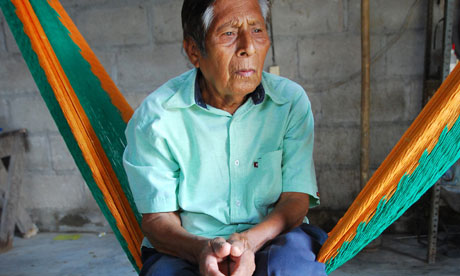
Manuel Segovia still speaks Ayapaneco to his wife and son who understand him but speak only a few words themselves.
Photograph: Jaime Avalos/EPA
 
There are just two people left who can speak it fluently – but they refuse to talk to each other. Manuel Segovia, 75, and Isidro Velazquez, 69, live 500 metres apart in the village of Ayapa in the tropical lowlands of the southern state of Tabasco. It is not clear whether there is a long-buried argument behind their mutual avoidance, but people who know them say they have never really enjoyed each other's company.

"They don't have a lot in common," says Daniel Suslak, a linguistic anthropologist from Indiana University, who is involved with a project to produce a dictionary of Ayapaneco. Segovia, he says, can be "a little prickly" and Velazquez, who is "more stoic," rarely likes to leave his home.

The dictionary is part of a race against time to revitalise the language before it is definitively too late. "When I was a boy everybody spoke it," Segovia told the Guardian by phone. "It's disappeared little by little, and now I suppose it might die with me."

Segovia, who denied any active animosity with Velazquez, retained the habit of speaking Ayapaneco by conversing with his brother until he died about a decade ago. Segovia still uses it with his son and wife who understand him, but cannot produce more than a few words themselves. Velazquez reputedly does not regularly talk to anybody in his native tongue anymore.

Suslak says Ayapaneco has always been a "linguistic island" surrounded by much stronger indigenous languages.

Its demise was sealed by the advent of education in Spanish in the mid 20th century, which for several decades included the explicit prohibition on indigenous children speaking anything else. Urbanisation and migration from the 1970s then ensured the break-up of the core group of speakers concentrated in the village. "It's a sad story," says Suslak, "but you have to be really impressed by how long it has hung around."

There are 68 different indigenous languages in Mexico, further subdivided into 364 variations. A handful of other Mexican indigenous languages are also in danger of extinction, though Ayapaneco is the most extreme case.

The name Ayapaneco is an imposition by outsiders, and Segovia and Velazquez call their language Nuumte Oote, which means the True Voice. They speak different versions of this truth and tend to disagree over details, which doesn't help their relationship. The dictionary, which is due out later this year, will contain both versions.

The National Indigenous Language Institute is also planning a last attempt to get classes going in which the last two surviving speakers can pass their knowledge on to other locals. Previous efforts have failed to take hold due to lack of funding and limited enthusiasm.

"I bought pencils and notebooks myself," Segovia complains. "The classes would start off full and then the pupils would stop coming."

Suslak says the language is particularly rich in what he calls sound symbolic expressions that often take their inspiration from nature, such as kolo-golo-nay, translated as "to gobble like a turkey".

© Guardian News and Media Limited

March 29, 2011

MEXICO: World’s Richest Man Opens His Soumaya Museum In Mexico City

.
NEW YORK / Forbes Magazine / Forbes Life / Lists / March 29, 2011

By Kerry A. Dolan
SHADES OF GREEN

In Mexico City, the world’s richest man has officially given his gift to the city: Carlos Slim Helu’s new Soumaya Museum is now open to the public.

The museum, designed by his architect son-in-law Fernando Romero, is open to the public for free and houses Slim’s vast art collection—reportedly 70,000 pieces, spanning works by Rodin, Leonardo da Vinci and other European artists as well as those by Mexican muralists Diego Rivera and David Alfaro Siqueiros, to name just a few.

Only a small handful of the world’s 1,210 billionaires can claim to have their own museum, though many have vast art collections. Continue reading....

Behind The Fortune Of Mexican Billionaire Carlos Slim,
World’s Richest Man: How Carlos Slim Got To Be The World’s Richest Man

Mexican telecom tycoon Carlos Slim Helu was born on January 28, 1940. 

He has a record-breaking fortune of $74 billion. His net worth grew $20.5 billion in a year. Getty Images

2010 Forbes.com LLC™

May 10, 2010

MEXICO: Older Women Caregivers Benefit from Reforms

.
MEXICO City, Mexico / La Crónica de Hoy / May 10, 2010


As we celebrate Mother’s Day, citizens of Mexico City remember the 279,189 older persons that benefit from the social welfare program provided by the local government. More than 60 percent of this population consists of older persons, and more specifically, older women.

The government has recognized this population and is aiming to reform programs to benefit this aging female population of caregivers.

Extract and photo by courtesy of 
Global Action on Aging, New York


Pensión alimenticia, una retribución a las mujeres de la tercera edad

Claudia Nohemí Pérez

Al celebrar el Día de la Madre, 279 mil 189 adultas mayores de la ciudad son beneficiarias del programa de pensión alimentaría del gobierno local, esto es más del 60 por ciento, según informó el Instituto de Atención de los Adultos Mayores del DF.

La directora general de la dependencia, Rosa Icela Rodríguez Velázquez, precisó que la pensión alimentaria representa para el 80 por ciento de las mujeres derechohabientes el primer ingreso fijo en toda su vida, por lo que, dijo, entregarles una pensión universal es la forma de retribuirles su esfuerzo.

Asimismo, enfatizó que ese sector está representado por las madres y abuelas de las actuales generaciones, “es ahora cuando el Gobierno del Distrito Federal retribuye a quienes dedicaron su vida entera a la crianza de los hijos y a las labores domesticas”.

La funcionaria explicó que de acuerdo con la encuesta de percepción aplicada entre la población derechohabiente, el 82 por ciento de las mujeres tiene conocimiento que se trata de un derecho universal en la ciudad de México, mientras que de las tres mil 823 personas encuestadas, 83.8 por ciento considera que su alimentación ha mejorado, debido a que puede adquirir más y mejores alimentos con el dinero que le es depositado gracias a dicho programa.

También señaló que el 89.6 por ciento de las mujeres adultas mayores consultada dijo sentirse más plena y feliz.

Rodríguez Velázquez explicó que con estas acciones se pretende prevenir y castigar la violencia física, psicológica, patrimonial y el abuso, por lo que, dijo, también se creó la Agencia Especializada para la Atención a Adultos Mayores Víctimas de Violencia Familiar y se instaló un módulo del Ministerio Público Virtual en las oficinas del Instituto para la atención también para ese sector.

® La Crónica de Hoy

November 20, 2009

MEXICO: Mexican once put up for oldest woman dies at 119

. BAKU, Azerbaijan / Trend News / World / November 20, 2009 A Mexican once put forward for the title of world's oldest woman has died at 119, government officials said Thursday, AP reported. Ana Maria Perez died of pneumonia Tuesday at a hospital in the Pacific state of Colima, said Dora Yanez, an official with the Colima state Institute for Attention to the Elderly. Perez has a valid birth certificate stating she was born June 22, 1890, in western Michoacan state, Yanez told The Associated Press. State authorities applied about three years ago to have Perez declared the world's oldest woman by the Guinness Book of World Records, but the attempt foundered when officials could not raise enough money for a Guinness judge to visit and confirm the claim, Yanez said. Yanez said her institute first learned about Perez through her granddaughter. Institute officials were visiting the granddaughter - then 77 - to offer their services. They were shocked when the elderly woman said she had a grandmother who could also use help. "We said, 'Ay caray! Well, where is your grandmother?'" Yanez said. Although Perez never got the world title, she received a visit last year from President Felipe Calderon, who awarded her a special recognition. Gertrude Baines, declared the world's oldest person by Guinness last January, died in September in Los Angeles at 115. Japan's Kama Chinen, 114, now holds that title, according to Gerontology Research Group, which tracks claims of extreme old age. Guinness says the oldest person ever known with an authenticated birth date was Jeanne-Louise Calment, who was 122 when she died Aug. 4, 1997, in Arles, France.[rc] © TREND News Agency

August 25, 2009

MEXICO: Peasants want to be treated with same respect as President Obama

. LONDON, England / The First Post / Pic of the Day / August 25, 2009 Peasants belonging to the '400 Pueblos' group wear Barack Obama masks at a protest in Mexico City. The group demands the return of land seized by past governments, and want to be treated with the same respect as President Obama. Photo: Dario Lopez-Mills [rc] Copyright of First Post Newsgroup IPR Limited

August 22, 2009

MEXICO: 92-year-old athlete won’t let age knock her off track

. GUADALAJARA, Mexico / Guadalajara Reporter / Mexican Lifestyle / August 22, 2009 By Alina Eagle Back in 1988, 72-year-old Maria Ramirez Bautista was as fit as she had ever been and full of energy. Not ready to kick back and accept “old age,” she instead decided to briskly walk (and sometimes even run) away from the advancing years by taking up competitive track. Twenty-one years down the line, the medals adorning the now 92-year-old’s Guadalajara home give a whole new meaning to the phrase “the golden years.” Ramirez is the proud owner of three world records, 202 national and 19 international medals. Her most recent accomplishment was winning two golds (the 5km and 10km walks) and one bronze (the 100m walk) at the 2009 World Master Athletics Championships in Lahti, Finland that took place July 28-August 8. “I was so happy I won medals in all three of my events and I got to see beautiful Finland,” Ramirez said this week while proudly wearing her team tracksuit. “It was a great country, very green and full of beautiful lakes,” she told the Reporter. Despite an exhausting journey home, Ramirez celebrated her success with family, friends, neighbors and even a mariachi band. “We had a huge party in the house that lasted into the night. About 80 people turned up from all generations. There were babies to even people as old as 92,” she joked. Ramirez not only has a team, but a whole league of supporters. Her family are the backbone and they alone consist of four generations – 15 children, 57 grandchildren, 192 great-grandchildren and 44 great-great grandchildren. Two golds and a bronze was the tally for Maria Ramirez in the recent World Master Athletics Championships. Her daughter Rosa Maria (left) also won a silver in a younger age category. “I have a very large family. But I am lucky all of them are very proud and supportive of my hobby. I think its because of them I have so much energy.” Daughter Rosa Maria Bañuelos, encouraged by her mom’s success, even switched from avid track-side cheerleader to competing herself. Joining Ramirez at the World Masters, Bañuelos successfully brought home a silver medal for the 50-54 years 10km walk. “It was such a great experience to share together. We trained together, traveled together, enjoyed Finland together, and won together,” said Bañuelos, who wore the same team suit as her mother. Both mom and daughter are members of the Jalisco Family Development Agency (DIF) older adults’ team that impressively won 13 medals at the world championships. They train three times a week with coach Alejandra Lopez Palacios, who though friendly, maintains an authoritative demeanor. “I am so pleased with how everyone did in the competition. We were only expecting six medals, so we doubled our expectations and more. Still, we need to start training again next week,” Palacios said firmly. Ramirez is keen to get back on the track after a week’s rest. She is already planning on attending the 2011 World Master Athletics Championship in Sacramento, California. “If I can do it there is no question I will be there. I just need to keep practicing and stay healthy,” she said. When not training, Ramirez keeps herself busy with a multitude of other activities. She loves spending time with her family, runs a Mexican food business with her daughters, sings and dances both the polka and danzon. Though her voice is gentle, her character is vivacious and her handshake strong. Ramirez’s energy is infectious and her achievements awe-inspiring. What she has accomplished over the past 21 years was no “walk in the park.” However, she is a true testament to the fact that age should never stand in the path of ambition. Anyone fancy a stroll? [rc] Copyright Guadalajara Reporter 2009

May 5, 2009

MEXICO: A critical patient, an overwhelmed hospital and a tenacious newspaper

. LOS ANGELES TIMES / Health / Swine Flu / May 5, 2009 Doctors at Dr. Aurelio Valdivieso General Hospital in Oaxaca, where the first swine flu fatality occurred. A newspaper sent in undercover reporters after a tip from an insider at the under-equipped facility. Alexandre Meneghini / Associated Press In Oaxaca, one of Mexico's poorest areas, the Despertar daily sniffed out the crisis, forcing doctors to announce, a week before emergency was declared, that they faced a deadly 'atypical pneumonia.' By Tracy Wilkinson Reporting from Oaxaca, Mexico It was Easter weekend when people in Oaxaca noticed strange happenings at the state-run Dr. Aurelio Valdivieso General Hospital. Sections were suddenly off-limits. Security guards were added. The cop reporter at the local newspaper, El Diario Despertar, got a tip from a source at the hospital. Not above dressing its journalists up as paramedics, the paper sent two people to investigate. They quickly realized that the hospital was seized by alarm. Queries from Despertar forced Oaxaca health officials to go public on April 16 -- a full week before a national emergency was declared over swine flu -- with news of a deadly "atypical pneumonia." One of the Oaxaca patients was the first person confirmed to have died from swine flu in an outbreak now circling the world. How Oaxaca, one of Mexico's poorest and most ethnically diverse regions, with a crusading newspaper and a strapped health system, faced the first strikes of what would become a global health crisis underscores the public health dilemma facing Mexico. Adela Gutierrez, who became the first fatality, sought hospital care late, after she was repeatedly misdiagnosed; the hospital stumbled, lacking the equipment for proper analysis; officials were perplexed and the public kept in the dark. Once the truth became known, Oaxaca also illustrated the important role of a grass-roots healthcare network in rugged, remote terrain with scattered migrant populations. In Valdivieso General's busy emergency room, Dr. Serafin Lopez Concha was hours into his shift on the Thursday before Easter when Gutierrez staggered in. She was gasping for breath, her oxygen-starved fingers turning blue. Gutierrez, 39, had been sick for a week. She had continued to work as a far-roaming door-to-door census-taker for the tax bureau until the Easter week break. She had seen three or four doctors, Lopez recalled. They'd told her she had a throat infection and given her medicine, but she only got worse. "She was in very serious condition," said Lopez, a Oaxaca native who took charge of Gutierrez's case. Believing she was suffering from pneumonia, Lopez and his team gave her antibiotics and serums to hydrate her. But Gutierrez couldn't catch her breath and they had to intubate her; she was no longer breathing on her own. Two days later, the hospital sent a bronchial sample from Gutierrez to an outside lab that often does testing for Valdivieso General, because despite being Oaxaca's largest medical facility, it doesn't have the equipment. Molecular chemist Adrian Juarez Avendano tested the sample and on Easter Sunday had the results: positive for coronavirus, a highly contagious and unusual viral strain. This result would prove incorrect, and testing in Canada would show Gutierrez had contracted the unique strain of swine flu. Still, the misdiagnosis set in motion a chain of reactions -- probably the right things to do, if for the wrong reason. Hospital authorities as early as the day before Easter isolated Gutierrez and began fumigating and sterilizing the building, even throwing away mattresses and pillows to calm hospital workers. They were preparing to transfer Gutierrez to a specialized hospital but she died at 4:45 p.m. on April 13, four days after being admitted. That same day, Dr. Ruben Coronado Garcia was springing into action. As head of the Intelligence Unit for Epidemiological Emergencies in the Oaxaca health department, he was in charge of finding everyone with whom Gutierrez had come into contact. Coronado mobilized seven brigades of three inspectors each to begin fanning through Oaxaca. They concentrated on three areas: the hospital, Gutierrez's home and family, and her place of work. At the hospital, Coronado and his inspectors made sure that everyone who came near Gutierrez was wearing protective gear, and they began testing the staff for infection. A total of 105 people were tested, "from the people pushing the gurneys to the X-ray technicians and the doctors," he said. At Gutierrez's house, her husband, three daughters and mother-in-law were tested. No one has shown any symptoms. Coronado's teams checked 106 of Gutierrez's co-workers through April 22. Most were fellow field agents and office workers with whom she met at the beginning and end of each workday. Among those checked at the hospital and Gutierrez's workplace, 26 developed flu symptoms. But none tested positive for the more serious strain and all have recovered. Coronado said his teams did not try to retrace Gutierrez's door-to-door route because they decided that her contact with people in her survey-taking was transitory compared with that with family and co-workers. And since none of the people she spent the most time with were infected, he said, he calculated that the chances of infection among people she visited briefly were minimal. "For a week or so, while sick, she was sleeping in the same bed with her husband every night, and living in close quarters with her children, like every Oaxacan family does, and not a single one of them shows any symptoms," Coronado said. His unit maintains 28 mobile centers throughout Oaxaca state that are on the lookout for flu symptoms. This is built on a rural network set up two years ago to care for scattered communities in a poor region with a large indigenous population. Oaxaca stretches over 36,000 square miles in southernmost Mexico, furrowed by mountain ridges. It's home to more than a dozen ethnic groups and 50 dialects. Gutierrez loved to visit those rural towns, her family says, and continued to do so until shortly before she died. She had been in reasonably good health until the flu hit her. Her family remains bitter, sad and confused. "She was very sociable, and very responsible," husband Luis Ramirez, a welder, said. They had been married 22 years. And Alfredo Martinez de Aguilar, publisher of the Despertar newspaper, is feeling vindicated. The paper (its name means "to wake up") was founded just a year ago, with $3 million from a group of investors, 100 employees and a commitment to a different kind of journalism. It has taken on inept officials, money launderers and corrupt cops. Martinez prides himself on his "intelligence unit," the less-than-orthodox team of staffers who might pose as something other than journalists if that's what it takes. And in this case, Martinez says, that is what it took. He wonders whether local health authorities would have informed the public of the emergency if his reporters had not gone into the hospital and dug up the truth. "We made them come to us," he said. wilkinson@latimes.com Copyright 2009 Los Angeles Times

November 4, 2008

MEXICO: Celebrating the dead in November

.
ST. CATHARINES, Ontario, Canada / The Brock Press / November 4, 2008

By Katherine Gottli


As we clean up our Halloween decorations, and gorge ourselves on left-over candy on November 1, Mexican families all over the country are celebrating with dances and wooden skull masks - a tradition which was originally assumed to be a mocking of the dead.

Photo: Dario Ayala

Yet, the Mexican Dia de los Muertos, or Day of the Dead, is an exact opposition to what the Spanish Conquistadors thought that Mexican families were doing 500 years ago. It is a celebration of the souls who may have passed on within the family. In traditional Aztec and Meso-American thought, the souls of the dead are believed to be back for a visit for the month of October and therefore, the families of the deceased take the opportunity to celebrate their lives as well as their death.

The history of Dia de los Muertos cannot be discussed without the inclusion of the fact that Spanish Conquistadors once attempted to ban festivals and celebrations of the dead, as they believed it to be sacrilegious and barbaric, as the pre-Hispanic cultures were assumed to be insulting the souls of the deceased

Death, for the Spaniards, was considered to be an end of life, and should be honoured as such. However, the indigenous people from which the traditions began believed that death was in fact the beginning of life, and should be celebrated as the souls of the deceased passed on into a life in which they were truly awake.

In order to 'Catholicize' the festival - which was originally held in the ninth month of the Aztec calendar, August - the Spaniards moved it closer to the Roman Catholic celebrations of All Saints Day (Nov.1), and All Souls Day (Nov.2).

Despite the fact that the indigenous festival underwent vast attempts of being destroyed, Dia de los Muertos is still celebrated all over Mexico and southern parts of the United States today.

The festival is celebrated differently all over the country, and changes slightly from the rural to more urbanized Mexican cities, but the most well known emblem of the festival goes by many names, perhaps the most recognizable be "La Muerte" - death.

Also know as "La Catrina", the historic engraving by José Guadalupe Posada (1851-1913) is of a skeleton woman, dressed ornately in a large floral-endowed hat, meant to symbolize the upper-class in Mexico during Posada's time. Many believe that the origins of "La Catrina" were an attempt to mock the upper-class in Mexico - as even they cannot escape death. Yet the depiction of the beautifully dressed woman has become synonymous with the holiday, and is regarded by many as a reminder that death can arrive at any time, but still should be welcomed as it is such an integral aspect of Mexican thought, history and on a grander scale, our lives.

Walking through the artist's community of Tubac, Arizona - a community just a short drive up the interstate from Mexico, and once a Spanish colony - many of the vendors have large collections of "La Catrina" statues, and many have their own individual Dia de los Muertos alters set up within their stores honouring their own deceased family members. The shrines include photos of the family members who have passed on, as well as small ornately decorated skulls - sugar skulls - with their family members' names written across the forehead. Many tourists ignorant to the festival believe that the skulls and statues have to do with Halloween, as skeletons are a common popular culture icon for the holiday, yet the shrines are a constant reminder for the artists' families of those who are no longer with them, as well as a celebration of their passing on to their new life.

Western culture, however - perhaps a comment on our own ignorant and inclusive nature - has seemingly commidified the ornate emblems into a fashion-statement, adorning clothing and jewelry with the colourfully decorated skulls.

Sugar Skulls (Calaveras) are a traditional folk art from Southern Mexico used to celebrate El Dia de los Muertos (Day of the Dead). This is a happy occasion in Mexico.

Also, popular tattoo designs often incorporate the image, and one has to wonder if the original intention of the edible offering has been misappropriated. Even within Mexican culture, less-traditional renditions of the classic sugar skull have become popular - rather than being hand-made pressed sugar decorated by the family to be given to family or adorn familial alters (many alters include offerings that will assist the deceased in their other-wordly travels, including food, personal items, and perhaps even bottles of tequila) - more popular versions of the skulls, many made from chocolate or other types of candy and decorated have become popular, and according to Chelsie Kenyon, a researcher of Dia de los Muertos, it is becoming increasingly difficult to find traditional sugar skulls in Southern Mexico.

Despite its early history, and current state of 'cultural upgrading', the fact remains that families all over Mexico are still reserving the first days of November as days for honouring their deceased relatives. Generally, November 1 is a day for celebrating the passing of young children and infants, and November 2 is reserved for the celebration of adults who are deceased. Families the country over flock to cemeteries to their family burial plots with offerings for the departed - religious rites are preformed, large celebrations and family reunions ensue all in an effort to remind the dead that even though they may be gone, they are certainly not forgotten.

© 2008 Brock Press