Remember ME - You Me and Dementia

Showing posts with label World. Show all posts

June 11, 2020

World Elder Abuse Awareness Day 2020 - #StandWithOlderPersons #PurpleDotChallenge

We #StandWithOlderPersons and accept #PurpleDotChallenge to raise Awareness and Prevention of Elder Abuse.


On occasion of 'World Elder Abuse Awareness Day' on 15th June 2020, INPEA in association with GAROP and Silver Innings seeks Support of all age group and gender to create awareness about elder abuse and it's prevention.

INPEA wants social media users to post a picture of a #PurpleDot on their palm or any other place or paper and express their thoughts about Elder Abuse, Awareness, Stigma and Prevention.


INPEA has created a separate hash tag #StandWithOlderPersons to take a strong stand on Elders issues. Accept the Purple Dot Challenge and post it on your social media handles with hash tag #StandWithOlderPersons and #PurpleDotChallange


So friends let’s #StandWithOlderPersons and send your Purple dot challenge pictures with your thoughts on our / post social media accounts like Facebook, LinkedIn, Instagram or Twitter.

This Challenge is open from 1st June to 30th June.


We will also post your support on our all social media accounts.

You can also forward us your pictures through E-mail at silverinnings@gmail.com or WhatsApp on 91+ 9987104233

Creative Support by Web Solutions India.

#WEAAD #WEAAD2020 #SILVERINNINGS #ELDERABUSE #INPEA 


________________________________________________________
Credit: Reports and photographs are property of owners of intellectual rights. Seniors World Chronicle, a not-for-profit, serves to chronicle and widen their reach.

August 8, 2012

INDIA : Senior Citizens to benefit from 'Celebrating Age' EXPO

Countdown begins for India’s biggest ever active-ageing carnival, the ultimate Retirement Lifestyle Expo 'Celebrating Age' is presented by MetLife India Insurance Company Limited, Associate Sponsor: State Bank Of India (Reverse Mortgage), in association with  International Longevity Centre India ILC-I India’s premier Institute in ageing as Patrons and produced by Vision India, a niche consulting and market analytic firm specializing in show management.  The event will be staged across 8 cites in India for two days each to propagate products, services   opportunities and activities that the elderly can participate to enrich their retirement lives.


“Celebrating Age”! Retirement Expo an active ageing series is being organized from Sept 1 to 21 Oct 2012 (two days in each city) at Bangalore ,Pune, Mumbai, Ahemedabad,  Goa, Chennai, Hyderabad , Delhi. It will be perfect platform for the industry to flourish, to enhance the retirement lifestyle of senior citizens. The challenge is to ensure that the elderly are able to lead a healthy & dignified life ahead. They should have every opportunity to pursue the activities of their choice and be treated with respect and dignity. The elderly form a rich repository of knowledge and experience. 

'Celebrating Age', an active ageing retirement expo is being organised by Vision India in association with the International Longevity Centre India Chapter and supported by the International Federation on Ageing (IFA), the Silver Inning Foundation (SIF) and the Association of Senior Living India (ASLI).

Event Composition includes Grand Inauguration followed by workshop on Qualitative and Healthy Ageing by panel of experts. Two day Exhibition featuring Banking, Insurance and Housing companies. Recruitment Desks. Health & Wellness Counters. Activity Zone, fun and frolic like Tambola, musical chair, live performances, Jaaz Band, Magic, Yoga, and Aerobics. Closing Celebrations on second day.

“Celebrating Age”! India Expo 2012, an active ageing series on Retirement is crafted with an objective of setting the tone where the 21st century ageing populations make useful networks. Profile includes assemblage of lifestyle products and services for those who are looking forward to enjoy the years of retirement in full style and grandeur. The newest products and services will be on showcase for discerning buyers.2012 Retirement expo will be perfect platform for the industry to flourish, to enhance the retirement lifestyle of senior citizens.

Focus: Worldwide ageing populations are recognizing that active ageing marks the emergence of new markets, requires adherence to innovation and inclusive practices. It is expected that the Private sectors and Governments would play an increasingly specific and supportive role to encourage qualitative ageing & productive human talent.

An opportunity exists to tap into the imagination of this potentially significant market given that the 55 + aged may spend 25 to 30 years in retirement. A burst of innovation is expected. Serving this market profitably may require fresh ideas, inclusive approach and new ways of doing business.

The senior community in India presents a tremendous opportunity to service providers and entrepreneurs to innovate on their housing needs and addressing their various lifestyle service and product needs. Seniors are evolving as a mature and serious consumer segment that have needs and wants, which are specific. A significant section of seniors today are independent, financially stable, well-travelled, socially connected, and as a result have well developed thoughts of how they want to spend time after retirement. There is, today, a larger percentage of educated seniors than ever before in India. This demographic, dubbed the active ageing 50+ generation has more wealth to spend and a greater desire for new experiences. 

The challenge is to ensure that the elderly are able to lead a healthy & dignified life ahead. They should have every opportunity to pursue the activities of their choice and be treated with respect and dignity. The elderly form a rich repository of knowledge and experience. 

Unique showcase of an unexplored market poised for growth, addressing trends and tipping points that are accelerating change in consumer attitudes of those aged 50 Plus. This market segment has only touched the tip of the iceberg. 

This Mega event is a pioneering initiative on qualitative ageing and productive human talent. This joint initiative aims to unfold the way forward and take retirement to the next level, thereby setting the tone for the forum, where emerging trends and challenges of the 21st century could reach out through an international network of exhibitions, conferences & entertainment .

You can Join 'Celebrating Age' at  Facebook: 

You can Follow 'Celebrating Age' at Twitter :


About : Vision India
Vision India is a fifteen year old organization founded by Janaki Raman. A niche consulting and market analytic firm, with an excellent track record of  designing and developing many National and International projects of high impact to match the needs of technocrats and policy makers on socially relevant subjects. Vision India specializes in educationally focused Trade Fairs and Conferences and creating live forums.


________________________________________________________
Credit: Reports and photographs are property of owners of intellectual rights.
Seniors World Chronicle, a not-for-profit, serves to chronicle and widen their reach.

May 26, 2012

IRELAND: Celebrates European Year for Active Ageing

DUBLIN , IRELAND / The Epoch Times / Ageing / May 24, 2012


Eight events across Ireland aim to strengthen ties between young and old


By Alan McDonnell


The benefits of active ageing were highlighted on Wednesday in eight regions around the country, as Active Retirement Ireland held a day of celebrations for the European Year for Active Ageing and Solidarity Between Generations.


Walking canes await elderly shoppers at a specialist retail store catering to senior citizens
Designated by the European Commission, the European Year for Active Ageing and Solidarity Between Generations is intended to raise awareness of the contribution that older people make to society. It seeks to encourage policymakers and relevant stakeholders at all levels to take action with the aim of creating better opportunities for active ageing and strengthening solidarity between generations.

With events taking place in Dublin, Westmeath, Limerick, Galway, Kerry, Waterford, Louth and Sligo, the importance of young and old helping each other in today’s society was highlighted. The day’s activities were supported by Active Retirement Ireland (ARI), the national representative body for 539 Active Retirement Associations throughout the country.

Commenting on the festivities, CEO of Active Retirement Ireland Ms Maureen Kavanagh said: “Our special day of celebrations highlights the significance of strengthening ties among people of all ages in society. The European Year for Active Ageing and Solidarity Between Generations is a fantastic initiative that Active Retirement Ireland fully supports.”

“With increasing uncertainty in the Irish economy, it’s important that everyone pulls together and combines their talents and skills to get the country back on its feet. Solidarity between generations is exactly what this is about, and our events today show what can be achieved when young and old come together.”


Read More about different events
 

The Epoch Times Copyright © 2000-2012


________________________________________________________
Credit: Reports and photographs are property of owners of intellectual rights.
Seniors World Chronicle, a not-for-profit, serves to chronicle and widen their reach.

AUSTRALIA: 104 years of great memories

TOOWOOMBA, South Queensland, AUSTRALIA / The Chronicle /  Active Ageing / May 26,2012

By Callum Bentley 

REACHING the ripe old age of 104-years-old is a milestone many people could not imagine - especially those who have been thrown off a horse and into a tree.

Rita Beauchamp celebrates turning 104-years-old at Lourdes Nursing Home
Rita Beauchamp reached the milestone recently and, according to her son Harry Beauchamp, she has quite a few stories to tell from her long and exciting life.

"She would always tell us of the time her and her brothers were riding their horses to school when they lived in Yuleba and instead decided to have a race," he said.

"It turns out that mum ended up coming off her horse and ended up stuck in a tree."

Mrs Beauchamp's frightful flight turned out to be the event which shaped her early adulthood.

"After that dad decided it would be best to send her to boarding school in Roma," Mr Beauchamp said.

"When she left school she came to Toowoomba in 1924 where she worked as a nurse at the Toowoomba Base Hospital."

Mrs Beauchamp remained in Toowoomba after falling in love with and marrying her husband James.

Mr Beauchamp said it was his mother's country upbringing which allowed her to live to such a remarkable age.

"They grew up eating anything they could grow themselves and she was always a hard worker," he said.

"Apart from a few minor ailments she's still quite well. She's just a bit worn out."

Mrs Beauchamp celebrated the day with friends at Lourdes Nursing Home.

 
© Toowoomba Newspapers Pty Ltd 2012.

________________________________________________________

Credit: Reports and photographs are property of owners of intellectual rights.
Seniors World Chronicle, a not-for-profit, serves to chronicle and widen their reach.

May 18, 2012

INDIA : As old ways change, senior-care homes are on the rise

TRIVANDRUM, INDIA /

More of India's urban families are rejecting traditional extended-family households, so older relatives are increasingly moving into elder-care facilities, an idea long stigmatized in the country.


R. Padmanathan Nair sits on a plastic chair in the entryway of the Heritage senior home talking about the fellow residents who treat him like family, which is helpful seeing as his own rarely visits.

Retirees at an elder-care home in Trivandrum, India
His wife tried to abscond with their valuables, he said, so he gave the house to a niece, who ignored him after she got the property. Now his daughter is the only one who visits the 76-year-old retired teacher here in the capital of the southern state of Kerala, and that's just a few times a year.

"But she only comes to get money from me," said Nair, unshaven and dressed in a white lungi skirt-like garment and striped polo shirt, his voice rising in anger. "It's a blessing there are homes like this."

India, a nation that prides itself on the inclusive embrace of its extended families, is slowly accepting a feature long common in the West: elder-care facilities.

Social changes find more urban families rejecting traditional arrangements involving grandparents, parents and children under one roof, preferring life without nosy in-laws. Economics is also playing a role as more professionals work abroad or in large Indian cities, too busy to care for aging parents.

But things work both ways, sociologists say. More older people also prefer living with others their age, even enjoying a bit of romance away from the disapproving gaze of grown-up children.

"Life here is easier than living with my family in all respects," said P.V. Bhaskasan, also a retired teacher. "There's too much fighting in extended families."

As India's traditional social contract frays, however, seniors are also more subject to neglect, physical and mental abuse and depression. In 2010, 11,100 people older than 60 committed suicide, a 20% increase from 2008.

"In abuse cases, parents don't want to come out against their own children," said Anjali Raje, deputy executive director of the International Longevity Center in Pune. "So it's swept under the rug."

The idea of senior homes has long carried a stigma in India.

"I can't imagine sending my parents to one of these," said Sathish Kumar, 47, a Trivandrum rickshaw driver who shares care of his 77-year-old father with his brother. "It's rather tragic."

But that's changing, as more upscale gated communities for seniors, such as Mumbai's pioneering Dignity Lifestyle, offer saunas, aromatherapy, gyms and pools.

Because it's a relatively new concept, there's a generational difference, with those in their 70s and 80s generally more unhappy about living in a senior home and those in their 60s — a group that's had more time to watch society change around them — more accepting, said Dr. C.P. Muralidhara, care home manager at Utsav Retirement Resort outside New Delhi.

India, with its relatively young population, is still a long way from Western nations. Most extended families still live together, and even when grown children move away they tend to stay relatively close and visit often.

But the picture is changing, with the number of India's people older than 60, now at 96 million, expected to double by 2030. Critics say government planners are so enamored of the "India shining" narrative of its young people that they all but ignore the demographic shift.

"This is the government's last priority," said Roshan Jacob, an elder-care expert. "We're digging our own grave. It's a 200% crisis for India if we don't start thinking about this."

A recent survey by Economist magazine rated India last among 40 nations, behind Uganda, on "end-of-life care services," including access to drugs and caregivers. Only a few medical colleges in this nation of 1.2 billion people teach geriatrics. And less than 15% of the population is covered by a pension system, which offers as little as $1.50 a month.

Kerala is at the leading edge of the trend, reportedly home at one point to half of India's senior-care facilities. The state is among India's most rapidly aging, its average life expectancy, at 72, nearly six years above the national average. And it has one of the highest percentages of its labor force working overseas.

Although there are growing options for middle-class retirees, those at the bottom in India often fall through the cracks. Institutions such as the 20-bed Bethany Home for the Aged, on the outskirts of Trivandrum, struggle to cope, taking in those destitute, abandoned, afflicted withAlzheimer's disease.

One resident thinks he's being poisoned every time they give him his blood-pressure medicine, said the home's director, P. Edison, a minister with the Church of South India. Others don't remember they've eaten and accuse the facility of starving them.

"Most of those living here don't want to be here but have nowhere else to go," he said. "It takes enormous patience."

At the other end of the spectrum is a growing number of upscale options, including the Utsav resort near New Delhi, where apartments for residents 55 and older in a gated enclave with manicured lawns and fancy topiary sell for $40,000 or more, plus monthly maintenance charges.

Residents Sushila Jagtiani, 75, and her husband, Lal, 78, both retired doctors, considered living at a senior home in Australia near their son but opted for Utsav in part because it was much less expensive. "And residents in the Australia home were all lonely," she said. "In India, it's not like that. At this stage we can't adapt."

Nair, the retired teacher, who's lived at Heritage Home for 12 years, bemoans the loss of traditional Indian values in society.

"Young people today have become more like in America," he said. "They're greedy and have no respect for the older generation."

With the afternoon heat at its peak, he heads up some stairs to his 15-by-15-foot studio apartment, with a single bed, a cupboard and a small altar with images of several Hindu gods.

Although he's pleased that his fellow residents help one another, he says moving into a community with 56 unrelated people has its challenges. Occupants argue, yell, even have brawls.

"The way some residents act is quite deplorable," he said. "They may be old, but they're not always very mature."


Tanvi Sharma of The Times' New Delhi bureau contributed to this report.


________________________________________________________
Credit: Reports and photographs are property of owners of intellectual rights.
Seniors World Chronicle, a not-for-profit, serves to chronicle and widen their reach.

May 17, 2012

UK: Society 'sanctioning violence' against elderly warns Cardinal

 LEICESTER UK / The Telegraph / Society / May 16, 2012

In a rare public intervention, Cardinal Cormac Murphy-O’Connor said that there was a “subtle and silent” process of “dehumanising” older people at work through common attitudes. 

He said a loss of “reverence” for humanity meant that some of the most vulnerable people in society are now routinely viewed as a “problem” or “threat”.
And he said that political decisions to cut back on vital care services amounted to denying older people’s fundamental right to life.
The Cardinal retired as Archbishop of Westminster, and leader of the Catholic Church in England and Wales, three years ago.

Cardinal fears legalise assisted suicide could create 'collateral damage' on society
He remains the senior Cardinal in the British Isles and, alongside Cardinal Keith O’Brien in Scotland, he is a voting member of the body which will chose the next Pope – a position he will relinquish later this year when he turns 80. 

In a wide-ranging lecture at Leicester's Anglican Cathedral, he spoke of a “deep unease” in western society, the importance of the family unit, religious freedom and questions such as assisted suicide.

He warned of a tendency to view human beings as a “product” or a “commodity” resulting in people ultimately being viewed as “disposable”.

“Instead of regarding the elderly as a source of value in their own right, a resource for families and communities especially in an increasingly fragmented social and cultural world, we view them as a problem or a threat,” he said.

“We have lost that deep reverence for humanity in all its different conditions.”

He quoted Cicero to illustrate that debates about care for the elderly date back millennia.

“An ageing population certainly presents its challenges – not least to our prejudices – but it is also an extraordinary gift,” he continued.

“When society only sees age as an expensive inconvenience, a threat to resources and lifestyles, it no longer sees a person but a problem.

“This permits a slow erosion of dignity; subtly and silently the process of dehumanisation has begun.”

He went on: “A symptom of this is the violence against the vulnerable elderly now documented in a number of independent studies and reports and the neglect which many have to endure.

“You do not care for what you do not cherish.

"If we load the elderly, or indeed any group, with fears – the fear of dementia and Alzheimer’s, the fear of growing dependence and the loss of autonomy, the fear of exhausting resources – you sanction violence against them.

“This need not only be physical, it can take other forms: it can be cultural in the way in which we dismiss their views or blame them; it can be political in the ways in which we justify withdrawal of vital services or quietly and privately deny their right to life.”

He also voiced feared that attempts to legalise assisted suicide could create "collateral damage" on society and leave vulnerable elderly people exposed to “darker” motivations.

“Of course, there are compassionate relatives who give that assistance with great reluctance and out of genuine compassion,” he said.

“But there is a darker side to humanity that we ignore at our peril.

“Not all cases of assisted suicide represent the final act or acts of love or the culmination of a lifelong loving relationship.

“The trouble with enabling laws is that they have a tendency, once they are on the statute book, to encourage the acts that they enable.”

He added: “Laws are not precision guided missiles. They have a habit of inflicting collateral damage well beyond the intended target area.”

 © Copyright of Telegraph Media Group Limited 2012


________________________________________________________
Credit: Reports and photographs are property of owners of intellectual rights.
Seniors World Chronicle, a not-for-profit, serves to chronicle and widen their reach.

May 16, 2012

USA: Grandma still sharp as a whip

 DETROIT USA / Examiner.com /  Mental Health / May 2012

By Debbie Nicholson 

The age old belief that the brain slows as we age may just be fiction as new research shows it just may be a matter of choice.
Grandma still as sharp she just prefers to be more accurate.
 Researchers from Ohio State University demonstrate that grandma just may be as mentally agile as the younger people in the family. They may appear slow but they just prefer to think things over before deciding. When they are trained to give a response faster in some decision tasks without hindering their accuracy.
The researchers have been studying cognitive processes and aging for almost ten years and have extended this researcher to children.
Dr. Gail McKoon, professor of psychology at the university and co-author of study noted results in children are what most scientists expect, young children have slower response times and less accuracy in comparison to adults. Those slow response times in children are signs that the brain is still growing. That slow thinking in seniors could just be due to the fact seniors prefer accuracy over speed.
Researchers conducted several experiments designed to rate mental ability and agility for all ages. One experiment consisted of 300 volunteers that watched a computer screen where asterisks would flash up on the screen. The amount of asterisks ranged from 31 to 70. Volunteers had been instructed to without hesitation to decide whether they had been shown a small amount (31 to 50) or a large amount (51 to 70) of the star shaped symbol by pressing one of two keys dependent on their answer.
Another experiment on the computer screen consisted of a string of letters. Volunteers had to decide if the words appeared in English or not. There was a mix with some words easy and some harder.
For the child development study the asterisk test had been used on students from second grade to college level. Third graders and college students had participated in the word test.
Research had shown there was an increase in accuracy and decrease in response time on both experiments from the second and third graders to college age.
Dr. Roger Ratcliff, professor of psychology and co-author of study explained that younger children are not able to make good use of the information they are presented so they are less accurate. Older adults have a different pattern.
The journal of Cognitive Psychology published a study by Dr. Ratcliff and associates. In the study researchers compared participants of college age and older adults aged 60 to 74 and 75 to 90. The same experiments had been used. Researchers found little difference in accuracy among the groups including the oldest of the groups.
Dr. McKoon stated “For these simple tasks, decision-making speed and accuracy is intact, even up to 85 and 90 years old.”
According to Dr. Ratcliff all cognitive processes decline at the same rate as people age. But keep in mind that does not mean that there are no affects on aging, decision making and accuracy.
Dr. Ratcliff notes that research is finding that there is no such thing as uniform decline. Seniors can do some things just as well as the younger generation. They just do not want to make mistakes so they choose a more conservative decision standard which slows them down.
What can help cognitive decline? In a word yoga. Studies have shown that yoga meditation improves cognitive functions in adults that experience cognitive decline.
Research as far back as 2005, from a study conducted by Harvard, MIT and Massachusetts General had used brain MRI's to compare those who regularly practiced yoga and those who did not use yoga. The study had revealed that those who meditated had a constantly thicker right insula in comparison to those who did not use yoga mediation. And those who meditated also the thickness of the Brodmann 9 and 10 areas of the brain (located in the frontal cortex) did not decrease with age.
For clarity the right insula is involved in brain functions such as body awareness, laughter, tears, language, heart rate, empathy, compassion, speech and social emotions. The Brodmann 9 and 10 regulates emotion and cognition.
Basically all this translates to is it seems that yoga mediation not only strengthens the brain but keeps it from degeneration.
There are many yoga practices so it is important to find the right one you like and fits any physical restrictions you may have.

 ©2006-2012 Clarity Digital Group LLC 

________________________________________________________
Credit: Reports and photographs are property of owners of intellectual rights.
Seniors World Chronicle, a not-for-profit, serves to chronicle and widen their reach.

USA: 'All About Family': Living In Multigenerational Households

CONCORD , NEW HAMPSHIRE / New Hampshire New / Family / May 14, 2012


The emotional and financial costs of caregiving have been a central theme in Morning Edition's special series called "Family Matters: The Money Squeeze." It profiles three families struggling with the complexities of living in multigenerational households and facing difficult financial decisions: how to afford care for an elderly relative while paying for college and saving for retirement.
"There's all these life milestones that we go through and caregiving is one of them. Yet it's often overlooked," says Denise Brown, who runs Caregiving.com, a online community for caregivers.
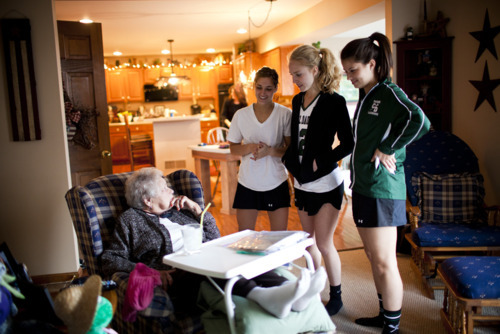
    AnnaBelle Bowers, 87, talks to her granddaughter Carley, 17 (right), and her friends
According to AARP, nearly 44 million Americans are taking care of an older family member at any given time. And, as the nation's baby boomers age, this number will only increase. In fact, as the population ages, the average worker will be a caregiver, according to Cheryl Matheis, senior vice president for policy at AARP. She recently spoke with Morning Edition host Steve Inskeep.
Currently, the average caregiver is female, 49 years old and working, and she spends roughly 20 hours a week on caregiving duties. And, the impact on the caregiver's life can be significant.
"[Caregivers] lose on average $325,000 in lifetime income in lost wages, lost social security, and lost pensions," Matheis says.
The National Alliance for Caregiving found nearly 70 percent of working caregivers reduced their work hours, took a leave of absence or chose early retirement due to their caregiving duties. According to a Pfizer-ReACT/Gallup poll, when caregivers did come to work, they were less productive than non-caregivers.
Many of our listeners wrote in about their own caregiving experiences.
Melissa Fitzpatrick wrote: "Thank you so much for this series! It really speaks to me. My mother-in-law, who has moderate dementia, moved in with us 1 1/2 years ago (shortly after I went through a particularly harrowing caregiving stint with my own mother when she was going through chemotherapy). Trying to figure out how to provide my mother-in-law with the care she needs, while also balancing taking care of my kindergartner and working has been tough."
Rebecca Hansbrough wrote: "These individuals family profiles strike a cautionary tale, not just for the senior members but for the middle aged children as well. One of the little spoken and ugly secrets is the fact that many of us will require long term care at some point in our lives and Medicaid won't cut it... I applaud these families for their ability to adjust in order to provide their loved ones with a caring and supportive environment."
Hank Scott wrote: "For me, it is a joy and a form of self reward to care for my elders, see to it there is a roof over their heads, food in the [fridge]. All the things they did for me as a young one. I have to admit without some aid from the government in the form of Social Security and Medicaid/Medicare, it would be almost impossible for me. So I not only appreciate the safety net, but willingly participate in it. The only sad part is the cost of all things has risen so much it makes it harder every year."
Ginger Hilgenberg wrote: "I am a caregiver for my mom who is 92 and still lives on her own. When she was in her seventies, she cared for her aunt... Now it is my turn to help, but it is very difficult some days. I am 52 and have one son in college, one still in high school. My husband is supporting us all as I am a stay-at-home mom. It's all about family, not politics, or money. Do the best with what you have. Isn't that what our mothers taught us as children?"

Copyright 2012 National Public Radio


________________________________________________________
Credit: Reports and photographs are property of owners of intellectual rights.
Seniors World Chronicle, a not-for-profit, serves to chronicle and widen their reach.

May 11, 2012

UK : The crisis in social care , Indifferent Civilised Society

LONDON UK / Mail Online / Society / May 8, 2012

By Dominique Jackson

The parallel universe of geriatric care is not somewhere most people visit willingly, nor regularly, if they can help it. Most of us cannot even begin to imagine the burgeoning twilight universe which exists alongside ours. After all, the care system only really hits the headlines when brave whistle blowers expose particularly shocking cases of neglect and abuse.
                                                                                                                                       
                     This is a terrifying indictment of how poorly we value the achievements of the older generation and of how quickly and how conveniently we forget the huge debt we owe them

I am not quite sure why most of us choose to remain so blinkered about the crisis in social care? After all, we are all going to get old one day; thus, someone, somewhere is probably going to have to help look after us and somehow, that care is going to have to be paid for. 

Today’s open letter, begging the Prime Minister to open his eyes to the care crisis, is signed by 78 charities and campaign groups, who are all working on the grim, often fraught and woefully under-funded frontline of care provision for the frail, elderly, disabled and otherwise most vulnerable members of society. They know all too well what they are talking about.

Surely, social care is the litmus test of a civilised society? The current crisis, both in funding and provision, is a terrifying indictment of how poorly we value the achievements of the older generation and of how quickly and how conveniently we forget the huge debt we owe them.

I sincerely hope that Mr Cameron takes a few minutes off from his busy day out with Mr Clegg, relaunching the aims of the coalition from a factory in Essex. I hope he takes enough time to read this important letter, to digest what it means and to decide to take some action.

Two years ago, when Messrs Clegg and Cameron stood side by side in the Downing Street Rose Garden, charities and the elderly lobby felt they had some cause for optimism. The coalition soon published a white paper on health care reform which promised “a sustainable legal and financial framework for adult social care” by the second session of parliament.

Yet today we are frustratingly no further on and the government looks increasingly out of touch with its growing numbers of elderly, and vocal, voters in the wake of the “Granny Tax” debacle.

The Queen’s Speech tomorrow is expected to include a vague nod to the importance of social care reform, but there will be no bill brought forward in this session. Thus, we have no hope of any realistic overhaul in long term elderly care for at least another two years.

This is two years too long for a shocking majority of elderly people and their family members, many of whom work as unpaid carers, and a huge number of whom are currently struggling to fund, or even to find, appropriate and adequate support and care. 

Tens of thousands of elderly pensioners are forced to sell their homes to pay for residential care. Many more thousands of senior citizens who do not have that option are trapped in the postcode lottery of care I wrote about on this forum only last week when I highlighted the plight of 99-year-old war veteran and dementia patient Bill Sandford, unable to move close to his daughter and her family because of a shortfall in local council funding.

The Commission on Funding of Care and Support, chaired by economist Andrew Dilnot, called for a limited liability model of social insurance, in which any individual’s liability for the cost of care would be capped at around £35,000, with the state coming in at this threshold.

However, implementing Dilnot’s proposals has reportedly been held up by rows within the Treasury over how to pay for the reforms. A much delayed White Paper on long term care will finally appear next month but is expected to focus mainly on issues such as improving service quality, safeguarding vulnerable patients and on personal budgets to allow greater freedom of choice. How on earth we are expected to pay for all of this is not expected to be directly addressed at all.

This is particularly bad news for those of our poorest senior citizens. Two thirds of the 400,000 pensioners in the country’s care homes are funded by the state and recent cuts to council funding have led inevitably to a drop in levels of staffing, recruitment criteria, provision of training and thus in standards of care.

A report on transforming social care for the poorest elderly people from the Centre for Social Justice think tank is also published today. It argues that the current means-tested system of funding is at breaking point and that the proposed Dilnot reforms ignore the plight of the war time generation who simply do not have any assets to sell.

The CSJ, which was established by work and pensions secretary Iain Duncan Smith while he was in opposition, hopes its findings may influence the politicians who are considering their response to Dilnot in cross-party talks ahead of the White Paper’s appearance in June. 

All this research and all these recommendations are all very well but what we really need  now is some joined-up thinking and some immediate action. We need an open and honest debate about the needs of the elderly and we should all, every single one of us, be involved. After all, we will all be elderly one day.

Our population is ageing and ageing fast. Almost 20 per cent, 11.8 million, of us are now over the retirement age. Of these, 1.3 million are already over the age of 85. Our rapidly ageing population means swiftly rising rates of dementia and growing legions of frail and vulnerable seniors, who are, whether they like it or not, dependent on younger generations.

It should not have to fall to a coalition of charities to have to highlight the scale and urgency of the challenge of social care reform but now that they have bravely brought the debate back into the headlines, it is high time for the government to wake up to this demographic time bomb and act.

© Associated Newspapers Ltd
 
________________________________________________________
Credit: Reports and photographs are property of owners of intellectual rights.
Seniors World Chronicle, a not-for-profit, serves to chronicle and widen their reach.

May 9, 2012

USA: 98-year-old woman graduates from USU, oldest on record

LOGAN ,UTAH USA / KSL.COM / Active Aging / May 8, 2012

By Mike Anderson

A Cache County woman is proving it's never too late to get an education. She just graduated from Utah State University at 98 years of age. 

Twila Boston never quite got her bachelor's degree because life got in the way. She had only a few credits left so the college of Humanities at USU, helped her finish a degree in American Studies. She walked with the class of 2012 last Saturday. 

        Twila Boston is the oldest person to graduate from Utah State University in its long history, completing an American Studies degree at the age of 98.
Boston has several younger Aggie alumni in her family. "It was expected of us in our family to get an education," Boston said. 

She just never got around to getting her diploma until now because she took on a career in taking care of others. 

"When you're a nurse, you're always a nurse," Boston said. 

One history project later, she finally got to wear that cap and gown. 

"I tell you, I had to be forced to go there. They told me they wouldn't send me my diploma if I didn't come," she said. 

The moment was exciting, at least for the college of humanities and social sciences. Boston is the university's oldest graduate on record. You can imagine why professors coaxed Boston into walking the walk, even though she would have preferred to get the diploma by mail. 

The event brought several family members, some coming all the way from the east coast to show their support. But she doesn't think that he graduation is that big of a deal, though many people seem to. 

"I think it's stupid. Everybody graduated, they had three sessions of graduates up here," she said. 

That's a graduating class of more than 3300. Boston said she shouldn't be seen as any more special than the rest of them. She finished that degree for one simple reason: She loves learning. She said she'd keep taking classes if she could. 

"Yeah. Why not? All I do is read," she said. "Somebody asked me what I read, and I said, 'everything.'" 

Her advice for fellow grads is fairly simple. "Go out in whatever you want, in whatever you want to do the rest of your life." 

Boston does have a challenge getting around. She said that's really the only thing keeping her from taking more classes. Since she only had a few credits left, professors allowed her to graduate by completing an oral presentation on American History. 


 © 2012 ksl.com

________________________________________________________
Credit: Reports and photographs are property of owners of intellectual rights.
Seniors World Chronicle, a not-for-profit, serves to chronicle and widen their reach.
May 8, 2012

INDIA : Unorganised workers and Elders demand pension


NEW DELHI , INDIA / The Hindu / Pension / May 8, 2012


Feeling excluded':Participants at the Pension 
Parishad dharna in New Delhi on Monday demanding 
universalisation of pension for the elderly.
- Photo: Sandeep Saxena

Demands for a universal pension scheme got bolstered with a large number of underprivileged people including farmers, domestic workers, single women, disabled persons, sex workers and trans-genders from more than 20 States beginning a five-day dharna at Jantar Mantar here on Monday.

The campaign for universalisation of Rs.2,000 as monthly pension for every elderly above 60 years in age and does not come under the tax slab is being spearheaded by Aruna Roy of the Mazdoor Kisan Shakti Sanghatan (MKSS) along with Dr. Baba Adhav, the veteran leader of the unorganised workers in Maharashtra.

Addressing the protestors, Ms. Roy said: “Pension is a right that the aging working poor have earned by virtue of having given the best years of their lives to contribute to the economy. They have grown food for the country's population, built houses and highways, cleaned streets, collected materials for recycling, cooked food and looked after households and assembled electronic goods.”

“Society must provide a decent pension for these people when they are no longer able to work. From where do you expect these poor people to pay for every thing, especially when you don't provide them even half the minimum wages?” Ms. Roy asked.

At present, all elderly over 60 years from the Below Poverty Lines category get Rs.200 per month as pension under the Indira Gandhi National Old Age Pension Scheme (IGNOAPS) with the State governments adding usually lesser and in some cases higher amount to the pension.

According to rough estimates there are around two crore beneficiaries of the Government pension scheme against the total elderly population of 10 crore.

The Pension Parishad, an assembly of organisations demanding a universal pension scheme, has rejected the IGNOAPS pension calling it “pittance” which can't ensure a dignified living to the elderly.

“The Government pension is a pittance which is in no way sufficient for the elderly. That is why we are asking for at least Rs.2,000 or half the minimum wage whichever is higher,” said Nikhil Dey, leader of MKSS, who is also part of the Pension Parishad.

On the issue of locating money for the scheme, Prabhat Patnaik, former member of the Kerala State Planning Board and member of the UN Commission, said the State has to do the needful. “If a child doesn't get food, you don't blame the child. In the same manner if the elderly starve, it is the State's duty to ensure a dignified living to them who can't be blamed for being poor.”

Patnaik said that with 14 per cent (Centre and State combined) India has the lowest tax GDP ratio in the world so it has enormous amount of potential to increase taxes.

Referring to the Arjun Sengupta Committee which had talked about modest cess increase of 0.5 per cent to generate funds for social welfare schemes, Mr. Patnaik said even if the government increases the tax by 2 more per cent to 16 per cent, India will still be the country with lowest tax GDP ratio and its elderly population will be able to live a decent life as well.

During the public hearing, most of the elderly talked about extreme despair and how they felt excluded from all entitlements and services even as they struggling to hold their lives together.

Sixty-seven-year-old Ramani Devi doesn't have anyone except a son who has abandoned her in her village in Rajasthan. Now she is left at the mercy of her neighbours. She doesn't get the pension because she doesn't have a BPL card.

“Even if I tell you (what I eat to survive), will you never be able to imagine what I eat?” said Ms. Devi when asked how she survives. Now only the hope for a decent pension has brought her to Delhi from the interiors in Rajasthan.


Copyright © 2012, The Hindu 


Senior Citizens Organizations like Helpage India , Silver Inning Foundation , AISCCON have extended their support to ' Pension Parisad'  .

 
Programme from May 8 - 11
 
8th – Public hearing on Accountability and Grievance Redress related to Pensions and entitlements for the elderly. The Grievance Redress Bill will also be discussed.
9th – Public hearing on issues of marginalised and vulnerable groups
10th – Public hearing on issues related to the National Food Security Bill and food security of the elderly
11th – Pension Parishad discussion on the response to the charter of demands. Planning the way forward.


________________________________________________________
Credit: Reports and photographs are property of owners of intellectual rights.
Seniors World Chronicle, a not-for-profit, serves to chronicle and widen their reach.