Remember ME - You Me and Dementia

Showing posts with label Hong Kong. Show all posts

December 9, 2011

CHINA: No pause at menopause


BEIJING / China Daily / Life / December 9, 2011 

By Chitralekha Basu, China Daily

No pause at menopause
Author Xu Xi has portrayed Hong Kong, where she was born and grew up, as a backdrop and theme in many of her works.
Provided to China Daily

A new collection of short stories from Xu Xi focuses on themes close to the author's heart -namely mature women, sex and Hong Kong. Chitralekha Basu reports.

Chinese-American novelist Xu Xi's new book is a collection of 13 short stories, titled Access, inwhich the distinguished academic, author of nine books and the editor of three anthologies about Hong Kong is largely concerned with middle age.

Her band of menopausal women - who appear as central characters in most of these tales - are often angsty and insecure as they teeter on the brink of losing husbands/boyfriends, jobs,security and the meaning of life. But they are also capable of rising above their situations -sometimes, inexplicably, reconciling with them.

For most of these women - often confident, sassy and powerful, even if they might have their unguarded moments - there's no pausing at menopause.

"Perhaps the stories reflect the fact that I'm 57," Xu says, in a phone call from Hong Kong. The woman, who "inhabited the flight path connecting New York, Hong Kong and the South Island of New Zealand" until about two years ago, is more or less stationed in Hong Kong now. That's to be close to her twin concerns - a 92-year-old mother suffering from Alzheimer's and a fledgling writing school focused on writing from Asia. 

"I'm around people nearing retirement age. I'm interested in what aging does to the body, mind and spirit," Xu says.

For some of her women protagonists, menopause seems to accelerate desire, and how! They love their husbands but sleep with their friends' husbands, without apology (in the story Anon).They take off for Europe to have clandestine rendezvous with their boyfriends who are married to someone else, but when the date does not show up, they take a walk down the back streets of Stockholm, reflecting on the way their lives have panned out (Iron Light).

There is a lot of sex, and it comes in various forms, sometimes violent, illicit and even incestuous.

"There's always a lot of sex in my novels," Xu says, laughing. "It's probably the reflection of aworld in which nothing sexual is held sacred anymore, the way it was before the coming of the Internet."

Her engagement with sexuality - which Xu says began with a curiosity to find out about unusualsexual phenomena when she was still quite young - has opened up newer vistas, pushing her to explore spaces in which desire blurs the lines between gender identities.

No pause at menopause

"What gender we are is not a very clear-cut idea anymore, physically or otherwise," Xu says. "We have allowed homosexuals to come out. Women are no longer just seenas baby-making machines.

"This new openness has changed our ideas of society.Now we can use sexuality as a tool to explore humanity abit more provocatively. It's one part of ourselves we're nolonger totally in control of."

In the story Lady Day, the protagonist's apparently aberrant sexuality is a "deformity" that sets off a chain of personal disasters - being disowned by family and abusedby bullies in a British public school - but is turned into a weapon, a source of power, later in life.

As a posh hermaphrodite prostitute who services business tycoons and Saudi princes in her plush apartment not too far away from Wall Street in New York, Lady Day lives lifeon her own terms, even as her high-profile clients take a tumble after a journalist runs an expose. She even gets herrevenge on the high school bullies.

The great thing about Xu's protagonists is that none ofthem ends up a loser, although they could easily have done so, as the situations they find themselves in arepotentially lethal.

In Crying With Audrey Hepburn, a danseuse past her prime is relegated to taking part in cheap striptease shows. She had married for love, but her dancer husband could notcope with the strains of having to prostitute his art and committed suicide. Her solitary existence is fraught withlonging as well as an understated sense of betrayal.

"But even she doesn't feel like it's the most terrible thing to have happened to her," Xu says.

"She's not unhappy with her life. There is a sense of being at peace with her state."

Xu's protagonists are as disparate as they come - amasseur, an MIT graduate-turned-gambling pro, a 75-year-old proprietor of a New York-based financial magazine trying to hang on to the old order while coping with the tide of new-age marketing strategies.

The settings vary, too. They shift from a sprawling house with an un-weeded garden on theeast coast of New Zealand's South Island to the opulently laid-out Plaza Suite in New York.Often, the setting becomes a character invested with a role.

Hong Kong, of course, remains the pivot. It's where Xu keeps coming back in her stories, just asshe does in real life.

Born to Chinese-Indonesian parents - a businessman and a pharmacist, who always encouraged her to write and indulged her curiosity about things - Xu grew up in Tsim Sha Tsui district.

Although the city has featured both as backdrop and theme in most of her previous works -Evanescent Isles, Overleaf  Hong Kong, The Unwalled City, Hong Kong Rose, Chinese Walls -Xu finds Hong Kong an inexhaustible repository of stories.

The most significant change since Hong Kong's reunification with the mainland in 1997, Xusays, is that "Hong Kong feels like it's lost its way. It probably needs 'access'".

Hong Kong is also something of "a cliche in the Western world", she says.

"It is associated with cheap plastic flowers from the 1960s. Whatever informs our image of places also misinforms our ideas about them. It's this difference that's interesting to watch."

For her, watching Hong Kong seems like a lifelong occupation.

Copyright 1995 - 2010 China Daily Information Co.
____________________________________________________________
Credit: Reports and photographs are property of owners of intellectual rights. 
Seniors World Chronicle, a not-for-profit, serves to chronicle and widen their reach.

August 13, 2011

HONG KONG: The Pain of Cage Home Tenants

HONG KONG / Asia Sentinel / Hong Kong Current Events / August 13, 2011

Written by Alice Poon (潘慧嫻)


This is the story of people who used to live in cage homes in Kwun Tong. This is my translation of an Inmediahk article written by Yuen Yan [原人] entitled "The Last Days of a Cage Home."
"The picture was taken three weeks ago. The writer went with a group of university students to visit three elderly occupants of a cage home. After climbing eight flights of steps, we discovered that the door to that home was locked. The home and the elderly men were gone.

Over a month ago, the writer had been to visit the three elderly occupants who had still remained. Their landlord and his wife were nowhere to be seen - they probably had moved out. The landlord was hard of hearing while his wife was partially disabled, according to their son who lives in Australia. The wife had never left the rooftop home in the last ten years. The piece of open sky and the rooftop garden were her only place of refuge. Everyday, she would start her day with the cleansing ritual, then she would ride around the garden in her wheelchair to water her plants and admire her flowers; in the evening she would have her dinner, with TV watching as her condiment. This was her everyday life, with her husband by her side, taking care of her. Together, they had been guarding this remaining cage home in Kwun Tong for over a decade.

Shortly before the close-down of the cage home for redevelopment purpose, they had been relying on rents collected from seven remaining tenants, at HK$700 each per month. This landlord couple had been gone for several months. During the writer's visit over a month ago, what I had witnessed was a deserted and filthy place with clutter of personal belongings everywhere. Only three elderly men had remained in the home that stank terribly. Unable to stay for more than fifteen minutes, the writer had had to say goodbye after offering them some oranges and had left in a hurry. On leaving the place, I couldn't but wonder: against the backdrop of redevelopment, could one shred of human dignity be allowed to remain?

For most people, cage homes never impress them as bright, comfortable and airy. In fact, cage homes from older times were never so. But for people like Wah Tse and two other elderly folks who used to live in a cage home, they've never cared for things like elevators, air-conditioners, etc. What have clung to their hearts are still the small bunk beds in the cage home.

Wah Tse already moved to a public housing unit. But she comes back everyday to the cage home to have lunch with her two elderly friends, chat with them and help them fill out lottery tickets. Perhaps her greater concern is for Siu Fa the Cat and her babies. Though financially strapped, she still tries to fork out a little cash to buy food for the cats. Each day she comes to watch the cats eat and play. She's emotionally tied to her old friends, even more so to the cats. In the redevelopment process, people can wait to be resettled, but what about the cats?

Each cage home tenant has his/her own reason to stay. But for cage home tenants to leave, there is only one reason - redevelopment.

Some elderly people say that they were once resettled into senior homes within a public housing estate under government policy. But they were required to share living space with other elderly people. When they found they could not get along, they chose to return to their cage homes. Some Chiu Chow elderly people have a habit of going to nearby night-snack shops [打冷店] and do not want to move to public housing estates in remote areas. Some have a passion for reading and are averse to moving to public housing estates that are a long distance from city centers where libraries are situated.

These people used to be factory workers in the old days. In their youth, they had to find work in the Kwun Tong factory area and cage homes were their answer for having a minimal shelter where they could sleep through the night in order to rise up in the morning to find work again. Those were the good old days. Factories could move north. But people couldn?t. They lost their jobs. They lost their future. Only their living space remained. Some took pleasure in their cats; some buried themselves in reading; some reminisced their old days. In the end though, even the cage homes are denied them. Industries heading north meant the loss of their jobs. Urban redevelopment is taking away their lives. Between finding a piece of ceiling above their heads in the public housing estates and continuing to live a gratifying life, is there really a choice for these cage home tenants?"

Copyright © 2005 - 2011 Asia Sentinel

___________________________________________________________
Credit: Reports and photographs are property of owners of intellectual rights.
Seniors World Chronicle, a not-for-profit, serves to chronicle and widen their reach.

August 8, 2011

HONG KONG: Singapore's Teresa Hsu, 113, Talks Longevity

SINGAPORE / Asian Scientist / News / August 8, 2011

Living to 100 isn’t all about genes, but rather it has a lot to do with good nutrition and living a healthy lifestyle, Hong Kong geriatric experts said yesterday at Elderly Health Day 2011.

According to Dr. Bernard Kong, President of the Hong Kong Geriatrics Society, and Dr. Lo Man Wai of the University of Hong Kong, good habits developed from at least middle age can contribute greatly to longevity and quality of life – lending credence to the Chinese saying that anyone can live to be 100.

"Skeletally, people are actually designed to live to 120,” said Dr. Kong.

“The typical belief is that you simply have to have the right genes to live for a very long time, but this is not always the case. As much as 70 percent of one’s longevity can be traced to lifestyle, including the way people eat, whether or not they smoke, and how much they exercise,” he explained.

Dr. Lo added that staying connected to society is an important factor, such as through social networking sites.

“Simply staying in touch with people has been demonstrated to have beneficial effects on our longevity,” Dr. Lo said.

Elderly Health Day 2011 was organized by the Hong Kong Health Care Association on Aging (HKAOA) to share the secrets of living a long, quality life through nutritional care and professional guidance. Also in attendance was a very popular centenarian, Teresa Hsu. (Photo courtesy: spreadia.com)

The 113-year-old “Sister Teresa” was born in abject poverty in Guangdong in 1898 but rose to become one of Asia’s most beloved and inspirational social workers. She started studying nursing after World War II, at the age of 47.

Today, Hsu is the founder of the Heart to Heart Service and the Home for the Aged Sick in Singapore, where she lives as one of the city’s most cherished treasures.

“My secrets of longevity are simple: I stay positive, I contribute, I eat a healthy diet, and every morning I do yoga,” said Sister Teresa, who was flown to Hong Kong for the event.

“I think nutrition is very important. I try to stay away from heavy cooking because it takes away much of the vitamins in food. I also try to avoid caffeine. Overall, my eating habits are very simple: I consume a lot of foods like avocado, milk, beans and raw eggs that are high in nutrients like proteins and omega-3,” she said.

Hsu also discussed the benefit of meditation in staying healthy at her age.

“Meditation is also an important part of my life. I spend a couple of hours every morning ‘clearing my brain’ and focusing on the day ahead. I believe a healthy brain goes a long way toward living a long, quality life,” she said.

Elderly Health Day 2011 was an open-to-the-public event at the Dragon Center, with an estimated 2000 people in attendance.

In addition to meeting Sister Teresa and the day’s guests of honor, attendees received free blood pressure and bone density tests as well as counsel from a nutritionist on dietary principles and supplements.

Source: Hong Kong Health Care Association on Aging Limited

Copyright © 2011 Asian Scientist, LLP.
___________________________________________________________
Credit: Reports and photographs are property of owners of intellectual rights.
Seniors World Chronicle, a not-for-profit, serves to chronicle and widen their reach.

August 1, 2011

HONG KONG: Relax residency rules, say elderly

HONG KONG / The Standard / News / August 1, 2011

Poor medical services in mainland China major deterrent for Hong Kong seniors

By Samson Lee

Nearly one in every five senior citizens plans to settle in the mainland and more will consider doing so if the government relaxes the residential qualification for old age allowances, or so-called "fruit money," a survey shows.

The Democratic Alliance for the Betterment and Progress of Hong Kong interviewed 508 people aged 60 or above between July 21 and 26. Nearly half of them are receiving the old age allowance of HK$1,035 a month. Of these, 18 percent said they would prefer to settle in the mainland because of the lower cost of living (48 percent) and the better living environment (21 percent), or to stay with relatives (27 percent).

A group of elderly Chinese relax in a park in Hong Kong. Illustration by courtesy: acclaimimages 

The biggest concerns about moving across the border are the poor quality of medical services (29 percent), losing the old age allowance (16 percent ) and inability to adapt to life there (16 percent).

Of the 416 who have not considered settling in the mainland, 26 percent said they will think about it if the residential qualification is relaxed.

DAB chairman Tam Yiu-chung called on the government to relax the qualification and to work with mainland authorities to provide a medical insurance program for senior citizens who have settled across the border so that they do not need to return to Hong Kong for treatment.

"Under the current system, the elderly need to stay in Hong Kong for [at least] 60 days to get the allowance," he said. "But can we amend that so that those who are here for less than 60 days can still get the allowance while in the mainland?"

An 83-year-old man, surnamed Lam, said he bought a flat in Dongguan, Guangdong province, early this year so that he and his wife, 81, can enjoy their twilight years. He hopes the government will relax the residential requirement.

"The fruit money is pocket money. Without it, I may need to rely on my children who have emigrated to Canada," he said.

The DAB said it will meet with Chief Executive Donald Tsang Yam-kuen on Wednesday to discuss elderly welfare for the 2012 policy address.

© 2011 The Standard
___________________________________________________________
Credit: Reports and photographs are property of owners of intellectual rights.
Seniors World Chronicle, a not-for-profit, serves to chronicle and widen their reach.

July 14, 2011

HONG KONG: Senior citizens are less lavish in daydreams

HONG KONG / The Standard /  July 14, 2011

Wealth dreams of elderly simply matters of joy


Kelly Ip

Many people dream of being rich, perhaps traveling the world in a luxury yacht, a home on The Peak, shopping to their heart's content, and more.

But senior citizens are less lavish in daydreams: time with family and friends, a short trip with a spouse, perhaps recording a song that stirs memories.

Researchers from Pok Oi Hospital and the City University of Hong Kong department of applied social studies interviewed 406 people aged 60 to 90 as part of the "Dreams Come True Projects for the Elderly." It aims to turn dreams into reality by providing subsidies of around HK$5,000 a month.

The survey, which resulted in the "happiness index" of this age group being put at 59.5 out of 100, included 14 dreams. Among them, most wishes were for quality time with family and friends, traveling with spouses and enjoying hobbies.

But it was also found that elderly people met families and friends an average 7.2 times last year.

"The dreams of the elderly are very simple," said Leong Che-hung, chairman of the Elderly Commission and a consultant on the project. "Having a meal with the family makes them happy."

An aging population "is a challenge rather than a problem," he added. "The elderly contributed a lot to Hong Kong when they were young, and we need to express gratitude by fulfilling their dreams."

The "Dream" program has run for a month, with 300 wishes granted. Many have been simple: being pictured with spouses and other family members, their singing recorded, preparing tea for others.

Chan Kiu-tin, 70, imagines an exhibition of his calligraphy, an interest since he was six. "It increases the concentration of children and teenagers," he said, "but few care about calligraphy nowadays. Everyone has a computer. People type rather than write."

Still, hoping to pass on the art to youngsters and offer an interest for other seniors, Chan now teaches calligraphy to 15 students aged from six to 80.

Yau Ling, 76, wants to share the joys of stamps he has been collecting for 50 years. A first-day cover with pride of place is of the Sino-British Joint Declaration. It is autographed by Margaret Thatcher, the prime minister who signed the pact.

The hobby combines culture and national pride, Yau said, "and it fills my heart."

© 2011 The Standard, The Standard Newspapers Publishing Ltd..
____________________________________________________________
Credit: Reports and photographs are property of owners of intellectual rights.
Seniors World Chronicle, a not-for-profit, serves to chronicle and widen their reach.

June 30, 2011

HONG KONG: Nothing to do, no place to go

BEIJING / The China Daily / Hong Kong Focus / June  30, 2011

By Guo Jiaxue (HK Edition)

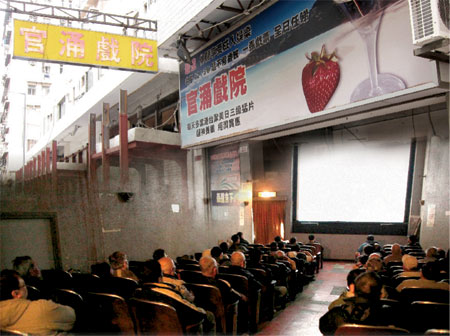
The signboard of the Kuwn Chung Cinema, now being torn down.
Guo Jiaxue / China Daily)

For the grassroots elderly people of Hong Kong, life has resolved into an enduring extension of days of nothing to do and no place to go. The situation doesn't appear to be improving - actually it is getting worse as demands for urban expansion overtake the places where those on limited income may gather. Guo Jiaxue reports.

Kwun Chung Street is an old, undistinguished, residential lane, all but lost around the corner from Tsim Sha Tsui, one of Hong Kong's busiest areas. It's hard to identify what shops are here from any distance, since the street serves as a convenient parking lot for long queues of commercial vans that block store fronts from view.

From a birds' eye view, the neighborhood is an oddity, squeezed in between the lavish environs of West Kowloon to the west and busy Nathan Road crammed with gold shops and tourists to the east. Grassroots elderly from the neighborhood don't even belong in those adjacent neighborhoods. They have no money. According to government population statistics in 2006, more than 6,000 families in Yau Tsim Mong District were earning less than HK$2,000 a month.

Here the observer is confronted with an isolated island of impoverishment, lost amid a sea of commercialism.

The sunlight strains but dimly down to the pavement on this narrow street. Passersby are mainly people who live in the apartments up above the commercial shops. Nighttime sees the street darker and even more deserted.

One shop that draws more notice than others is vacant. At the front is a sign emblazoned with the word: "Leasing". Still, people stop here and snap photographs, evidently indulging some nostalgic urge. Up until March this year, there was a pornographic cinema here, although the establishment hardly merited the name cinema. Video room probably would be more apt.

It's is difficult to fathom why this evidently unpromising locale saw commercial property rentals leap 80 percent in recent times.

"I don't know it exactly, but it's more or less 80 percent," Hui Tak-leung, a Yau Tsim Mong district councilor, said, trying to recall the rent increase that drove out the cinema. "The shop owner believed there was huge business potential ... Time has changed, the property prices are climbing up constantly."

The rent hike spelled the end of the 18-year tenure of the cinema on Kwun Chung street. Business had been poor anyway. But it may have been Hong Kong's last cinema featuring pornographic films. And that made the vacant premises a draw for nostalgia buffs to come and take pictures.

People in the neighborhood are reluctant to talk about the old movie house.

"They don't wanna talk. It's like, 'I went to watch porn movies', equals to 'I am a randy old goat'," said Hui.

Nevertheless the old dirty pictures establishment is missed. Some people feel its absence, anyway.

"Old people who live here play chess at parks. They go to the cinema on hot days. What's most important is for them to have a place to meet and chat," he said.

Hui believes the sense of loss in the wake of the porn cinema closure reflects the lack of elderly facilities in Hong Kong, especially in old districts like Yau Tsim Wong.

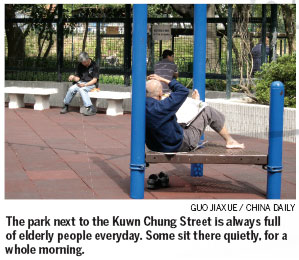
"You see many old people sitting in parks - very few of them play cards or chess - most just sit, have nothing to do, just sitting there for a whole day. And they are all male."

So, the cinema was not strictly about pornography. It was an air-conditioned refuge for the old folks on hot days.

Places like Kwun Chung Cinema were "suitable" for them. A HK$40 ticket was the price of admission for the whole day. They could sit and chat in the coolness of the air-conditioned space, watch movies, even doze off, the district councilor said. They couldn't get away with that in a modern multiplex cinema.

"But now they've lost the place," said Hui.

That's the thing. These grass-roots elderly don't really have much choice about where to go in neighborhoods like these. Most of the crowded old residential structures are more than 40 years old. The people are getting old. "Young people are moving out," Hui said.

"Community features." Hui shrug his shoulders, "It's sad, seeing so many old people on the street all day long, don't know where to go, and no one talk to them."

That social reality cannot be overstated. The King George V Memorial Park, just one block away from the Kwun Chung Street, is full of the elderly everyday. There is barely an empty seat, especially during cool and comfortable days in spring. Only a few can be seen reading newspapers or taking exercise. Most just sit, staring into the distance, apparently disinterested in everything.

Ching who lives nearby is one. The 70-year-old spends a lot of time in the park.

"Too many cars, people, and tail gas too. There is no room outside," he said slowly. He sits to escape the cacophony of automobile engines. He has no hobbies. "Mahjong? No. It costs money..."

The onset of summer makes sitting in the park nearly intolerable. Ching tries to escape to the shopping malls of Tsim Sha Tsui, where he finds relief under the Arctic blast of the air-conditioning.

These elderly, idle people leading empty lives eagerly embrace almost anything that gives them something to do. A few steps farther along Kwun Chung Street, from the old porn cinema, is a shop called Carrot House. It opened early this year. Elderly folk can be seen waiting in long queue every morning, waiting for the shop to open. The doors open. The people are let in. The doors are closed. Music and muffled voices over a microphone can be heard. But the place has no window to the outside world, nor perspective from the outside looking in.

Googling "Carrot House" reveals a business that has engaged in the sale of expensive so-called health food to elderly people for years.

But cheap gathering places for elderly folk are becoming more and more rare. Kwun Chung Street appears on the verge of a real estate boom. The demise of the old cinema is simply an early sign of changing times.

The high-speed rail link terminal, the West Kowloon Cultural District, and more luxury properties are all under construction just next to the old district.

"Once the high-speed rail starts to run, the commercial value will be much higher," Hui said.

The ground-floor shops under these old buildings have already begun to show their values.

The local barber shop moved away from the street in April. Austin Road, connecting Kwun Chung Street to the south, has totally transformed. Eight property agency shops have blossomed there, at one side of the street, extending a distance of two blocks. Quite spectacular, they are. The high-powered lights emanating from the agency shops are bright enough to turn night into day.

Another shop selling tableware closed, replaced by a glittering Sasa cosmetics shop.

To that degree, the convenient location is no convenience for people who live there. The neighborhood is not out of the way, in the fashion of public estates.

"For example, in Wong Tai Sin and Lok Fu, there are malls and plazas where they can stay and sit. But we can't sit as we like in private places," Hui said.

The district councilor called for the government to build some in-door public facilities in these old districts like Yau Tsim Wong so that the elderly can stay as long as they want. (photo on left)

"Maybe a multi-floor, multi-purpose center ... That would be good for the neighborhood," he said.

Copyright 1995 - 2011 China Daily Information Co (CDIC)
___________________________________________________________
Credit: Reports and photographs are property of owners of intellectual rights.
Seniors World Chronicle, a not-for-profit, serves to chronicle and widen their reach.

June 25, 2011

HONG KONG: Friending Grandma - More Likely Than Ever

HONG KONG: / International Business Times / June 24, 2011

By James Lee Phillips 

Photo courtesy: parentesource.com

More reason than ever to get rid of those embarrassing pics and questionable comments -- the studies are more or less consistent about the fact that your grandparents are likely to be using social media.

Comparison of various studies undertaken over the past few years has shown an almost exponential growth in social networking interest and consistent activity among users among more advanced age ranges. The usual interpretation is the 'graying' of the Baby Boomers -- for whom technical sophistication and adoption of cultural trends is far more prevalent than in previous generations.

Between 2007 and 2008, according to eMarketer data, only about 1% more Baby Boomers 'actively maintained' social networking profiles. However, the 2008 and 2009 growth was around 15% (and it breaks down to about about 73% for Facebook, 13% for Twitter and LinkedIn).
In the following year, however, a Pew Internet report lshowed that social networking doubled among the 65-and-older group, and grew about 88% among persons aged 55-64. As far as Pew is considered, this was a marked increase from the study done a year before, which suggested that only one in ten people in the 50+ age range utilized 'status updates' a la Facebook or Twitter.
A more recent UK study paints an even more 'booming' picture for the baby boomers.

According to a study of over 1300 UK grandparents (with no exact age range stated, alas), over one-fifth are using a social network and over half (51%) log in at least once per week (35% say a few times per month is sufficient). Nearly 70% have joined their social media site of choice within the last year -- to find old friends (about 25%), and to maintain the flow of communication with existing friends and family (around 20%).

As far as social media of choice, grandparents are relatively consistent with the rest of the social media-using public: Facebook comes in at 71%, Twitter at 34% and LinkedIn accounts for 9% (professional seniors, perhaps?). These details are courtesy of MyVoucherCodes (secondhand, via Mashable).

James Lee Phillips is a Senior Writer & Research Analyst for IBG.com. With offices in Dallas, Las Vegas, and New York, & London, IBG is quickly becoming the leading expert in Internet Marketing, Local Search, SEO, Website Development and Reputation Management. More information can be found at www.ibg.com.

© Copyright 2011 International Business Times.
______________________________________________________  
Credit: Reports and photographs are property of owners of intellectual rights.
Seniors World Chronicle, a not-for-profit, serves to chronicle and widen their reach.

May 13, 2011

HONG KONG: Elderly suffer as heat alert smashes record

.
HONG KONG / The Standard / May 13, 2011

By Natalie Wong


Nearly 1,200 elderly residents sought help yesterday as the SAR sizzled under the earliest "very hot weather warning" since records began 12 years ago.

The Senior Citizen Home Safety Association said 74 sufferers needed hospital treatment as the mercury hit 35 degrees Celsius in Tai Po and Sheung Shui and 34 degrees in most other areas of the New Territories.

Observatory scientific officer William Shum Chi-tai said the very hot weather warning had only been issued in May twice before - in 2000 and 2007 - and then not as early as yesterday.

"The precipitation for the period is much lower than normal. Therefore, there has been a lengthy hot and sunny period with not many clouds," Shum said.

The observatory said temperatures will begin to fall today as a trough of low pressure over Guangdong moves gradually southwards, bringing with it thundery showers and southerly winds.

Association deputy director Carmen Ng Ka-man said the senior citizens taken to hospital were suffering from dizziness and pain-related disorders.

Assistant director of health promotion Regina Ching Cheuk- tuen warned those engaged in strenuous outdoor activities to avoid beverages containing caffeine and alcohol, as the substances speed up water loss from the body.

The Labour Department advises employers to set up temporary sunshades and provide mechanical aids during extremely hot weather.

A vendor at a home appliances chain said he has sold twice the number of air conditioners over the same period last year thanks to the temperatures.

"Some customers even have to wait until the end of the month to have their sets installed," he said.

Fujikon Industrial Holdings' head of overall strategic planning and business development Johnny Yeung Chi-hung said the prices of electronic appliances from Japan, including air conditioners, have soared by 30 percent because Japanese manufacturers reduced production after the March 11 earthquake.

Yeung said more locals are now switching to products from the mainland or Southeast Asia.

© 2011 The Standard, The Standard Newspapers Publishing Ltd..

April 30, 2010

CHINA: Jackie Chan, 56, top Forbes China Celebrity

..
BEIJING, China / The Global Times / Life & Art / Entertainment / April 30, 2010


Hong Kong movie star Jackie Chan (born April 7, 1954) ranks Number One
in the recently released Forbes China Celebrity List of 2010.


Chan, who held a concert in Beijing's Bird Nest in May 2009, became the first artist to perform in the National Stadium. Jay Chou didn't receive good reviews for his movies, but he got more attention for his work in the Hollywood film The Green Hornet with American actress Cameron Diaz. Meanwhile, Lau has starred in three movies, but his secret marriage to Carol Zhu that was exposed grabbed headlines.

Basketball forward Yao Ming continues to lead the list of celebrities from the Chinese mainland and actress Zhang Ziyi ranks fourth with 25 cover stories. Skit and sitcom actor Zhao Benshan is in the fifth place.

Writer Guo Jingming who edits Top Novel magazine is in 58th spot, while writer, blogger and racecar driver Han Han is 74th.

According to Forbes Chinese edition, the two standards for ranking celebrities are personal income and media exposure rate which is judged from 28 popular newspapers, 18 nationwide TV programs and cover stories in 29 magazines. [rc]

Copyright by Global Times © 2007-2010,

March 29, 2010

HONG KONG: `Suzie' shows how to age gracefully

. HONG KONG / The Standard / March 29, 2010 By Jacqueline Pang I wasn't born when Nancy Kwan reached the pinnacle of her acting career. I'm not a fan, and have only watched The World of Suzie Wong once [frankly more because of William Holden]. The success of her later films, such as Flower Drum Song, is to me largely hearsay. I've heard people talking about her documentary, To Whom it May Concern: Ka Shen's Journey, but only started looking forward to it lately after reading interviews she gave during her recent trip back to her native Hong Kong. To Whom It May Concern: Ka Shen's Journey. Nancy Kwan (born May 19, 1939), now 70, she has had a rich life, and built up quite a resume - graduation from the Royal Ballet School in England, with a certificate to teach; the Golden Globe Award for Most Promising Newcomer; Golden Ring Award; and interestingly, her recognition as style icon for the Vidal Sassoon bob! But like everyone else, she has reasons to be sad: two divorces and the death of her only son at 33. Related reports Bangkok Post: Actress Nancy Kwan speaks outside the re-built Luk Kwok hotel, a former waterfront location where she filmed the movie 'The World of Suzy Wong', in Hong Kong. Hotel employees appear incredulous at Kwan's unexpected appearance as an AFP photographer snaps pictures of the former screen siren, born to a Chinese father and Scottish mother. The New York Times: Heady Days for Hong Kong Women Instead of complaining, she remains energetic and active. She still acts [did you know she played a role in the TV series ER?] and is politically active. While here, she criticized the tearing down of colonial buildings and the ever-shrinking Victoria Harbour. Her philosophy is simple: "I was very lucky. Everything in life is about timing, and if it's not meant to happen, I don't care what you do, it's not going to happen." I guess this is the key to aging gracefully. [rc] TV hostess and disc jockey Jacqueline Pang takes the passing years in her stride. © 2010 The Standard, The Standard Newspapers Publishing Ltd..

March 28, 2010

CHINA: A Golden Oldie

. BEIJING, China / Global Times / Life / Odd Enough / March 28, 2010 A 117-year-old woman who lives in a nursing home in Tai Po is the oldest person in Hong Kong and possibly the oldest in the world. According to the Ming Pao Daily News, Cheung Kwai-mui was born on January 4, 1893. She has a daughter, two sons, eight grandsons and four great grandsons. Her favorite activity is singing old Chinese folk songs. Illustrative photo of Tai Po in Hong Kong A supercentenarian is considered verified if their claim has been accepted by an international body that specifically deals in longevity research, such as the Gerontology Research Group or the Guinness Book of World Records. The verified oldest living person currently is 113-year-old Walter Breuning from Montana in the United States who was born on September 21, 1896. [rc] Source: Xinhua

February 22, 2010

HONG KONG: Age is no barrier

. HONG KONG / South China Morning Post / Opinion / February 22, 2010 Forcing early retirement on able and experienced workers leaves Hong Kong society worse off FORCED RETIREMENT By Mike Rowse It's a good job Sir Alex Ferguson is not manager of the Hong Kong government's football team, or he would have been forced to retire nine years ago when he reached his 60th birthday. Instead, he has been free during the last decade to help Manchester United go on winning trophies, including the Champions League and three consecutive premiership titles, with his team fighting hard this season for what would be an unprecedented fourth. Why does our society insist on consigning fit and well performers at the top of their game to the scrap heap? And should we continue to do so when the evidence all around us is that this is unnecessary and indeed socially and economically counterproductive? The argument for raising the retirement age to 65, or even scrapping it altogether, is overwhelming. So why are we stuck in our present situation? The answer is a combination of history and inertia. Not so long ago, the standard retirement age for civil servants was 55, applications to retire early at 50 were readily granted and even retirement at 45 was possible if there were special circumstances. These numbers came from an era when terms and conditions were largely geared to serving the interests of expatriates who dominated the senior ranks of the civil service. Before air conditioning became widespread, and while shorts and long socks (or safari suits) were standard dress, it was felt life in the tropics was especially energy-sapping and hence worthy of generous retirement arrangements. Even the increase of the retirement age to 60, when it came, needs to be compared to average life expectancy which now stands at about 79 for men and well over 80 for women. So our society is planning for the average person to spend 20 or more years being economically inactive. From the perspective of the individual, the consequences of spending decades without income can be devastating. Gradually, savings accumulated over a working career of 40 years or so disappear, which could leave the retiree in poverty or as a serious burden on his family (or the community at large, of which more later). While the financial implications are serious enough, the effect on the morale of the person can be even grimmer. For most people, their job is an integral part of who they are. It helps define them, gives them a sense of purpose. The prospect of an enforced early retirement with inactivity stretching over the horizon often results in a collapse of their spirit and can even result in early death (the so-called "gold watch" syndrome). Of course, some of the effects of this can be softened by courses preparing people for retirement and, at some point, everyone does have to stop working. So in a sense, raising the retirement age only postpones the problem rather than removes it altogether. But it is surely easier to slip into graceful retirement - preferably with an interim stage involving part-time work - when one's mind and body are sending unmistakable signals that enough is enough. From society's point of view, early retirement is an extraordinary waste of expertise. People educated at great expense and sharpened by years of hard-won experience are shoved aside when they still have much to offer. Moreover, with the deterioration of family values that seems to be an inevitable part of the switch from rural to urban living, the community now has a tendency to look to the government to provide support for the elderly. Where once it was common for three or even four generations to live under one roof, now this is exceptional and the nuclear family has become the norm. Governments everywhere are struggling to cope with the financial consequences of people hammering on the door for old-age pensions set high enough to support independent living. At this point, it is worth pointing out that when old-age pensions were first introduced with 65 set as the qualifying age in Britain, the average life expectancy was considerably lower than this - somewhere in the mid-50s. It has just been reported that Shanghai is on the verge of raising the retirement age. An increase is an inevitable part of any package to rescue the American social security system. In addition to the direct consequences, there are also indirect ones. Already there are concessionary fares on public transport for those aged 65 (or 60 on Citybus). How long before there is pressure to lower the qualifying limit? In other words, by setting the benchmark at 60 for retirement, we lend subtle support to the idea of dependency and subsidies. We should instead be encouraging self-sufficiency for as long as possible. There are many other aspects of this subject that there is no room to cover here. But, suffice to say, the conclusion is clear: the Hong Kong government should take the lead and announce immediately that in principle it has decided to move the normal retirement age to 65 and will be making arrangements for early implementation. Does it have the courage to do so, or is this another one for the overflowing "too difficult" basket? [rc] Mike Rowse is a retired civil servant and an adjunct professor at the Chinese University of Hong Kong Copyright © 2010 South China Morning Post Publishers Ltd.

February 2, 2010

HONG KONG: Feng shui master denied Nina Wang fortune in Hong Kong

. LONDON, England / BBC News / February 2, 2010 A court in Hong Kong has thrown out a feng shui master's claim to the multi-billion dollar estate of Asia's richest woman, Nina Wang. Tony Chan, who said he was Nina Wang's lover, had argued she left him her fortune in a 2006 will. Nina Wang was renowned for her short skirts and pigtails even in her old age. This photo was taken in Beijing in 2001. But a high court judge said the will was a fake and a 2002 will was valid which left the estate to a charitable trust run by Wang's family. Nina Wang's Chinachem was worth $4.2bn (£2.1bn) when she died in 2007. The fortune had been part of an earlier dispute with her father-in-law. Kidnapping High Court Judge Lam Man-hon ruled: "The court finds that the 2006 will was not signed by Nina." The competing 2002 document left the estate to the Chinachem Charitable Foundation, which was set up by Wang and her husband and is run by members of her family. "The 2002 will truly reflected the long-held intention on the part of Nina to leave her estate to charity," the ruling said. The Chinachem Charitable Foundation's lawyer, Keith Ho, told reporters outside the High Court that the foundation was "very happy with the result". "The main point is that the judge accepted the evidence from us that some signatures in the 2006 will are forgeries," he said. Mr Ho said the foundation would continue to "carry out its charitable purpose". Mr Chan's lawyer said his client was "extremely disappointed" by the judgment. "But he appreciates how difficult this sort of trial is to judge and that there has to be a judgment," said Jonathan Midgley. He said Mr Chan's position remained "the same as it has always been - namely that the will in question was given to him by Nina and accordingly it is inconceivable that that will is a forgery". Mr Midgley said Mr Chan would appeal against the ruling. Frugal life By the time Nina Wang died of cancer in 2007, she had created a huge business empire - a conglomerate of high-rise towers and companies around the world. She wore miniskirts and her hair in pigtails into old age and was reputedly very frugal, despite her wealth, says the BBC's Annemarie Evans in Hong Kong. Her life was marked by the 1990 kidnap and disappearance of her husband, Teddy Wang Teh-huei. Nina Wang paid half the HK$60m (US$7.7m) ransom for him early on, before proof of life had been made and, unusually, the money and most of the kidnappers were found, but never the body of Teddy Wang. When he never came back she refused to accept his death and reportedly spoke of wanting to join him. Teddy's father later claimed his son's fortune as his own, alleging that Teddy had been upset at an alleged affair of Nina's. It was the father who pressed for Teddy to be declared legally dead nine years later, prompting Nina to produce the hand-written will showing the fortune was hers. A court ruled it was a forgery in 2002 but a higher court reversed that ruling in 2005, and Nina Wang inherited the estate. [rc] © BBC MMX

October 23, 2009

HONG KONG: Doyenne of war correspondents parted from life’s savings

. LONDON, England / The Telegraph / Expats / October 23, 2009 Clare Hollingworth, 98, is one of ours. She is a British expatriate living in Hong Kong and former Telegraph journalist. By Emma Hartley She is also the reporter who broke the story of the Germans invading Poland in 1939 for The Daily Telegraph, a strong contender for scoop of the 20th century. Sadly Miss Hollingworth, whose hearing and eyesight are not what they once were, has been subject to a mercurial acquaintance, who separated her from her money and has failed to repay it, even following a court case at the end of which he agreed to do so. Ted Thomas, 80, a British-born PR executive, met her at the Foreign Correspondents Club in Hong Kong, to which she still goes on most days, and in January 2003 offered to “assist” the nonagenarian with her financial affairs. He was given control over her account at the Standard Chartered Bank and obtained a cheque book and ATM card. Large sums were soon being removed from her account. During one five-day period that August a total of HK$1,446,500 (about £112,000) was withdrawn by Thomas, who kept very limited records and receipts. When challenged by the British magazine Private Eye about the use to which the money was put, Thomas said it was spent on “wet fish and taxi fares”. However, as the sum involved is approximately HK$1 million (£77,600), this seems unlikely to be the whole story. In 2006 Miss Hollingworth filed a writ against Thomas, asking him to account for the whereabouts of the money and the case was settled in 2007. The terms of the agreement are confidential but the Telegraph understands that Thomas agreed to repay more than HK$1 million. Two years on, he has not done so. As a result of this stalemate Miss Hollingworth’s family are preparing to apply to have Thomas declared bankrupt. Ms Hollingworth’s great nephew and biographer, Patrick Garrett, lived in Hong Kong until he was moved by his employer to its Moscow office. He said that the sum still outstanding represented more than half of Miss Hollingworth’s life savings. “We’re hoping that this application will encourage the guilty party to put his hand on his cheque book,” he said. “Ted Thomas has not met his obligations and we hope that the threat of bankruptcy might motivate him to do the decent thing. In particular, a bit of publicity can’t do any harm as I’ve met people who seem to be under the impression, as a result of speaking to him, that the family is somehow in the wrong. “And yet part of the case was that this so-called friend of Clare’s was charging HK$400 an hour ‘chatting fees’ - he was charging her to have a conversation. He agreed to pay the money back in 2007. I would like to know what’s changed since then?” Speaking to the Telegraph, Thomas said the following: “I have every intention to pay it. I don’t have enough to pay it at the moment, though. Clare and I are old friends of nearly 20 years standing. “I didn’t charge anything at all to talk to her – not until it got to six times a day. I was under the impression that she was still working for the Telegraph, so charging a nominal fee did not seem unreasonable.” In 2003, Miss Hollingworth was 92 years old. He went on to dispute the sum owed and suggested that Miss Hollingworth had, in fact, received a bargain from him. “If I were charging full price for my time I would have charged her HK$1,200 an hour,” he said. He complained about the re-writing of Miss Hollingworth’s will before adding that the sum owed was not a very large amount. This poses the question: why not pay it back, Mr Thomas? Clare Hollingworth had a 40-year career in British journalism that began and ended with The Daily Telegraph, by which time she was in her seventies. She had been in the business for only a week in 1939 when she noticed, travelling towards the Polish border from Germany, that huge screens of hessian had been erected along the roadside, concealing the valley behind from passing traffic. As she looked, the wind caught a loose piece of tarpaulin, revealing large numbers of troops, hundreds of tanks, armoured cars and field guns, lined up, battle ready - and facing Poland. She had stumbled across the beginning of World War Two. She went on to cover conflicts in Algeria, Aden and Vietnam among others, and in 1973 at the age of 61 became the first Telegraph correspondent in Beijing since the imposition of the "bamboo curtain" in 1949. [rc] © Copyright of Telegraph Media Group Limited 2009

September 16, 2009

HONG KONG: No sex please, you're just a loveless nag

. HONG KONG / The Standard / Asia News / September 16, 2009 By Patsy Moy When it comes to sex, nagging is a top passion killer for men - while their wives are more likely to have fallen out of love with them. That may explain why a third of young and middle-aged couples in Hong Kong have not been active between the sheets for the past year. A new study by the Chinese University also appears to suggest that couples tend to avoid getting a divorce even after their lust for each other has long gone. Centre for Health Behaviours research assistant director Jean Kim was attracted to the steamy subject after coming across widespread discussions by netizens. Kim then designed questionnaires for a telephone poll with 808 married men and 2,038 married women, aged 25 to 59. All respondents were local Chinese and came from all levels of society. It was found that one in six men (17 percent) and nearly a third (31.6 percent) of women in the 45 to 59 age group have not had sex with their spouses for a year. In the 25 to 44 age group, 5 percent of men went without sex for a year while for women between 25 to 34 it was 8.3 percent and 12.4 percent for those aged 35 to 44. The results have been published by the International Society for Sexual Medicine. Findings show commonly perceived factors such as long working hours, unemployment, smoking and heavy drinking play no significant roles in sexless marriages. However, women who have a poor relationship with their husbands are seven times more likely to say "no" than those who get along with spouses. The poll showed 81 percent of wives with a poor marital relationship did not have sex for the past year. The marital relationship factor appears to be statistically insignificant in men who claim they have merely lost interest in sex. However, men with lower education - an indicator of their socio-economic status - are nearly four times more likely to go sexless. Age is significant in both genders - with men between 45 and 59 twice more likely to go sexless than those between 25 and 34, while the difference is up to five times higher in older women, the findings show. Kim cited another focus group study which showed most men who refused to have sex with their wives complained about their nagging. "Fat or ugliness were not factors. In fact, most men considered their wives physically rather attractive. However, they said they nagged and yelled at them too much," Kim said. "These husbands use many excuses not to have sex with their wives. Some pretend they have erectile dysfunction, and some say they are busy at work and have to stay very late in the office. "Some use their children as excuses, telling their wives to sleep with the kids." Most wives put their lack of sex drive down to no longer loving the men they married, poor mental health, poor quality of life, loss of satisfaction and depression. [rc] Copyright 2005, The Standard Newspaper Publishing Ltd

June 8, 2009

HONG KONG: Bank charges slammed as unfair to elderly and small depositors

. HONG KONG / The Standard / Business / June 8, 2009 By Patsy Moy Hong Kong banks have been accused of trying to force out small account holders by dumping a raft of charges on them, a concern group says. Civil Force has also called on the Hong Kong Monetary Authority to monitor banks more closely and pressure them into dropping unnecessary charges and to make concessions to the elderly, students and people on the dole. The group says some banks charge HK$20 to HK$30 for people to settle their credit card bills over the counter. There is no charge at ATM machines. Civil Force policy research convenor and Sha Tin district councillor Leung Ka-fai said a survey of 10 major banks showed ICBC (Asia) had 260 charge items. At least five other banks had more than 100. Leung said most of the charges were unfair and excessive. HSBC, Hang Seng Bank, Bank of East Asia, DBS and Wing Hang Bank charged customers for settling their credit card bills over the counter, he said. Standard Chartered Bank and Citibank did not provide this service. But Citibank even charged HK$200 a month for accounts with less than HK$30,000. Other banks had similar charges, such as HK$50 to HK$60 for accounts with less than HK$5,000. If customers closed their new bank accounts in the first three to six months, they would be charged between HK$30 and HK$500 depending on bank policy. Customers who have lost their safety deposit box keys are subject to a penalty of up to HK$1,000. Leung accused the banks of trying to edge out small account holders. "We are angry over the bank charging policies. For instance, it is unfair for customers to be charged if they feel unhappy with the service and decide to close their new accounts," he said. Based on the survey of 565 people conducted in April and May, about half said they were unclear about the different bank charges. Civil Force said banks should waive their "administrative" charges on the elderly, students and those on the dole. "The Hong Kong Monetary Authority should regularly review the banks' charging policies and pressure them to drop those found to be unreasonable and excessive. We hope the banks will seriously look into the issues we have raised." Leung said. "They should have a social responsibility to provide the community with a friendly one-stop financial service which is the key to Hong Kong as a world financial hub." © 2009 The Standard, The Standard Newspapers Publishing Ltd..

April 14, 2009

HONG KONG: Court hears Hong Kong tycoon tricked into giving away fortune

. HONG KONG / Earth Times / April 14, 2009 Asia's richest woman signed a will giving away her entire 13-billion-US-dollar fortune believing that the document was only for use in a feng shui ceremony, a court heard Tuesday. Nina Wang, who died of cancer aged 69, was told by feng shui master Tony Chan to sign the 2006 will which he said would be burned later to give her a longer life, Hong Kong's High Court was told. Instead, according to an expert report given to the court by Wang's family, Chan kept the document and used it to claim her estate after her death in 2007. The accusation was immediately rebutted by Chan's lawyer who said it was unfair to make an allegation of fraud based upon a report written by another feng shui expert. Feng shui is a traditional Chinese practice of divining the elements such as wind and water to ensure good fortune. Hong Kong people regularly consult feng shui masters to determine the best days for everything from moving house and office to getting married. The claim is the latest twist in a sensational battle over the fortune of Wang, former head of the Chinachem property empire, with whom Chan claims he had a secret 14-year love affair. However, Wang's family claim the 2006 will naming Chan as sole beneficiary cannot be relied upon and that a 2002 will leaving the money to her family and charities should be used instead. A bitter court battle is now looming over Wang's fortune, estimated to be worth up to 100 billion Hong Kong dollars (12.8 billion US dollars). Lawyers for 48-year-old Chan claimed earlier that he and Wang shared a "long-lasting, close and affectionate love" from 1993 to her death. The pair allegedly had "midnight meetings" disguised as feng shui consultations during their secret affair, which began three years after Wang's husband Teddy was kidnapped in 1990, never to reappear. Wang died of ovarian cancer shortly after winning an eight-year legal battle over the fortune of her husband, Teddy, whose fortune she inherited when he was declared legally dead. Wang then built Chinachem into a multimillion-dollar business conglomerate, but initially lost a probate battle with her elderly father-in-law, which also centred around the authenticity of a will. Source: DPA

March 29, 2009

HONG KONG: Long-Awaited 'Ashes of Time Redux' Opens This Weekend

. BEIJING, China / China Daily / Life / Entertainment / Films / March 29, 2009 Fifteen years ago, when as his career was just starting to take off, Hong Kong director Wong Kar-Wai made a martial arts movie, his only one so far. An adaptation of Louis Cha's famous martial arts novel The Eagle-Shooting Heroes, Ashes of Time it was, as his films would later be, a vague and strikingly beautiful piece of work. With the original negatives lost and multiple versions now floating around the world, Wong had long wanted to return to Ashes of Time for a restored, remastered and definitive cut. The result is Ashes of Time Redux. Film Director Wong Kar-wai, born in Shanghai, China on July 17, 1958, has lived in Hong Kong since the age of five. Set in ancient China, Ouyang Feng (Leslie Cheung) is a fallen swordsman driven by greed toward both friend and foe. He is a perpetual loner and afraid of love after having his heart broken but the bounty hunters who work for him, like "Blind Swordsman" (Tony Leung Chiu Wai) and Hung Chi (Jacky Cheung), discover the intangible secret of true love and teach him precious lessons. Wong's film had stunning photography, from a palette that included searing acid yellows and scorched ambers and reliant on reflected light and layered images. Shot in China's remote Gobi Desert, it featured possibly the most impressive cast ever assembled in Hong Kong cinema. Even the production crew, which includes action choreographer Sammo Hung, production designer William Chang Suk-ping and cinematographer Christopher Doyle, are now all legends in their own fields. The film is no traditional Wu Xia movie, though - it remains the most abstract of Wong's works and a poetic dream on unreturned love and memory. The film is set in five parts, representing four seasons in the Chinese almanac, Lichun, Jingzhe Xiazhi and Bailu. Wong clarifies the central narrative while intensifying the film's most inspiring moments, including a vital scene in which Maggie Cheung delivers her sorrowful soliloquy. The biggest change is the soundtrack: gone are the synthesizer tracks, replaced by lush orchestral movements with cello by Yo-Yo Ma. In Ashes of Time Redux, Wong has streamlined the narrative without losing the essence of the original work. It is an aural and visual feast that will doubtless prove as timeless as its star, the late Leslie Cheung. The long-anticipated movie opens this weekend. Source: China Daily

February 20, 2009

HONG KONG: Large portion of Elderly population not sexually active

. HONG KONG / Chinese University of Hong Kong / UroToday / February 20, 2009 Department of Community and Family Medicine, The Chinese University of Hong Kong, Hong Kong Written by: Wong SY, Leung JC, Woo J yeungshanwong@cuhk.edu.hk Sexual Activity, Erectile Dysfunction and Their Correlates among 1,566 Older Chinese Men in Southern China - Research Abstract Few studies on sexuality and its correlates in adults have been conducted in Asia; most studies in Asia have focused instead on erectile dysfunction in men rather than sexuality or sexual activities. AIM: This study was conducted to evaluate the prevalence and factors associated with sexual activity and erectile dysfunction in elderly Chinese men aged 65 years and above. Sexual activity and sexual functions were assessed using the International Index of Erectile Function-5. Depressive symptoms were measured by the Chinese version of the Geriatric Depression Scale. Lower urinary tract symptoms (LUTS) were measured by the International Prostatic Symptom Score. Cross-sectional data from a large prospective cohort study of Chinese elderly men were used in this study. A questionnaire that included demographic, lifestyle, and medical risk factors and physical examination were administered to 1566 Chinese men aged between 65 to 92 years in Hong Kong. Only 30.7% of men were sexually active in the previous 6 months in this sample and among those who were sexually active, 88% had some form of erectile dysfunction. Being sexually inactive in the previous 6 months was associated with being older (odds ratio [OR] = 1.80; confidence interval [CI]: 1.56-2.09), single (OR = 1.87; CI = 1.19-2.94) and the presence of peripheral arterial disease (OR = 2.43; CI: 1.25-4.71). In multiple multinomial logistic regression, having clinically relevant depressive symptoms (OR = 3.37; CI: 1.31-8.70) and having moderate to severe LUTS (OR = 1.63; CI: 1.01-2.64) were independently associated with increased risk of having erectile dysfunction. We showed that a large proportion of elderly men were not sexually active in Hong Kong. For those who were sexually active, most suffered from some degree of erectile dysfunction. Having clinically relevant depressive symptoms and LUTS were independently associated with increased risk of erectile dysfunction. Reference: J Sex Med. 2009 Jan;6(1):74-80 10.1111/j.1743-6109.2008.01034.x © 2009 UroToday

February 16, 2009

HONG KONG: HK population tops 7 million

. SINGAPORE / The Straits Times - AFP / Asia / February 16, 2009 Hong Kong's population has grown by 211,200 in the past five years. Photo: Kelvin Chng HONG KONG - The population of Hong Kong, one of the world's most densely populated cities, rose 0.8 per cent in 2008 to 7.01 million, official figures showed on Monday. The net increase in the southern Chinese territory's population was 56,100, made up of a natural increase through births and deaths of 37,400 and a net increase of 18,700 from new residents, mainly from mainland China, the Census and Statistics Department said. The population has grown by 211,200 in the past five years. Hong Kong has one of the world's lowest fertility rates, with less than one baby born for every woman of child-bearing age. Officials fear the underlying trend downwards will put pressure on a shrinking workforce to support the growing number of elderly. In 2007, Hong Kong's chief executive Donald Tsang tried to use tax incentives to encourage couples to have more babies, including higher child allowances and a one-off tax rebate upon the birth of a baby. Copyright © 2008 Singapore Press Holdings Ltd. Co.