Remember ME - You Me and Dementia

Showing posts with label Marriage Divorce. Show all posts

March 15, 2013

Love is waiting to bloom in the silver years

MUMBAI, INDIA / EVENT / March 14th , 2013 

For the first time in India, live in relationship / companionship options, besides marriage; have been included in a unique match-making initiative for senior citizens, to be organized in Mumbai by the Rotary Club of Mumbai Nariman Point, in association with Silver Inning Foundation and Vina Mulya Amulya Sewa (VMAS). This is the ‘Senior Citizens Jeevan Saathi Samelan’, for the 50+ who are not married, divorced or widowed and seek the company of a soul mate. This Full day event will be held on 7th April 2013 at 10:00 am at the Dadar Matunga Cultural Centre, 122-A, J K Sawant Marg, Opp Bombay Glass Works, Mahim West, Next to Yashwant Natya Mandir ,  Mumbai 400 016, where senior citizens from across the country are expected to participate in large numbers. Entry is free and caste, creed, sex, location across the country, faith and community is no bar.


The UNFPA report attributes the demographic transition to declining fertility in the reproductive age group and increased longevity. UN projections suggest that India is “gradually but surely transitioning away from a young age structure with the elderly population soon outnumbering children in India”.

In the social scenario, where the joint families are breaking down, old people’s health, security issues and psychological issues have to be handled.

With nuclear families becoming the order of the day, senior citizens are often left to fend for themselves, even in times of need. Isolation, the feeling of rejection, gradually cause them to withdraw from active social lives; they retreat into their solitary cocoons, often falling into depression.   In lonely and depressing old age for those who are divorced or have lost their spouse and by taking up this initiative we hope to help elderly singles to find a suitable companion and enter into matrimony.

A major transition into old age occurs due to the loss of spouse that contributes to a feeling of increased insecurity among both men and women. The 2001 Census analysis shows that the differential in marital status by sex is more pronounced among the elderly. Among the elderly, 82 per cent of men and 47 per cent of women were still married. About half of all elderly women were widowed while only 15 per cent of elderly men were widowers. In more advanced age of 80 years and above, widowhood dominates the status for women with 71 per cent of women and only 29 per cent of men having lost their spouses. These differentials reflect the marriage and mortality patterns in which a majority of Indian men who survive to the age of 60 are still married state while more than half of the older women live without their spouse.

Not having a spouse in the older ages is a cause for concern for both men and women. Studies from other parts of the world have shown that those who are married have better health than those who are not, but this relationship is more apparent in the case of older men compared to older women (Goldman et. al., 1995; Bose and Gangrade, 1988). For Indian women who have lost their spouse, financial security poses a problem, since women generally do not own land or other assets and are dependent on their children, particularly sons. In fact, research on widows in India by Marty Chen (1998) and others indicates that there is a high level of poverty among women in India upon becoming widows.

Longer life expectancy gives many people the opportunity to form new relationships at advanced ages, and it makes sense emotionally to find someone to enjoy old age with. In many cases, it makes good financial sense to marry when you're older, but social security and tax laws discourage marrying after 60 for some individuals. Each person must balance cultural and religious beliefs with financial considerations to decide whether or not marrying after 60 is best for them.

“There is a difference between what men and women in their twilight years seek from a partnership,” says Natubhai Patel, 62, founder-chairman of VMAS and the brain behind the initiative. “For most men, companionship is the prime motive while for women financial security is the primary concern,” says Patel, who has successfully arranged more than 75 marriages and 25 live-in relationships through his pan-India venture since he established VMAS four years ago.

Sailesh Mishra founder president of Silver Inning Foundation Says ‘There is nothing wrong with a second marriage or remarriage after 60. The Elders should not feel guilty. This is one of the option / opportunity to bring happiness into their lives once again, by having a person to love and share a fulfilling life.  Companionship is the need of old age.

Rajiv Agarwal , president of Rotary Club of Mumbai Nariman Point say’s ‘‘ our club is supporting this programme as per our commitment for Elders and our major focus is to provide " companionship opportunities to the lonely elders , beside marriage " ’ . ‘The next generation is opening up to the idea, becoming more supportive of their elderly singles thinking of new companions in the silver years of their lives ' .

Lonely senior citizens in the city looking for companionship are now only a step away from finding a partner for the rest of their lives.

New Relationship & Love is waiting to bloom in the twilight years and we all need to support it with care and support.

This programme is supported by AISCCON, FESCOM, Mumbai; iVolunteers, iCONGO and 1298 Senior Citizens Helpline.

To attend the Sammelan prior registration is compulsory. Interested senior citizens from all over India may send
           Their biodata , Registration Form can be asked
           2 passport size photographs
           A copy of the death certificate of the spouse, or documentary proof of divorce, whichever is relevant can be bought at the day of event
           A valid copy ID proof can be bought at the time of event
by email to:  silverinnings@gmail.com

For more information call: Silver Inning Foundation 09987104233 / 09029000091 Email: silverinnings@gmail.com
Or Natubhai Patel of Vina Mulya Amulya Sewa (VMAS)   09825185876


A good companion shortens the longest road ...........................


Press Release by Silver Inning Foundation 


________________________________________________________
Credit: Reports and photographs are property of owners of intellectual rights.
Seniors World Chronicle, a not-for-profit, serves to chronicle and widen their reach.

April 27, 2012

MALAYSIA: Love and wedded bliss in their 70s

PENANG, Malaysia / The Star / Nation / April 27, 2012

By Kow Kwan Yee


GEORGE TOWN: At an age when most senior citizens would be complaining of aches and pains, septuagenarians Goh Ah Bah and Ch'ng Kheng Hoon fell in love and decided to get hitched.
Newly-weds Goh, 72, and Ch'ng, 73, who are residents of the Silver Jubilee Home for the Aged in Sungai Dua, decided to seal their love after “dating” for about a year.
“Age should never be a barrier to true love,” said the couple, who met at the home in 2010.
The couple said their romance blossomed after they started chit-chatting in the television room after dinner everyday.
True love: Goh (right) holding Ch’ng lovingly at their honeymoon suite in
Shangri-La’s Rasa Sayang Resort & Spa in Batu Ferringhi yesterday.
Ch'ng, a widow who does not have any children from her previous marriage, said she found Goh to be a good companion.
Her husband died at the age of 85 two years ago.
“One day, while taking a stroll in the home's garden, I asked him whether we could get married,” Ch'ng recalled.
When asked how he responded to her proposal, Goh smiled shyly and said he accepted whatever Ch'ng said.
“I was single and had never thought of getting married until I met Ch'ng.
“When you find your true love, you should just go for it and not overthink it,” he said, adding that he and Ch'ng had never considered old age as an obstacle to getting married.
Goh, who looked resplendent in his black suit as did Ch'ng in a red cheong sam, were at the Shangri-La's Rasa Sayang Resort & Spa yesterday for their honeymoon stay. The one-day stay was sponsored by the hotel.
Earlier, the couple held a simple wedding luncheon at the home where they cut a five-tiered cake before some 200 residents.
Copyright © 1995-2012 Star Publications (M) Bhd
___________________________________________________________
Credit: Reports and photographs are property of owners of intellectual rights. 
Seniors World Chronicle, a not-for-profit, serves to chronicle and widen their reach.

April 3, 2012

ITALY: Elderly married couple writes pope’s Good Friday talk

ROME, Italy / Catholic News Agency / Religion News / March 29, 2012

Reflections for 2012 Good Friday stations draw on family life

By David Kerr

 
Danilo and Anna Maria Zanzucchi talk about their reflections for Good Friday. 
The Vatican asked 83-year-old Anna Maria and her 92-year-old husband 
Danilo to write this year’s stations.
Pope Benedict XVI’s meditations for the upcoming Good Friday Stations of the Cross ceremony have been written by an Italian couple that has been married for nearly 50 years.
“In all of the moments of the Stations of the Cross, there were special moments within us for the family,” Anna Maria Zanzucchi says.

“They were taken on by Jesus to redeem the family, and this was the strongest thing that we confronted, and the path that we have always followed illumined us, we were illuminated by the grace concentrated in the stations,” Anna Maria explained.

The traditional Catholic practice of praying the Stations of the Cross is done each Friday of Lent. The liturgy involves remembering and reflecting on 14 different moments in the passion and death of Jesus.

Traditionally, the Pope leads a procession of pilgrims in praying the stations on the evening of Good Friday at Rome’s Colosseum. At each station, the Pope recalls the particular moment of Christ’s passion and reads a reflection. This year, the meditations will come from the Zanzucchis.

The Vatican asked 83-year-old Anna Maria and her 92-year-old husband Danilo to write this year’s stations. The Zanzucchi’s explained that they compiled the prayers with the help of the Holy Spirit and their own experience of family life.

The couple has known each other since 1952, when Danilo proposed within a day of meeting Anna Maria. She said “yes” and they were married the following spring. They went on to have five children.

In 1967 they were asked by the founder of the Focolare Movement, Chiara Lubich, to help establish a new families’ movement. It aims to help families to “live the spirituality of unity and to spread throughout the world family values that promote universal brotherhood.”

“It is God who helps the family and society to rebuild themselves, to live as true men,” said Danilo.

He explained that if families “have this disposition of being ready to love others as oneself, for the love of God,” then “they put into practice the words of Jesus that wherever two or more are gathered in my name, I am with them.”

This, he said, is a “formidable resource to heal and aid people, without judging anyone because we are all poor people.”

“The family needs to be renewed, to be reinforced, to be united,” added Anna Maria.

“Unity is that love that unites, it is the impetus that forms families, but then humanity is such that – and we all know what can happen – we have arguments, misunderstandings, little things can become big.”

She explained that these obstacles can be overcome by love, which is used in turn to “renew the love that we all carry within.”

“It is like Danilo said, it is about renewing ourselves and then we can look to help others.”

Copyright © CNA
____________________________________________________________
Credit: Reports and photographs are property of owners of intellectual rights. 
Seniors World Chronicle, a not-for-profit, serves to chronicle and widen their reach.

March 30, 2012

USA: How to Live Alone Without Being Lonely

WASHINGTON, DC / US News & World Report / Money / March 29, 2012

Healthy and happy solo households achieve well-being by expanding social networks and activities


By Philip Moeller

They are known as singles, singletons, the never-married, the divorced, and the widowed. What they share is that they are part of the country's fastest-growing living unit—more than 31 million one-person households in 2010, according to the U.S. Census.

Traditionally, relationship researchers have found that people living alone are on the bottom rung of the wellness ladder. They lack the emotional, financial, and daily help of a committed partner, which are major reasons why people in successful marriages and other strong two-person relationships fare better in measures of health, happiness, and longevity.
"When people succeed in having a good intimate relationship, it has so many benefits," says UCLA psychology professor Ben Karney. "Your body works better, your immune system functions better, your body produces more antibodies. Study after study shows that people in good relationships live longer." Even severely ill people who were in good relationships recovered faster and lived longer than comparably ill people who were not in good relationships.
Single men, in particular, take especially poor care of themselves. "Unmarried men are more likely to have bad health habits than married men," says Linda Waite, a sociologist at the University of Chicago. "They drink too much, don't eat well, don't wear seat belts, have more unprotected sex" and don't enjoy the kind of social supports they would in a committed relationship. Single women, by comparison, fare better, precisely because they have better social connections and are used to taking care of themselves.
However, many experts say the health and happiness disadvantages of living alone are disappearing. Social science research tends to look at a long-distance rearview mirror, analyzing large groups of people over many, many years. Current trends are easily documented.
"Over the past 30 years, the health gap between the married and never-married has narrowed to almost nothing," says Debra Umberson, a sociologist at the University of Texas. "Being not married has increasingly become an accepted option."
"Once they accept [being unmarried] and make their peace with it, they fare just as well as anyone else," says Deb Carr, a Rutgers University sociologist. "We see them expanding their definitions of what is a family. Not only do they have larger numbers of friends [than married people], but they have more frequent contact with them and closer relationships with them." Carr says society has become friendlier to "never marrieds" as well, and that people are more tolerant and supportive of a broad range of different ways people choose to live.
"I think that there is a really important distinction to be made between social isolation and choosing to live alone," Umberson says. "People who are socially isolated are the ones more likely to die" at earlier ages.
Eric Klinenberg is a sociologist at NYU and author of a recent book about living alone called Going Solo. It supports, if not celebrates, the emergence of the one-person household as an increasingly preferred living choice, not only in the United States but even more so in many Western European nations.
Klinenberg is careful to distinguish among different types of one-person households when assessing their occupants' health and well-being. He also thinks that much of the pro-marriage research is based on either misleading or flawed assumptions.
"Many, if not most, studies of the health consequence of marriage compared currently married people versus never married people," he says. The adverse health consequences of divorce and widowhood are well-documented but are usually viewed separately from the positive health effects of people who remain married. No one gets married thinking the marriage will fail or their spouse will die, Klinenberg notes. And while staying married produces benefits, he says it's impossible to conclude that simply getting married improves a person's well-being and longevity compared with staying single.
In looking at the effects of living alone, Klinenberg says, "I make a very careful distinction between living alone, being alone, being isolated, and feeling lonely. These are four different things. And most researchers, even the best of them, conflate them."
"It's really a specific minority of people who live alone who are vulnerable," he says. "And we could do much more to provide care and support for them than we do now. We could do more to connect them to other people and services. And that's what would make them safer."
The opportunities and challenges of living alone differ greatly, depending on a person's age and marital history. About 5.5 million young adults under age 35 live alone, Klinenberg says. Especially in larger urban areas, they have an unparalleled mix of social options. Coupled with the explosion of online media and networking tools, there is no societal reason for these people to be lonely, and many reasons why living alone can produce a fulfilling and happy experience.
Among people ages 35 to 65, he explains, most of the those who live alone were previously married. "What's new today is that they are not going to remarry the wrong person." Social pressure to be married has receded, and single people are getting a lot more affirmation about making the best decisions for themselves. "People who live alone do get lonely," Klinenberg says, "but so do people in marriages."
Among people over age 65, there are 11 million one-person households. It's here, many experts fear, that loneliness and isolation can take an enormous toll on health and happiness. Many of these people are widowed, and most of them are women who have outlived their husbands.
Building new friendships and social networks is an effective strategy to ward off the negative consequences for older people who live alone. Moving into a senior living complex may make sense for those who may need help finding companionship, social activities, and help with their daily lives. Throughout the country, hundreds of groups of seniors have formed virtual senior communities to provide organized support to one another as they continue to live alone in their homes.
The key to healthy aging, sociologist Laura Carstensen says in her book A Long Bright Future, is to build a plan that anticipates the needs of older age. Renew your social networks. Find younger friends and new activities and social organizations. Build daily routines and a lifestyle that matches what you've previously envisioned as the way you want to live.
In the end, human relationships are the best antidote to the downside effects of living alone. Toni Antonucci, a University of Michigan psychologist and relationship expert, creates an image of people having a social convoy that helps them navigate their life. Keeping that convoy intact is essential for our happiness. People need to realize this and take ownership of their relationships. "We just sort of think happiness comes to us," she says. "We need to rethink that. You can do things to make yourself happier. People should take some responsibility for being happy instead of it being a passive thing."
Copyright © 2012 U.S.News & World Report LP
____________________________________________________________
Credit: Reports and photographs are property of owners of intellectual rights. 
Seniors World Chronicle, a not-for-profit, serves to chronicle and widen their reach.

March 2, 2012

USA: Elderly Couple Breaks Wedding World Record

PALM SPRINGS, California / The Desert Sun / March 1, 2012

He's 98, She's 95. Credit: Crystal Chatham/The Desert Sun

He's 98, she's 95 -- and they set a world record for being the oldest newlyweds

Kate McGinty, The Desert Sun

This Leap Year, 95-year-old Lillian Hartley used the extra day in February to sneak in an extra shot at love: She got married.

The bride wed her longtime sweetheart, 98-year-old Allan Marks, in a brief civil ceremony Wednesday at the Riverside County clerk's office in Indio.

“I don't know what will happen. I want to be together for all eternity, and I'm not taking any chances,” the bride said.

“We're the Romeo and Juliet of senior citizens.”

Their reign as eldest romantics in California could be bigger than even they thought. Their marriage breaks the Guinness World Record for oldest combined age of a couple on their wedding day.

Guinness spokeswoman Jamie Panas, who spoke after a Desert Sun inquiry about the record, said the couple will officially take the new title once they provide verification of their ages.

“They would definitely beat the current record we have for aggregate age,” Panas said.

A French couple set the record for oldest combined age when they married in 2002. The 96-year-old groom and the 94-year-old bride had lived 191 years, 126 days between them.

The Markses have lived a combined 193 years, eight months and three days.

When told their marriage could set a record, Lillian was shocked.

“Honest to God? Oh, I can't believe it,” Lillian said. “Oh, I'm impressed with myself.”

The couple — a widow and widower who both grew up on the East Coast — first met at Temple Isaiah in Palm Springs. It was 18 years ago on Yom Kippur, the holiest Jewish holiday.

Allan, a retired veterinarian from Brooklyn, complimented the then-78-year-old's dress. Lillian, a retired paralegal from Boston, told him it was “just an old rag” but liked the compliment.

“I'm not deeply religious, but I just think it was meant to be,” Lillian said. “I didn't want a relationship — I enjoyed my freedom — but he got me.”

The couple have been “living together in sin” ever since, Lillian joked, but never took the time out of their busy schedules to have a ceremony.

Instead, they travel — they've gone to Cancun, Mexico, six times in the last decade. They go to temple together. They stop everything to watch the Lakers play basketball.

“We're not what you would call couch potatoes,” Lillian said.

Combined, their blended family has seven adult children, 11 grandchildren and eight great-grandchildren, scattered across the nation.

Riverside County Deputy Commissioner Yvonne Cruz, who has presided over thousands of weddings in the last seven years, helped them fill out their marriage certificate Wednesday.

Cruz checked their birthdates on their driver's licenses because she couldn't believe how old they were.

It was simple and brief, but she counted it among the best weddings she's ever overseen.

“Very plainly, they both told me they wanted to be together forever,” Cruz said. “There was no question about that.”

After their two-minute ceremony in a small room in the county office, the couple ate lunch at a nearby International House of Pancakes and returned to their Palm Springs condominium.

There, Lillian helped Allan fix his hearing aid, and he affectionately called her “mama.”

Though they call themselves the most romantic couple they know, they are in no rush to honeymoon.

“We celebrate every day,” Lillian said. Then she paused and thought for a moment. “I might go to Swiss Donut and have one of the nice donuts.”

Kate McGinty is a reporter for The Desert Sun. 

Copyright © 2012 www.MyDesert.com.  
____________________________________________________________
Credit: Reports and photographs are property of owners of intellectual rights. 
Seniors World Chronicle, a not-for-profit, serves to chronicle and widen their reach.
February 23, 2012

USA: Watch What This 90 Year Old Couple Does at the Clinic


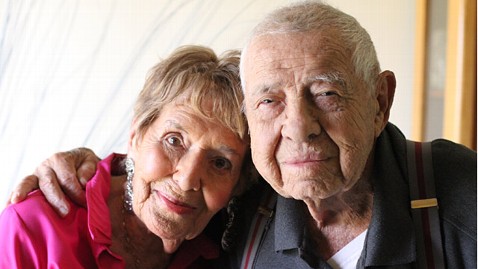
At the age of 90 and married 62 years, these two are acting like they're in their 20s.
This is a great video that shows we are only as old as our attitude. These two were
an inspiration to everyone at the clinic that day. 
Source: godvine.com
____________________________________________________________
Credit: Reports and photographs are property of owners of intellectual rights. 
Seniors World Chronicle, a not-for-profit, serves to chronicle and widen their reach.

February 5, 2012

INDIA: Nagpur man aims to unite lonely elders

KOLKATA, West Bengal / CalcuttaNews.net / February 5, 2012

Advocating the need for companionship in the autumn of life, a Nagpur octogenarian has taken up the task of mooting live-in relationships for senior citizens who are leading a lonely life after outliving their spouses.

Arvind Godbole got inspired by a book written
by Dada Dharmadhikari, an Indian freedom
fighter and philosopher - IANS
"The relationship might not be sexual only. They can live together as friends or define their own relationship," Arvind Godbole, 81, who is spearheading the initiative, told IANS.

Godbole is working under the aegis of Jayeshthanche Live-In Relationship Sanyojak Mandal, formed by the Geeta Godbole Smriti Trust named after his daughter.

He said he got inspired by a book written by Dada Dharmadhikari, an Indian freedom fighter and philosopher.

"Fondly known as Acharya Dada Dharmadhikari, he was one of the strongest adherents of Mahatma Gandhi's principles. In his book 'Purush aur Stree Sahajeevan' Dada quoted Gandhiji as saying that a woman has many 'roopas'. She can be a sister, a mother, an aunt, a friend and so on," Godbole said.

"What we need to realise is that a woman can shower her affection in any form of a relationship. It does not have to be sexual. When we understand this, we will be free from the shackles of backward and narrow-minded mindsets," he added.

Godbole said that the book inspired him to bring together lonely senior citizens. The recent Supreme Court verdict making live-in relationships legal encouraged Godbole to take the initiative forward.

The mandal is now on the verge of laying down rules for membership and soon a drive would be formally launched to enrol interested elders.

"Once that is done, we will be open to registering members. A general member can be anyone over the age of 55 years -- single, married or widowed. We will then call them for a general meeting next month and discuss the format of the mandal and put it up for approval," Godbole said.

The octogenarian said that the mandal currently had 15 core committee members and that the committee was a part of the Geeta Godbole Smriti Trust.

"As of now we are a sub-committee of the trust. Later, we might apply for a separate entity," he said.

"Once the members agree upon a format, we will be organising several workshops and programmes for senior citizens," he added.

Godbole, however, conceded that the initiative might be much more difficult to take forward. "While it sounds like a wonderful idea at first instance, we also cannot ignore the fact that elders are set in their ways and their ideas. If we bring together a hundred people, chances are that only two of them would be compatible," he said.

"But companionship is only one part of it. We would also look forward to sponsoring hostels where seniors could pay and stay in the comfort and company of others," he added.

Godbole said that youngsters could also register as volunteers. "From all the general members, those who are left alone in society will be registered as beneficiaries. Our aim is that these beneficiaries be benefited from the mandal."

The former Bank of India officer said that once the members were registered, the mandal would help them with a memorandum of understanding (MoU).

"The agreement of the MoU will be signed by both the beneficiaries who plan to stay together. We are also thinking about deciding an amount of compensation for women who might get cheated in this case. But this is just a preventive measure," he said.

Godbole said that the core committee may arrive at a decision that the legal or biological heirs of the elders give a clearance to their proposed live-in relationship.

According to 61-year-old Nandini Pimplapure, a committee member of the Mandal, "This is an age of nuclear families. Moreover, when your children grow up and start working or go abroad for work, parents are left alone. It becomes even more difficult to tackle loneliness if your spouse dies".

Pimplapure, a retired school principal, says that a live-in relationship is often misunderstood.

"By taking this initiative, we are trying to remove the tabboo that surrounds a live-in relationship. I never married due to my dedication to work. Today I stay with my 92-year-old mother and take care of her. This is a live-in relationship of sorts," she said.

Pimplapure said that instead of misinterpreting the phrase people should look at it in a broader sense.

"At the evening of your life, you look for moral support and companionship. Our organisation will work towards this. Two women or two men or even a group of oldies can live-in and be good friends," she said.

(Mauli Buch can be contacted at mauli.b@ians.in)

© 1999 - 2012 Mainstream Media EC 
____________________________________________________________
Credit: Reports and photographs are property of owners of intellectual rights. 
Seniors World Chronicle, a not-for-profit, serves to chronicle and widen their reach.

January 7, 2012

CHINA: Senior couples celebrate golden wedding anniversary in Beijing

BEIJING /China Economic Net / Life / January 7, 2012

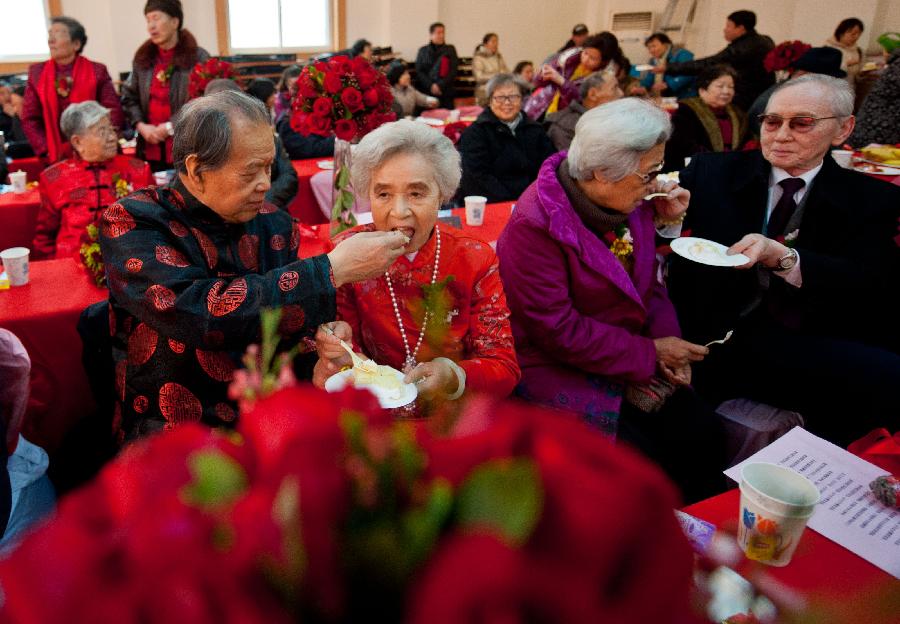
Couples Couples of senior citizens who have been married for over 50 years enjoy cakes in Beijing, capital of China, Jan. 6, 2012. More than 38 couples of citizens who have been married for more than 50 years attended a gathering to celebrate their anniversary of wedding in Beijing on Friday. (Xinhua/Zhang Yu)


Source: Xinhua
____________________________________________________________
Credit: Reports and photographs are property of owners of intellectual rights. 
Seniors World Chronicle, a not-for-profit, serves to chronicle and widen their reach.
November 3, 2011

INDIA: Now, senior citizens look for love and live-ins

AHMEDABAD, Gujarat /The Times of India / November 3, 2011

By Radha Sharma - Times News Network

Live-in relationships, popular among youngsters who want to check compatibility with their partners before marriage, has found favour with the elderly as well.

The first-ever public function to help 50-plus men and women from across India find live-in companions will be held on November 20 at Mehndi Nawaz Jung Hall in Ahmedabad. 


Organizer Natubhai Patel, who runs Vina Mulya Amulya Sewa, an organization created to help arrange marriages of lonely senior citizensin the country, says the concept of live-in relationships has interested a lot of elderly, who are shy of getting married again fearing legal wrangles and succession disputes. Also, many seniors are wary of being stuck with an incompatible partner in old age.

"Of the 3,000-odd applications, nearly 1,000 prefer finding a live-in partner who will keep them company without inviting social and legal complications associated with marriage. Most women still prefer marriage but many say they are fine with live-in companions if they provide them financial security," Patel said.

Asha Pandya, a 51-year divorcee in Vejalpur, is keen to find a partner with whom she can live to the fullest, watching movies, eating out and travelling. "Once bitten, twice shy, I do not want to get into a marriage without knowing if my relationship with the man will work or not. However, I need financial security and want the partner to put some money in my name first," said Pandya, who confesses to feeling lonely after her only daughter got married.

Alpesh Parikh, 61, a retired bank officer who draws a pension of Rs 16,000 is also looking for a live-in partner. "I live with my son and daughter-in-law and need a companion. I am ready to move out if I find the right partner. I would like to get married only if I am comfortable," said Parikh.

Patel said all men and women above 50 years of age including divorcees, widows and single are eligible to join the meet in Ahmedabad.

Copyright © 2011 Bennett, Coleman & Co. Ltd.
__________________________________________________________ 
Credit: Reports and photographs are property of owners of intellectual rights. 
Seniors World Chronicle, a not-for-profit, serves to chronicle and widen their reach.